IEEPA

Search documents
有的15%,有的更多?美国贸易代表这话啥意思
Di Yi Cai Jing· 2026-02-26 09:23
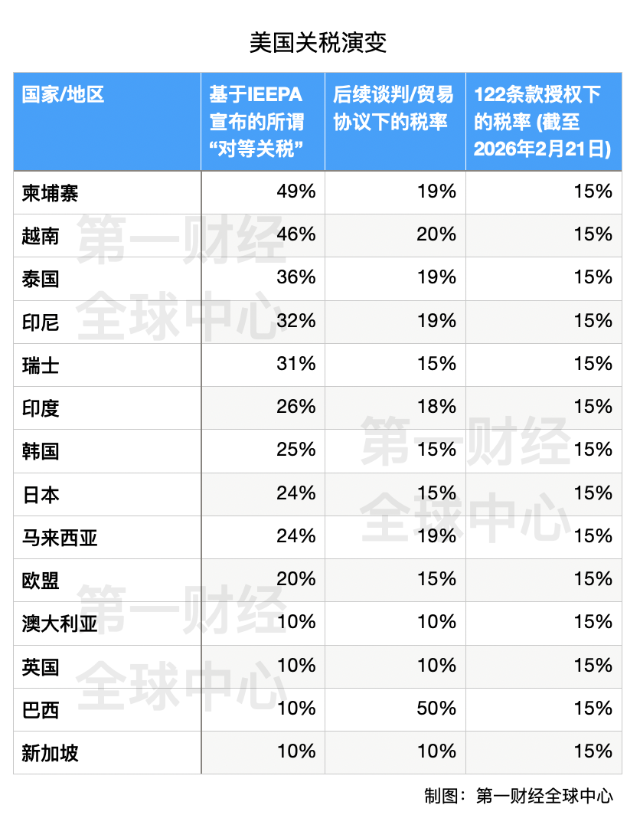
格里尔表示,白宫正在准备一份公告,将"在适当情况下"的临时关税提高到15%。 当地时间25日,美国贸易代表格里尔在接受媒体采访时表示,美国对部分国家和地区的关税税率将从新 近实施的10%提高到15%或更高,但他没有点名任何具体的贸易伙伴,也没有提供更多细节。 格里尔表示,白宫正在准备一份公告,将"在适当情况下"的临时关税提高到15%,同时美国政府将"照 顾"与美国签订贸易协定的国家和地区。 英国杜伦大学法学院副院长、跨国法教授兼全球政策研究所联合主任杜明对第一财经记者表示,特朗普 政府未来将全球关税从10%升至15%的这一过程,有三个核心诉求:第一,维持对外关税压力;第二, 不能影响已经谈下来的贸易协定;第三,要灵活处理不同情况。 当前的问题是,"美国国内贸易法提供的工具好不好用,例如122条款等,能允许目前这种灵活使用 吗?"杜明补充道。 近日,中国商务部新闻发言人表示,中方也注意到,美方在多个场合表示,将利用301、232等调查征收 关税。中方正密切关注并将全面评估美方相关举措,后续将视情适时决定调整针对美方原芬太尼关税和 对等关税的反制措施。中方将保留采取一切必要措施的权利,坚决捍卫自身合法权益。 新全 ...

全球关税议题超越 IEEPA 裁决-Global Economic Briefing-Global Tariffs Moving Past IEEPA
2026-02-24 14:16
Summary of Key Points from the Conference Call Industry Overview - The discussion revolves around global tariffs, particularly the implications of the Supreme Court ruling on the International Emergency Economic Powers Act (IEEPA) and its replacement with Section 122 tariffs. Core Insights and Arguments - **Tariff Levels**: Headline tariffs peaked in late 2025, with estimates indicating a reduction from approximately 13% to 11% due to the replacement of IEEPA with Section 122. Without Section 122, tariffs could fall to around 6-7% [6][12][27]. - **Complicated Path Ahead**: The path to higher tariffs is now more complex, with a risk skew towards lower tariffs, which supports expectations for lower US inflation in the second half of 2026 [6][10][29]. - **Sector vs. Country Tariffs**: The ruling suggests a shift from country-based tariffs to sector-based tariffs, which may have more legal grounding and could accelerate the tariff adjustment process [6][10][47]. - **Effective Tariff Rates**: The effective tariff rate remained subdued near 10%, and both nominal and effective rates are expected to decline post-IEEPA ruling [11][12][20]. Important but Overlooked Content - **Refunds Outlook**: The process for refunds related to tariffs remains unclear, with expectations that any refunds will be limited and delayed, potentially amounting to around $85 billion [31][30]. - **Bilateral Trade Agreements**: The ruling may not significantly alter existing bilateral agreements, as many countries are already facing lower tariff levels than before [32][66]. - **US-China Trade Relationship**: The US-China trade relationship is expected to remain stable, with a significant portion of tariffs tied to fentanyl and Section 301 investigations. Any reduction in IEEPA tariffs could be offset by increases in Section 301 tariffs [36][60]. - **Sector-Level Implications**: The transition to Section 122 tariffs is likely to reduce the dispersion in product-level tariffs, particularly benefiting consumer sectors, although the overall boost may be smaller than previously anticipated [68][69]. Conclusion - The Supreme Court ruling on IEEPA has significant implications for tariff structures, with a shift towards Section 122 tariffs expected to lower overall tariff levels and complicate future tariff adjustments. The focus on sector-based tariffs may provide a more stable framework moving forward, while the economic impact remains to be fully realized in the coming quarters.

“对等关税”被美国高院驳回,特朗普还有什么招?
Xin Lang Cai Jing· 2026-02-21 00:19
华尔街见闻综合各方分析发现,特朗普拥有至少五种替代IEEPA的法律工具重建关税体系,不过,这些 工具相比IEEPA均附带更多的限制条件。 乔治城大学贸易法教授Kathleen Claussen对媒体表示:"很难看到关税终结的路径。我相信他可以利用其 他授权重建现有的关税格局。" 去年9月美国财长贝森特就曾向媒体透露,政府正考虑将替代方案作为 备选。 国家安全条款:最倚重工具 分析认为,《1962年贸易扩展法》的第232条款是特朗普两届任期内最倚重的关税工具。该条款授权总 统基于国家安全的理由对进口商品征关税,且对关税的税率和实行期限均不设上限。 特朗普在2018年首个任期内利用232条款对钢铁和铝征收关税,去年重返白宫后继续以此为由加征这些 领域的关税,并据此对汽车、汽车零部件、铜产品和木材征关税。去年9月,他还对橱柜、浴室家具和 软垫家具征收此条款授权下的关税。 这一工具的优势在于,关税规模不受法律限制,且调查由美国商务部主导,使政府对调查结果拥有很高 的控制权。 该工具的局限之处是无法即刻实施。商务部必须先完成调查,并在270天内向总统提交报告。此外,232 条款针对特定行业而非整个国家,不如IEEPA覆 ...

Supreme Court Axes Trump Tariffs | Balance of Power: Early Edition 2/20/2026
Bloomberg Television· 2026-02-20 21:29
-- ♪ >> LIVE FROM WASHINGTON, D. C. , THIS IS "BALANCE OF POWER," WITH JOE MATHIEU.>> IT'S ON TO PLAN B AS THE PRESIDENT GETS HIS SAY. PRESIDENT TRUMP SCHEDULES A NEWS BRIEFING THAT IS SET TO BEGIN ANY MOMENT AFTER THE SUPREME COURT STRUCK DOWN THE PRESIDENT'S TARIFFED. WE WILL TALK ABOUT THIS WITH BLOOMBERG'S ANNMARIE HORDERN AND JEFF MASON.BLOOMBERG POLITICS CONTRIBUTED GENIE IS WITH US ALONGSIDE JOHN C IN. -- SETON . NORAH MULINDA HAS HER VIEW ON THE MARKETS. >> WE CHECK MARKETS FOR YOU ALL DAY LONG ON B ...
美国最高法院未宣判!但要警惕特朗普政府布局这些关税后手
Di Yi Cai Jing· 2026-01-09 22:55
Core Viewpoint - The U.S. Supreme Court will not make a ruling on the Trump administration's tariff case on January 9, and the next scheduled hearing is on January 14. The administration has prepared alternative legal strategies in case of an unfavorable ruling regarding tariffs imposed under the International Emergency Economic Powers Act (IEEPA) [1][2][5]. Group 1: Legal Framework and Tariff Strategies - The Trump administration has various legal tools available, including the 1974 Trade Act Section 122, Section 232 investigation, Section 301 investigation, and the 1930 Tariff Act Section 338, which can be utilized to impose tariffs if IEEPA is deemed invalid [3][11][13]. - The IEEPA is considered the most straightforward method for imposing tariffs, granting significant negotiation power to the President, but other methods, while more complex, can still achieve similar outcomes [6][7][8]. Group 2: Potential Financial Implications - If the Supreme Court rules against the Trump administration, the government may face a refund obligation ranging from $133.5 billion to $150 billion [9][10]. - The administration has indicated that even if tariffs are overturned, they will seek alternative methods to maintain tariff revenue, suggesting a strategy to continue imposing tariffs through different legal avenues [10][11]. Group 3: Immediate Actions and Future Considerations - The administration is expected to utilize the Section 122 of the Trade Act, which allows for the rapid imposition of tariffs up to 15% within 150 days, as an immediate response [13]. - Experts believe that while the Section 301 investigation is currently being used against certain countries, it is less likely to be employed immediately due to its lengthy process [13][14].

热点思考 | 如果“对等关税”被判违法?——美国最高法关税辩论分析(申万宏观·赵伟团队)
赵伟宏观探索· 2025-11-13 17:18
Group 1 - The U.S. Supreme Court is debating the legality of Trump's IEEPA reciprocal tariffs, with a majority of justices (6 out of 9) leaning towards declaring them illegal, citing that tariff authority belongs to Congress and that the IEEPA was intended to limit presidential power rather than expand it [1][6][34] - Three potential outcomes of the Supreme Court's ruling are anticipated: a high probability of declaring the tariffs illegal but possibly delaying the ruling's effect to allow the government time to adjust; a moderate probability of declaring some tariffs illegal while allowing others, such as those on fentanyl; and a low probability of upholding the legality of the tariffs [11][12][34] - If the reciprocal tariffs are deemed illegal, the overall tariff structure in the U.S. may decline significantly, with a potential 25% reduction in tariff revenue, impacting the trade policy landscape [3][19][29] Group 2 - In response to a potential ruling against the reciprocal tariffs, Trump may resort to existing tariff laws such as Sections 232, 301, and 338, with a short-term reliance on Section 122 for global tariffs [2][35] - The likelihood of comprehensive tariff refunds is low, with targeted refunds being more feasible, as legal principles dictate that remedies must align with the harm suffered by the plaintiffs [18][35] - The current tariff revenue structure shows that reciprocal tariffs account for 45% of total tariff income, with significant contributions from Section 301 and Section 232 tariffs, indicating a complex interplay of tariffs that may be affected by the court's decision [3][19][27] Group 3 - The U.S. effective tariff rate stands at 9.75%, with the highest rates applied to Chinese imports at 40.4%, indicating a significant reliance on tariffs for revenue generation [27][19] - If the reciprocal tariffs are invalidated, the U.S. may struggle to maintain similar levels of tariff revenue, with projections suggesting a drop to approximately $2.554 trillion in annual tariff income [29][31] - The ongoing investigations into Section 232 tariffs cover an import scale of $544.4 billion, with reports expected in the coming months, which could influence future tariff strategies [2][17][35]

热点思考 | 如果“对等关税”被判违法?——美国最高法关税辩论分析(申万宏观·赵伟团队)
申万宏源宏观· 2025-11-12 16:04
Group 1 - The U.S. Supreme Court held oral arguments on November 5 regarding Trump's IEEPA reciprocal tariffs, with a majority of justices (6 out of 9) leaning towards declaring the tariffs illegal, raising concerns about the future of U.S. trade policy and capital markets [1][6][34] - The likelihood of the reciprocal tariffs being ruled illegal has increased, with potential outcomes including a ruling of illegality with delayed implementation to allow for government adjustment, partial illegality focusing on specific tariffs like those on fentanyl, or a ruling upholding the legality of the tariffs [6][11][12] Group 2 - If the reciprocal tariffs are deemed illegal, Trump may resort to existing tariff laws such as Sections 232, 301, and 338, with a low probability of widespread tax refunds and a higher chance of targeted refunds [2][35] - The current tariff structure shows that reciprocal tariffs account for 45% of U.S. tariff revenue, with projections indicating a potential 25% decrease in tariff revenue if the reciprocal tariffs are invalidated [3][19][29] Group 3 - The U.S. effective tariff rate stands at 9.75%, with the highest rates applied to Chinese imports at 40.4%, and if the reciprocal tariffs are ruled illegal, the overall tariff levels may not reach previous heights, potentially dropping to 7.3% [27][29][36] - The anticipated tariff revenue for the fiscal year 2025 is approximately $195.9 billion, with significant contributions from various tariff categories, including $89 billion from reciprocal tariffs and $35.1 billion from Section 301 tariffs [19][31]

——美国最高法关税辩论分析:如果对等关税被判违法?
Shenwan Hongyuan Securities· 2025-11-12 12:31
Legal Analysis - The U.S. Supreme Court's debate on the legality of "reciprocal tariffs" shows a 3:6 split, with 6 justices leaning towards declaring them illegal[2] - The likelihood of a ruling against reciprocal tariffs is increasing, but a delayed effect is probable, allowing the government time to adjust[2][10] - Possible outcomes include a ruling of illegality with a delay (45%-55% probability), partial illegality focusing on specific tariffs like fentanyl (20%-30% probability), or a ruling upholding their legality (10%-20% probability)[16][17] Economic Implications - If reciprocal tariffs are deemed illegal, U.S. tariff revenue could decline by 25%, potentially dropping from $3,412 billion to $2,554 billion[4][23] - Current tariff structure: reciprocal tariffs account for 45% of U.S. tariff revenue, with 301 tariffs at 18% and 232 tariffs at 17%[4][23] - The effective tariff rate for the U.S. is currently 9.75%, with the highest rate on Chinese imports at 40.4%[4][29] Political Response - Trump may pivot to existing tariff laws (Sections 232, 301, and 338) if reciprocal tariffs are invalidated, with a low probability of widespread tax refunds[3][20] - The likelihood of targeted tax refunds is higher, but broad automatic refunds are unlikely due to legal constraints[3][22] Market Reactions - Following the Supreme Court's deliberations, market expectations for tariff legality have shifted, impacting capital markets and trade policies[5][10] - The recent government shutdown affected 670,000 federal employees, with 1.52 million remaining on payroll, highlighting the political stakes involved[5]
美国最高法关税辩论分析:如果“对等关税”被判违法?
Shenwan Hongyuan Securities· 2025-11-12 12:12
Legal Analysis - The U.S. Supreme Court's debate on the legality of "reciprocal tariffs" shows a 3:6 ratio in favor of declaring them illegal, indicating a high probability of a ruling against them[2] - The main arguments for declaring the tariffs illegal include the assertion that tariff authority belongs to Congress and that the IEEPA was intended to limit presidential power, not expand it[2][11] - Three potential outcomes of the ruling are identified: a likely illegal ruling with delayed effect (45%-55% probability), partial illegality with possible allowance for fentanyl tariffs (20%-30% probability), and a low probability (10%-20%) of upholding the legality of reciprocal tariffs[17][18] Economic Implications - If reciprocal tariffs are deemed illegal, the U.S. tariff structure may decline by approximately 25%, with total tariff revenue potentially dropping from $1,959 billion to $1,554 billion[4][26][37] - Current tariff revenue composition shows reciprocal tariffs account for 45%, Section 301 tariffs for 18%, and Section 232 tariffs for 17%[4][26] - The effective tariff rate for the U.S. is currently 9.75%, with the highest rate on Chinese imports at 40.4%[4][32] Political Response - In response to a potential ruling against reciprocal tariffs, Trump may resort to existing tariff laws such as Sections 232, 301, and 338, but the likelihood of broad tax refunds is low due to legal constraints[3][22] - The probability of universal tax refunds is low, with refunds likely limited to specific plaintiffs rather than a blanket return to all importers[3][25] - Trump's proposal to distribute tariff revenues to citizens faces significant legislative hurdles, requiring Congressional approval[3][25]
特朗普对部分木制家具加征关税,进一步增加美国人住房成本
Sou Hu Cai Jing· 2025-09-30 03:36
Core Points - The Trump administration continues to utilize import tariffs to revitalize U.S. manufacturing and strengthen national security [1][4] - New tariffs include a 10% tax on imported softwood lumber and a 25% tax on imported cabinets and wood products, effective from October 14, with some rates increasing on January 1 [1] - The increase in tariffs is expected to raise costs in the residential construction and renovation sectors, exacerbating housing affordability issues for average Americans [1] - Approximately 30% of the softwood used in the U.S. comes from Canada, which faces a 14.5% countervailing and anti-dumping duty [1] Industry Insights - The new tariffs are part of a broader strategy to restructure domestic supply chains, although domestic lumber production may not meet the immediate demands of builders [4] - There is a noted generational gap in interest towards manufacturing jobs, with younger individuals preferring careers in fields like social media and fashion design [4] - The latest tariff measures stem from an investigation initiated by the U.S. Department of Commerce under Section 232 of the Trade Expansion Act, which allows for tariffs based on national security concerns [4][5] Legislative Context - The U.S. Department of Commerce has also launched new investigations into imports of robots, industrial machinery, and medical devices under the same legal framework [5] - The International Emergency Economic Powers Act (IEEPA) allows the President to impose tariffs without stringent requirements to prove national security concerns, which has been a focal point in recent tariff implementations [5] - The legality of the White House's invocation of IEEPA is set to be debated in the Supreme Court on November 5 [5]