IP

Search documents
《飞驰人生3》断层领跑,上海蝉联春节票房第一城
Di Yi Cai Jing· 2026-02-19 11:35
IP不仅是春节档,也是全年市场的重要引擎。 上海电影在春节档一马当先。 从供给侧来看,2026年春节档,上海电影产业交出亮眼答卷。上海出品持续发力,以《飞驰人生3》为 代表的精品力作领跑全国票房大盘;从需求侧来看,上海城市电影消费活力强劲,核心数据稳居全国第 一,彰显"中国电影第一城"的市场底气。 《飞驰人生3》领跑 《飞驰人生3》在2026马年春节档一骑绝尘。 作为《飞驰人生》系列的续作,《飞驰人生3》已经积累了一定IP知名度。此前《飞驰人生》、《飞驰 人生2》分别斩获17.28亿元、33.61亿元票房。 目前,猫眼专业版对《飞驰人生3》的票房预测已经超过50亿元。 大麦娱乐旗下灯塔专业版数据分析师陈晋对第一财经记者表示,IP不仅是春节档,也是全年市场的重要 引擎。《飞驰人生》系列凭借前作口碑积累了观众信任,《熊出没》则依托稳定的家庭刚需市场,二者 国民度都非常高,但IP只是档期"入场券",但最终票房仍取决于影片质量。 从《繁花》《好东西》到《飞驰人生3》,上海持续输出类型多元、口碑过硬的精品力作,在赛车、都 市、现实等多个赛道实现突破。 票房第一城 2026年大年初一,一共有13129家影院营业,较去年同 ...
海内外AI应用产业迎密集催化,机构称IP、AI仍为传媒行业双主线,游戏ETF(159869)现已翻红
Mei Ri Jing Ji Xin Wen· 2026-01-30 06:23
Group 1 - The gaming sector is experiencing a rise, with the gaming ETF (159869) showing a slight increase and a total scale of 14.432 billion yuan as of January 29, indicating strong investor interest with a net inflow of 663 million yuan over six consecutive trading days [1][2] - Recent advancements in AI applications are catalyzing growth in the industry, with notable releases such as DeepSeek's OCR 2 model and the multi-modal model Kimi K2.5, alongside the popularity of the AI agent Clawdbot, which distinguishes itself from traditional chatbots by executing complex tasks [1] - According to Wanlian Securities, the media industry is expected to focus on IP and AI as dual mainlines for development by 2026, with a shift in consumer perception from functionality to emotional value, enhancing the commercial potential of IP content and derivatives [1] Group 2 - The gaming sector is influenced by multiple catalysts, including AI, content, and changes in commercialization models, with the gaming ETF tracking the performance of the A-share animation and gaming industry [2] - The current environment is characterized by favorable policies, product cycles, and the empowering effects of AI, suggesting a strategic opportunity for investment in the gaming sector [2]
天龙集团尾盘20%涨停,蓝色光标收涨14%!IP、AI成为2026年传媒双主线
Mei Ri Jing Ji Xin Wen· 2026-01-29 07:26
Group 1 - Tianlong Group (300063) saw a 20% surge in stock price, while BlueFocus Communication Group (300058) rose by 14.93%, and other companies like Hengdian Film and Television (603103) and Zhejiang Wenlian (600986) reached their daily limit [1] - Tianlong Group's performance forecast indicates an expected net profit attributable to shareholders of 100 million to 130 million yuan for 2025, representing a year-on-year growth of 53.44% to 99.48% [1] - The growth in Tianlong Group's net profit is attributed to enhanced operational service capabilities in the internet marketing sector, increased service fee income, and improved management efficiency leading to cost reduction [1] Group 2 - Wanlian Securities highlights that the development trends in the media industry for 2026 will focus on IP and AI as dual main lines, with a shift in consumer perception from "functional" to "emotional value" [2] - The application of AI across various sub-industries in media is driving a new phase of market development [2] - 华夏 Fund recommends using thematic indices like Media ETF Huaxia (516190.SH) for diversified and low-threshold investment opportunities, emphasizing its transparent holdings and high investment efficiency [2]


万联证券:传媒业AI+IP双轮共振 重构内容产业新生态
智通财经网· 2026-01-29 03:19
Core Viewpoint - The media industry is experiencing steady revenue growth and a rebound in net profit for the first three quarters of 2025, with cyclical changes observed in Q3 2025. The development trends for the media industry in 2026 highlight IP and AI as dual mainlines, driven by a shift in consumer perception from "functional" to "emotional value" [1] Group 1: IP Development - IP is categorized into content-based IP and image-based IP, both of which can convert into each other to explore higher value and enhance commercialization through derivative products [2] - Content-based IP includes literary and film IP, with web literature being a core creative source and value engine, leading to frequent cross-form transformations and a strategy of multi-channel development [2] - Game IP possesses strong commercial potential and cross-form content derivation capabilities, enabling comprehensive user engagement and multi-dimensional monetization through diverse content matrices [2] - Anime IP focuses on emotional engagement and long-term value by transforming virtual characters into relatable emotional carriers, maximizing commercial value [2] Group 2: Image-based IP - The commercial value realization and longevity of image-based IP depend on recognition, audience coverage, and diverse monetization models, requiring structured character matrices and continuous updates [3] - Derivative products based on IP are crucial for materializing influence and monetizing content value, with the market for these products experiencing explosive growth driven by Gen Z consumption and the "emotional value" economy [3] Group 3: AI Integration - AI is recognized as a transformative technology in the digital age, with vast potential and application across various media sub-industries, driving new market developments [4] - The AI industry has diversified into multiple application tracks, enhancing user experience and meeting personalized needs across various dimensions [4] - In gaming, AI enhances narrative richness and player immersion through intelligent NPCs and dynamic story generation, while also automating content creation and testing processes [5] - In advertising, traditional marketing models are facing challenges due to shifts in user information acquisition, leading to the emergence of Generative Engine Optimization (GEO) as a solution for marketing effectiveness [6] - In film production, AI significantly reduces costs and enhances efficiency, with new forms like AI manga gaining market attention [6]
万联晨会-20260129
Wanlian Securities· 2026-01-29 00:53
Core Insights - The A-share market showed mixed performance with the Shanghai Composite Index rising by 0.27% and the Shenzhen Component Index increasing by 0.09%, while the ChiNext Index fell by 0.57%. The total trading volume in the Shanghai and Shenzhen markets reached 29,650.88 billion yuan [1][7] - In the industry sector, non-ferrous metals, oil and petrochemicals, and coal led the gains, while sectors such as comprehensive, media, and national defense and military industry lagged behind. Concept sectors like gold, lead, and zinc saw significant increases, while monkeypox, cell immunotherapy, and newly listed tech stocks experienced declines [1][7] Important News - The Federal Reserve maintained its benchmark interest rate at 3.50%-3.75%, following three consecutive rate cuts of 25 basis points. This decision aligns with market expectations. The Fed noted signs of stabilization in the unemployment rate, while inflation remains relatively high, and economic uncertainty persists [2][8] Industry Analysis - The media industry experienced a strong performance in 2025, with the Shenwan Media sector rising by 27.17%, ranking ninth among Shenwan's first-level industries and outperforming the CSI 300 Index. The industry valuation (PE-TTM) has shown fluctuations but remains above the average level of the past seven years. Revenue and net profit for the first three quarters of 2025 showed steady growth, with year-on-year increases in Q3 [9][10] - The dual focus on IP and AI is reshaping the media industry. As consumer preferences shift from "functional" to "emotional value," there is a growing market for IP content and its commercialization. AI is recognized as a transformative technology with vast potential across various media sub-industries, driving new market developments [9][12] Investment Highlights - IP is categorized into content-based and image-based types, both of which can interchange to explore higher value and enhance commercialization through derivative products. Content-based IP includes literary and film adaptations, while image-based IP focuses on recognizable visual symbols [10][11] - The market for IP derivatives is experiencing explosive growth, driven by the rise of Generation Z consumers and the popularity of "emotional value" economics. Key product categories include collectibles and toys, which resonate with younger audiences' social and entertainment needs [12] - AI applications are expanding across multiple media sectors, enhancing content production efficiency and reducing costs. In gaming, AI is revolutionizing narrative and gameplay experiences, while in advertising, traditional marketing models are being restructured to adapt to new consumer information-seeking behaviors [14][13]
2026年传媒行业投资策略报告:AI+IP双轮共振,重构内容产业新生态
Wanlian Securities· 2026-01-28 10:24
Investment Rating - The report maintains a positive outlook on the media industry, indicating it will outperform the market, with a projected increase of 27.17% in 2025, ranking ninth among all primary industries in the Shenwan index [2][15]. Core Insights - The media industry is expected to experience robust growth in 2025, driven by the dual focus on Intellectual Property (IP) and Artificial Intelligence (AI). The shift in consumer behavior from "functional" to "emotional value" is anticipated to enhance the commercial viability of IP content and its derivatives [2][29]. - The report highlights that AI is a transformative force in the digital age, becoming a focal point of global technological competition and a key driver of economic development, with significant applications across various sub-sectors of the media industry [2][8]. Summary by Sections 1. Market Performance - The media industry showed strong performance in 2025, with a total revenue of 3,874.8 billion yuan, reflecting a year-on-year growth of 5.90%, and a net profit attributable to shareholders of 320.97 billion yuan, up 36.80% [20][24]. - The industry’s PE ratio has adjusted to 27.12X, which is above the average of 26.03X from 2018 to 2024, indicating a period of valuation adjustment [16][18]. 2. Investment Highlights - IP is categorized into content-based IP and image-based IP, both of which can interchangeably enhance their commercial value through derivative products [3][43]. - Content-based IP includes literary, film, game, and animation types, with a focus on cross-media development and the extraction of commercial potential [3][43]. - Image-based IP relies on unique visual symbols and requires structured character matrices and continuous updates to maintain its commercial viability [4][72]. 3. AI Development - The AI sector is rapidly evolving, with applications spanning over 20 different fields, including AI assistants, cameras, and writing tools, enhancing user experience and meeting personalized needs [8][9]. - In gaming, AI is revolutionizing production processes, improving narrative depth and player immersion through intelligent NPCs and dynamic storylines [9][35]. - In advertising, traditional marketing models are being restructured by AI, leading to the emergence of Generative Engine Optimization (GEO) as a key strategy for enhancing marketing effectiveness [9][40]. 4. Future Outlook - The report emphasizes the importance of leveraging IP and AI as dual mainlines for future industry transformations, with a focus on emotional value and consumer engagement driving the growth of IP derivatives [2][29]. - The integration of AI across various media sectors is expected to facilitate significant changes in content production efficiency and cost reduction, thereby reshaping the industry landscape [9][30].
2026年传媒行业投资策略报告:AI+IP双轮共振,重构内容产业新生态-20260128
Wanlian Securities· 2026-01-28 10:09
Core Insights - The media industry is expected to perform well in 2025, with a projected increase of 27.17%, ranking ninth among all primary industries in the Shenwan index, outperforming the CSI 300 index [2][15] - The industry valuation (PE-TTM) is experiencing fluctuations, currently above the seven-year average level [2][16] - Revenue growth is steady in Q1-Q3 of 2025, with a year-on-year increase in net profit attributable to shareholders [2][20] - The dual focus on IP and AI is anticipated to drive new transformations in the media industry, as consumer preferences shift from "functional" to "emotional value" [2][29] Market Performance - The media industry showed a strong performance in 2025, with a 27.17% increase, ranking ninth among Shenwan's primary industries and outperforming the CSI 300 index [2][15] - The valuation of the media industry is currently at 27.12X, which is higher than the average PE of 26.03X from 2018 to 2024 [2][16] Performance Analysis - In Q1-Q3 of 2025, the media industry achieved a revenue of 387.48 billion yuan, a year-on-year increase of 5.90%, and a net profit of 32.097 billion yuan, up 36.80% [2][20] - The gross margin remained stable, with a slight increase of 1.34 percentage points to 32.81% [2][20] - In Q3 of 2025, the media industry saw a revenue increase of 9.20% year-on-year, reaching 132.625 billion yuan, and a net profit increase of 57.00% to 10.316 billion yuan [2][24] Industry Outlook - The dual focus on IP and AI is expected to reshape the media industry, with IP becoming a core driver of content business models and AI emerging as a transformative technology [2][29] - The shift in consumer behavior towards emotional value is creating broader opportunities for the commercialization of IP content and derivatives [2][29] IP Insights - IP is categorized into content IP and image IP, with both types capable of mutual conversion to enhance commercialization [3][43] - Content IP includes literary, film, game, and animation types, focusing on deep narrative construction to build emotional resonance with users [3][43] - Image IP relies on unique visual symbols to evoke emotional connections, with a focus on social media and design innovation to maintain relevance [4][72] AI Insights - AI is recognized as a transformative force in the digital age, with applications across various media sectors, enhancing content production efficiency and reducing costs [8][9] - AI technologies are being integrated into gaming, advertising, and film production, driving industry innovation and efficiency [9][9] Investment Recommendations - The report suggests that the media industry will continue to outperform the market, driven by the dual focus on IP and AI, and recommends monitoring developments in these areas for potential investment opportunities [6][6]
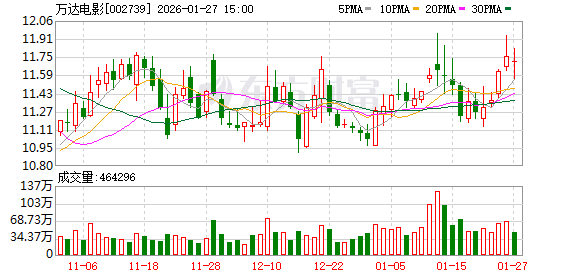
万达电影预计2025年扭亏为盈 聚焦直营增长势能领先行业
Zheng Quan Ri Bao· 2026-01-27 13:41
Core Viewpoint - Wanda Film is expected to achieve a net profit of 480 million to 550 million yuan in 2025, marking a turnaround from losses, driven by the recovery of the film industry and the implementation of its "super entertainment space" strategy, which opens up a second growth curve [2] Group 1: Industry Performance - In 2025, the Chinese film market is projected to see a dual growth in box office and audience numbers, reaching a total box office of 51.832 billion yuan and 1.238 billion viewers [3] - Wanda Film's box office revenue reached 7.678 billion yuan, an increase of 18.53% year-on-year, with audience numbers at 163 million, up 14.76%, maintaining its market share as the industry leader for 17 consecutive years [3] - The company has expanded its direct-operated cinemas to 714, with 6,179 screens, adding 24 new cinemas in 2025, further solidifying its national cinema network [3] Group 2: Competitive Advantages - Wanda Film's high-quality cinema layout allows it to effectively target consumer demographics and secure a dominant position in box office allocations during peak periods and with quality films, creating a competitive barrier [4] - As a leading cinema chain, Wanda Film possesses significant advantages in operational efficiency, scheduling authority, and resource integration, enabling it to maintain stable profitability amid industry fluctuations [4] Group 3: Strategic Initiatives - The company is transitioning from a reliance on box office revenue to a diversified income model through its "super entertainment space" strategy, which aims to transform cinemas into comprehensive entertainment destinations [5] - In 2025, Wanda Film has strategically invested in brands like 52TOYS and others, introducing diverse experiences such as trendy toys and health drinks into cinemas, enriching the concept of "super entertainment space" [5] - The synergy between IP operations and trendy toy businesses has led to steady growth in non-ticket revenue, with collaborations on popular game and film IPs, creating a comprehensive online-to-offline experience [6]


从商品到社交硬通货 IP激活情感消费
Bei Jing Shang Bao· 2026-01-20 06:18
Core Insights - The integration of IP (Intellectual Property) with toys has transformed simple product transactions into a deeper emotional and cultural experience for consumers, making toys not just consumer goods but also trendy collectibles [1][2] Group 1: Importance of IP in the Toy Industry - The necessity of IP in the toy industry is emphasized, as it allows brands to connect cultural content with products, enhancing emotional resonance and consumer engagement [2] - Successful brands in the competitive toy market are often backed by strong, well-recognized IPs that serve as the soul of the products and create emotional connections with consumers [2][3] - The rise of domestic cultural IPs reflects a strong emotional connection among Chinese consumers, indicating a shift towards valuing local culture in the toy market [3][4] Group 2: Market Trends and Consumer Behavior - The transition from conventional products to IP collaborations is a common growth path for Chinese toy companies, aiming for higher value products and brand equity [4] - The demand for high-value consumption is driven by emotional resonance, with consumers willing to pay for the cultural and emotional significance of the IPs [5][6] - The emergence of "meaningful consumption" reflects a shift in consumer preferences towards products that fulfill emotional and social needs rather than just entertainment [6][7] Group 3: Emotional Engagement and Content Creation - Successful IPs today are characterized by their ability to resonate with contemporary emotions and provide a platform for user participation in content creation [8][9] - The new generation of consumers seeks products that reflect their identities and emotions, indicating a shift from mere transactions to emotional consumption [9]
潮尚重构消费|从商品到社交硬通货 IP激活情感消费
Bei Jing Shang Bao· 2026-01-20 06:08
Core Insights - The integration of IP (Intellectual Property) with toys has transformed simple product transactions into emotional and cultural experiences for consumers, making toys not just consumer goods but also trendy collectibles [1][3]. Group 1: Importance of IP in the Toy Industry - The necessity of IP in the toy industry is emphasized, as it allows brands to connect cultural content with products, enhancing emotional resonance and consumer engagement [3][4]. - Successful brands in the competitive toy market are often backed by strong, well-recognized IPs that serve as emotional connectors and brand differentiators [3][4]. - The rise of domestic cultural IPs reflects a strong emotional connection among Chinese consumers, indicating a shift towards valuing local culture in product offerings [4][6]. Group 2: Market Dynamics and Consumer Behavior - The transition from conventional products to IP collaborations is a common growth path for Chinese toy companies, aiming for higher value products and brand differentiation [6][7]. - The emotional and social aspects of toy consumption have evolved, with products now serving as "social currency" for adults, reflecting deeper emotional needs and social connections [7][8]. - The success of IPs is increasingly tied to their ability to resonate with contemporary consumer emotions and facilitate user participation in content creation [10][11]. Group 3: Case Studies and Brand Strategies - Brands like Pop Mart and 52TOYS have established recognizable cultural symbols through their IPs, which connect with consumer emotional demands [4][6]. - The development of military-themed IPs and collaborations with cultural institutions has allowed companies like Senbao to enhance brand value and consumer engagement [6][7]. - The emotional pull of products like the Shandong aircraft carrier model demonstrates how national pride can drive consumer interest and sales [7][9].