
中国资产

Search documents
央行金融研究所张怀清:中国资产将成为全球投资者分散风险、提升收益的重要一环
Jing Ji Guan Cha Wang· 2025-11-26 05:58
Core Viewpoint - The future of China's assets is positioned as a crucial component for global investors to diversify risks and enhance returns, supported by a well-established financial market system [1] Financial Market Development - China has developed a comprehensive and deep financial market system, with both bond and stock markets ranking second globally in terms of scale [1] - The stability of the Renminbi and the diversity of asset types contribute to global investors' ability to achieve diversified asset allocation and risk dispersion [1] Financial Opening and Stability - China's financial opening emphasizes institutional openness, including rules, regulations, management, and standards, which enhances market stability [1] - The stable value of the Renminbi and low volatility in exchange rates are long-term favorable factors for international investors allocating Renminbi-denominated assets [1] Economic Resilience and Asset Quality - The resilience of the Chinese economy and the presence of high-quality assets provide value for risk diversification and stable returns [1]
A股分析师前瞻:更多是短期扰动,中国资产已调整出性价比?
Xuan Gu Bao· 2025-11-23 13:49
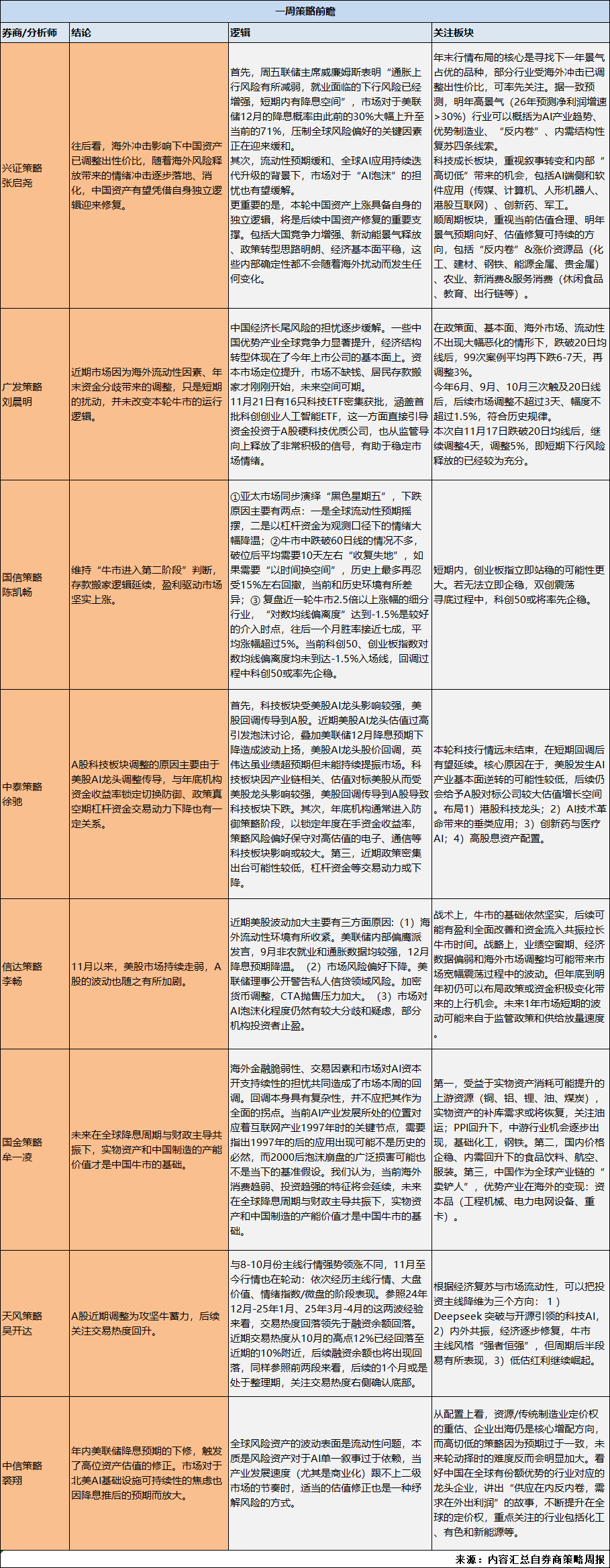
Core Viewpoint - The consensus among brokerage strategy analysts indicates a rebound in the market, as multiple factors that led to last week's stock index adjustments have improved over the weekend [1] Group 1: Market Sentiment and Economic Indicators - The market's perception of the Federal Reserve's potential interest rate cuts has shifted significantly, with the probability of a rate cut in December rising from 30% to 71%, alleviating global risk aversion [1] - The expectation of liquidity improvement and the ongoing iteration of global AI applications are likely to ease concerns regarding an "AI bubble" [2] - The internal logic supporting the rise of Chinese assets remains strong, driven by enhanced national competitiveness, the release of new economic momentum, clear policy transformation, and stable economic fundamentals [2][3] Group 2: Sector Focus and Investment Opportunities - Analysts suggest focusing on sectors that are expected to outperform in the coming year, particularly those benefiting from high growth forecasts, such as AI, advanced manufacturing, and structural recovery in domestic demand [3] - The approval of 16 technology ETFs, including those focused on AI, is expected to guide capital towards high-quality technology companies in the A-share market, providing a positive regulatory signal [2][3] - The technology sector's recent adjustments are attributed to the influence of U.S. AI leaders and year-end institutional fund strategies, but the overall tech market is expected to continue its upward trajectory post-correction [2][4] Group 3: Long-term Market Outlook - The current market adjustments are viewed as short-term disturbances that do not alter the underlying bull market logic, with expectations of continued capital inflow and improved earnings across sectors [3][4] - The potential for a significant reversal in the fundamentals of the AI industry in the U.S. is considered low, which should provide substantial valuation growth opportunities for comparable companies in China [4] - The overall sentiment indicates that the market is not lacking in liquidity, and the concerns regarding long-tail risks in the Chinese economy are gradually easing [3][4]

时报观察|主权债券屡受热捧 中国资产“圈粉”全球
证券时报· 2025-11-21 00:00
Group 1 - The core viewpoint of the articles highlights the strong global demand for Chinese sovereign bonds, evidenced by the record-breaking issuance of €4 billion in Luxembourg, which attracted over 1,000 institutional investors and achieved a subscription multiple of 25 times [1] - The issuance of $4 billion in sovereign bonds two weeks prior also saw a high subscription multiple of nearly 30 times, indicating robust global investment interest in Chinese sovereign debt [1] - The distribution of international investors shows a significant allocation to long-term investors such as central banks and sovereign wealth funds, with over 60% of the bonds allocated to regions outside Asia, reflecting confidence in the safety and sustainability of Chinese assets [1] Group 2 - In 2023, China has significantly expanded its overseas sovereign bond issuance, surpassing the total amount issued in the previous year, supported by a favorable global interest rate environment and increasing financing needs of Chinese enterprises going abroad [1] - The issuance of multi-currency sovereign bonds provides a pricing benchmark for Chinese companies seeking overseas financing, helping to reduce their financing costs and uncertainties [1] - The continuous inflow of foreign capital into Chinese assets is also evident domestically, with a record high of $31 billion in securities investment settlement in October, indicating a positive outlook from foreign institutions on China's stock and currency markets [2]

时报观察丨主权债券屡受热捧 中国资产“圈粉”全球
Zheng Quan Shi Bao Wang· 2025-11-20 23:21
Group 1 - The Ministry of Finance successfully issued €4 billion in sovereign bonds in Luxembourg, attracting over 1,000 institutional investors with a subscription rate of 25 times, setting a record for China's euro-denominated sovereign bond issuance [1] - Two weeks prior, a $4 billion sovereign bond issuance also saw strong demand with a subscription rate of nearly 30 times, indicating unprecedented global investment demand for Chinese sovereign bonds [1] - The distribution of international investors shows a high proportion of long-term investors such as central banks, sovereign wealth funds, and banks, with over 60% of allocations going to regions outside Asia, reflecting confidence in the safety and sustainability of Chinese assets [1] Group 2 - In 2023, China has significantly increased its overseas sovereign bond issuance, surpassing the total amount issued in the previous year, supported by a favorable global financing environment due to central bank interest rate cuts [2] - The ongoing overseas bond issuance provides a pricing benchmark for Chinese enterprises seeking to finance abroad, helping to reduce their financing costs and uncertainties [1] - The recent data from the State Administration of Foreign Exchange indicates that in October, the scale of securities investment settlement reached a historical high of $31 billion, with a surplus of $5 billion, suggesting a continued inflow of foreign capital into Chinese assets [2]
主权债券屡受热捧 中国资产“圈粉”全球
Zheng Quan Shi Bao· 2025-11-20 22:56
Group 1 - The Ministry of Finance successfully issued €4 billion in sovereign bonds in Luxembourg, attracting over 1,000 institutional investors with a subscription rate of 25 times, setting a historical record for China's euro-denominated sovereign bond issuance [1] - Two weeks prior, a $4 billion sovereign bond issuance also saw strong market demand with a subscription rate of nearly 30 times, indicating unprecedented global investment demand for Chinese sovereign bonds [1] - The distribution of international investors shows a high proportion of long-term investors such as central banks, sovereign wealth funds, and banks, with over 60% of allocations going to regions outside Asia, reflecting confidence in the safety and sustainability of Chinese assets [1] Group 2 - In 2023, China has significantly expanded its overseas sovereign bond issuance, surpassing the total amount issued in the previous year, supported by a favorable global financing environment due to central bank interest rate cuts [2] - The increasing overseas bond issuance is also driven by the rising financing needs of Chinese enterprises going global, providing a pricing benchmark for their offshore financing and helping to reduce costs and uncertainties [2] - The trend of foreign capital inflow into Chinese assets continues, with October seeing a record high of $31 billion in securities investment settlement, indicating a positive outlook for China's stock and foreign exchange markets [2]
时报观察 主权债券屡受热捧 中国资产“圈粉”全球
Zheng Quan Shi Bao· 2025-11-20 18:26
Group 1 - The Ministry of Finance successfully issued €4 billion in sovereign bonds in Luxembourg, attracting over 1,000 institutional investors with a subscription rate of 25 times, setting a record for China's euro-denominated sovereign bond issuance [1] - Two weeks prior, a $4 billion sovereign bond issuance also saw strong market demand with a subscription rate of nearly 30 times, indicating unprecedented global investment demand for Chinese sovereign bonds [1] - The distribution of international investors shows a significant presence of long-term investors such as central banks and sovereign wealth funds, with over 60% of allocations going to regions outside Asia, reflecting confidence in the safety and sustainability of Chinese assets [1] Group 2 - In 2023, China has significantly expanded its overseas sovereign bond issuance, surpassing the total amount issued in the previous year, supported by a favorable global financing environment due to central bank interest rate cuts [1] - The increasing overseas bond issuance is also driven by the rising financing needs of Chinese enterprises expanding internationally, providing a pricing benchmark for their offshore financing and helping to reduce costs and uncertainties [1] - The inflow of foreign capital into Chinese assets is also evident domestically, with the State Administration of Foreign Exchange reporting a record $31 billion in securities investment settlement in October, indicating a positive outlook for China's stock and foreign exchange markets [2]
鲍威尔隔空对中国宣战?中国抛售856亿美债,神秘资金趁机抄底?
Sou Hu Cai Jing· 2025-11-20 09:55
Group 1 - Federal Reserve Chairman Powell's hawkish stance on interest rates contrasts sharply with China's accommodative monetary policy, leading to significant market reactions [1][3] - In October 2025, Powell indicated a tightening of expectations for a rate cut in December due to persistent inflation pressures and a stable labor market, causing emerging market assets to decline and the dollar index to rise [1][19] - The Federal Reserve's actions throughout 2025, including maintaining the federal funds rate between 4.25% and 4.5% early in the year, reflect a cautious approach to inflation data [5][21] Group 2 - China's central bank continues to implement loose monetary policies, utilizing tools like reserve requirement ratio cuts and repurchase operations to stabilize economic growth [3][19] - In 2025, China reduced its holdings of U.S. Treasury securities by $25.7 billion, bringing its total holdings to $730.7 billion, the lowest since 2008 [5][7] - The overall foreign holdings of U.S. debt reached a record high of $8.9 trillion, driven by other countries compensating for reduced Chinese investments [5][12] Group 3 - Foreign capital flows into emerging markets, particularly Chinese A-shares, have increased significantly, with net inflows exceeding 120 billion yuan in the first three quarters of 2025 [8][10] - Major financial institutions like Goldman Sachs and Morgan Stanley have shifted their outlooks, citing undervaluation of Chinese assets and supportive policies as reasons for increased investment [10][19] - The influx of foreign capital into A-shares is primarily focused on technology and consumer sectors, with notable investments in companies like CATL and BYD [10][17] Group 4 - The dynamics of U.S. Treasury selling by Japan, the UK, and China in early 2025 were influenced by rising U.S. fiscal deficits and debt ceiling issues, with a combined sell-off of $81 billion [12][21] - Powell's hawkish comments have led to increased volatility in the U.S. bond market, with the 10-year Treasury yield rising from 4% to over 4.5%, impacting emerging market currencies [13][19] - China's strategy includes increasing gold reserves and reducing reliance on the dollar, with gold production reaching 271.78 tons in the first nine months of 2025 [15][23]
做多中国资产 外资机构看好明年A股表现
Zhong Guo Zheng Quan Bao· 2025-11-19 21:36
Group 1 - Several foreign institutions have raised their target index levels for the Chinese market in 2026, indicating a positive outlook for long-term investment in Chinese assets [1][2] - Morgan Stanley has set the target for the CSI 300 index at 4840 points by December 2026, citing moderate profit growth and stable valuations as key factors [2] - UBS has set the target for the MSCI China Index at 100 points by the end of 2026, predicting inflows from domestic and foreign investors to boost overall valuations [2] Group 2 - There is a clear trend of increasing foreign investment in Chinese assets, with UBS reporting a slight increase in China allocations across various funds in Q3 [3] - Foreign institutions have conducted over 1300 surveys of A-share listed companies since the beginning of Q4, indicating strong interest in the A-share market [3] - Notable foreign institutions like JPMorgan and BNP Paribas have increased their allocations in A-shares, focusing on sectors such as electrical equipment, chemicals, and software services [3] Group 3 - The ongoing improvement of the Qualified Foreign Institutional Investor (QFII) system is expected to enhance the convenience of cross-border investment, supporting the influx of foreign capital [4][5] - The China Securities Regulatory Commission (CSRC) is working on optimizing the QFII system to attract more long-term foreign capital, including measures to streamline approval processes [5] - The CSRC aims to establish a transparent and comprehensive legal framework for foreign investment in the capital market, enhancing the stability and predictability of the investment environment [5]


做多中国资产外资机构看好明年A股表现
Zhong Guo Zheng Quan Bao· 2025-11-19 20:13
Core Viewpoint - Multiple foreign institutions are optimistic about the long-term allocation value of the Chinese stock market, with firms like UBS and Morgan Stanley raising their target index levels for 2026 [1][2] Group 1: Target Index Adjustments - Morgan Stanley has slightly raised its target for the CSI 300 index to 4,840 points by December 2026, citing moderate profit growth and stable valuations [1] - UBS has set a target of 100 points for the MSCI China Index by the end of 2026, indicating potential upside from current levels [2] Group 2: Investment Preferences - The technology sector remains a primary investment focus, with UBS and Morgan Stanley recommending overweight positions in high-quality internet and technology stocks [2] - High-dividend assets are also favored, particularly quality state-owned enterprises, due to their stable cash flows and policy support [2] Group 3: Foreign Capital Inflows - There is a noticeable trend of foreign institutions increasing their allocation to Chinese assets, with UBS reporting a slight increase in Chinese positions across various fund types in Q3 [2][3] - Over 1,300 instances of foreign institutional research on A-share companies have been recorded since the beginning of Q4 [2] Group 4: QFII System Enhancements - The QFII system is expected to continue improving, enhancing the convenience of cross-border investments, with recent measures aimed at optimizing access and management [3][4] - The China Securities Regulatory Commission (CSRC) is working on enhancing the legal framework for foreign investment, aiming for a transparent and comprehensive system [4]
利好!外资机构:看好中国资产
Zhong Guo Zheng Quan Bao· 2025-11-19 08:48
Core Viewpoint - Multiple foreign securities and fund companies have released outlook reports for 2026, indicating that the current Chinese stock market has medium to long-term allocation value driven by ample liquidity and improving profitability [1] Group 1: Market Outlook - UBS sets the MSCI China Index target for the end of 2026 at 100, representing a 14% upside from current levels [3] - Morgan Stanley raises its target for the CSI 300 Index to 4840 points by December 2026, citing moderate corporate profit growth and a more favorable external environment [3] Group 2: Investment Strategies - Foreign institutions favor sectors such as technology, internet, and high-dividend assets [4] - UBS is optimistic about technology stocks, internet stocks, and the brokerage sector, while Morgan Stanley recommends a "barbell strategy" focusing on high-quality internet and technology leaders alongside some high-dividend assets for stable cash returns [4] - Goldman Sachs has identified 50 stocks across 21 sub-industries, including 30 A-shares and 20 overseas-listed Chinese stocks, expected to outperform the market in the future [4] Group 3: Cross-Border Investment Facilitation - Foreign institutions express confidence in China's capital market due to a series of landmark opening measures aimed at enhancing cross-border investment and financing convenience [5] - The recent approval of Huafu International Asset Management Co., Ltd. as a qualified foreign investor by the China Securities Regulatory Commission (CSRC) exemplifies the expedited approval process [6] - The CSRC has introduced an optimization plan for the qualified foreign investor system, aiming to streamline the investment pre-approval process and enhance efficiency in various related procedures [6][7]
