固态电池技术

Search documents
机构:固态电池是下一代电池升级方向
Zheng Quan Shi Bao Wang· 2026-01-07 02:01
据报道,当地时间1月5日,芬兰初创企业Donut Lab正式宣布推出全球首款具备商业化量产条件的全固 态电池。这款全固态电池的核心优势在于"全维度超越",从能量密度、充电速度、循环寿命到极端环境 适应性,均打破传统锂电的技术瓶颈。可应用在乘用车上,同时也能应用到电动摩托车、重型卡车甚至 是工程机械设备,有望彻底变革电动汽车行业。 中银证券(601696)认为,固态电池作为新能源汽车动力电池的下一代技术,在安全性、能量密度上具 备显著优势,受到政策大力支持。随着固态电池技术和产业化不断成熟,其在新能源汽车上的需求量有 望高速增长。在政策和市场驱动下,固态电池量产将提速,技术和产业升级有望对现有生产设备形成替 代,固态电池产线设备作为产业链先行者,有望率先受益。 甬兴证券认为,固态电池是下一代电池升级方向,全球正在大力发展。相比于液态电池,固态电池在材 料和设备端的变化主要有:1)硫化锂,即硫化物电解质关键原材料,是固态电池新型材料;2)集流体, 特别是负极侧的铜箔集流体将产生重大变化;3)原纤化、干法辊压、等静压,是固态设备新增环节。 财通证券(601108)认为,2025年以来,固态电池技术持续获突破,多家车 ...
全球首款全固态电池问世!
DT新材料· 2026-01-06 16:04
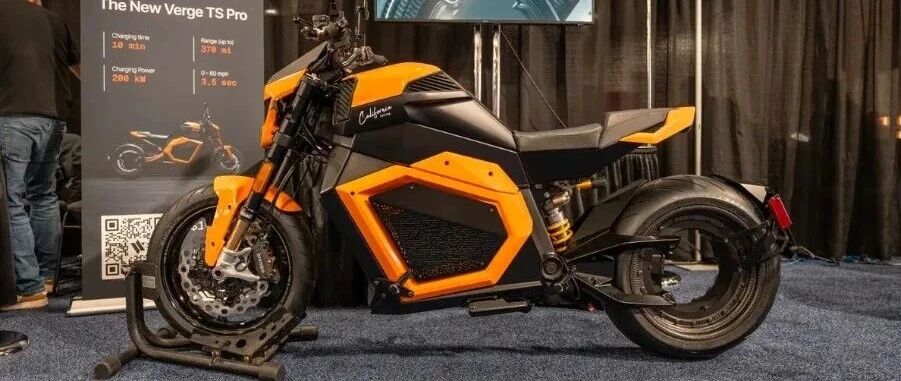
Core Viewpoint - Donut Lab has launched the world's first commercially viable all-solid-state battery, marking a significant advancement in the electric vehicle and energy storage industries [2][3]. Group 1: Battery Specifications and Performance - The new battery achieves an energy density of 400 Wh/kg, significantly higher than the current mainstream lithium-ion batteries, which typically range from 250 to 300 Wh/kg [3]. - It can be charged in just 5 minutes, representing a qualitative leap in charging speed [3]. - The battery boasts a cycle life of up to 100,000 cycles, far exceeding the 5,000 cycles limit of existing technologies, allowing for nearly 30 years of stable use with daily charge and discharge [5]. Group 2: Material and Cost Efficiency - Donut Lab's solid-state battery is made from abundant, low-cost materials that are geopolitically stable, avoiding reliance on rare or sensitive elements, thus significantly reducing costs compared to traditional lithium-ion batteries [5]. - This development addresses the core cost bottleneck that has historically limited the large-scale application of solid-state batteries [5]. Group 3: Safety and Testing - The battery has undergone rigorous testing under extreme conditions, maintaining over 99% capacity at temperatures as low as -30°C and above 100°C without any signs of fire or degradation [5]. Group 4: Market Applications and Collaborations - Donut Lab has partnered with Verge Motorcycles to offer the first production motorcycle equipped with this solid-state battery, with pre-orders starting and deliveries expected in Q1 2026 at a starting price of $29,900 [6]. - The motorcycle can be charged in 10 minutes, providing up to 60 kilometers of range per minute of charging, and a long-range version can travel 600 kilometers on a single charge [6]. - Additionally, Donut Lab is collaborating with WATTEV to create a lightweight modular electric vehicle platform that integrates their battery technology [8]. Group 5: Future Outlook - Donut Lab asserts that solid-state batteries are ready for application in OEM production vehicles now, indicating a shift towards the future of electric mobility [8].

5分钟充满电!全球首款可量产全固态电池来了
2 1 Shi Ji Jing Ji Bao Dao· 2026-01-06 14:25
Group 1 - The solid-state battery sector continues to rise, with companies like HaiXi Communications and DaoShi Technology seeing gains of over 10% [1] - Donut Lab announced the launch of the world's first mass-producible all-solid-state battery at the CES in Las Vegas, boasting an energy density of 400Wh/kg, enabling longer range and lighter structure [1][2] - The all-solid-state battery can be fully charged in just 5 minutes and supports safe, reliable full discharge without significant capacity degradation over its lifespan, which can reach up to 100,000 cycles [1] Group 2 - The battery is designed without flammable liquid electrolytes, eliminating the risk of thermal runaway and dendrite formation, and has been rigorously tested under extreme conditions [2] - Donut Lab claims that the materials used for the solid-state battery are abundant, low-cost, and geopolitically secure, avoiding reliance on rare or sensitive elements [2] - Verge Motorcycles will be the first to use Donut Lab's solid-state battery, allowing for a 10-minute charge that provides up to 60 kilometers of range per minute of charging, with a long-range version capable of 600 kilometers on a single charge [3] Group 3 - Traditional lithium-ion batteries are nearing their theoretical energy density limit of 300Wh/kg, making it difficult to meet the demands for higher energy density and safety in electric vehicles and other applications [3] - Solid-state batteries are recognized as a disruptive technology that can achieve higher energy density and safety, prompting global companies and research teams to innovate to avoid falling behind [3] - The year 2026 is identified as a critical period for equipment localization in the solid-state battery industry [3]






5分钟充满电!全球首款可量产全固态电池来了
21世纪经济报道· 2026-01-06 14:24
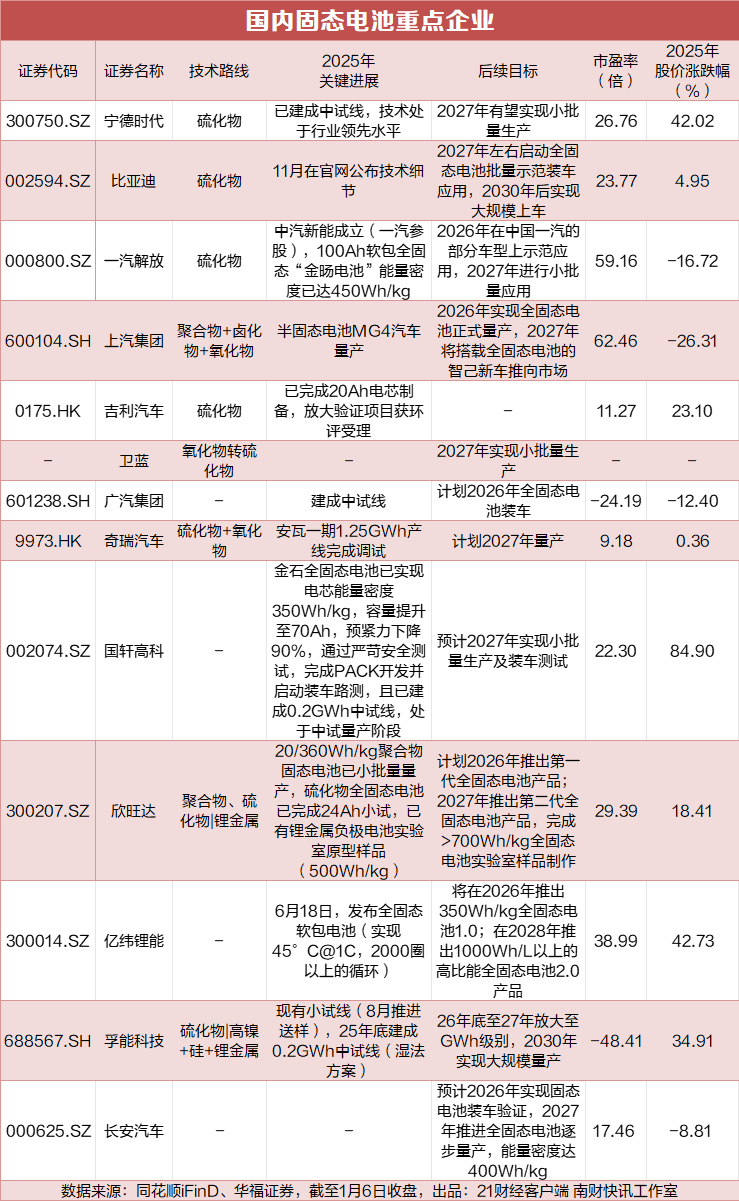
Core Viewpoint - The solid-state battery sector is experiencing significant growth, driven by innovations such as Donut Lab's announcement of the world's first mass-producible solid-state battery, which boasts a high energy density of 400Wh/kg and rapid charging capabilities [1][2]. Group 1: Industry Developments - Donut Lab's solid-state battery can be fully charged in just 5 minutes and supports complete discharge without safety concerns, unlike traditional lithium-ion batteries [1]. - The battery maintains over 99% capacity in extreme temperatures, both at -30°C and above 100°C, demonstrating superior safety and reliability [1]. - The solid-state battery technology is recognized as a disruptive innovation in the industry, with a consensus on the need to reduce liquid electrolyte content and increase solid electrolyte usage [3]. Group 2: Market Impact - Verge Motorcycles will be the first to utilize Donut Lab's solid-state battery, allowing for a 10-minute charge that provides up to 60 kilometers of range per minute of charging, with a long-range version capable of 600 kilometers on a single charge [2]. - Donut Lab is collaborating with WATTEV to create a lightweight modular electric vehicle platform, integrating their battery technology [2]. - Traditional lithium-ion batteries are nearing their theoretical energy density limit of 300Wh/kg, which poses challenges for applications requiring higher energy density and safety [2]. Group 3: Key Players in Solid-State Battery Development - Major companies in the solid-state battery space include CATL, BYD, and others, with various technological approaches and timelines for mass production [4][5]. - CATL aims for small-scale production of solid-state batteries by 2027, while BYD plans to start demonstration applications around the same time [4]. - Other companies like SAIC and Chery are also making strides in solid-state battery technology, with specific targets for production and energy density improvements by 2026 and 2027 [5].
5分钟充满电!全球首款可量产全固态电池来了 概念股一览
2 1 Shi Ji Jing Ji Bao Dao· 2026-01-06 10:17
Core Insights - The solid-state battery sector continues to rise, with companies like HaiXi Communications and DaoShi Technology seeing gains of over 10% [1] - Donut Lab announced the launch of the world's first mass-producible all-solid-state battery at CES 2023, boasting an energy density of 400Wh/kg and a design life of up to 100,000 cycles [1][2] - The all-solid-state battery is claimed to be safer than traditional lithium-ion batteries, with no flammable liquid electrolytes and minimal capacity degradation under extreme conditions [1][2] Industry Developments - Donut Lab's solid-state battery is made from abundant, low-cost materials, avoiding reliance on rare or sensitive elements, and is expected to be cheaper than lithium-ion batteries [2] - Verge Motorcycles will be the first to use Donut Lab's solid-state battery, allowing for a 10-minute charge time and a range of up to 600 kilometers on a single charge [2] - The solid-state battery technology is recognized as disruptive, prompting global companies and research teams to innovate to avoid falling behind [3] Company Progress - Companies like CATL and BYD are advancing in solid-state battery technology, with CATL expected to achieve small-scale production by 2027 and BYD planning to start mass demonstration applications around the same time [5] - Various automotive manufacturers, including SAIC and Changan, are also working on solid-state battery integration, with targets for production and vehicle testing set for 2026 and 2027 [6]




5分钟充满电!全球首款可量产全固态电池来了,概念股一览
2 1 Shi Ji Jing Ji Bao Dao· 2026-01-06 10:11
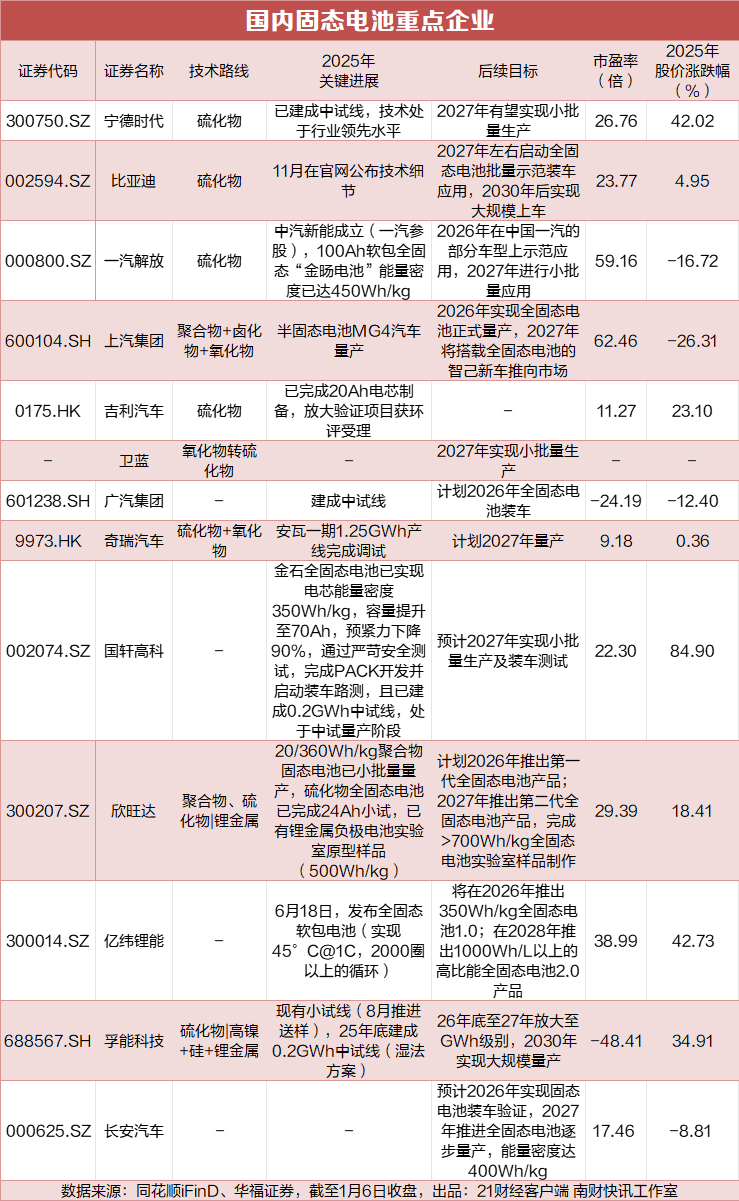
1月6日,固态电池板块延续前一天走势继续拉涨,海希通讯、道氏技术涨超10%领涨,常铝股份、滨海 能源、国晟科技等多股涨停。 消息面上,芬兰初创公司Donut Lab宣布,将在今年的美国拉斯维加斯消费电子展(CES)上,发布"全球首 款可量产全固态电池"。 华福证券在最新研报中指出,传统锂离子电池采用了易燃的液态电解质,能量密度已经接近理论极限 300Wh/kg,难以满足智能化电动车、电动航空、智能终端等场景对能量密度、安全性更高的要求。 华福证券表示,固态电池已成为全球公认的颠覆性技术,能实现高比能、高安全性,减少液态电解质含 量、提升固态电解质占比是行业共识。由此带来的对材料体系、装备体系的颠覆,迫使全球企业、研究 团队展开新一轮的创新竞争,避免在新技术方向上的掉队风险。2026年将进入设备定点的关键时期。 | 证券代码 证券名称 | 技术路线 | 2025年 | 后续目标 | 市密率 | 2025年 股价涨跌幅 | | --- | --- | --- | --- | --- | --- | | | | 关键进展 | | (倍) | | | | | | | | (%) | | 300750.SZ 宁德时代 ...
1月6日,碳中和50ETF(159861)涨超1.2%,固态电池技术革新引关注
Mei Ri Jing Ji Xin Wen· 2026-01-06 07:40
(文章来源:每日经济新闻) 华福证券指出,固态电池已成为全球公认的颠覆性技术,能实现高比能、高安全性,减少液态电解质含 量、提升固态电解质占比是行业共识。材料端,全固态电池颠覆现有体系,核心增量环节是硫化物/氧 化物/卤化物/聚合物固态电解质,其中硫化锂降本和量产是瓶颈;能量密度提升依赖高镍/富锂锰基正 极、锂金属/硅碳负极的性能突破。设备端,干法电极能实现厚电极、减少能耗,是固态电池优选方 案,等静压设备解决界面接触问题,是有别于传统锂电的高壁垒增量环节。2026年将进入设备定点的关 键时期,2027年实现小批量生产是国内外企业的一致预期。行业目前处于中试阶段,国内企业2025年基 本建成中试线,能量密度达350-500Wh/kg,部分已启动装车测试。 ...
固态电池深度研究报告:电池变革重要赛点,材料设备全新颠覆
Huafu Securities· 2026-01-06 06:59
证券研究报告|行业深度报告 电力设备与新能源 行业评级 强于大市(维持) 2026年1月6日 电池变革重要赛点,材料设备全新颠覆 ——固态电池深度研究报告 证券分析师: 邓伟 执业证书编号:S0210522050005 游宝来 执业证书编号:S0210523030002 研究助理: 请务必阅读报告末页的重要声明 李宜琛 华福证券 华福证券 投资要点 2 华福证券 华福证券 Ø 发展固态电池已成为行业共识、全球竞争赛点:理论上能实现高比能、高安全性的固态电池体系,是全球公认的颠覆性 技术。减少液态电解质含量,提升固态电解质占比,逐步实现固态化,是行业发展共识。由此带来的对材料体系、装备 体系的颠覆,迫使全球企业、研究团队展开新一轮的创新竞争,避免在新技术方向上的掉队风险。2027年实现小批量生 产、工艺定型,基本上是国内外企业一致预期的重要时间节点。 Ø 材料端:固态电池颠覆材料环节,重视增量、升级、瓶颈环节。全固态电池颠覆现有体系,核心增量环节是硫化物/氧化 物/卤化物/聚合物固态电解质,其中降本、量产瓶颈在于硫化锂(成本高、工艺放大难)。此外,能量密度的提升依赖 高镍/富锂锰基正极、锂金属/硅碳负极的性能突 ...

华福证券:电池变革重要赛点 材料设备全新颠覆
Zhi Tong Cai Jing· 2026-01-06 06:44
华福证券发布研报称,发展固态电池已成为行业共识、全球竞争赛点:理论上能实现高比能、高安全性 的固态电池体系,是全球公认的颠覆性技术。减少液态电解质含量,提升固态电解质占比,逐步实现固 态化,是行业发展共识。由此带来的对材料体系、装备体系的颠覆,迫使全球企业、研究团队展开新一 轮的创新竞争,避免在新技术方向上的掉队风险。2027年实现小批量生产、工艺定型,基本上是国内外 企业一致预期的重要时间节点。 华福证券主要观点如下: 建议关注 主线1:关键材料:【硫化物电解质】当升科技(300073)、国瓷材料(300285)、容百科技、泰坦股 份(003036)、道氏技术(300409)等;【硫化锂】上海洗霸(603200)、厦钨新能、恩捷股份 (002812)、海辰药业(300584)、华盛锂电、光华科技(002741)等;【锂金属负极】中一科技 (301150)、天铁科技(300587)、道氏技术、英联股份(002846)等;【硅碳负极】璞泰来 (603659)、贝特瑞、杉杉股份(600884)、元力股份(300174)、道氏技术等;【辅材】博苑股份 (301617)、日播时尚(603196)、海辰药业、松井股份、 ...
重磅!全球首款可量产全固态电池问世,5分钟充满!
是说芯语· 2026-01-06 06:00
Core Viewpoint - Donut Lab has introduced the world's first mass-producible all-solid-state battery at CES 2026, marking a significant milestone in the electric vehicle industry as it transitions from laboratory technology to production models [1][11]. Group 1: Product Features - The all-solid-state battery boasts an energy density of 400Wh/kg, enabling longer range, lighter structure, and unprecedented design flexibility in vehicles [1]. - It can be fully charged in just 5 minutes without the need to limit charging to 80%, supporting safe, repeatable, and reliable full discharges [2]. - Unlike traditional lithium-ion batteries, this solid-state battery has minimal capacity degradation over its lifespan, with a design life of up to 100,000 cycles, significantly exceeding current technologies [3]. Group 2: Safety and Testing - The battery is designed with safety as a core feature, eliminating flammable liquid electrolytes and preventing thermal runaway reactions, thus fundamentally reducing fire risks [3]. - It has been rigorously tested under extreme conditions, maintaining over 99% capacity at temperatures as low as -30°C and above 100°C without any signs of fire or degradation [3]. Group 3: Material and Cost - Donut Lab claims that the solid-state battery is made from abundant, low-cost materials that are geopolitically secure, avoiding reliance on rare or sensitive elements, and showing lower costs compared to lithium-ion batteries [4]. Group 4: Application and Market Impact - The battery is currently set to power Verge Motorcycles' electric motorcycles, which will be the first mass-produced vehicles to utilize this groundbreaking technology [9]. - The Verge TS Pro motorcycle can be charged in 10 minutes, providing up to 60 kilometers of range per minute of charging, with a long-range version capable of 600 kilometers on a single charge [9]. - Donut Lab is also collaborating with WATTEV to create a lightweight modular electric vehicle platform that integrates their motor and battery technology, highlighting the broader implications of solid-state battery technology in the electric vehicle sector [11].