
大语言模型

Search documents
DeepSeek冲击一年,中国大模型超1500种
日经中文网· 2026-01-26 03:12
Core Insights - The article discusses the emergence of Chinese AI companies, particularly DeepSeek, which is expected to disrupt the market starting January 2025, showcasing a shift towards self-reliance in AI development rather than following the U.S. model [2][8] - The performance of Chinese AI models, such as Qwen from Alibaba, has significantly improved, with Alibaba's stock rising approximately 90% over the past year [2][7] - The article questions the effectiveness of U.S. high-tech export controls, suggesting that while they may still pose some threat, Chinese companies are developing capabilities that could mitigate these restrictions [8][9] Summary by Sections DeepSeek's Market Impact - DeepSeek is anticipated to make a significant impact in the AI market starting January 2025, with its performance in large language models (LLMs) being highly rated [2][5] - On January 27, 2025, DeepSeek surpassed OpenAI's ChatGPT in the Apple app download rankings, indicating its growing popularity [2] Performance of Chinese AI Models - DeepSeek ranked 10th in the global LLM rankings, praised for its mathematical reasoning capabilities and cost-effectiveness [6] - The total number of LLMs released in China has reached 1,509, making it the leading country in this regard [7] - Alibaba's Qwen series has achieved over 700 million downloads, becoming the most downloaded open-source AI on the Hugging Face platform [7] Financial Performance and Projections - Alibaba's market capitalization increased by approximately HKD 1.5 trillion, with a projected revenue growth of over 35% for its cloud services in 2026, potentially accelerating to 40% in 2027 [7][8] - The stock price of Zhiyuan, a Chinese AI company, rose by 22% following the announcement of a domestically developed multimodal AI model [8] Competitive Landscape - The article highlights the different approaches of Chinese and U.S. AI companies, with China focusing on efficiency and lightweight solutions rather than solely on cutting-edge GPUs and massive investments [8] - The Chinese government is actively promoting the widespread application of AI across various sectors, indicating a strategic push towards integrating AI into the economy [8]


DeepSeek——少即是多
2026-01-26 02:49
Summary of DeepSeek Conference Call Company and Industry Overview - **Company**: DeepSeek - **Industry**: Artificial Intelligence (AI) and Semiconductor Equipment in China Key Points and Arguments 1. **Engram Module Launch**: DeepSeek has introduced the Engram module, which decouples storage from computation, reducing reliance on High Bandwidth Memory (HBM) and lowering infrastructure costs. This innovation aims to alleviate bottlenecks in AI computing in China and suggests that future AI competition may focus on more efficient hybrid architectures rather than larger models [1][2][3] 2. **Efficiency Improvements**: The Engram module enhances the efficiency of large language models by implementing "conditional memory," which allows for better utilization of GPU resources. This decoupling of static memory from computation is expected to improve the performance of AI systems while reducing the need for expensive HBM [1][9][10] 3. **Infrastructure Cost Dynamics**: The findings indicate that infrastructure costs may shift from GPU to storage, as medium computational configurations may offer better cost-effectiveness than pure GPU expansions. The AI inference capability is expected to improve beyond knowledge growth, highlighting the importance of storage value beyond just computation [2][3][10] 4. **Next Generation Model**: DeepSeek's upcoming V4 model will utilize the Engram memory architecture, potentially achieving significant advancements in code generation and inference. The model is expected to run on consumer-grade hardware, such as the RTX 5090, and will be closely monitored for its performance against key benchmarks [2][3][10] 5. **Investment Opportunities**: The report highlights potential investment opportunities in the Chinese semiconductor equipment sector, particularly focusing on companies like Northern Huachuang (target price: RMB 514.2), Zhongwei Company (target price: RMB 364.32), and Changdian Technology (target price: RMB 49.49) [3][24][25] Additional Important Insights 1. **Performance Comparison**: Despite facing stricter constraints in advanced computing and hardware acquisition, Chinese AI models have rapidly closed the performance gap with leading models like ChatGPT 5.2. This progress is attributed to a focus on efficiency-driven innovations rather than sheer computational expansion [8][14] 2. **Long-term Implications**: The architecture developed by DeepSeek may lead to a more cost-effective, scalable, and adaptable AI ecosystem in China, potentially impacting global competitors by reducing the marginal costs of high-level intelligence and decreasing reliance on unlimited computational expansion [14][16] 3. **Engram's Unique Approach**: Engram's design allows for a more efficient memory usage model, significantly lowering the demand for HBM. This approach enhances the core transformer model without increasing FLOP or parameter scale, thereby improving overall system efficiency [11][18] 4. **Testing Results**: Tests on a 27 billion parameter model have shown that Engram outperforms in several benchmark tests, particularly in long-context processing, which is crucial for enhancing AI practicality [16][18] 5. **Strategic Positioning**: DeepSeek's advancements represent a strategic response to geopolitical and supply chain constraints, emphasizing algorithmic and system-level innovations over direct hardware competition [16][18] This summary encapsulates the critical insights from the conference call regarding DeepSeek's innovations, market positioning, and the broader implications for the AI and semiconductor industries in China.

AI重塑大气污染防治决策模式,北京大兴的“超脑”治污“进化史”
Zhong Guo Huan Jing Bao· 2026-01-26 01:53
Core Insights - The article discusses the integration of AI-assisted decision-making technology based on large language models in air pollution prevention, aiming to transform decision-making from reactive to proactive approaches [1]. Group 1: Technology Application and Initial Results - The Daxing District Ecological Environment Bureau has developed multiple air quality analysis agents, creating an intelligent closed-loop process of "perception-planning-execution-presentation" [2]. - The system can accurately identify user queries in natural language, such as pollution causes at specific locations and times, and link relevant meteorological data and pollution source information for deeper analysis [2]. - Workflow planning and routing have become more intelligent, allowing the system to break down complex requests into sub-tasks and automatically coordinate data queries and model calculations [2]. Group 2: Interactive Responses and Presentation of Results - The system generates readable and practical analysis results, including professional charts for PM2.5 events, and provides specific conclusions and recommendations for pollution inspection [3]. Group 3: Challenges and Issues - Limitations of large language models include risks of generating fabricated data and conclusions, which can affect decision-making accuracy [4]. - The current application of the intelligent agent is primarily focused on data queries and simple rule judgments, with decision accuracy in complex scenarios needing improvement [4][5]. - Data quality and heterogeneity issues hinder the intelligent agent's judgment and model simulation results, with current interactions being superficial rather than deeply integrated [5]. Group 4: System Optimization and Application Results - The Daxing District Ecological Environment Bureau has optimized the air quality analysis system by enhancing knowledge base construction and improving reasoning frameworks [6][7]. - A business-oriented AI-assisted decision-making platform has been established, integrating multiple intelligent agents for comprehensive analysis [8]. - The new system significantly improves data collection and analysis efficiency, allowing for rapid pollution source identification within five minutes [8]. Group 5: Future Outlook - The future of AI-assisted decision-making in air pollution prevention is expected to evolve with new scenarios and deeper functionalities, expanding from monitoring to comprehensive management systems [9]. - The integration of multi-source data and models will lead to a more intelligent and dynamic decision-making process, transitioning from experience-driven to intelligence-driven governance [9].
2026北京两会|对话市政协委员王仲远:北京形成了人工智能闭环式产业生态
Bei Jing Shang Bao· 2026-01-25 11:17
Core Insights - The artificial intelligence industry has transitioned from a phase of rapid development to a more pragmatic focus on application efficiency, particularly moving from single-agent systems to multi-agent systems [2][5] - Beijing is positioned as a core hub for AI development, with a comprehensive ecosystem that supports the industry through policies, talent, and technological advancements [3][6] Industry Trends - The development of foundational models, especially large language models, has slowed, while the application of these models is accelerating, emphasizing the shift towards multi-agent systems [5][9] - AI is expanding beyond digital realms into the physical world, necessitating advancements in multi-modal models and world models to tackle challenges in time-space cognition and physical reasoning [2][5] Market Potential - By 2025, Beijing's AI core industry is expected to reach a scale of 450 billion yuan, with over 2,500 companies, accounting for about half of the national figures [3] - The city is home to nearly 60 listed AI companies and around 40 unicorns, showcasing its leadership in the AI sector [3] Talent and Education - Beijing boasts a significant talent pool, with 148 individuals listed in the "AI 2000 Global Influential Scholars" ranking, representing over 40% of the national total [3][7] - The city has a complete talent development chain, supported by top universities and research institutions, fostering the growth of AI professionals [7][8] Policy and Ecosystem - The policy framework in Beijing is comprehensive and practical, supporting both disruptive innovations and the development of new research institutions, which contributes to a closed-loop industrial ecosystem [6][8] - The collaboration between research institutions, enterprises, and policy-makers is driving breakthroughs in new technologies and applications in the AI field [3][6] Future Outlook - The year 2026 is anticipated to be a pivotal year for the explosion of intelligent agents in China, with expectations for significant advancements in multi-agent systems [3][8] - The focus is on achieving commercial viability for large models, which is essential for high-quality development in the industry [9][10]
AI量化的当下与未来
HTSC· 2026-01-25 02:55
证券研究报告 金工 AI 量化的当下与未来 2026 年 1 月 22 日│中国内地 深度研究 人工智能 100:AI 量化的过去、现在与未来 本文是华泰人工智能系列的第 100 篇研究报告。过往的八年半里,我们亲 历了量化投资行业的这场深刻变革:技术路径上,从早期的机器学习,演进 到深度学习,再到如今以大语言模型为代表的新范式。应用场景上,从早期 的因子合成,拓展至因子挖掘与端到端建模,进而渗透到组合优化、行业轮 动、资产配置、流程管理等投资的各个环节。行业认知上,从最初的质疑与 观望,逐渐转向接纳与尝试,直至今日的全面拥抱。第 100 篇研究,既是 对过往足迹的回顾,也是对未来征途的眺望。 AI 量价端到端策略的演进 在量价研究普遍内卷的当下,端到端建模不仅是效率的提升,亦是一种回归 原始数据的研究范式。我们已实现从日频、周频等低频数据到逐笔成交、 level2 高频数据的全面覆盖,通过引入 GRU 及 Transformer 等架构,模型 得以直接在原始数据空间中学习量价数据间的内在联系。展望未来,全频段 融合或是关键,未来的端到端模型或将致力于打破时间尺度与数据形态的边 界,一方面通过对比学习等技术实 ...
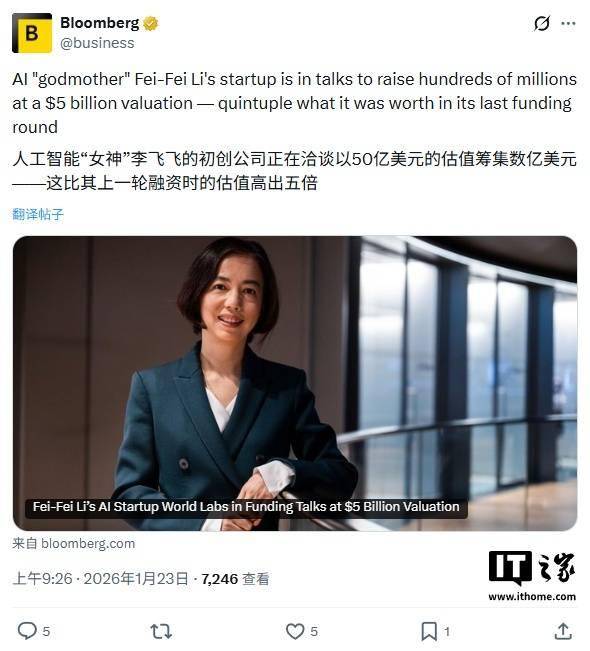
“AI教母”李飞飞初创公司World Labs拟融5亿美元,估值50亿美元
Sou Hu Cai Jing· 2026-01-23 02:50
Group 1 - The core focus of World Labs is to develop AI tools capable of understanding, navigating, and making decisions in three-dimensional environments, referred to as "Large World Models" [3] - World Labs is currently in discussions for a new funding round aiming for a valuation of approximately $5 billion, with expected new funding of around $500 million [3][5] - The company previously completed a funding round in 2024, raising $230 million at a valuation of about $1 billion [1][3] Group 2 - World Labs has notable investors including Andreessen Horowitz, NEA, Radical Ventures, NVIDIA's venture capital arm, Sanabil Investments from Saudi Arabia, and Temasek Holdings from Singapore [1][5] - The company launched its first product, Marble, in late 2024, which generates three-dimensional worlds based on image or text prompts [3] - Li Fei-Fei, known as the "AI Mother," is a prominent figure in AI, having created the ImageNet project and currently serves as a professor at Stanford University [4]
英矽智能涨超6%破顶 NLRP3抑制剂ISM8969获FDA临床试验批件
Zhi Tong Cai Jing· 2026-01-23 02:37
消息面上,英矽智能今日宣布,其用于炎症及神经退行性疾病治疗的口服NLRP3抑制剂ISM8969临床试 验新药(IND)申请获得美国食品药品监督管理局(FDA)批准,用于帕金森病治疗。即将开展的这项I期临 床研究旨在评估ISM8969在健康人群中的安全性、耐受性及药代动力学表现,并找到临床推荐最佳剂量 以供后续的进一步研究。值得一提的是,为加速ISM8969的全球开发,英矽智能已与衡泰生物达成共同 开发合作协议。双方各持有该项目50%的全球权益,同时英矽智能有权获得最高逾5亿港币的预付款和 里程碑付款。 此外,英矽智能日前发布了大语言模型训练框架Science MMAI Gym,旨在将具有因果推理能力的LLM 转化为具备在真实世界处理药物发现与开发任务能力的高性能引擎。经过训练后,原本在专业任务领域 失败率高达75%–95%的LLM,可在关键药物发现基准测试中实现最高10倍的性能提升。此次发布将进 一步推进制药超级智能(PSI)愿景。 英矽智能(03696)涨超6%,高见62.9港元创上市新高。截至发稿,涨6.11%,报62.5港元,成交额2637.99 万港元。 ...
DeepSeek新模型曝光?
新华网财经· 2026-01-22 05:00
Core Insights - DeepSeek has released a new model "MODEL1" in the open-source community, coinciding with the one-year anniversary of the DeepSeek-R1 model launch [1] - The company plans to gradually unveil five code repositories during the "Open Source Week" starting in February 2025, with Flash MLA being the first project [3] - Industry analysts suggest that "MODEL1" may represent a new architecture distinct from the existing "V32" model, potentially indicating the next-generation model (R2 or V4) that has not yet been publicly released [4] Group 1 - Flash MLA optimizes memory access and computation processes on Hopper GPUs, significantly enhancing the efficiency of variable-length sequence processing [3] - The core design of Flash MLA includes a dynamic memory allocation mechanism and parallel decoding strategy, which reduces redundant computations and increases throughput, particularly for large language model inference tasks [3] - DeepSeek has been active since January 2026, releasing two technical papers on a new training method called "optimized residual connections (mHC)" and a biologically inspired "AI memory module (Engram)" [4] Group 2 - On January 12, DeepSeek published a new paper in collaboration with Peking University, introducing a conditional memory mechanism to address the inefficiencies of the Transformer architecture in knowledge retrieval [5] - The Engram module proposed by DeepSeek is said to enhance knowledge retrieval and improve performance in reasoning and code/mathematics tasks [5] - The private equity firm managed by Liang Wenfeng, known for high returns, has provided substantial support for DeepSeek's research and development efforts [5]
东软集团与Cerence AI签署战略合作协议,共同探索智能语音交互创新应用
Zheng Quan Shi Bao Wang· 2026-01-22 04:03
Core Insights - Neusoft Group has signed a memorandum of understanding with Cerence AI to collaborate on advanced technologies such as intelligent voice and large language models, aiming to create high-experience smart interaction solutions for global automotive partners [1] Group 1: Collaboration and Technology - The partnership focuses on co-creating technologies and integrating ecosystems to enhance user interaction in smart vehicles, moving beyond basic voice responses to more emotionally resonant communication [1] - Cerence AI is recognized as a leading provider of conversational AI user experience solutions, and the collaboration will leverage Neusoft's NAGIC intelligent cockpit software platform alongside Cerence's expertise in voice technology and generative AI [1] Group 2: Market Position and Strategy - Neusoft Group emphasizes an "open integration, ecosystem win-win" philosophy, aiming to collaborate with top technology partners to support automotive companies in navigating market challenges and enhancing user experiences [2] - With over 30 years of experience in the automotive electronics sector, Neusoft has established itself as a core partner for innovation in the software-defined vehicle era, providing a range of products including intelligent cockpit domain controllers and IVI in-car entertainment systems [2] Group 3: Supplier Agreements and Financial Impact - Neusoft has been designated as a supplier for a major domestic automotive manufacturer, expected to supply intelligent cockpit domain controllers for multiple vehicle models set to be produced between 2026 and 2027, with a projected total contract value of approximately 4.2 billion RMB [3] - The products will utilize Qualcomm's platform, integrating AI computing power and multimodal large model technology to enhance interaction experiences and multitasking capabilities [3]

东软集团与Cerence AI签署合作谅解备忘录
Zheng Quan Shi Bao Wang· 2026-01-22 01:37
Core Viewpoint - Neusoft Group (600718) has signed a memorandum of understanding with Cerence AI to collaborate on advanced fields such as intelligent voice and large language models, aiming to create integrated, scenario-based, and high-experience intelligent interaction solutions for global automotive partners [1] Group 1 - The collaboration will focus on deep cooperation in cutting-edge technologies [1] - The partnership aims to leverage technology co-creation and ecosystem integration [1] - The goal is to enhance user experience in automotive intelligent interaction solutions [1]