市场多元化

Search documents
南非农业:在挑战中谋转型,于多元中求发展
人民网-国际频道 原创稿· 2025-10-15 02:30
Core Insights - South Africa's agricultural sector is experiencing a complex yet positive development trend, driven by strong crop production in Q3 and a push for market diversification amid international trade barriers [1] Group 1: Production Dynamics - The agricultural sector contributes 3% to South Africa's GDP, with strong linkages to processing and logistics, enhancing its economic impact [2] - Summer grains and oilseeds have seen a remarkable 28% year-on-year increase in production, reaching nearly 20 million tons, although price pressures exist due to ample supply [2] - The horticulture sector is performing well, with citrus, deciduous fruits, and wine grapes showing increased yields, and a record citrus harvest of 180 million boxes is expected by 2025 [2] Group 2: Trade Adaptation - South Africa's agricultural sector is adapting to a 30% tariff imposed by the US on certain agricultural products, which has impacted exports of citrus and wine, potentially affecting up to 80,000 jobs [3] - The US accounts for only 4%-6.5% of South Africa's agricultural exports, with the Southern African Development Community (SADC) and the EU being more significant markets, comprising 39% and 25% respectively [3] - South Africa is successfully diversifying its markets, having opened the Philippine fresh grape market and increasing exports of citrus to Vietnam and avocados to China [3] Group 3: Policy and Innovation - The South African government is focusing on inclusivity and technological innovation as key strategies for growth and competitiveness in agriculture [4] - The small drone market is expected to grow at an annual rate of 22.35% from 2020 to 2025, reaching a size of $138 million by 2025 [4] - Agricultural technology cooperation with China has shown significant results, enhancing efficiency and connecting South Africa to the global digital agriculture network [4] Group 4: Challenges and Resilience - Despite positive trends, the agricultural sector faces challenges such as market friction with the US and slow diversification of exports [5] - Young people in rural areas show a strong preference for non-agricultural employment, hindered by education and skill shortages [5] - The government and industry are collaborating to address these challenges, with initiatives like the "Farmer Field School" program adding 260 agricultural technicians [6]
欧圣电气:公司在非美市场的开拓进展顺利,逐步减少了对美国市场以及大客户的依赖
Mei Ri Jing Ji Xin Wen· 2025-10-15 01:25
Core Viewpoint - The company has experienced disruptions in its shipment schedule to the U.S. due to significant changes in U.S. tariff policies, but has successfully transitioned production to its Malaysian factory, mitigating the impact of these tariffs on its business [2]. Group 1: Impact of U.S. Tariff Policies - In Q2 of this year, the company's shipments to the U.S. were affected by the substantial changes in U.S. tariff policies [2]. - The company has reported that the impact of U.S. tariff policies on its business is gradually diminishing as production has shifted to the Malaysian factory [2]. Group 2: Operational Adjustments - The Malaysian factory is in its initial production phase, which has also contributed to a certain degree of impact on the company's revenue [2]. - The company is making progress in expanding its non-U.S. market presence, which is helping to reduce reliance on the U.S. market and major clients, thereby further lessening the impact of U.S. tariff changes [2].

中国拒接美国电话原因找到了!外贸稳得很,加关税威胁毫无效果
Sou Hu Cai Jing· 2025-10-14 19:28
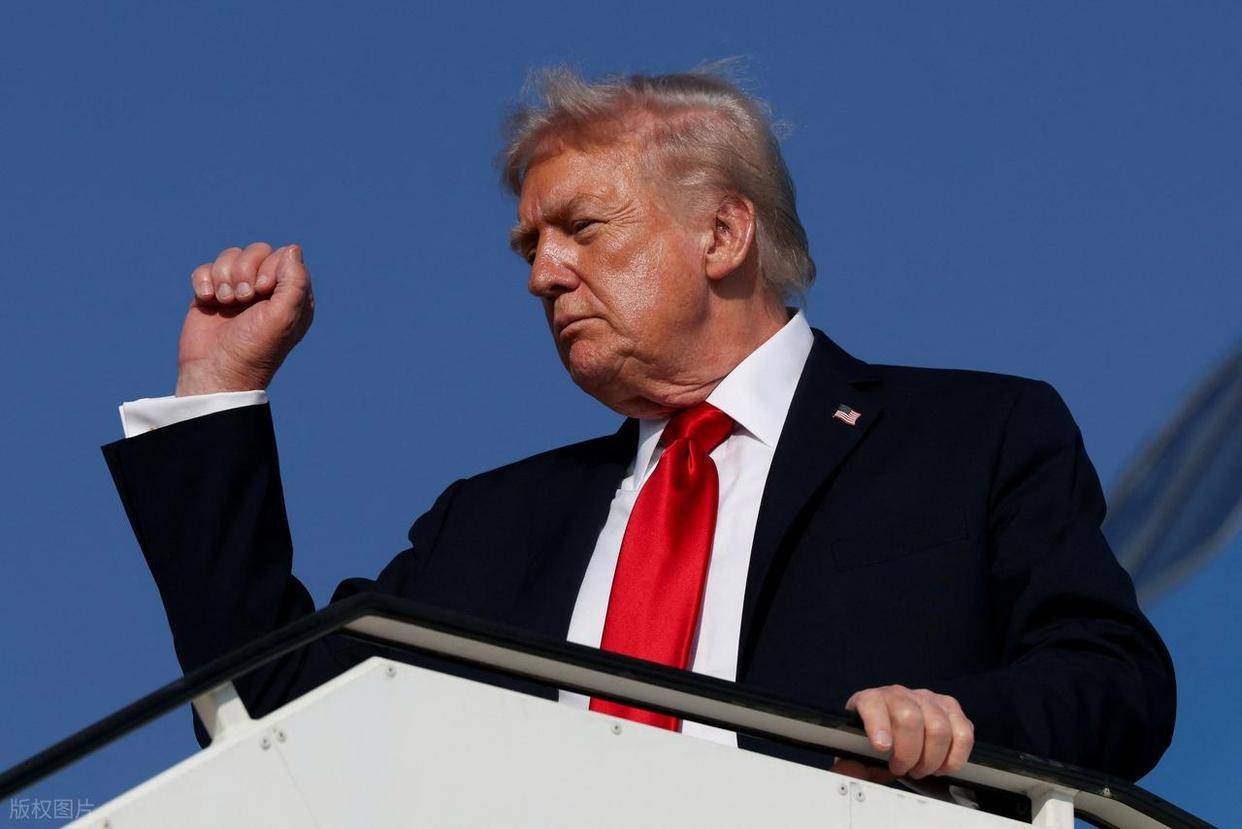
Group 1 - China's tightening of rare earth export controls has led to a significant escalation in international dynamics, with the U.S. attempting to communicate with China but failing to establish a dialogue [1] - The U.S. President's strong reactions indicate the credibility of the situation, reflecting his frustration with China's non-responsive stance [3] - Despite the U.S. imposing high tariffs on Chinese imports, China's exports have shown resilience, achieving growth against the odds [8][11] Group 2 - China's exports to ASEAN and the EU have been particularly strong, compensating for declines in exports to the U.S. due to tariffs [10] - Emerging markets, especially Africa, present substantial opportunities for Chinese products, with Chinese brands dominating the smartphone market [10] - The dual strategy of rare earth export controls and robust foreign trade resilience provides China with a significant buffer against U.S. trade pressures [11]
2025年9月进出口数据解读:特朗普关税3.0风波再起,中国进出口贸易现状、走势及发展
Lian He Zi Xin· 2025-10-14 12:40
Group 1: Trade Performance - In September 2025, China's exports grew by 8.3% year-on-year, up from a previous growth of 4.4%[5] - Imports increased by 7.4%, compared to a prior growth of 1.3%[5] - The trade surplus for September was $90.45 billion, down from $102.33 billion in the previous month[5] Group 2: Contributing Factors - The growth in exports is attributed to market diversification, optimization of export product structure, and a rebound in demand for high-tech products driven by the global AI wave[3] - The low base effect from September 2024, where exports fell by 6.3 percentage points to 2.3%, also contributed to the current growth figures[6] - High-tech product exports saw significant increases, with growth rates of 11.48% for high-tech products, 12.63% for electromechanical products, and 24.85% for general machinery[7] Group 3: Challenges Ahead - The announcement of a 100% tariff on all Chinese imports by the U.S. starting November 1, 2025, introduces uncertainty for China's trade outlook[16] - The potential economic backlash from high tariffs could negatively impact both the U.S. and Chinese economies, complicating trade relations[18] - Despite the challenges, the upcoming Canton Fair in October 2025 is expected to showcase a record participation of over 32,000 companies, indicating resilience in China's trade sector[19]
主动应变市场多元化见效 中国外贸稳中向好“面貌”清晰、抗压能力显现
Yang Shi Wang· 2025-10-14 07:49
Core Insights - China's goods trade imports and exports increased by 4% year-on-year in the first three quarters of 2025, with a notable acceleration in growth rate [1] - In September, the import and export growth reached 8%, marking the highest monthly growth rate of the year [1] - Despite global economic challenges, China's foreign trade shows a clear trend of stability and resilience [1] Group 1: Export Performance - China's exports of mechanical and electrical products reached 12.07 trillion yuan, growing by 9.6% and accounting for 60.5% of total exports [4] - High-tech products, including electronic information and advanced equipment, saw strong export growth [4] - The overall performance of China's foreign trade reflects strong resilience, driven by the steady expansion and upgrading of the manufacturing sector [6] Group 2: Market Diversification - Chinese exporters are actively exploring new markets in Asia, Africa, and Latin America as the share of exports to the U.S. declines [9] - The strategic shift towards emerging markets has resulted in record-high exports to India, Africa, and Southeast Asia [9] - Market diversification and targeted domestic support are key strategies for maintaining export growth momentum [9] Group 3: Impact of Tariffs - Despite facing U.S. tariff pressures, China's export performance remains robust, indicating limited overall impact from the trade conflict [12] - This resilient trade performance supports China's economic development and strengthens its position in U.S.-China trade negotiations [12]
前三季度进出口总额增长4%
Zhong Guo Hua Gong Bao· 2025-10-14 06:11
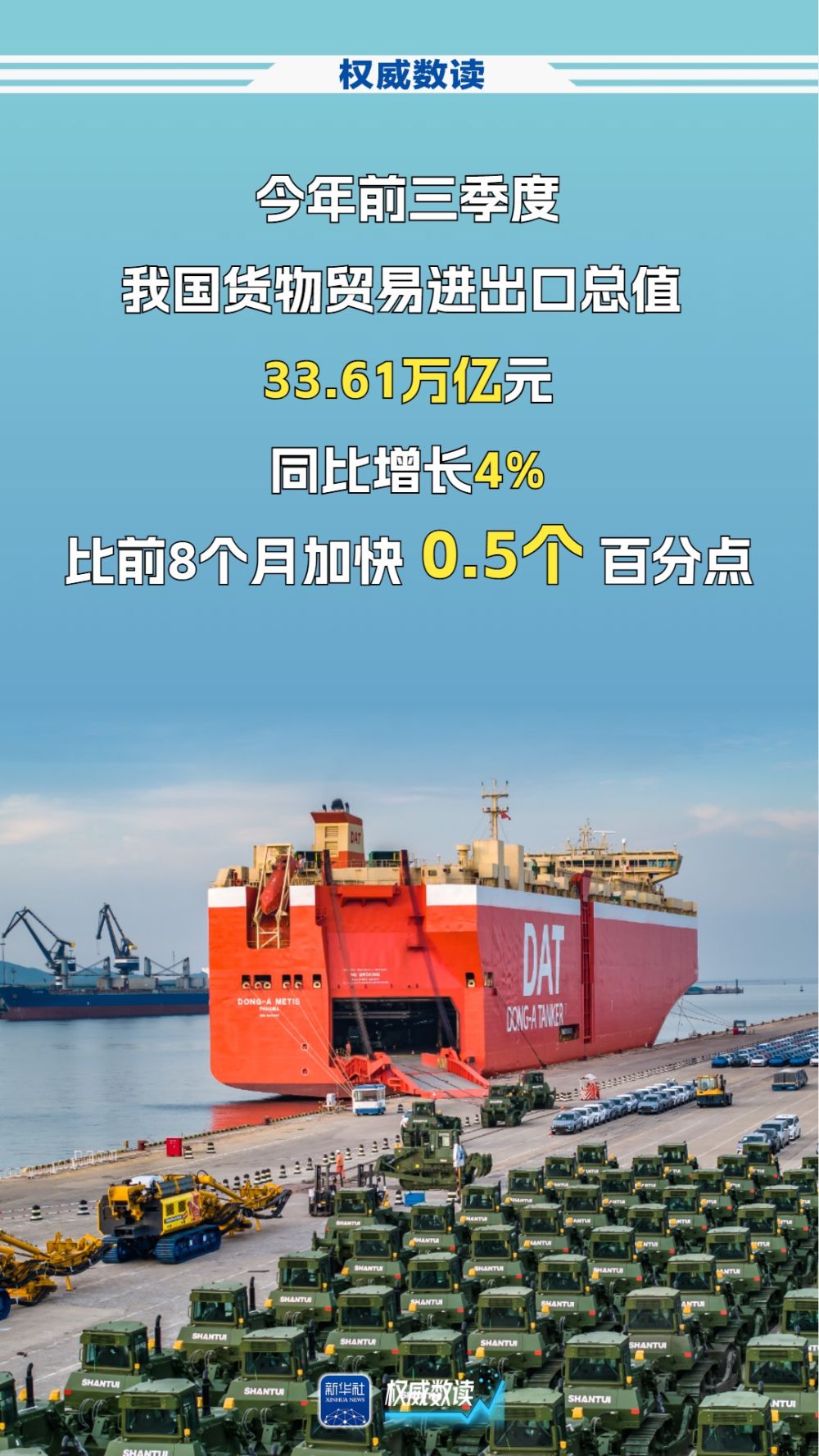
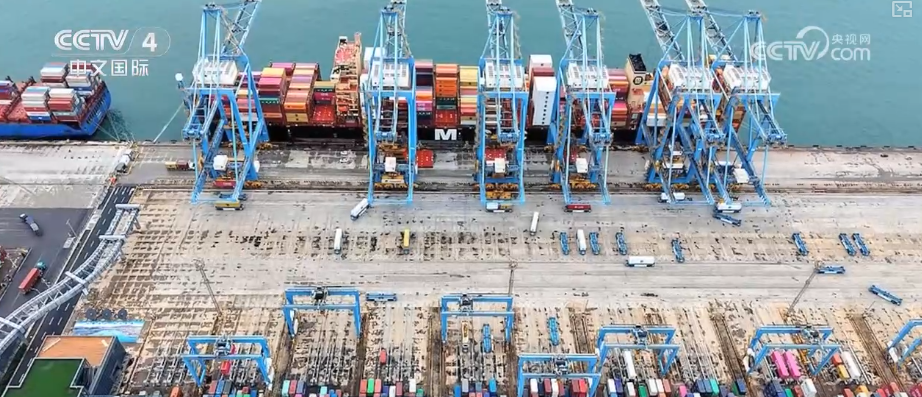
Core Insights - China's goods trade import and export reached 33.61 trillion yuan in the first three quarters of the year, showing a year-on-year growth of 4% [1] Group 1: Trade Growth - The growth rate of imports and exports has accelerated each quarter, with increases of 1.3%, 4.5%, and 6% in the first, second, and third quarters respectively, marking eight consecutive quarters of year-on-year growth [1] Group 2: Market Diversification - Trade with countries involved in the Belt and Road Initiative reached 17.37 trillion yuan, growing by 6.2%; trade with ASEAN, Latin America, Africa, and Central Asia increased by 9.6%, 3.9%, 19.5%, and 16.7% respectively; trade with other APEC economies grew by 2% [1] Group 3: Export Product Quality - Exports of electromechanical products totaled 12.07 trillion yuan, increasing by 9.6%; high-tech products such as electronic information, high-end equipment, and instruments grew by 8.1%, 22.4%, and 15.2% respectively; green products also saw double-digit growth [1] Group 4: Import Recovery - Imports showed a gradual recovery, with a 0.3% year-on-year growth in the second quarter and a further acceleration to 4.7% in the third quarter; crude oil imports increased by 4.9%, while imports of measuring instruments and computers grew by 9.3% and 8.9% respectively [1] Group 5: Active Foreign Trade Entities - The number of foreign trade enterprises with import and export performance reached 700,000, an increase of 52,000 year-on-year [2]
前三季度我国货物贸易顶住压力实现平稳增长,同比增速达4%
Ren Min Ri Bao· 2025-10-14 01:32
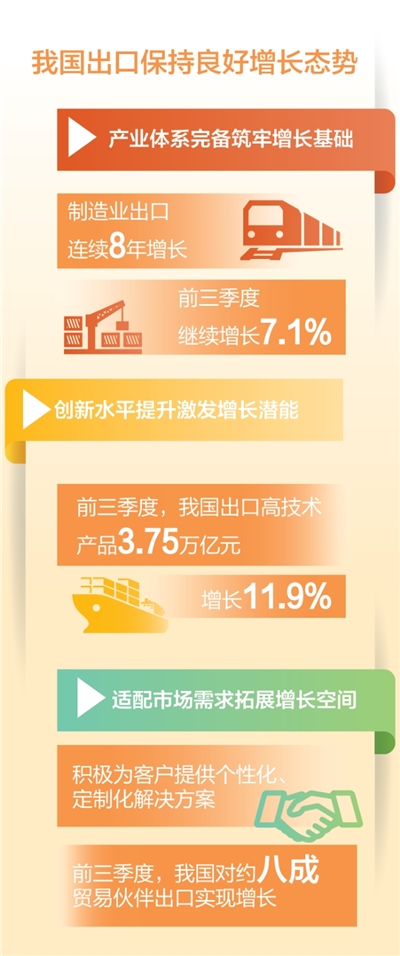
Core Viewpoint - China's foreign trade has shown resilience and steady growth in the first three quarters of the year, with a year-on-year growth rate of 4% in total goods trade [2] Group 1: Trade Performance - In the first three quarters, China's total goods trade reached 33.61 trillion yuan, with exports at 19.95 trillion yuan (up 7.1%) and imports at 13.66 trillion yuan (down 0.2%) [2] - The import and export growth rates have accelerated quarterly, with growth rates of 1.3%, 4.5%, and 6% in the first, second, and third quarters respectively [2][3] - The number of foreign trade entities with import and export performance reached 700,000 for the first time, exceeding last year's total [2][3] Group 2: Market Diversification - Trade with countries involved in the Belt and Road Initiative reached 17.37 trillion yuan, growing by 6.2% and accounting for 51.7% of total trade [2] - Exports to ASEAN, Latin America, Africa, and Central Asia grew by 9.6%, 3.9%, 19.5%, and 16.7% respectively [2] Group 3: Export Product Trends - Exports of mechanical and electrical products reached 12.07 trillion yuan, growing by 9.6% and accounting for 60.5% of total exports [3] - High-tech product exports, including electronic information and high-end equipment, saw significant growth rates of 8.1%, 22.4%, and 15.2% respectively [3] Group 4: Import Trends - Imports began to recover, with a growth rate of 4.7% in the third quarter, driven by increased demand for raw materials and high-tech equipment [3][6] - The import quantity index increased by 0.6% year-on-year, despite a 0.2% decline in total import value [6] Group 5: Cross-Border E-commerce - Cross-border e-commerce imports and exports reached approximately 2.06 trillion yuan, growing by 6.4%, with exports at about 1.63 trillion yuan [7] - Major export categories included apparel, digital products, and home appliances, while imports were primarily beauty products, food, and healthcare items [7] Group 6: Regional Trade Developments - The western region of China saw foreign trade growth of 10.2%, with total trade reaching 3.21 trillion yuan in the first three quarters [8] - The western region's trade through the New Western Land-Sea Corridor grew by 19.3%, contributing significantly to overall trade growth [8]
前三季度外贸增速何以逐季加快
Xin Hua Wang· 2025-10-13 23:35
Core Viewpoint - China's foreign trade has shown resilience and steady growth in the first three quarters of the year, with a year-on-year growth rate of 4% in total goods trade [4]. Group 1: Trade Performance - In the first three quarters, China's total goods trade reached 33.61 trillion yuan, with exports at 19.95 trillion yuan (up 7.1%) and imports at 13.66 trillion yuan (down 0.2%) [4]. - The import and export growth rates have accelerated each quarter, with growth rates of 1.3%, 4.5%, and 6% respectively in the first, second, and third quarters [4]. - In September, the total import and export value was 4.04 trillion yuan, reflecting an 8% increase [4]. Group 2: Market Diversification - Trade with countries involved in the Belt and Road Initiative reached 17.37 trillion yuan, growing by 6.2% and accounting for 51.7% of total trade, an increase of 1.1 percentage points [4]. - Exports to ASEAN, Latin America, Africa, and Central Asia grew by 9.6%, 3.9%, 19.5%, and 16.7% respectively [4]. Group 3: Export Product Trends - Exports of electromechanical products totaled 12.07 trillion yuan, increasing by 9.6% and making up 60.5% of total exports [5]. - High-tech product exports, including electronic information and high-end equipment, saw significant growth rates of 8.1%, 22.4%, and 15.2% respectively [5]. Group 4: Import Trends - Imports began to recover, with a 0.3% increase in the second quarter and a further acceleration to 4.7% in the third quarter [5]. - The import volume of crude oil and metal ores increased by 4.9% and 10.1% respectively in the third quarter [5]. Group 5: Active Trade Entities - The number of foreign trade entities with import and export performance reached 700,000 for the first time, an increase of 5.2% year-on-year [5]. - Private enterprises accounted for 613,000 of these entities, with a total import and export value of 19.16 trillion yuan, up 7.8% [5]. Group 6: Cross-Border E-commerce - Cross-border e-commerce imports and exports reached approximately 2.06 trillion yuan, growing by 6.4%, with exports at about 1.63 trillion yuan (up 6.6%) and imports at approximately 425.54 billion yuan (up 5.9%) [9]. - The main export products included clothing, jewelry, and digital products, while imports were primarily beauty products, food, and healthcare items [9]. Group 7: Western Region Trade Growth - The western region's foreign trade maintained strong momentum, with imports and exports totaling 3.21 trillion yuan, a year-on-year increase of 10.2% [10]. - The western region's trade through the New Western Land-Sea Corridor reached 611.5 billion yuan, growing by 19.3% [10].
前三季度外贸增速何以逐季加快(权威发布) 我国货物贸易顶住压力,实现平稳增长,同比增速达4%
Ren Min Ri Bao· 2025-10-13 22:15
Core Viewpoint - China's foreign trade shows resilience and steady growth in the first three quarters of the year, with total imports and exports reaching 33.61 trillion yuan, a year-on-year increase of 4% [1][2]. Trade Performance - Exports amounted to 19.95 trillion yuan, growing by 7.1%, while imports were 13.66 trillion yuan, down by 0.2% [1][5]. - The trade growth rate accelerated each quarter, with increases of 1.3%, 4.5%, and 6% in the first, second, and third quarters respectively [1]. Market Diversification - Trade with countries involved in the Belt and Road Initiative reached 17.37 trillion yuan, up 6.2%, accounting for 51.7% of total trade [1]. - Exports to ASEAN, Latin America, Africa, and Central Asia grew by 9.6%, 3.9%, 19.5%, and 16.7% respectively [1]. Export Product Trends - Exports of mechanical and electrical products reached 12.07 trillion yuan, a 9.6% increase, making up 60.5% of total exports [2]. - High-tech product exports, including electronic information and high-end equipment, saw significant growth rates of 8.1%, 22.4%, and 15.2% respectively [2]. Import Trends - Imports began to recover, with a 0.3% increase in the second quarter and a further acceleration to 4.7% in the third quarter [2]. - Notable increases in import volumes for crude oil and metal ores were 4.9% and 10.1% respectively [2]. Active Foreign Trade Entities - The number of foreign trade entities with import and export performance reached 700,000, a year-on-year increase of 5.2 [2]. - Private enterprises accounted for 613,000 of these, with a total import and export value of 19.16 trillion yuan, growing by 7.8% [2]. Global Trade Position - China maintained its position as the world's largest goods trader, accounting for 11.8% of global trade in the first seven months [3]. - Exports of industrial robots surged by 54.9%, and wind power equipment exports increased by 23.9% [3]. Import Policy and Market Access - China expanded its import market by adding 135 new agricultural products from 50 countries and regions [5]. - The country implemented zero tariffs on 100% of products from the least developed countries it has diplomatic relations with, resulting in a 9.7% increase in imports from these nations [5]. Cross-Border E-commerce - Cross-border e-commerce imports and exports reached approximately 2.06 trillion yuan, growing by 6.4% [6]. - Major export categories included clothing, digital products, and home appliances, while imports were primarily beauty products, food, and healthcare items [6]. Western Region Trade Growth - The western region of China saw a robust trade performance, with imports and exports totaling 3.21 trillion yuan, a year-on-year increase of 10.2% [7]. - The western land-sea new passage contributed significantly to this growth, with a 19.3% increase in trade through this route [7].
顶压前行,我国进出口连续8个季度同比增长!
Xin Hua She· 2025-10-13 09:30
海关总署13日发布数据显示,今年前三季度,我国外贸在复杂的外部环境下顶压前行,延续了稳中向好的发展势头。至此,我国进出口已 连续8个季度实现同比增长,反映出我国经济持续向好的强劲韧性。 汉 同年575年 x -、二季度數国旗出口 a 255 分别增长1.3%和4.5% 三年度增长6% 目達到3个基度实现同比增长 49 官方共产1 这周其下,45% 国 可 下 90 CRP 調港 X 同Z-X 权威数恒 市场多元化特级推进 all and the start of the start of the start of the start of the see of the see and 载国对英章 file -路" 国家进出口 00- 單卡6.2% 对泵里、拉美、非洲、中亚套进出口 分别增长 9,6%、3.9%、19-5%和16-7% yours ses start station with a 聘长2% 权威数读 胎口产品向新向优 Films and 进口运行逐步回升 季度湖口 同比增长0.3% 三年 (3) 3 步加快el4.7% 05 载国H口机电产品12.07万亿元 增长9.6% 与H回属信的60.5% ...