新基建

Search documents
2025年卫星互联网行业词条报告
Tou Bao Yan Jiu Yuan· 2026-01-14 12:20
Investment Rating - The report does not explicitly state an investment rating for the satellite internet industry Core Insights - The satellite internet industry is characterized by strong strategic importance, high investment requirements, a complete and highly collaborative industrial chain, and a wide range of application scenarios with significant demand [4][10][11][13] - The market size of the satellite internet industry is projected to grow from 4 billion RMB in 2019 to 261.33 billion RMB in 2024, with an expected increase to 522.67 billion RMB by 2029 [4][50] - The growth is driven by policy support, capital influx, technological breakthroughs, and cost structure optimization [4][52][56] Industry Definition - Satellite internet refers to broadband services using satellites as access points, belonging to the new infrastructure category [5] - It enables global high-bandwidth internet access, overcoming geographical limitations [5] Industry Classification - The industry can be classified into high-orbit and low-orbit satellite internet based on the altitude of the satellites [6] High-Orbit Satellite Internet - High-orbit satellites operate at approximately 36,000 kilometers above the Earth, providing stable communication but with significant latency [7] - They are suitable for fixed area communication services due to lower deployment costs and longer operational lifespans [7] Low-Orbit Satellite Internet - Low-orbit satellites operate at altitudes of 500-2,000 kilometers, offering low latency suitable for real-time applications [8] - Achieving global coverage requires deploying hundreds or thousands of satellites, presenting significant challenges in cost and technology [9] Industry Characteristics - The industry has strong strategic attributes, high barriers to entry, a complete industrial chain, and widespread application scenarios [10][11][13] Development History - The industry has evolved through three phases: the embryonic phase (1980-2000), the startup phase (2001-2014), and the rapid development phase (2015-present) [14][18] Industry Chain Analysis - The industry chain includes satellite manufacturing, launching, ground equipment, and service provision [21] - The upstream focuses on satellite manufacturing and launching, while the midstream involves ground equipment and satellite operations [26][35] Market Dynamics - The low-orbit satellite segment is becoming the market's core growth driver, with significant revenue contributions from ground equipment and IoT applications [25][42] - The report highlights the competitive landscape, with major players like SpaceX and OneWeb leading the deployment of low-orbit satellite constellations [24][41] Future Growth Drivers - Continued government support and capital investment are expected to drive market growth, with a focus on technological integration and application expansion [56][57][58]
2026开门红后的策略思考
Guoxin Securities Co., Ltd· 2026-01-14 10:43
Group 1 - The core viewpoint of the report emphasizes that the A-share market has shown strong performance at the beginning of 2026, with significant increases in both volume and price, leading to a ten-year high in the market index [1][11] - The report highlights that the A-share financing balance has exceeded 2.66 trillion, marking a historical high, and the market is expected to maintain a long-term bullish trend despite short-term fluctuations [1][11] - Key sectors such as satellite internet and AI applications are noted for their active performance, indicating potential investment opportunities in these areas [1][11] Group 2 - The macroeconomic environment is described as stable and improving, with GDP growth expected to meet the target of around 5% for 2025, supported by a manufacturing PMI of 50.1, indicating further economic recovery [2][14] - The report mentions that the "14th Five-Year Plan" emphasizes the importance of expanding domestic demand and enhancing the quality of economic growth, which is expected to provide a favorable policy environment for the capital market [2][15] - The report outlines that the government is likely to implement proactive fiscal policies and flexible monetary measures to support economic growth, which will positively impact the capital market [2][19][22] Group 3 - Investment recommendations for 2026 focus on technology innovation as the main market theme, with specific attention to AI applications, satellite technology, chip manufacturing, and autonomous driving as key areas for investment [3][25] - The report suggests that timing and selection of investments are crucial, as current valuations are high, and market sentiment may be influenced by profit-taking and international market fluctuations [3][26] - The report advises a balanced investment strategy that includes both left-side (buying quality assets at low prices) and right-side (trading based on momentum) approaches to enhance returns [3][26]
赵明琪获任普洛斯中国CEO,聚焦新经济业务协同增效
第一财经· 2026-01-14 07:53
Core Viewpoint - The appointment of Zhao Mingqi as CEO of GLP China signifies the company's commitment to local talent development and strategic focus on enhancing synergies in China's new economy business [3][5][8]. Group 1: Leadership and Strategy - Zhao Mingqi, a founding member of GLP, has played a crucial role in driving the rapid growth of the company's operations in China and has a strong sense of responsibility and mission towards the company's goals [3][5]. - The "Glocal" culture emphasizes the importance of local talent and empowerment, which is seen as a key factor for GLP's rapid development and competitive advantage in the Chinese market [5]. - Under Zhao's leadership, GLP has expanded its operations to include large-scale data centers and the renewable energy sector, while maintaining a strong reputation in private and public real estate funds and private equity investments [3][5][9]. Group 2: Market Position and Growth - GLP has established a comprehensive ecosystem by integrating logistics, industrial infrastructure, computing power, and renewable energy, which supports the rapid development of China's domestic industries and modern service sectors [8][9]. - The company operates over 40 million square meters of logistics and industrial infrastructure across 70 cities, serving more than 2,500 clients, with a focus on meeting domestic consumption needs [5][9]. - GLP's services have evolved from traditional logistics to encompass supply chain, computing power, and renewable energy, positioning the company as a key player in the new economy infrastructure sector [9][10]. Group 3: Investment and Financial Performance - GLP's real estate funds, such as the CICC GLP REIT, have been recognized for their robust performance, with 14 distributions totaling nearly 1.4 billion yuan since its launch, showcasing the company's expertise in asset management and operational efficiency [11]. - The company has attracted significant investment, including a $1.5 billion investment from the Abu Dhabi Investment Authority, highlighting confidence in GLP's prospects in China's new economy [10].


六大部委释放四大关键信号,这些产业要飞
21世纪经济报道· 2026-01-13 13:35
Core Viewpoint - The article emphasizes the proactive measures taken by various Chinese government departments to ensure stable economic growth in 2026, marking the beginning of the "14th Five-Year Plan" period. Key policies focus on stabilizing growth, expanding domestic demand, supporting technological innovation, and maintaining stability in the real estate and stock markets [1][3]. Group 1: Economic Policy Measures - The National Development and Reform Commission (NDRC) and other ministries are implementing policies to strengthen economic monitoring, improve policy tools, and manage expectations to ensure a smooth start to 2026 [3]. - The fiscal policy for 2026 will be more proactive, with an expanded fiscal spending plan and optimized government bond tools to enhance financial efficiency [3]. - The People's Bank of China (PBOC) will continue a moderately loose monetary policy, focusing on high-quality economic development and reasonable price recovery, while maintaining liquidity and promoting balanced credit growth [3][4]. Group 2: GDP and Fiscal Projections - The GDP growth target for 2026 is expected to remain around 5%, with a fiscal deficit rate holding steady at 4% and an increase in special bonds to 4.8 trillion yuan [4]. - The broad deficit scale is projected to rise from 11.86 trillion yuan in 2025 to approximately 12.45 trillion yuan in 2026, with a corresponding increase in the broad deficit rate from 8.4% to 8.5% [4]. Group 3: Consumer and Investment Stimulus - The NDRC emphasizes the need for practical measures to boost consumption, including optimizing the trade-in policy for consumer goods and enhancing service consumption [7]. - Investment strategies will focus on stabilizing and increasing effective investment, particularly in new infrastructure and technology sectors, with significant government funding allocated for major projects [8][9]. Group 4: Emerging Industries Development - The Ministry of Industry and Information Technology aims to enhance technological innovation capabilities and support the growth of emerging industries such as integrated circuits, new materials, and biomedicine [11][12]. - The establishment of the National Venture Capital Guiding Fund, with an initial investment of 100 billion yuan, aims to attract further investment in key technology sectors [12]. Group 5: Real Estate and Stock Market Stability - The housing and urban-rural development meeting outlines strategies to stabilize the real estate market through targeted policies, including optimizing housing purchase restrictions and supporting demand for housing [15]. - The PBOC is focused on mitigating financial risks in key areas and has established mechanisms to provide liquidity support to non-bank institutions, enhancing market stability [16][17].

东方钽业:已实现高纯钽粉、高纯钽锭及12英寸钽靶坯的全流程技术突破
2 1 Shi Ji Jing Ji Bao Dao· 2026-01-13 10:26
Core Viewpoint - The company, Dongfang Tantalum Industry, indicates that the domestic demand for high-value-added products such as high-temperature alloys, semiconductor tantalum targets, and high-purity niobium materials is gradually increasing due to the development of high-tech and new infrastructure industries in China [1] Group 1: High-Temperature Alloys - The company benefits from the growth in demand for high-temperature alloys driven by gas turbines and aerospace engines, leading to continuous capacity release [1] Group 2: Semiconductor Sector - In the semiconductor field, the company has achieved breakthroughs in the entire process technology and industrial integration for high-purity tantalum powder, high-purity tantalum ingots, and 12-inch tantalum target blanks, spurred by the development of AI and computing power chips [1]

任泽平:重启中国经济复苏,关键在于“债务大挪移”
Sou Hu Cai Jing· 2026-01-13 00:02
Group 1 - The core viewpoint emphasizes the need for a "debt transfer" strategy to revitalize the economy, drawing lessons from Japan's prolonged stagnation and the successful responses of the U.S. during the 2008 financial crisis and the COVID-19 pandemic [1][2][4] - Japan's experience post-1990 highlights the consequences of a real estate bubble burst leading to prolonged deflation, balance sheet recession, and a low-desire society characterized by reduced consumption and investment [1][4] - The U.S. managed to recover from its debt pressures through government and central bank interventions, which restored consumer and business confidence, leading to robust economic activity [2][4] Group 2 - The proposed macroeconomic policies for China include three main strategies: aggressive economic stimulation, establishment of a housing reserve bank, and investment in new infrastructure [3][4] - The housing reserve bank aims to alleviate financial pressures on developers and local governments by acquiring land and housing inventory, thereby addressing issues related to unfinished projects and housing security for new citizens [3][4] - New infrastructure initiatives are intended to support long-term economic growth by investing in advanced technologies and industries, which will stabilize growth and employment in the short term while fostering new economic engines for the future [3][4]
任泽平:A股此轮大牛市十年一遇
Xin Lang Cai Jing· 2026-01-12 23:31
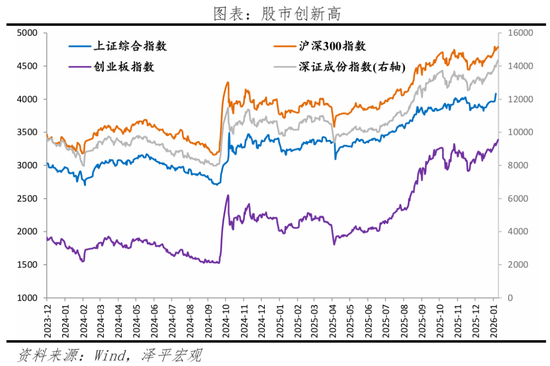
Core Viewpoint - A new bull market has begun since September 24, 2024, driven by significant policy easing, abundant liquidity, and a new wave of technological revolution, termed the "Confidence Bull" [2][31][34]. Group 1: Characteristics of the Bull Market - This bull market is described as a once-in-a-decade event, comparable to previous major bull markets in 2004-2007 and 2014-2015, with the current market driven by policy easing and technological advancements [4][34]. - The bull market has already seen substantial gains, with the Shanghai Composite Index rising by 45.5% and the ChiNext Index by 109.8% from September 24, 2024, to January 12, 2026 [7][35]. - Trading volume has surged from a few hundred billion before September 2024 to over 3 trillion recently, indicating a significant increase in market activity [9][37]. Group 2: Drivers of the Bull Market - The bull market is supported by three main drivers: continuous policy easing, a new technological revolution, and abundant liquidity, creating a combination of policy, technology, and liquidity-driven confidence [11][37]. - Policy easing has included interest rate cuts, relaxed housing market restrictions, and substantial fiscal measures, which have significantly boosted market risk appetite [38]. - The technological revolution is characterized by advancements in artificial intelligence, semiconductors, robotics, and innovative pharmaceuticals, leading to a strong performance in high-risk growth sectors [12][38]. Group 3: Historical Missions of the Bull Market - The bull market is expected to support the development of new productive forces, assist in major power competition, and repair household balance sheets, highlighting its strategic importance [15][41]. - It aims to provide capital market support for new economy sectors, which often struggle to secure financing through traditional banking systems [41]. - The bull market is also seen as a means to counteract the negative wealth effects from the real estate market downturn, with the A-share market's value increasing from under 70 trillion to over 100 trillion, creating a wealth effect of over 30 trillion [16][42]. Group 4: Future Outlook - The sustainability of the bull market will depend on continued macroeconomic policy easing, including further interest rate cuts and fiscal measures to stimulate demand [44]. - There is a need for effective regulation of leverage in the market to ensure healthy development, given the characteristics of the A-share market, which is primarily retail investor-driven [45][46]. - The potential for a long-term bull market could significantly impact the recovery of consumer spending and the real estate market, particularly in major cities [42][44].
国内高频 | 工业生产边际改善(申万宏观·赵伟团队)
赵伟宏观探索· 2026-01-12 16:04
Group 1: Industrial Production - The operating rate of blast furnaces has improved slightly, with a week-on-week increase of 0.4% and a year-on-year rise of 1.3 percentage points to 2.2% [1][4] - Apparent steel consumption has decreased, with a week-on-week decline of 0.6% and a year-on-year drop of 1.5 percentage points to 0.6% [1][6] - Steel social inventory continues to decline, with a week-on-week decrease of 2.5% [1] Group 2: Chemical and Automotive Industries - In the chemical sector, the operating rate of soda ash has significantly increased, with a week-on-week rise of 4.4% and a year-on-year increase of 0.2 percentage points to -2.2% [10][11] - The operating rate of PTA has also improved, with a week-on-week increase of 3.2% and a year-on-year rise of 4.1 percentage points to -4.2% [10][14] - The automotive sector shows weaker performance, with the operating rate of semi-steel tires declining by 2.4% week-on-week and a year-on-year drop of 2.8 percentage points to -13% [10] Group 3: Construction Industry - The cement production and demand have marginally improved, with a week-on-week increase in grinding operating rate of 2.1% and a year-on-year rise of 5.2 percentage points to 9.9% [22][23] - Cement shipment rates have slightly decreased, with a week-on-week decline of 1.5% and a year-on-year increase of 1.9 percentage points to 0.5% [22][26] - Cement inventory continues to decline, with a week-on-week decrease of 0.5% and a year-on-year increase of 0.9 percentage points to 1.3% [22][29] Group 4: Demand Tracking - The average daily transaction area of commercial housing in 30 major cities has decreased by 47.4% week-on-week and a year-on-year drop of 13.6 percentage points to 38.4% [44][45] - The transaction volume in first-tier and second-tier cities remains weak, with week-on-week declines of 30.8% and 61.9% respectively [44][48][51] - Port cargo throughput has also declined, with a year-on-year decrease of 3.6 percentage points to -0.4% [56][63] Group 5: Price Tracking - Agricultural product prices show differentiation, with vegetable and fruit prices decreasing by 0.9% and 0.2% respectively, while egg prices increased by 1.4% [98][99] - The industrial product price index has risen by 1.7% week-on-week, with the energy and chemical price index increasing by 0.7% and the metal price index rising by 3.9% [110][111]

月度前瞻 | 再议宏微观“温差”(申万宏观·赵伟团队)
申万宏源宏观· 2026-01-12 09:31
Group 1 - The core viewpoint of the article discusses the economic "temperature difference" at the end of 2025, highlighting a divergence between macro indicators like PMI and micro indicators such as production and consumption [2][10][115] - At the end of 2025, production indicators such as high furnace operation and PTA operation showed a decline, while manufacturing PMI increased by 0.9 percentage points to 50.1% in December [2][10][115] - Consumer high-frequency indicators further declined at the end of 2025, but the overall consumer goods industry PMI rose to a prosperous zone, increasing by 1 percentage point to 50.4% in December [20][10][115] Group 2 - Investment indicators such as asphalt operation rates and cement shipment rates did not show significant improvement, yet the construction industry PMI surged by 3.2 percentage points to 52.8% at the end of 2025 [3][32][10] - The article identifies that the economic growth momentum is shifting, with new momentum areas lacking high-frequency indicators contributing more to the economy [4][44][10] - The service consumption sector, which lacks tracking indicators, has shown significant improvement, contrasting with the consumer goods sector facing "demand overdraft risks" [4][56][10] Group 3 - The article anticipates that service consumption and new infrastructure investments will support the economy at the beginning of 2026, despite pressures on commodity consumption due to the decline of the "old-for-new" policy [6][78][10] - The easing of the debt issuance effect is expected to lead to a rebound in broad infrastructure and service investment at the beginning of 2026 [7][82][10] - The delayed Spring Festival in 2026 is projected to extend the "export rush" window, potentially boosting January export figures [8][105][10] Group 4 - The overall economic situation at the end of 2025 remains within a reasonable range, with a projected GDP growth of around 4.4% for the fourth quarter [8][110][10] - The article concludes that the divergence in macro and micro indicators is primarily due to different recovery paces in economic structures, with policies leaning towards service consumption and new infrastructure investments expected to bolster the economy [8][110][10]

国内高频 | 工业生产边际改善(申万宏观·赵伟团队)
申万宏源宏观· 2026-01-12 09:31
Group 1: Industrial Production - The operating rate of blast furnaces improved slightly, with a week-on-week increase of 0.4% and a year-on-year rise of 1.3 percentage points to 2.2% [1][4] - Apparent steel consumption decreased by 0.6% week-on-week and fell by 1.5 percentage points year-on-year to 0.6% [1][6] - Steel social inventory continued to decline, down 2.5% week-on-week [1] Group 2: Chemical and Automotive Industries - In the chemical sector, the operating rate of soda ash increased significantly by 4.4% week-on-week and rose by 0.2 percentage points year-on-year to -2.2% [10][11] - The operating rate of PTA rose by 3.2% week-on-week and increased by 4.1 percentage points year-on-year to -4.2% [10][14] - The operating rate of polyester filament increased by 0.4% week-on-week and rose by 3 percentage points year-on-year to 4.8%, while the operating rate of automotive semi-steel tires showed weakness, down 2.4% week-on-week and falling by 2.8 percentage points year-on-year to -13% [10][18] Group 3: Construction Industry - The cement production and demand showed marginal improvement, with the national grinding operating rate increasing by 2.1% week-on-week and rising by 5.2 percentage points year-on-year to 9.9% [22][23] - Cement shipment rate decreased by 1.5% week-on-week but increased by 1.9 percentage points year-on-year to 0.5% [22][26] - The cement inventory ratio continued to decline, down 0.5% week-on-week and up 0.9 percentage points year-on-year to 1.3% [22][30] Group 4: Demand Tracking - The average daily transaction area of commercial housing in 30 major cities decreased by 47.4% week-on-week and fell by 13.6 percentage points year-on-year to 38.4% [44][45] - The transaction volume in first-tier and second-tier cities was significantly weaker than the previous year, with first-tier cities down 30.8% week-on-week and 12.7 percentage points year-on-year to 44.5%, and second-tier cities down 61.9% week-on-week and 15.8 percentage points year-on-year to 29.8% [44][48][51] - The freight volume related to domestic demand showed a decline, with railway freight volume down 5.9 percentage points year-on-year to -10.3% and highway freight traffic down 8.4 percentage points year-on-year to -9.7% [56][58] Group 5: Price Tracking - Agricultural product prices showed differentiation, with vegetable and fruit prices decreasing by 0.9% and 0.2% respectively, while egg prices increased by 1.4% [98] - The industrial product price index rose by 1.7% week-on-week, with the energy and chemical price index increasing by 0.7% and the metal price index rising by 3.9% [110][114]