无人驾驶技术

Search documents
文远知行上涨2.2%,报8.319美元/股,总市值23.67亿美元
Jin Rong Jie· 2025-07-07 14:23
Core Insights - WeRide (文远知行) is a leading autonomous driving technology company, recognized for its innovative solutions and significant market presence [1][2]. Financial Performance - As of March 31, 2025, WeRide reported total revenue of 72.437 million RMB, reflecting a year-on-year growth of 1.77% [1]. - The company experienced a net loss attributable to shareholders of 385 million RMB, which represents a year-on-year increase of 17.73% [1]. Upcoming Events - WeRide is scheduled to disclose its mid-year financial report for the fiscal year 2025 on August 20, 2023 [1]. Company Overview - WeRide, established in 2017 and registered in the Cayman Islands, operates through its domestic entity and has conducted autonomous driving research, testing, and operations in 30 cities across 7 countries [1]. - The company has been operational for over 1,600 days and holds autonomous driving licenses in China, the USA, the UAE, and Singapore, making it a unique player in the industry [1]. Product and Service Offerings - WeRide has developed a comprehensive product matrix that includes Robotaxi, Robobus, Robovan, Robosweeper, and Advanced Driving Solutions, catering to various sectors such as smart mobility, smart logistics, and smart sanitation [2]. - The company is recognized for its commercial revenue leadership among global peers in the autonomous driving sector [2]. Strategic Partnerships - WeRide has established strategic partnerships with several top global manufacturers and suppliers, including the Renault-Nissan-Mitsubishi Alliance, Yutong Group, GAC Group, and Bosch [2]. Industry Recognition - In 2023, WeRide was ranked eighth on Fortune's list of companies changing the world, making it the only Chinese company to enter the top ten [2].

小马智行20250703
2025-07-03 15:28
Summary of the Conference Call for Xiaoma Zhixing Company Overview - Xiaoma Zhixing plans to expand its autonomous vehicle fleet to 1,000 units by the end of 2025, enhancing network effects, reducing passenger wait times, increasing order volume, and raising per-kilometer charges, which will benefit revenue growth [2][4][25] - The cost of the seventh-generation vehicle has significantly decreased to several hundred thousand RMB, thanks to advancements in algorithms and software, utilizing NVIDIA Orin X chips and more efficient algorithms, reducing reliance on high-performance LiDAR [2][5] Key Points and Arguments - **Profitability Model**: Xiaoma Zhixing believes that achieving a single-vehicle profitability model is crucial for scaling operations. The company expects to quickly reach single-vehicle profitability with the deployment of the seventh-generation vehicle, attracting leasing companies to take on robotaxi assets [2][6][15] - **Operational Safety**: The company operates in four major cities (Beijing, Shanghai, Guangzhou, Shenzhen) with a coverage area of over 2,000 square kilometers, achieving safety levels ten times higher than human drivers, capable of operating safely in various weather conditions 24/7 [2][9] - **Remote Driving Risks**: Xiaoma Zhixing rejects remote driving due to risks of signal instability and potential hacking, insisting on relying solely on the vehicle's algorithms and sensor hardware for operation to ensure safety [2][11] - **Licensing Achievements**: The company has obtained autonomous driving licenses in Beijing, Guangzhou, and Shenzhen, and a free open license in Shanghai, demonstrating compliance with regulations through quantitative metrics [2][21] Market Strategy - **Market Penetration**: The company plans to initially target lower-tier cities while gradually penetrating second-tier cities, focusing on overseas markets but currently adopting a testing and R&D strategy due to the lack of stringent regulations outside China and the U.S. [3][17][22] - **Operational Cost Structure**: The operational costs for Xiaoma Zhixing's robotaxi include depreciation, rental fees, charging costs, maintenance, cleaning, remote assistance, insurance, and parking fees, with the seventh-generation vehicle expected to have significantly lower per-kilometer costs compared to human-operated taxis [19] Competitive Advantages - **Comparison with Tesla**: Xiaoma Zhixing claims several advantages over Tesla's RoboTaxi, including a larger fleet in major cities, no user restrictions, broader operational area, capability to operate in various weather conditions, and no reliance on remote control or safety personnel [12][14][13] Future Outlook - **Fleet Expansion Plans**: The company aims to increase vehicle numbers in existing cities to improve density and reduce wait times, with plans to expand into more first-tier cities by 2026, while avoiding immediate entry into second-tier cities due to greater commercial potential in first-tier cities [25]
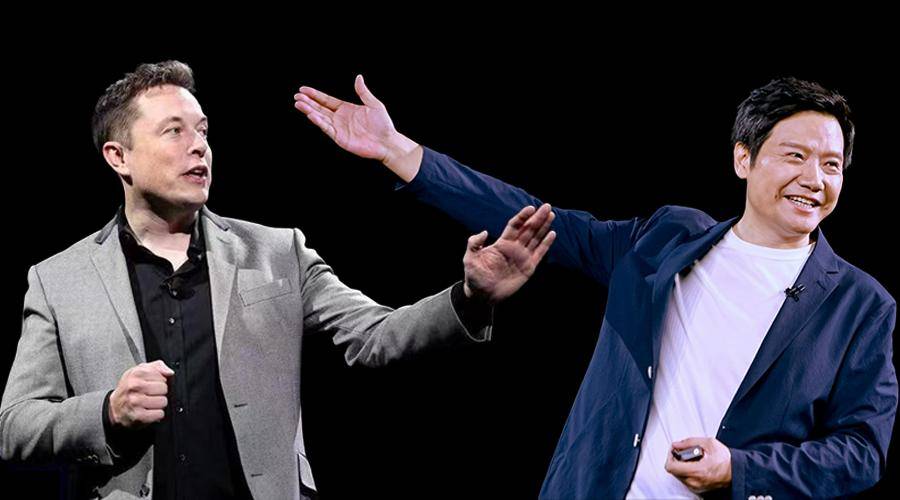
雷军距离马斯克有多远?
Sou Hu Cai Jing· 2025-07-01 08:13
Core Insights - Xiaomi's YU7 SUV is positioned as a direct competitor to Tesla's Model Y, with a starting price of 253,500 RMB, only 10,000 RMB cheaper than Model Y [4][16] - The initial demand for YU7 is significant, with over 200,000 pre-orders within three minutes and 240,000 within 18 hours, indicating a strong market entry [4][14] - Tesla is facing challenges in maintaining its market dominance due to increasing competition from Chinese manufacturers like Xiaomi, especially in key markets such as China and Europe [16][17] Company Analysis - Xiaomi's YU7 launch has generated considerable attention, with comparisons to Tesla's Model Y and discussions about its potential impact on Tesla's market share [3][5] - The company aims to deliver 350,000 vehicles this year, with the YU7 being a crucial part of this strategy [8][14] - Xiaomi's future plans include expanding into international markets by 2027, which could further challenge Tesla's position [15][17] Industry Trends - The automotive industry is witnessing a shift with increased competition from Chinese manufacturers, leading to a decline in Tesla's sales in Europe and China [16] - Tesla's sales in Europe dropped by 27.9% in May, highlighting the impact of competition from companies like BYD and SAIC [16] - The introduction of lower-priced models by Tesla, such as the potential Model Y "Youth Edition," is seen as a necessary response to the competitive pressure from Xiaomi and other Chinese automakers [18]



新能源行业出清进行时 又一只主题基金“退场”
Zheng Quan Shi Bao· 2025-06-25 22:11
Group 1 - A total of four new energy-themed funds have been liquidated this year, all of which are initiated funds that failed to pass the scale test after three years due to performance losses [1][2] - The recently liquidated fund, Baoying New Energy Industry Mixed Fund, was established in May 2022 and experienced a decline of over 54% during the three-year downturn in the new energy sector [1] - As of the end of the first quarter this year, the fund's heavy holdings included stocks such as CATL, Sungrow Power Supply, and EVE Energy [1] Group 2 - The funds that have been liquidated this year, including Changcheng New Energy and Wanji New Energy Theme Fund, triggered liquidation clauses due to their asset scale falling below 200 million yuan after three years [2] - Currently, there are 45 actively managed equity funds with "new energy" in their names, of which only 22 have positive performance since inception, many established before 2020 [2] - Some new energy-themed funds have seen significant declines, with several products dropping over 40%, primarily those launched at market highs in 2021 [2] Group 3 - Multiple public funds believe that solid-state batteries may present investment opportunities, driven by positive policy attitudes and market demand since the introduction of new national standards for power batteries [3] - EV Tank projects that by 2030, the global shipment of solid-state batteries will reach 614.1 GWh, with a market size exceeding 250 billion yuan [3] - The demand for lithium batteries is expanding into various fields, including energy storage and AI, with solid-state batteries seen as a key technology upgrade for the future [3]
文远知行上涨2.4%,报7.69美元/股,总市值21.88亿美元
Jin Rong Jie· 2025-06-23 13:53
Core Viewpoint - WeRide (文远知行) is a leading global autonomous driving technology company, achieving significant growth in revenue and net profit while expanding its operational footprint across multiple countries and cities [1][2]. Financial Performance - As of March 31, 2025, WeRide reported total revenue of 72.437 million RMB, representing a year-on-year growth of 1.77% - The company recorded a net loss attributable to shareholders of 385 million RMB, which is an increase of 17.73% year-on-year [1]. Company Overview - WeRide, established in 2017 and registered in the Cayman Islands, operates through its domestic entity in China and has conducted autonomous driving research, testing, and operations in 30 cities across 7 countries [1]. - The company has been operational for over 1,600 days and is the only technology firm holding autonomous driving licenses in China, the USA, the UAE, and Singapore [1]. Product and Service Offerings - WeRide focuses on developing safe and reliable autonomous driving technologies, with applications in smart mobility, smart logistics, and smart sanitation [2]. - The company has entered the commercial operation phase of autonomous driving, leading the global market in revenue among similar enterprises, and offers a product matrix that includes Robotaxi, Robobus, Robovan, Robosweeper, and Advanced Driving Solutions [2]. Strategic Partnerships - WeRide has established strategic partnerships with several top global manufacturers and suppliers, including the Renault-Nissan-Mitsubishi Alliance, Yutong Group, GAC Group, and Bosch [2]. Recognition - In 2023, WeRide was ranked eighth on Fortune's list of companies changing the world, making it the only Chinese company to break into the top ten [2].
特斯拉Robotaxi上路接单,邀请制内测、“一口价”4.2美元、配安全员
Bei Jing Shang Bao· 2025-06-23 07:54
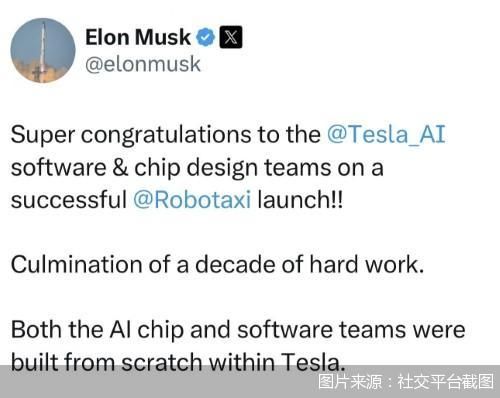
多次爽约的特斯拉Robotaxi终于上线。当地时间6月22日,特斯拉在得州奥斯汀市正式推出无人驾驶出 租车Robotaxi服务,约10辆焕新Model Y作为首批无人驾驶出租车投入使用,并开始接送首批乘客。特 斯拉CEO埃隆·马斯克在社交媒体上表示:"这是大家十年来辛勤工作的成就,特斯拉人工智能芯片和软 件团队是在特斯拉内部从零开始创立的。" 据了解,此次特斯拉Robotaxi首批用户试乘采用邀请制,受邀用户可通过"Tesla Robotaxi"App呼叫 Robotaxi,如果用户拥有特斯拉账户,在上车前Robotaxi将自动同步用户的车辆设置,如支付信息、媒 体、娱乐、应用等,提供个性化的体验。 在收费方面,目前使用特斯拉Robotaxi的单次费用采用"一口价"模式,固定为4.2美元(约合30元人民 币),服务覆盖得州奥斯汀市南部区域,运行时间为早6时至晚12时。值得一提的是,尽管此前特斯拉 方面曾承诺Robotaxi将实现完全无人驾驶,但根据特斯拉投资人索耶·梅里特在社交平台上发布的一段约 13分钟的特斯拉Robotaxi体验视频,车辆驾驶位为无人状态,但前排乘客座位上配备安全员。 对此,业内人士表示, ...
库萨科技完成数千万元Pre-A轮融资:已实现L4级机器人量产及全国20城部署
IPO早知道· 2025-06-19 02:22
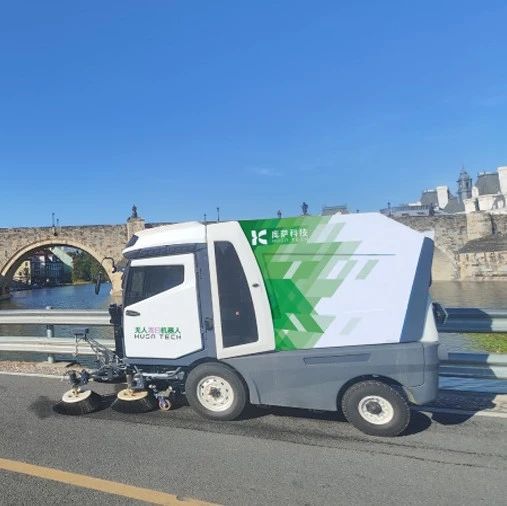
Core Viewpoint - Kusa Technology is focused on developing and deploying autonomous cleaning robots, aiming to enhance urban sanitation efficiency and reduce operational costs significantly [2][8]. Company Overview - Kusa Technology, established in June 2023, has completed several funding rounds, including a recent Pre-A round raising several million yuan led by Jinshui Lake Venture Capital [2][3]. - The company has successfully developed its first autonomous cleaning robot, Kusa Xingjun® S1, which began operations in urban roads in Q4 2023, followed by the launch of Kusa Xingjie® in the subsequent year [3]. Product and Technology - Kusa Technology's robots operate at twice the efficiency of the industry average and have been deployed in over 20 regions across major provinces such as Beijing, Shanghai, and Guangdong [3]. - The core technology of Kusa Technology lies in its comprehensive embodied robot technology architecture, integrating an AI vision-based multimodal perception system [4]. - The robots utilize a self-developed closed operating system, enabling them to understand their environment in open road scenarios and execute cleaning tasks with centimeter-level precision [4][5]. Operational Efficiency - The intelligent cloud control platform of Kusa Technology features dynamic task scheduling and integrates a Multi-Agent data closed-loop system, significantly reducing operational costs by 50% compared to traditional methods [5]. - The company aims to provide a comprehensive solution for unmanned operations throughout the equipment lifecycle, focusing on the sanitation sector as its primary commercial application [5]. Market Potential - Investors express confidence in Kusa Technology's strategic value in reshaping urban services, highlighting its ability to lower operational costs by over 40% and its rapid deployment across 20 cities within two years [8]. - The introduction of autonomous cleaning robots is seen as a means to alleviate labor intensity in the sanitation industry, enhancing safety and precision in operations [9]. Future Plans - Kusa Technology plans to launch new cleaning robot products this year to cover more sanitation scenarios, indicating a commitment to continuous product iteration and market expansion [6].
重卡行业无人驾驶应用现状及趋势展望
2025-06-15 16:03
Summary of Key Points from the Conference Call Industry Overview - The conference call discusses the current status and future trends of the **autonomous driving technology** in the **heavy truck industry**, particularly focusing on its applications in various sectors such as mining, logistics, and sanitation [1][2]. Core Insights and Arguments Autonomous Driving in Mining - Autonomous driving technology has transitioned from small-scale pilot projects before 2022 to large-scale implementation in mining operations, with approximately **3,000 autonomous mining trucks** currently in the domestic market, of which over **2,400** are in operation, resulting in a penetration rate of about **7%** [2][10]. - The market is expected to reach a **10% penetration rate** within the next three years, primarily in large open-pit mines, while other types of mines face challenges due to high transformation costs and limited effectiveness [11]. - Over **90%** of new mining trucks sold are electric, with preferences varying by region; hybrid models are favored in harsh environments, while pure electric models are preferred in milder southern regions [14]. Autonomous Driving in Ports - Port applications utilize traditional technologies like **AGV** and **PVR**, enhancing logistics efficiency and reducing labor costs. Key players include **Feiyu Technology** and **Huawei**, with the market experiencing continuous growth [4]. Autonomous Driving in Logistics - The trunk logistics sector has not yet achieved large-scale commercial operation, although the technology is ready. Companies like **Hidi** are exploring convoy operation modes to reduce costs and improve efficiency [5][18]. - The delivery sector has reached **L4** level automation, primarily in end-delivery scenarios, with companies like **New Stoneware** and **White Rhino** nearing this level of automation [6]. Sanitation Industry Applications - In the sanitation sector, autonomous vehicles operate on fixed routes for short-distance cleaning tasks, with a focus on project contracting for comprehensive service delivery. Notable companies include **Kuwah Technology** and **Wenyan Zhixing** [7]. Additional Important Insights - The **market share** of leading companies in the autonomous heavy truck sector shows **Yikong Zhijia** holding approximately **50%** of the market, while **CD Zhijia** and **Tage Zhijia** follow with significantly lower shares due to recent safety incidents [26]. - The **engineering operation model** is viewed as a more favorable business model for rapid market penetration and long-term customer relationships, as it alleviates the financial burden on clients [20][22]. - The **integration of autonomous driving kits** with existing vehicle models requires customized development to ensure optimal performance, highlighting the importance of collaboration between technology providers and manufacturers [23][24]. Future Outlook - The key factor for the growth of the autonomous heavy truck market in the next **3-5 years** is expected to be **policy changes** rather than technological limitations. Current regulations are stringent due to past safety incidents, but as policies evolve, the market could see significant expansion [27].
高盛“无人驾驶”深度报告:汽车保险将重大变革 ,事故频率、理赔分布和法律责任都会改变
Hua Er Jie Jian Wen· 2025-06-10 02:51
Group 1 - The core viewpoint of the articles is that the autonomous driving technology is transitioning from a proof-of-concept phase to a commercial phase, which is expected to create significant profit pools in shared mobility, freight, and insurance sectors [1][2]. - The North American Robotaxi market has officially entered the commercialization stage, with projections indicating that the U.S. autonomous driving shared mobility market will reach $7 billion by 2030, accounting for 8% of the total market [1]. - The global auto insurance market, valued at over $400 billion, is anticipated to undergo disruptive changes due to a decrease in accident frequency, leading to shifts in claims distribution and legal liability [1][2]. Group 2 - The U.S. auto insurance market is currently valued at $432 billion, representing 41% of the property and casualty insurance market [2]. - Despite the gradual penetration of autonomous driving technology, the insurance market is expected to maintain moderate actual growth over the next 10-15 years, driven by an increase in vehicle numbers and rising claims costs, which are above inflation levels but partially offset by declining accident frequency [2]. - Long-term, autonomous driving technology is likely to significantly reduce accident frequency, particularly those caused by human error, shifting insurance products from a "frequency-driven" model to a "severity-driven" model, where fewer accidents occur but the cost per incident is higher [2]. Group 3 - Current advancements in technology, such as Advanced Driver Assistance Systems (ADAS), have begun to lower accident rates, with L2-level technologies reducing collision accident frequency by 14.4% and bodily injury accident frequency by 23.2% [3]. - Data from Waymo indicates that its vehicles have an accident rate that is 83% lower for airbag-deploying incidents and 81% lower for injury incidents compared to human drivers in cities like San Francisco and Phoenix [3]. - However, the complexity of these technologies has led to increased repair costs, resulting in the severity of claims (cost per incident) remaining consistently above inflation levels [3]. Group 4 - As autonomous driving technology permeates the auto insurance sector, the distribution of legal liability may shift from individuals to manufacturers or technology providers [4]. - This shift could alter the distribution of claims costs between physical damage insurance and liability insurance, prompting insurance products to transition towards product liability and cybersecurity insurance [4]. - Existing insurance companies that do not proactively develop relevant capabilities may fall behind in future competition, while automotive manufacturers like Tesla, General Motors (GM), and Rivian are beginning to enter the insurance business, seeking to capture market share but needing to demonstrate their underwriting capabilities [4].
中国共享电单车行业研究报告
艾瑞咨询· 2025-06-06 07:07
Core Insights - The shared electric bike industry is experiencing upward momentum driven by government support and market demand, with a focus on establishing a unified national market and breaking down local barriers [1][24][80] - Competition is intensifying among national brands, with a few key players like Qingju, Meituan, and HelloBike emerging as market leaders due to their scale and operational efficiency [2][27][83] - Young consumers, particularly those aged 16-34 in lower-tier cities, are becoming the backbone of the shared electric bike market, driven by the need for convenient commuting options [3][46] - The introduction of national standards for electric bikes is crucial for industry regulation, product quality enhancement, and technological innovation [4][16][21] - Advancements in autonomous driving technology are expected to address operational challenges and reshape the industry landscape [5][89] Market Dynamics - The shared electric bike industry is characterized by heavy asset investment and faces challenges across various operational aspects, including technology development and supply chain management [2][30] - The market is transitioning from a phase of rapid expansion to one of differentiation, with weaker brands exiting and stronger ones consolidating their positions [2][27] - The demand for shared electric bikes is supported by a growing economy and increasing consumer spending on transportation, with a projected 8.9% increase in transportation-related expenditures in 2024 [7][24] User Insights - User satisfaction with shared electric bikes is high, with an average satisfaction score of 8.5, particularly regarding the ease of use in key processes like scanning, riding, and payment [3][73] - The primary user demographic is young adults aged 16-34, predominantly in lower-tier cities, where shared bikes are seen as a vital supplement to public transport [3][46][56] - The average riding distance is approximately 2.91 kilometers, with peak usage times occurring in the evening [60][53] Technological Advancements - The new national standards for electric bikes emphasize safety and innovation, requiring features like real-time communication and dynamic monitoring capabilities [16][17] - The integration of technologies such as AI and autonomous driving is anticipated to enhance operational efficiency and user experience [5][89] Policy Environment - Government policies are increasingly supportive of the shared electric bike industry, promoting green transportation and facilitating market entry for new players [21][80] - The establishment of a unified market standard is expected to enhance regulatory clarity and encourage further investment in the sector [1][80] Competitive Landscape - The industry is witnessing a shift towards national scale brands that leverage operational efficiency and technological advancements to gain market share [2][83] - Companies are focusing on product innovation and user experience to differentiate themselves in a crowded market [87][85] Future Trends - The shared electric bike industry is poised for growth, driven by technological innovations, supportive policies, and evolving consumer preferences for sustainable transportation options [89][87]