
猪周期

Search documents
消费品 “药食同源”系列电话会议
2025-12-08 00:41
Summary of Conference Call Notes Industry Overview - The conference call primarily discusses the **pork industry** and **liquor market**, focusing on the challenges faced by the pig farming sector and the dynamics of the liquor market, particularly **Kweichow Moutai**. Key Points on the Pork Industry - **Oversupply and Weak Demand**: The pork price has declined due to oversupply and weak consumer demand, with a 5% year-on-year increase in the number of pigs slaughtered in the first three quarters of 2025, but the slaughter volume growth is significantly lower than previous years [1][2]. - **Losses Across All Categories**: All categories of pigs (commercial, piglets, and breeding sows) are experiencing losses, leading to accelerated capacity reduction [1][4]. - **Self-breeding Model Struggles**: The self-breeding model is facing severe losses, with cash flow pressures on some enterprises [1][5]. - **Slow Capacity Adjustment**: The speed of capacity adjustment is slower than expected, with limited reduction in the number of breeding sows in November [1][7][8]. - **Changing Cycle Characteristics**: The characteristics of the pig cycle are changing, with shorter cycles and reduced volatility. The ability to quickly adjust capacity is limited due to improved epidemic prevention capabilities and high fixed asset standards [1][9][10]. - **Cost Reduction Focus**: The industry is entering a phase of cost reduction and efficiency improvement, with leading companies expected to gain cost advantages [1][10]. - **Investment Recommendations**: Companies such as Muyuan, Wens Foodstuff, Tiankang Biological, and Dekang Agriculture are recommended for investment due to their potential for value recovery [1][11]. Key Points on the Liquor Market - **Kweichow Moutai Price Decline**: The price of Kweichow Moutai has recently dropped by approximately 100 yuan, primarily due to changes in supply and demand dynamics, with increased supply from manufacturers and weak seasonal demand [1][12]. - **Future Price Expectations**: Prices are expected to remain low in the first quarter of 2026, with fluctuations around the low point throughout the year [1][12]. - **Market Dynamics**: The liquor market has seen a shift since the third quarter, with companies reducing growth rates to relieve pressure. The second quarter of next year is anticipated to see a release of pressure on financial reports, with a potential turning point in the third quarter [1][13][14]. Additional Insights - **Consumer Goods Sector**: The consumer goods sector is expected to see improvements in pricing stability and competitive dynamics, with specific recommendations for companies like Anjijia Foods and Yili Group [1][15]. - **Medical Device Sector**: The medical device sector is entering a low growth phase, with expectations of growth rates remaining below 5% in the coming years [1][16][18]. This summary encapsulates the critical insights from the conference call, highlighting the challenges and opportunities within the pork and liquor markets, as well as broader consumer goods and medical device sectors.

格林大华王骏:全球经济增长面临多重挑战,抓住长周期趋势进行资产配置能提升投资胜率
Qi Huo Ri Bao· 2025-12-06 23:57
Group 1: Key Events Impacting the Futures Market - The series "Futures Discussion - 2025 Futures Industry Review" aims to provide insights into the 2025 futures market and its key events, with a focus on macro to micro analysis and future planning for 2026 [2] - A significant event in 2025 was the global tariff war initiated by Trump in early April, which led to the largest price drop for many commodities throughout the year, providing purchasing opportunities for physical enterprises [2] Group 2: Global Economic Growth Challenges - According to IMF and OECD forecasts, global economic growth is expected to slow to around 3.1% in 2025, marking the lowest level in five years, with developed economies struggling while emerging markets, particularly in the Asia-Pacific region, contribute 60% of global growth [3] - The economic policies of different regions are diverging, with the US, Europe, and the UK entering a rate-cutting cycle, while Japan plans to raise rates, and countries like Turkey and Argentina are increasing rates due to high inflation [3] - China's economy shows resilience with a GDP growth of 5.2% in the first three quarters, but a continuous PMI index below the threshold indicates weak consumer demand, suggesting potential stimulus measures in 2026 [3] Group 3: Geopolitical Conflicts and Commodity Price Volatility - Geopolitical conflicts in various regions in 2025 have led to significant volatility in commodity prices, increased supply chain costs, and heightened market risk aversion [4] - The situation in the Middle East has affected container shipping rates, oil, and gold prices, while the Russia-Ukraine conflict has caused energy price fluctuations and disruptions in grain transport, raising food prices [4] Group 4: Development Opportunities from the 14th Five-Year Plan - The "14th Five-Year Plan" emphasizes high-quality development and technological self-reliance, which will have a profound impact on the futures market by enhancing the underlying market for futures [5] - New infrastructure and industrial development are expected to boost demand for raw materials like steel and non-ferrous metals, while technological advancements will drive demand for new materials such as lithium carbonate and platinum [5] Group 5: AI Demand and Energy Transition - In 2025, global investments in AI data centers and chip industries reached $2.9 trillion, with new AI-driven demands promoting green energy development and altering energy consumption structures [6] - The share of green energy in traditional energy provinces has reached 50%, leading to increased demand for silver, aluminum, copper, and polysilicon [6] - The traditional pig cycle has shortened from around 40 months to 15-20 months due to enhanced breeding scale, necessitating attention to breeding stock and production efficiency [6] Group 6: Futures Tools Supporting the Real Economy - The performance of the non-ferrous metals sector in 2025 was notably influenced by the tariff war, which provided hedging opportunities for companies to lock in low raw material prices [7] - The focus on AI development is shifting from investment to application scenarios, which will become a new direction for capital market growth in 2026 [7] - Understanding long-term economic cycles can enhance asset allocation strategies, making it easier for traders and companies to navigate investment decisions [7]


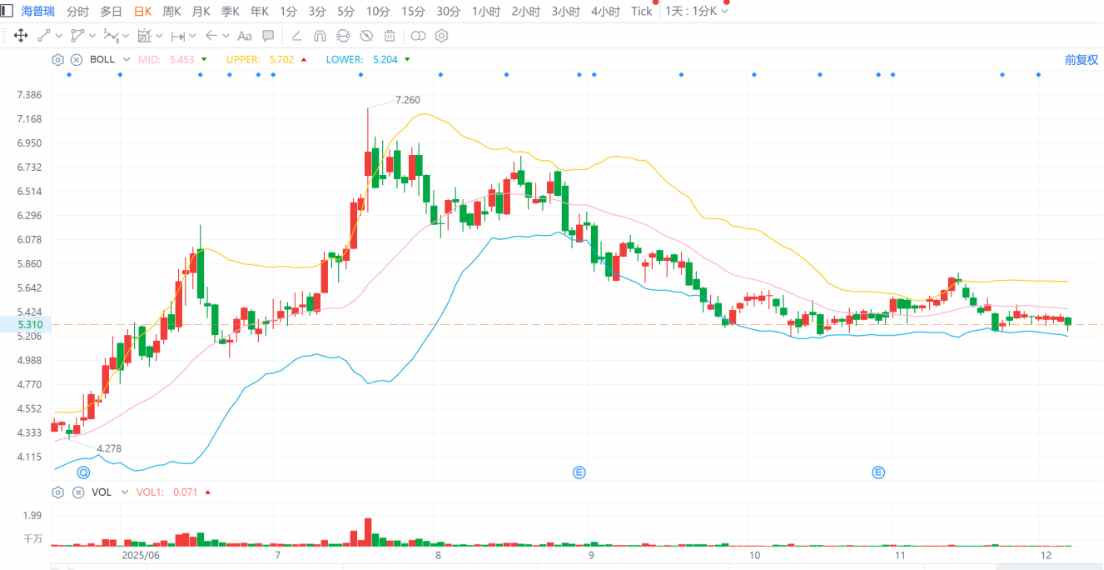
较A股折价60%,肝素即将走出下行周期海普瑞现抄底信号?
智通财经网· 2025-12-06 06:28
Financial Performance - In the first three quarters of 2023, the company reported revenue of 4.194 billion yuan, a year-on-year increase of 3.09% [1] - The net profit attributable to shareholders was 554 million yuan, a year-on-year decrease of 29.04% [1] Stock Market Reaction - Following the earnings report, the company's stock experienced a brief rally, achieving five consecutive days of gains from November 7 to November 13 [2] - However, this upward momentum did not lead to sustained price increases, and the stock entered a downward trend, declining over six trading days [2][4] Technical Analysis - The stock has been in a downward trend since late July, with a peak of 7.26 HKD on July 21, followed by a series of declines [3] - After the Q3 report, the stock saw a temporary rise but failed to maintain volume support, leading to a "false breakout" scenario [4] Market Sentiment and Trading Activity - During a period of low trading activity, there were signs of bottom-fishing by investors, particularly through the Hong Kong Stock Connect [6] - Recent trading data indicated that the proportion of shares held by Hong Kong Stock Connect investors reached 43.14% [9] Industry Context - The heparin industry is cyclical and closely tied to the pig farming cycle, with China being the largest supplier of heparin raw materials globally [11] - Historical data shows that heparin prices are highly sensitive to supply and demand changes, with significant price fluctuations observed in recent years [12] Future Outlook - The market anticipates a potential recovery in pig prices by mid-2024, which could positively impact the heparin market [12] - The company's A-share price has increased by 81.63% from its low point, while the Hong Kong stock remains undervalued compared to its A-share counterpart [13]

国投期货农产品日报-20251205
Guo Tou Qi Huo· 2025-12-05 11:06
Report Industry Investment Ratings - Douyi: ★★★, indicating a clearer upward trend and a relatively appropriate investment opportunity currently [1] - Doupo: ★☆☆, indicating a bullish bias, with a driving force for price increase but poor operability on the trading floor [1] - Douyou: ★★★, suggesting a clearer upward - trend and a relatively appropriate investment opportunity currently [1] - Palm oil: ★★★, suggesting a clearer upward trend and a relatively appropriate investment opportunity currently [1] - Caipo: ★☆☆, suggesting a bearish bias, with a driving force for price decline but poor operability on the trading floor [1] - Caiyou: ★☆☆, indicating a bearish bias, with a driving force for price decline but poor operability on the trading floor [1] - Corn: ★★★, suggesting a clearer upward trend and a relatively appropriate investment opportunity currently [1] - Live pigs: ★☆☆, suggesting a bearish bias, with a driving force for price decline but poor operability on the trading floor [1] - Eggs: ★☆☆, suggesting a bearish bias, with a driving force for price decline but poor operability on the trading floor [1] Core Views - The overall performance of agricultural products in the market shows different trends, with some products affected by supply - demand relationships, policies, weather, and other factors [2][3][4] - Different agricultural products have different price trends, and investment strategies should be adjusted according to the specific situation of each product [3][7][8] Summary by Related Catalogs Douyi - The main contract of Douyi shows a reduction in positions and a price decline. The spot price of domestic soybeans is stable and firm. The price of US soybeans is affected by South American weather and US soybean exports, and is expected to fluctuate strongly in the medium - term. Short - term attention should be paid to the policy and spot performance of domestic soybeans [2] Soybeans & Doupo - The price of Dalian Doupo futures fluctuates weakly. Attention should be paid to the December USDA global agricultural product supply - demand report. The 05 contract has not broken through the upper edge of the box. Whether it can break through upward in the medium - term depends on US soybean exports and the impact of the La Nina weather in South America. The strategy is to observe whether it can break through upward and look for long - entry opportunities later [3] Douyou & Palm oil - The market expects that the palm oil inventory in Malaysia in November is still increasing, with high inventory pressure. If the supply - side production reduction continues, the signal of a phased price bottom will be prominent, but the rebound strength is limited. The medium - term of Douyou also needs to pay attention to policy changes. The domestic soybean crushing profit is improving. The overall view of soybean and palm oil is range - bound, and short - term attention should be paid to the fundamentals of the oil market [4] Caipo & Caiyou - The Caisi market continues its weak trend, and the external rapeseed price is under pressure. The production of Canadian rapeseed in 2025 is estimated to be higher than expected, and the supply of the Caisi market has temporarily eased after Australian rapeseed arrives at the port. The domestic demand for Caisi is still weak, and the futures price of Caisi will continue to fluctuate weakly in the short - term [6] Corn - The Dalian corn futures C2601 contract rose 0.97% after rising and then falling, but the subsequent contracts lack upward momentum. The supply - demand mismatch in the corn market still exists. Future attention should be paid to the sales progress of new corn in the Northeast and the auction of overdue wheat. The 01 contract should be observed first, and the 03 and 05 contracts should wait for a pullback [7] Live pigs - Live pig futures are running weakly, and the 03 contract has hit a new low. The inventory of breeding sows in November continued to decline slightly month - on - month. The southern curing will gradually start, and the supply side has the pressure of fattening pigs for secondary fattening to be sold. In the medium - to - long - term, the pig price is likely to form a second bottom in the first half of next year [8] Eggs - Egg futures are slightly weak, and the spot price in most parts of the country has declined. The current supply pressure is high, and the forward - looking inventory decline expectation has ended. The 01 contract has a premium over the spot, and a short - selling strategy is recommended for the near - term contract [9]
国投期货农产品日报-20251204
Guo Tou Qi Huo· 2025-12-04 11:03
Report Industry Investment Ratings - **Bullish**: Soybean Meal, Eggs [1] - **Bearish**: None - **Neutral**: Soybean, Soybean Oil, Palm Oil, Rapeseed Meal, Rapeseed Oil, Corn, Live Pigs [1] Core Views - The overall outlook for agricultural products shows a mixed trend, with different factors influencing each commodity. The market is mainly affected by factors such as South American weather, exports, domestic supply and demand, and policies [2][3][4]. Summary by Commodity Soybean - The main contract of soybeans shows a reduction in positions and a decline in price. The domestic soybean spot price is stable and firm, while the US soybeans are expected to be volatile and bullish due to South American weather and export factors. Short - term attention should be paid to domestic policies and the spot market [2]. Soybean & Soybean Meal - Dalian soybean futures prices are weakly volatile. South American new - season Brazilian soybean sowing progress is normal, while Argentine soybean planting is slow due to weather. Domestic soybean supply is sufficient, but the profit of oil mill crushing is poor. Soybean meal inventory has returned to a high level, suppressing prices. Whether the 05 contract can break through the upper limit depends on US soybean exports and South American weather [3]. Soybean Oil & Palm Oil - Palm oil's rebound is restricted, and the market is in the process of position transfer. The market expects Malaysia's palm oil inventory to increase in November. If supply - side production cuts continue, the price may bottom out, but the rebound is limited by high inventory. For soybean oil, focus on policy changes, and the domestic soybean crushing profit is improving. Overall, the prices of soybean and palm oil are expected to fluctuate within a range [4]. Rapeseed Meal & Rapeseed Oil - Most rapeseed - related futures contracts declined, with only the near - month rapeseed meal contract being resistant to decline due to tight delivery resources. Rapeseed oil led the decline in the oil sector. Canadian rapeseed exports are weak, and its price is under pressure. The supply of rapeseed is expected to be more relaxed in the medium - term, and the short - term price of rapeseed - related products is under pressure but the decline space is limited [6]. Corn - Corn spot prices in the north and at northern ports remain firm, and futures are strong. Northeast new - grain supply is lower than expected, and there are concerns about supply and transportation. The 01 contract should be observed, while the 03 and 05 contracts should wait for a pull - back [7]. Live Pigs - Live pig futures and spot prices are weak, and the average spot slaughter price continues to decline. With the approaching of the winter solstice, southern curing will start, but there is also an exit pressure from second - fattened pigs. Historically, the bottom of the pig cycle often shows a double - bottom pattern, and it is expected that pig prices may form a second bottom in the first half of next year [8]. Eggs - The near - month January contract of eggs hit a new low, and the spot price is stable but weak. The long - position trend of the far - month contract is driven by the expectation of declining inventory, but the current valuation is high, and the spread between near - and far - month contracts is too large. The long - position trend is expected to end, and the near - month contract is bearish [9].
国投期货农产品日报-20251203
Guo Tou Qi Huo· 2025-12-03 01:20
1. Report Industry Investment Ratings - **Beans 1**: ☆☆☆, indicating a more distinct long - trend with a relatively appropriate investment opportunity currently [1] - **Soybean Meal**: ★☆☆, representing a bullish bias, with a drive for price increase but poor operability on the trading floor [1] - **Soybean Oil**: ★☆☆, suggesting a bullish bias, with a drive for price increase but poor operability on the trading floor [1] - **Palm Oil**: ★☆☆, meaning a bullish bias, with a drive for price increase but poor operability on the trading floor [1] - **Rapeseed Meal**: ★☆☆, showing a bullish bias, with a drive for price increase but poor operability on the trading floor [1] - **Rapeseed Oil**: ★☆☆, denoting a bullish bias, with a drive for price increase but poor operability on the trading floor [1] - **Corn**: ★☆☆, indicating a bullish bias, with a drive for price increase but poor operability on the trading floor [1] - **Live Pigs**: ★☆☆, representing a bullish bias, with a drive for price increase but poor operability on the trading floor [1] - **Eggs**: ★☆☆, suggesting a bullish bias, with a drive for price increase but poor operability on the trading floor [1] 2. Core Viewpoints - The prices of various agricultural products show different trends, mainly affected by factors such as supply and demand, weather, and policies. Most products are expected to fluctuate within a range, and investors are advised to pay attention to relevant information and market changes [2][5][7] 3. Summary by Related Catalogs 3.1 Beans 1 - Domestic soybeans are in short - term sideways consolidation, with stable spot prices and increasing domestic warehouse receipts. The price difference between domestic and imported soybeans has declined from a high level. The supply of high - protein domestic soybeans is tight, bringing a relatively strong expectation to the overall soybean market. US soybeans are mainly affected by South American weather and US soybean exports, and are expected to fluctuate strongly. Short - term attention should be paid to the performance of the domestic soybean spot market and policy guidance [2] 3.2 Soybean Oil & Palm Oil - US soybeans are affected by South American weather and exports, and are expected to fluctuate strongly. The domestic soybean near - term shipping schedule crushing gross profit has deteriorated again, supporting soybean oil. The domestic soybean - palm oil price difference has adjusted from a high level. Malaysian palm oil had a slight production cut in November, but demand was weak, and it is expected to accumulate inventory. Due to flood problems in Southeast Asian producing areas, the supply side was disturbed, and prices stopped falling and rebounded. Overall, it is expected that soybean and palm oil will maintain range fluctuations [3] 3.3 Soybeans & Soybean Meal - Today's soybean futures opened high and closed low, with prices fluctuating weakly. Brazil's soybean planting rate is 78% with normal progress, while Argentina's is slow due to less rainfall. The domestic soybean supply is sufficient, and the crushing volume has increased. The soybean meal inventory has rebounded to a high level, suppressing prices. The M2605 contract has risen to the upper edge of the shock platform, and the follow - up trend depends on US soybean exports and the impact of South American weather [5] 3.4 Rapeseed Meal & Rapeseed Oil - Today, the near - month main contract of rapeseed meal continued to decline with position reduction, and the main contract of rapeseed oil slightly declined. The arrival of Australian rapeseed in China eased the market's concern about the tight supply of rapeseed. Rapeseed meal demand is weak, and rapeseed oil is mainly in the process of de - stocking. The supply of rapeseed oil depends on Russian crushing and exports, and the demand benefits from the seasonal peak in the fourth quarter. Overall, the rapeseed series lacks trend - driving factors in the short term and is expected to fluctuate within a range [6] 3.5 Corn - The spot price of corn in the northern port remains firm, and Northeast farmers are reluctant to sell, resulting in lower - than - expected new grain supply. The quality of North China corn is poor, and the market favors high - quality Northeast grain, causing concerns about supply and transportation. The downstream corn inventory is generally very low, but the willingness to replenish inventory has increased. The new grain is still in the peak release period. In the short term, the Dalian corn futures 01 contract fluctuates at a high level, and the 03 and 05 contracts are waiting for a correction. In the medium term, the rebound range is limited, and a sharp rise in corn prices next year is not optimistic [7] 3.6 Live Pigs - The spot and futures prices of live pigs continue to weaken. With less than a month until the Winter Solstice, southern bacon - curing will gradually start, but there is also pressure on the supply side from the second - fattening of large hogs. The industry's average weight is still high, and there is a de - stocking process in the later stage. In the long - term, the bottom of the pig cycle often shows a "double - bottom" feature, and it is expected that pig prices may have a second bottom - probing in the first half of next year [8] 3.7 Eggs - The near - and far - month contracts of eggs show a differentiated trend, with a total increase of over 30,000 lots in positions. The far - month contracts are supported by the expectation of a decline in the laying - hen inventory in the medium - and long - term and have risen sharply. The near - month contracts are difficult to continue rising due to the premium of futures over spot prices and are trading the logic of price convergence. The current price difference between near - and far - month contracts is too large, and it is not recommended to chase the rise. Attention should be paid to the performance of the spot market for near - month contracts [9]
国投期货农产品日报-20251202
Guo Tou Qi Huo· 2025-12-02 11:09
1. Report Industry Investment Ratings - Beans (domestic): ☆☆☆ [1] - Soybean Meal: ☆☆☆ [1] - Soybean Oil: ☆☆☆ [1] - Palm Oil: ☆☆☆ [1] - Rapeseed Meal: ☆☆☆ [1] - Rapeseed Oil: ☆☆☆ [1] - Corn: ★☆☆ [1] - Live Pigs: ☆☆☆ [1] - Eggs: ☆☆☆ [1] 2. Core Views of the Report - The domestic soybean market is expected to be bullish in the short - term, while the US soybean market will likely oscillate with an upward bias, influenced by South American weather and export factors [2][3] - The soybean meal supply in the domestic market is ample, which exerts downward pressure on prices. The 05 contract's upward breakthrough depends on US soybean exports and potential South American production cuts [3] - The soybean and palm oil markets are expected to fluctuate within a range. Although there are some positive supply - side signals, high inventory levels may limit price rebounds [3] - The rapeseed market lacks trend - driving factors and is expected to trade in a range in the short term [5] - Corn futures are expected to remain volatile at high levels, with concerns about supply and transportation in the Northeast [6] - Live pig prices may form a double - bottom pattern, with a high probability of a second trough in the first half of next year [7] - The egg futures market shows a mixed performance, with the far - month contracts not suitable for chasing highs and the near - month contracts likely to be weak [8] 3. Summaries by Related Catalogs [Soybean] - Domestic soybeans are in a sideways and slightly bullish trend, with stable and firm spot prices. The supply of high - protein domestic soybeans is tight, leading to optimistic market expectations [2] - US soybeans are influenced by South American weather and export factors. South American weather is dry in parts before mid - December, and overall, US soybeans are expected to be slightly bullish [2][3] [Soybean & Soybean Meal] - In the new South American season, Brazil's soybean sowing progress is normal, while Argentina's is slow due to weather. Brazil's 2025/26 soybean output is estimated to be 1.772 billion tons, a 0.9% reduction from the November forecast [3] - The domestic soybean supply is abundant, and the crushing volume has increased. The soybean meal inventory has rebounded to a high level, maintaining a loose supply situation. The expected inventory at the end of December is around 900,000 tons [3] - The upward breakthrough of the 05 contract depends on US soybean exports and potential South American production cuts. It is advisable to observe for fluctuations before looking for long - entry opportunities [3] [Soybean Oil & Palm Oil] - Malaysian palm oil had a slight production cut in November, but demand was weak, resulting in inventory accumulation. Indonesia lowered its December export reference price and tax, which is beneficial for exports [3] - If the supply - side production cuts are sustained, it may signal a bottoming - out of prices. However, high overseas inventories may limit price rebounds [3] - US soybeans are expected to be slightly bullish, which will support soybean oil prices. The soybean and palm oil markets are expected to fluctuate within a range [3] [Rapeseed Meal & Rapeseed Oil] - The rapeseed market is in a weak and sideways trend due to a lack of trading catalysts. The arrival of Australian rapeseeds has eased supply concerns [5] - Rapeseed meal demand is weak as the aquaculture feed season is off - peak, and it is not competitive in terms of unit - protein price compared to soybean meal [5] - Rapeseed oil is mainly in a de - stocking phase. Supply depends on Australian rapeseed crushing and Russian rapeseed oil arrivals, while demand benefits from the seasonal peak in the fourth quarter [5] [Corn] - Corn futures are volatile at high levels, driven by strong spot prices. The supply of new grain in the north is lower than expected, and there are concerns about supply and transportation in the Northeast [6] - The 01 contract of Dalian corn futures is expected to be volatile at high levels, and it is advisable to wait and see. The 03 and 05 contracts should wait for pull - backs [6] [Live Pigs] - Live pig futures have narrow fluctuations, and spot prices are slightly lower. Southern curing will start soon, but there is also pressure from the出栏 of second - fattened pigs [7] - Historically, the pig cycle bottom often shows a double - bottom pattern. The low price in October was likely the first bottom, and there is a high probability of a second trough in the first half of next year [7] [Eggs] - Egg futures showed a sharp rise followed by a decline, with a reduction of over 10,000 lots in positions. The far - month contracts are not suitable for chasing highs due to high premiums [8] - The near - month contracts are at a premium to the spot, and the spot prices are slightly weak today. The near - month contracts may be weak [8]
如何看待越南猪周期和行业整合逻辑
2025-12-01 00:49
Summary of Conference Call on Vietnam Pig Cycle and Industry Integration Industry Overview - The conference call discusses the pig farming industry in Vietnam, highlighting its similarities and differences with China's pig farming sector [1][2]. Key Points and Arguments - **Market Demand and Supply Dynamics**: Vietnam is experiencing a growth in market demand, with a shorter down cycle compared to China, which is facing a stable or declining market [1][2]. - **Drivers of Pig Cycle Reversal**: The reversal of the pig cycle in Vietnam is driven by multiple factors including losses, disease outbreaks, and policy impacts. Currently, the industry is in a recovery phase, utilizing vaccines to control diseases [1][3][4]. - **Industry Structure**: The Vietnamese pig farming industry is dominated by overseas investment enterprises, such as Charoen Pokphand Group, which have better cost control and financial strength compared to family farms. This leads to a faster exit of small and medium-sized producers from the market [1][5]. - **Comparison with China**: China's pig farming structure is more complex, with strong competition between leading enterprises and smallholders. However, mid-tier companies face significant challenges and cost control pressures [1][5]. - **Future Prospects for Major Players**: Companies like Muyuan, Wens, Dekang, and Shennong are highlighted as key players to watch, as they possess strong risk resilience and are expected to benefit from the cycle reversal [1][6][7]. Additional Important Insights - **Investment Opportunities**: Muyuan has received approval for a Hong Kong IPO, laying a foundation for its overseas expansion, particularly in Vietnam. Collaborating with multinational companies like Charoen Pokphand will help Muyuan quickly adapt to the Vietnamese market [1][6]. - **Historical Context of Pig Cycles**: Vietnam has experienced three rounds of pig cycle reversals since 2007, each driven by unique factors such as disease impacts and market dynamics [3][4]. - **Resource Dependency**: Both Vietnam and China rely heavily on imported feed materials, with Vietnam importing approximately 40 million tons of rice and 4 million tons of corn annually [2]. This summary encapsulates the critical insights from the conference call regarding the Vietnamese pig farming industry, its dynamics, and the implications for major players in the market.

农产品组行业研究报告:产能逐步去化,猪周期有望迎来拐点
Hua Tai Qi Huo· 2025-11-30 11:29
1. Report Industry Investment Rating - For the pig market, the short - term strategy is cautiously bearish, and the medium - to - long - term strategy is cautiously bullish [9] - For the egg market, the strategy is neutral [13] 2. Core Viewpoints of the Report - **Pig Market**: In 2025, the pig market showed an oscillating downward trend. The stable inventory of reproductive sows led to relatively moderate price fluctuations. The industry's production efficiency improvement and policy - guided slaughter rhythm adjustment pushed pig prices down, causing the industry to fall into a loss. The current focus is on the "capacity reduction" process. In the short term (end - 2025 to Q1 2026), due to high supply pressure and limited demand support, pig prices will remain weakly oscillating. In the medium - to - long term (after June 2026), as capacity data drops, supply pressure will ease, and pig prices may turn upward. However, the impact of diseases needs to be watched [1][6][7] - **Egg Market**: In 2025, the egg market was dominated by high supply and weak demand. High chicken - fry sales in the first half of the year led to a high inventory of laying hens. Traditional seasonal demand boosts were not obvious, and prices showed an oscillating downward trend throughout the year. Currently, capacity reduction has started, but the high inventory of laying hens makes it difficult to substantially relieve short - term supply pressure. In 2026, as capacity reduction continues, supply pressure is expected to ease, and the market will operate with seasonal fluctuations [9][10][11] 3. Summary According to the Directory 2025 Pig Market Review - **Spot and Futures Market Trends**: Pig prices in 2025 mainly oscillated downward. After a small rebound in the middle of the year, prices fell due to policy and supply factors. In the first quarter, prices were low and stable. In April, prices rose due to feed cost increases, then fell back. In June - July, prices rose again due to factors like reduced slaughter weight and secondary fattening, and then fell rapidly after August [19][21][24] Pig Breeding Profit and Capacity Cycle - **Pig Capacity Cycle**: In 2025, the pig capacity was stable, with the inventory of reproductive sows fluctuating around 40.5 million. Starting from October, the inventory decreased to 39.9 million due to "capacity reduction" policies and industry losses, and it is expected to continue to decline [26] Pig Supply Situation - **Capacity - side Changes**: From June 2024 to September 2025, the inventory of reproductive sows was stable at around 40.5 million, which supported high pig slaughter volumes from Q4 2025 to Q2 2026. After October 2025, the inventory decreased, which may adjust the supply pattern in the second half of 2026 [28] - **MSY Changes**: In 2025, China's pig MSY was about 21, a year - on - year increase of 5.4%. With the improvement of breeding technology, PSY and MSY are expected to continue to rise [33] - **Breeding Profit Changes**: Low feed costs and cost - control measures of large - scale farms have reduced breeding costs. Currently, self - breeding and self - fattening profits are around - 100 yuan per head, while purchasing piglets for fattening incurs a greater loss of about - 270 yuan per head [36] - **Pig Slaughter Weight and Secondary Fattening**: During the pig - price decline, farmers' reluctance to sell led to a high average slaughter weight. Secondary fattening in April and October provided short - term price support, but its impact on the market is expected to be mild in the future [41][43] Pig Demand Situation - **Pig Slaughter**: As pig prices fell, the frozen - meat inventory increased, and the slaughter data did not fully reflect consumption. In October, the average pig price decreased by 28% year - on - year, but the slaughter volume increased by 26.8%. The impact of year - end demand on pig prices remains to be seen [45] Domestic Pig - Breeding Industry Structure Changes - **Increased Concentration of Leading Enterprises**: In 2025, the market share of leading pig - breeding enterprises continued to increase. The top ten and top 23 group farms had market shares of 24.6% and 27.8% respectively from January to September, a year - on - year increase of 5 percentage points. The pig market is expected to remain in a low - volatility cycle [54] Pig Market Outlook - Short - term: Due to high supply pressure and limited demand support, pig prices at the end of 2025 and in Q1 2026 will remain weakly oscillating [7] - Medium - to - long - term: After June 2026, as capacity reduction affects supply and the third quarter is a slaughter off - season, supply pressure will ease, and pig prices may turn upward. However, the impact of diseases needs to be watched [8] 2025 Egg Market Review - **Spot and Futures Market Trends**: In 2025, egg prices showed a two - stage decline. High laying - hen inventory put pressure on prices at the beginning of the year. After a short - term rebound in the middle of the year, prices continued to fall due to oversupply. At the end of the year, prices rebounded due to capacity reduction and increased demand [64][68][72] Egg Supply Situation - **Egg Inventory and Chicken - fry Sales**: As of the end of November, the inventory of laying hens was about 1.307 billion, slightly decreasing month - on - month but still 8.46% higher year - on - year. In November, chicken - fry sales were 36.03 million, a slight month - on - month increase. Overall, farmers' willingness to replenish the flock is still insufficient [76] - **Culled - hen Slaughter**: Currently, the total culled - hen slaughter volume has increased, with a month - on - month increase of 4.04% and a year - on - year increase of 17.4%. The average age of culled hens has decreased to 491 days [79] - **Egg - laying Hen Breeding Costs and Profits**: Currently, egg - laying hen breeding costs are 3.45 yuan per catty, a month - on - month increase of 0.58%. The breeding profit is - 0.51 yuan per catty, a month - on - month decrease of 18.6%. The industry is still in a loss [83] Egg Demand Situation - **Production - area Shipment Volume**: As of November 28, 2025, the total egg shipment volume was 295,000 tons, a year - on - year decrease of 14.95%. With the approaching of the demand peak season, future shipment volumes may increase [86] - **Sales - area Receipt Volume**: As of November 28, 2025, the receipt volume in the Beijing market decreased by 19.5% month - on - month, while that in the Guangdong market increased by 6.28% month - on - month, showing a significant difference between the north and the south [90] - **Egg Market Inventory**: As of November 28, the production - link inventory was 1 day, a month - on - month decrease of 21.26%, and the circulation - link inventory was 1.26 days, a month - on - month decrease of 10%, indicating obvious inventory reduction [94] Egg Market Outlook - In 2025, the egg market was dominated by high supply and weak demand. Currently, capacity reduction has started, but short - term supply pressure remains high. In 2026, as capacity reduction continues and the supply - conduction cycle is about four months, supply pressure is expected to ease. The market will operate with seasonal fluctuations, and two key variables need to be tracked: the rhythm and intensity of capacity reduction and the actual demand boost effect [95][96][98]
2026年度债市策略 - “慢熊”与“分岔”中的“相对价值”
2025-11-28 01:42
Summary of Key Points from Conference Call Industry Overview - The focus is on the bond market strategy for 2026, characterized by a "slow bear" and "divergence" in "relative value" [1] - The real estate industry is expected to bottom out in Q2 2026, with sales, inventory, and new construction growth rates having reached their lowest points [1][6] Core Insights and Arguments - The projected upper limit for interest rates in 2026 is 2.25%, driven primarily by nominal GDP recovery, which is expected to exceed 5% [1][3] - The current policy framework emphasizes stability to address uncertainties and structural challenges, avoiding large-scale stimulus while supporting emerging industries [1][7] - The CPI is forecasted to center around 0.8% next year, while PPI is expected to recover to above -1%, influenced by monetary activation and the bottoming out of real estate investment [1][8] - The market's focus on the lower limit of interest rates is determined by the cost of bank liabilities, which is currently stable at around 1.6% [1][9] Important but Overlooked Content - The phenomenon of monetary activation is reflected in the M1-M2 differential, which has decreased from over 8% to 1%-2% recently, indicating a shift from time deposits to demand deposits [4][5] - The real estate sector is currently experiencing negative growth across all metrics, but improvements are expected as investment growth bottoms out [6] - The sales regulations are aimed at protecting investors and promoting long-term holding, which has led to behavioral changes in the market [21][22] - Non-bank institutions are facing challenges due to new sales regulations and valuation adjustments, leading to potential liquidity opportunities [14] - The macro trading strategy for 2026 will focus on the expected recovery of fundamentals and the panic caused by new redemption fee regulations [15] Market Dynamics - The bond market in 2026 will be characterized by "trading," with structural gaming opportunities arising from the rotation between interest rates and credit [20] - The current monetary policy is expected to have limited room for rate cuts, with only 1-2 potential cuts anticipated [11] - The anticipated rise in funding prices for 2026 is expected to be around 1.5%, slightly higher than the current levels [12] Conclusion - The bond market strategy for 2026 will require a focus on trading and structural opportunities, with an emphasis on liquidity and the impact of regulatory changes on market behavior [20][21]