
绿色化转型

Search documents
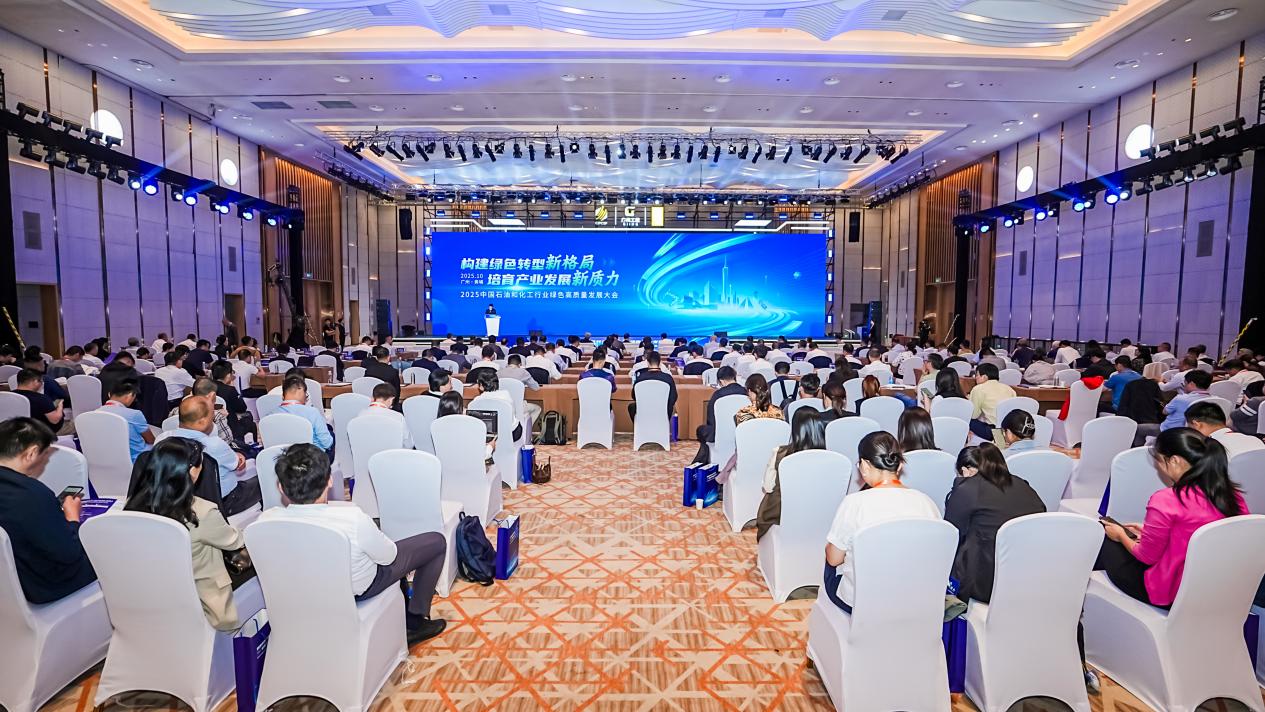
共探“十五五”石化行业高质量发展路径——2025中国石油和化工行业绿色高质量发展大会在广州举办
Zhong Guo Jin Rong Xin Xi Wang· 2025-10-29 11:48
Core Viewpoint - The 2025 China Petroleum and Chemical Industry Green High-Quality Development Conference was successfully held in Guangzhou, focusing on the theme of building a new pattern for green transformation and cultivating new quality power for industrial development during the 14th Five-Year Plan period [1] Group 1: Industry Development Direction - The 20th Central Committee of the Communist Party emphasized the need to focus economic development on the real economy, with a direction towards intelligent, green, and integrated development for the petroleum and chemical industry [3] - Guangzhou Industrial Control Group has established seven national-level green factories and is developing a cluster of green manufacturing [3] - The Guangzhou government aims to accelerate innovation breakthroughs in key areas such as special engineering plastics and new energy battery materials, while enhancing energy management systems [3] Group 2: Key Strategies for Transformation - The industry should focus on five key areas: innovation-driven high-end breakthroughs, systematic thinking for green transformation, digital empowerment for intelligent upgrades, ecological construction through circular economy concepts, and standard upgrades for high-quality development [4] - The establishment of a carbon footprint management system and entry into carbon trading markets are essential for promoting green low-carbon transformation in the petrochemical industry [4] - The main theme for the "14th Five-Year Plan" in the petrochemical industry is optimizing capacity structure, with core development paths including high-end, internationalization, and avoiding excessive competition [4] Group 3: Collaborative Efforts and Achievements - The conference released important results such as typical case practices, industry blue papers, and ESG evaluation reports to support green development in the industry [6][7] - A strategic cooperation agreement was signed between Guangzhou Industrial Control Group and China Petroleum and Chemical Corporation to deepen collaboration in industrial synergy, technological innovation, and green development [6] - The conference included discussions on the development paths of green petrochemicals and new materials, with a focus on transforming the industry from scale expansion to value enhancement [7]


渤海证券研究所晨会纪要(2025.10.27)-20251027
BOHAI SECURITIES· 2025-10-27 05:48
Macro and Strategy Research - The report emphasizes the need for "high-quality" development, with a focus on technology and reform as the main themes for the upcoming five years [2][3] - The "15th Five-Year Plan" will specifically highlight "technological self-reliance" and "comprehensive deepening of reform," indicating a shift towards more concrete and detailed goals compared to the previous plan [2][3] - The modern industrial system will prioritize "intelligent, green, and integrated" development, with advanced manufacturing playing a crucial role [3] - The report stresses the importance of domestic circulation and consumer demand, aiming to enhance living standards and stimulate new consumption [4] - There is a strong emphasis on social welfare, including education and social security, to address the immediate concerns of the populace [5] - The report outlines a commitment to accelerate the green transition and build a new energy system, with specific targets for carbon neutrality and renewable energy [6] Fixed Income Research - The report notes a narrow fluctuation in interest rates, with the yield curve flattening, indicating a stable but cautious market environment [12][14] - Recent fiscal data shows an improvement in tax revenue due to inflation, while government spending is increasingly focused on technology and public welfare [12] - The issuance of local government bonds has been significant, with a total of 789.5 billion yuan issued, aimed at stabilizing economic operations in the fourth quarter [13] - The bond market is currently influenced by uncertainties in U.S.-China relations and expectations of monetary policy adjustments [14] Industry Research - The report highlights significant achievements by Chinese pharmaceutical companies at the ESMO conference, showcasing advancements in cancer treatment and innovative therapies [18][19] - A notable collaboration between Innovent Biologics and Takeda Pharmaceuticals has been established, with a potential total deal value of up to 11.4 billion USD, marking a significant milestone in the Chinese biopharmaceutical sector [19][20] - The report indicates a mixed performance in the pharmaceutical sector, with a slight decline in the industry index, but suggests that the outlook remains positive due to ongoing innovation and market opportunities [19][20]
高质量发展看亮点·读数丨从制造到智造,轻工业向新而行
Ren Min Ri Bao· 2025-10-27 03:05
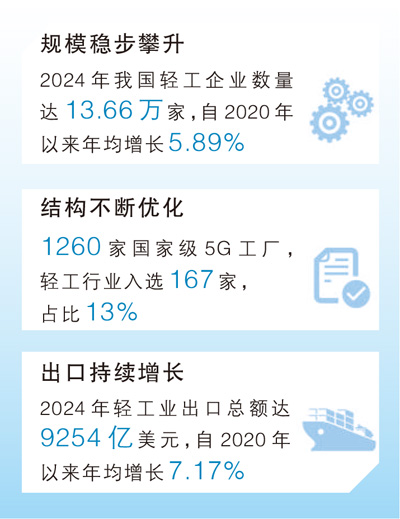
Core Insights - The light industry in China has shown significant growth during the "14th Five-Year Plan" period, with key metrics indicating a robust performance in terms of enterprise numbers, retail sales, and export volumes [3][12]. Industry Scale - By 2024, the number of light industry enterprises in China is projected to reach 136,600, with an average annual growth rate of 5.89% since 2020 [3]. - Retail sales of key light industry products are expected to reach 7.93 trillion yuan, accounting for 16.2% of total retail sales of consumer goods [3]. - The total export volume of light industry products is anticipated to hit 925.4 billion USD, with an average annual growth rate of 7.17% since 2020 [3]. Technological Advancements - The light industry is undergoing a dual transformation driven by smart upgrades and green transitions, with significant advancements in automation and AI technologies [4][6]. - As of now, 1,260 national-level 5G factories exist, with 167 in the light industry, representing 13% of the total [6]. - The proportion of smart home appliances has increased from 38% to 62% during the "14th Five-Year Plan" period, contributing to a projected revenue of 1.95 trillion yuan in 2024, a 31.6% increase from 2020 [5]. Innovation and R&D - The light industry has seen a continuous increase in innovation investment, with R&D expenditure intensity rising from 1.72% at the end of the "13th Five-Year Plan" to 2.31% in 2023, reflecting an annual growth rate of 9.2% [8]. - The number of authorized invention patents in the light industry has exceeded 1.79 million, with effective invention patents increasing from 127,000 in 2020 to 214,000 in 2024, showing an annual growth rate of 12.3% [8]. Market Competitiveness - The light industry has strengthened its market competitiveness through supply innovation, channel upgrades, and open cooperation [11]. - In 2024, the export volume of the light industry is expected to account for 25.9% of the national total, maintaining the top position for five consecutive years [12]. - The retail sales of key light industry products have grown from 5.98 trillion yuan in 2020 to 7.93 trillion yuan in 2024, with an average annual growth rate of 7.29% [12].
高质量发展看亮点·读数|从一粒酵母看轻工业之变
Bei Jing Ri Bao Ke Hu Duan· 2025-10-27 02:29
Core Insights - The "14th Five-Year Plan" for the light industry in China shows significant achievements, with the number of light industry enterprises reaching 136,600 by 2024, an average annual growth of 5.89% since 2020 [3] - Retail sales of key light industry products reached 7.93 trillion yuan, accounting for 16.2% of total retail sales of consumer goods [3] - The total export value of light industry products reached 925.4 billion USD, with an average annual growth of 7.17% since 2020 [3] Industry Structure Optimization - The light industry is undergoing a dual transformation driven by intelligent upgrades and green transitions, with significant advancements in smart factories and AI applications [4] - The proportion of smart home appliances increased from 38% to 62% during the "14th Five-Year Plan," contributing to a 31.6% growth in the main business income of the home appliance industry, reaching 1.95 trillion yuan by 2024 [4] - By 2024, 1,321 light industry enterprises were recognized as national green factories, covering various sectors including home appliances, paper, food, and batteries [4] Innovation and Technology - Continuous innovation investment has led to a significant increase in research and development intensity, rising from 1.72% at the end of the "13th Five-Year Plan" to 2.31% in 2023, with an annual growth rate of 9.2% [6] - The number of authorized invention patents in the light industry exceeded 1.79 million, with effective invention patents increasing from 127,000 in 2020 to 214,000 in 2024, reflecting an annual growth rate of 12.3% [6] Market Competitiveness - The light industry has strengthened its market competitiveness through supply innovation, channel upgrades, and open cooperation, with exports of bicycles reaching 259 million units and an export value of 17.71 billion USD from 2020 to 2024 [8][10] - The export share of light industry products accounted for 25.9% of the national total in 2024, maintaining the top position for five consecutive years [10] - Domestic retail sales of key light industry products grew from 5.98 trillion yuan in 2020 to 7.93 trillion yuan in 2024, with an average annual growth of 7.29% [10]
从制造到智造,轻工业向新而行
Xin Hua Wang· 2025-10-26 23:54
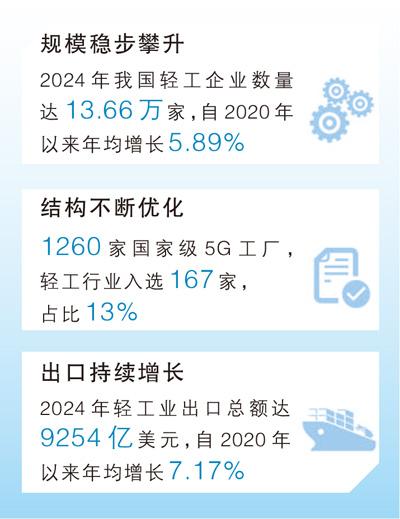
Core Insights - The light industry in China has established itself as the largest producer and exporter of light industrial products globally, with significant growth in production scale, market performance, and export volume since 2020 [1][10]. Industry Scale and Market Performance - By 2024, the number of light industry enterprises in China is projected to reach 136,600, with an average annual growth rate of 5.89% since 2020 [1]. - Retail sales of key light industry products are expected to reach 7.93 trillion yuan, accounting for 16.2% of total retail sales of consumer goods [1]. - The total export value of light industry products is anticipated to be 925.4 billion USD, with an average annual growth rate of 7.17% since 2020 [1]. Technological Advancements and Upgrades - The light industry is undergoing a dual transformation driven by intelligent upgrades and green transitions, with significant improvements in smart manufacturing capabilities [3][4]. - As of now, 1,260 national-level 5G factories exist, with 167 in the light industry, representing 13% of the total [4]. - The proportion of smart home appliances has increased from 38% to 62% during the "14th Five-Year Plan" period, contributing to a projected revenue of 1.95 trillion yuan in 2024, a 31.6% increase from 2020 [3]. Innovation and R&D Investment - The light industry is witnessing a continuous increase in innovation investment, with R&D expenditure intensity rising from 1.72% at the end of the "13th Five-Year Plan" to 2.31% in 2023, reflecting an annual growth rate of 9.2% [5][6]. - The number of authorized invention patents in the light industry has exceeded 1.79 million, with effective invention patents increasing from 127,000 in 2020 to 214,000 in 2024, showing an annual growth rate of 12.3% [7]. Market Competitiveness and Export Performance - The light industry has strengthened its market competitiveness through supply innovation, channel upgrades, and open cooperation, with exports accounting for 25.9% of the national total in 2024, maintaining the top position for five consecutive years [10]. - From 2020 to 2024, the export of light industrial products to countries involved in the Belt and Road Initiative increased from 30% to 33%, and exports to ASEAN countries rose from 13.7% to 15% [10]. Future Outlook - Looking ahead to the "15th Five-Year Plan," the light industry aims to enhance innovation capabilities, brand influence, and sustainable development, with goals to cultivate over 10 globally recognized brands and maintain the highest international market share by 2030 [11].
我国稳居全球最大轻工产品生产国和出口国 从制造到智造,轻工业向新而行(高质量发展看亮点·读数)
Ren Min Ri Bao· 2025-10-26 21:42
Core Insights - The light industry in China has shown significant growth and resilience, becoming the largest producer and exporter of light industrial products globally, with key metrics indicating a steady increase in enterprise numbers, retail sales, and export volumes [2][5][10]. Industry Scale - By 2024, the number of light industry enterprises in China is projected to reach 136,600, with an average annual growth rate of 5.89% since 2020 [2]. - The retail sales of key light industry products are expected to reach 7.93 trillion yuan, accounting for 16.2% of the total retail sales of consumer goods [2]. - The total export volume is anticipated to be 925.4 billion USD, with an average annual growth rate of 7.17% since 2020 [2]. Technological Advancements - The light industry is undergoing a dual transformation driven by smart upgrades and green transitions, with significant advancements in automation and artificial intelligence [4][5]. - As of now, 1,260 national-level 5G factories exist, with 167 in the light industry, representing 13% of the total [5]. - The proportion of smart home appliances has increased from 38% to 62% during the "14th Five-Year Plan" period, contributing to a projected revenue of 1.95 trillion yuan in 2024, a 31.6% increase from 2020 [4]. Innovation and R&D - The light industry has seen a substantial increase in innovation investments, with R&D expenditure intensity rising from 1.72% at the end of the "13th Five-Year Plan" to 2.31% in 2023, reflecting an annual growth rate of 9.2% [7]. - The number of authorized invention patents in the light industry has exceeded 1.79 million, with effective invention patents increasing from 127,000 in 2020 to 214,000 in 2024, showing an annual growth rate of 12.3% [7]. Market Competitiveness - The light industry has strengthened its market competitiveness through supply innovation, channel upgrades, and open cooperation, with exports to countries involved in the Belt and Road Initiative increasing from 30% to 33% from 2020 to 2024 [11]. - The export share of the light industry accounted for 25.9% of the national total in 2024, maintaining the top position for five consecutive years [10]. - Domestic retail sales of key light industry products have grown from 5.98 trillion yuan in 2020 to 7.93 trillion yuan in 2024, with an annual growth rate of 7.29% [11]. Future Outlook - Looking ahead to the "15th Five-Year Plan," the light industry aims to enhance innovation capabilities, brand influence, and sustainable development, with goals to cultivate over 10 globally recognized brands and 50 regional specialty brands by 2030 [11].
亚历山大·辛:中国为世界矿业发展注入新活力
Sou Hu Cai Jing· 2025-10-24 16:48
Core Viewpoint - China is playing a significant role in the global mining industry's digital and green transformation, enhancing development efficiency through high-tech applications and international cooperation [2][3]. Group 1: China's Role in Mining - China has injected new vitality into the global mining sector, significantly impacting the industry's development efficiency [3]. - The country is a key player in the application of emerging technologies such as machine learning and artificial intelligence, which are crucial for the digitalization and green transformation of mining [3]. - China's advancements in new energy development, particularly in electric vehicles, have benefited numerous enterprises [3]. Group 2: International Cooperation - The mining conference serves as a platform for global mining collaboration, emphasizing the necessity of cooperative development of critical mineral resources [3]. - Such cooperation is deemed beneficial for all global enterprises, highlighting the importance of mutual support in the mining sector [3]. Group 3: Conference Insights - The conference provides valuable opportunities for investment and consulting firms to engage with clients and relevant companies, facilitating discussions on past projects and future developments [3]. - Although immediate partnership agreements may not be feasible during the brief conference, the interactions are essential for reviewing previous work and supporting future corporate growth [3].

品质为王 广交会企业喜提“丰收季”
Zhong Guo Jing Ji Wang· 2025-10-23 00:46
Group 1 - The 138th Canton Fair has sparked a global procurement frenzy, showcasing China's manufacturing transformation towards high-end, intelligent, and green production [1] - Zhejiang manufacturing companies are leveraging the Canton Fair to transition from traditional manufacturing to intelligent manufacturing, with significant international interest and orders [2] - Companies like Beijing Aibingguo Technology and Fumate Technology are gaining attention for their innovative products, such as AI tutoring devices and cost-effective window-cleaning robots, attracting substantial orders from European buyers [3] Group 2 - Xi'an trading group companies reported strong engagement with international buyers, with existing customer orders increasing by 34% and new orders expected to reach $1 million [4] - Companies from Guangxi are focusing on "hardcore equipment" and "green intelligence," achieving significant sales, including a $300,000 contract for excavators and a $9 million order for elevators [5] - The Tianjin trading group also showed strong performance with an initial intention to transact $27 million, highlighting the growing number of buyers from Belt and Road Initiative countries [6]
【热点评述】关注2025泰达论坛
乘联分会· 2025-10-20 08:37
Core Viewpoint - The 2025 TEDA Forum emphasizes the need for the Chinese automotive industry to transition towards sustainable high-quality development, focusing on innovation, cross-industry integration, digital transformation, and globalization in response to current challenges and opportunities [3][12][13]. Group 1: Forum Overview - The 2025 China Automotive Industry Development (TEDA) International Forum was held from September 11 to 14, 2025, in Tianjin, focusing on key topics such as the "14th Five-Year Plan" policies, hard technology breakthroughs, and global layout strategies [3][4]. - The forum's annual theme is "Increase Momentum, Open New Chapters, and Go Global," aiming to enhance the overall efficiency of the automotive industry system [4]. Group 2: Policy Signals - Various ministries released positive signals regarding the automotive industry, including the Ministry of Industry and Information Technology's plan for a new round of growth initiatives and the Ministry of Commerce's push for deeper automotive circulation reforms [5][6][13]. - The Ministry of Ecology and Environment will revise the National VI emission standards and continue checks on new vehicle production consistency [13]. Group 3: Innovation in the Automotive Industry - The automotive industry is at a critical juncture for growth momentum transformation, facing challenges such as slowing growth in the new energy vehicle market and core technology bottlenecks while seizing opportunities in intelligent and green transitions [7][13]. - Experts at the forum suggested a balanced approach to progress and innovation in the automotive sector [7]. Group 4: Cross-Industry Integration - The forum discussed the rapid development of emerging fields like low-altitude economy and vehicle-network interaction, driven by policy support and technological breakthroughs [8]. - It explored the integration of automotive technology with aviation, energy, and other sectors to foster collaborative innovation [8]. Group 5: Digital Transformation - Consensus was reached on the "digital intelligence ecosystem," focusing on data-driven approaches and AI model applications to enhance practices in autonomous driving and supply chain management [9]. - The aim is to promote a comprehensive digital transformation across the automotive value chain [9]. Group 6: Global Development - Industry experts highlighted the importance of international expansion, discussing trends in the global automotive industry and opportunities and challenges in overseas markets [10]. - Companies are encouraged to adopt win-win strategies for international collaboration [10]. Group 7: Consensus Reached - The forum reached five key consensuses aimed at guiding the future development of the domestic automotive industry, including a focus on safety, green low-carbon development, emerging technology deployment, long-termism for national brands, and deepening internationalization [12][13].

交行副行长杨涛:围绕航运产业链各环节 系统做好航运金融服务
Xin Hua Cai Jing· 2025-10-19 13:40
Core Insights - The Chinese shipping industry is innovating and accelerating the formation of new productive forces, enhancing the capabilities of the Shanghai International Shipping Center, which supports international trade and contributes to China's high-level opening-up [1] Group 1: Shipping Industry Performance - In the first half of this year, China's shipbuilding completion and new orders accounted for 52% and 68% of the global total, respectively, with new orders for green ships making up 69% of the global total [1] - China has historically gathered the manufacturing of large LNG carriers, large cruise ships, and aircraft carriers, which are considered the "crowning jewels" of shipbuilding [1] - The Yangshan Deep-Water Port has the world's leading operational efficiency for automated terminals and ranks first globally in port connectivity index, forming a shipping industry cluster worth hundreds of billions [1] Group 2: Financial Services and Green Transition - The company is embracing the trend of green transformation in shipping, focusing on financing for LNG-powered and methanol-powered vessels, and has participated in establishing the first financial standards for the water transport industry's transition [2] - The company has a significant presence in shipping leasing, with over half of its leasing investments in the past three years directed towards compliant green vessels [2] Group 3: Digitalization and Smart Manufacturing - The company is enhancing its shipping financial services through digitalization, utilizing AI, big data, and blockchain to improve online and automated service levels [2] - The company has launched various financial solutions like "Shipping Butler" to help shipping companies reduce costs and increase efficiency, and is actively involved in building a digital platform for shipping trade [2] - The company is also focusing on financing for high-end ship manufacturing, supporting smart ships and unmanned vessels, with a total project amount exceeding 100 billion and holding over 450 vessels [3] Group 4: Future Strategies - The company plans to deepen its commitment to the national strategy of building a strong shipping nation, enhancing its shipping financial service capabilities, and providing comprehensive financial services across the shipping industry chain [3] - The company aims to leverage its comprehensive operational advantages to offer integrated financial services such as equity, loans, bonds, and leasing to upstream and downstream enterprises [3] - The company will continue to strengthen its digital operations, focusing on building financial scenarios in shipping and exploring technology empowerment for efficient cross-border settlement, financing, and risk control [3]
