
可再生能源

Search documents
这些公司正在利用人工智能重塑能源行业
财富FORTUNE· 2025-08-07 13:05
Core Insights - The rise of artificial intelligence (AI) has created an energy paradox, with AI data centers potentially consuming 20 to 30 times more energy than traditional CPU-based data centers, raising concerns about environmental impacts [1] - AI is expected to account for over 10% of U.S. electricity consumption within the next five years, which could exacerbate climate change if not managed properly [1] - However, the integration of AI in the energy sector presents opportunities to optimize energy flow and reduce environmental impacts [1] Group 1: AI and Energy Efficiency - Kraken Technologies is a leader in using AI to tackle energy efficiency challenges, serving over 70 million customer accounts through its AI-driven operating system [2] - The system connects over 500,000 consumer devices and controls more than 5 gigawatts of flexible energy supply, offsetting 14 million tons of CO2 emissions in 2024 alone [2][3] - The company utilizes machine learning to analyze energy consumption patterns, achieving up to 90% accuracy in distributing renewable energy [3] Group 2: Renewable Energy Solutions - Exowatt is developing solar power systems to provide continuous power supply for AI data centers, addressing the intermittent nature of solar energy [3] - The company emphasizes the urgency of scaling its solutions to avoid reliance on fossil fuels, which could severely impact surrounding communities [3] - Exowatt also employs AI-driven "digital twin" systems for real-time performance simulation and preventive maintenance [3] Group 3: AI in Regulatory Compliance - Halcyon has raised $10.8 million in seed funding to leverage AI for supporting energy sector professionals by processing regulatory documents into searchable structured information [4] - The use of large language models aims to streamline the regulatory analysis process, significantly reducing the time needed to find relevant data [4] - Halcyon's mission includes ensuring that the growing electricity demand from AI supports the transition to clean energy [4]


英飞凌FY25Q3跟踪报告:消费类业务FY24H2或将复苏,SiC明年营收增50%
CMS· 2025-08-07 12:22
Investment Rating - The report maintains a recommendation for the industry, indicating a potential recovery in consumer-related businesses in FY24H2 and a projected 50% revenue growth for SiC in the coming year [1]. Core Insights - The semiconductor market is showing signs of recovery as inventory adjustments are nearly complete, with expectations for a gradual rebound in demand across various sectors, particularly in AI infrastructure and automotive electronics [35]. - The company reported a slight revenue increase in FY25Q3, achieving €3.704 billion, with a gross margin of 43%, reflecting a positive trend despite adverse currency fluctuations [17][24]. - The guidance for FY25Q4 anticipates a revenue increase of approximately 5.3% compared to the previous quarter, with an upward revision of the FY25 gross margin to over 40% [3][33]. Summary by Sections Financial Performance - FY25Q3 revenue reached €3.704 billion, slightly exceeding guidance, with a year-on-year stability and a quarter-on-quarter increase of 3% [17]. - The gross margin improved to 43%, benefiting from increased sales and reduced idle costs, despite a year-on-year decline of 0.4 percentage points [24]. - The company has a backlog of approximately €18 billion in orders, indicating strong future demand [17]. Business Segments - Automotive (ATV) segment revenue was €1.87 billion, showing a year-on-year decline of 3% but a quarter-on-quarter increase of 1% [2]. - Green Industrial Power (GIP) segment revenue increased to €431 million, with a quarter-on-quarter growth of 9% driven by rising end-user demand [2]. - Power & Sensor Systems (PSS) segment revenue reached €1.053 billion, reflecting a strong demand for AI server power solutions, with a year-on-year growth of 13% [2]. - Connected Secure Systems (CSS) segment revenue was €349 million, experiencing a slight decline due to adverse currency effects [2]. Market Outlook - The automotive market in China and the U.S. may face pressures in H2 2025 due to inventory buildup and pricing wars, while the semiconductor inventory adjustment is largely complete [4]. - AI infrastructure continues to drive strong demand, with the company collaborating with NVIDIA to develop a high-voltage power supply architecture for AI data centers [4][22]. - The overall semiconductor demand is expected to be influenced by geopolitical and macroeconomic factors, with a cautious outlook on customer purchasing behaviors [31]. Strategic Initiatives - The company is focusing on enhancing its product portfolio through strategic acquisitions, such as the Marvell automotive Ethernet business, to strengthen its position in high-growth areas [16]. - The report emphasizes the importance of maintaining a balanced inventory level to navigate the upcoming industry upcycle effectively [30].

龙源电力: 龙源电力集团股份有限公司2025年7月发电量数据公告
Zheng Quan Zhi Xing· 2025-08-07 11:10
| 青海 | | 78,514 | 25,518 | | 207.69 | | 251,196 | 164,749 | 52.47 | | --- | --- | --- | --- | --- | --- | --- | --- | --- | --- | | 河南 | | 53,758 | 48,800 | | 10.16 | | 406,266 | 321,568 | 26.34 | | 加拿大 | | 8,774 | 11,017 | | -20.36 | | 133,687 | 145,793 | -8.30 | | 南非 | | 75,110 | 64,201 | | 16.99 | | 379,970 | 409,828 | -7.29 | | 乌克兰 | | 14,163 | | 9,654 | 46.70 | | 85,774 | 116,915 | -26.64 | | 光伏业务 | | 1,594,002 | 774,096 | | 105.92 | | 7,740,917 | 4,360,497 | 77.52 | | 其他可再生能源业务 | | 446 | | | 503 | -11 ...

锚定高质量发展:协合新能源在行业调整期的破局之道
Jin Tou Wang· 2025-08-07 08:04
Group 1: Industry Overview - The global renewable energy sector is expected to see investments rise to $2.2 trillion by 2025, driven by declining interest rates and surging clean energy demand [1] - In the first four months of this year, China's installed capacity for wind and solar exceeded 1.5 billion kilowatts, highlighting its role as a key market [1] - However, challenges such as insufficient grid capacity have led to increased curtailment of wind and solar energy, with utilization rates dropping below 90% in most regions [1] Group 2: Company Performance - Despite the industry's challenges, the company reported an 18% year-on-year increase in equity installed capacity, reaching 4,778 MW, with solar capacity growing by 60% to 934 MW [2] - The company's solar power generation increased by 28% to 604 GWh, and net profit from solar power stations rose by 59.7%, demonstrating resilience amid industry pressures [2][3] - The company managed to reduce equipment failure losses by 40% and lowered financing costs to 3.63%, resulting in a 22.5% increase in operating cash flow to 1.041 billion yuan [3] Group 3: Strategic Initiatives - The company is transitioning from a pure power station developer to a green energy service provider, enhancing its electricity marketing and green certificate sales [4] - In the first half of the year, the company secured 152.5 MW of solar and 300 MW of storage projects outside China, diversifying its market exposure [5] - The company is pursuing high-quality long-term power purchase agreements (PPAs) to mitigate market price volatility and ensure predictable cash flows [6] Group 4: Capital Operations - The company initiated a secondary listing in Singapore to enhance its international project financing capabilities and attract ESG-focused long-term investors [7] - Plans to establish a private equity fund and explore new business areas like virtual power plants are aimed at improving asset management and creating new growth points [7] - The company's strategy focuses on high-certainty revenue assets, which is expected to enhance its operational efficiency and capital returns [8]
Enlight Renewable Energy .(ENLT) - 2025 Q2 - Earnings Call Transcript
2025-08-06 11:00
Financial Data and Key Metrics Changes - The company reported a revenue increase of 53% year-over-year, reaching $135 million, and adjusted EBITDA rose by 57% to $96 million [6][24][28] - Net income decreased to $6 million from $9 million in the same quarter last year, primarily due to a foreign currency shareholder loan revaluation [6][26] - The company raised its full-year 2025 guidance, projecting revenues between $520 million and $535 million and adjusted EBITDA between $385 million and $400 million, reflecting a 5.5% to 6% increase [7][28] Business Line Data and Key Metrics Changes - Revenue from electricity sales grew by 37% to $160 million, driven by newly operational projects, contributing $30 million to revenues [24][25] - The company’s adjusted EBITDA growth was supported by $47 million from the same factors driving revenue increases, despite a $13 million rise in cost of sales linked to new projects [26][27] Market Data and Key Metrics Changes - Revenue distribution for the second quarter was 40% from Israel, 35% from Europe, and 25% from the U.S., indicating a diversified revenue base [25] - The company is well-positioned in the U.S. market due to regulatory clarity and a supportive business environment, which is expected to drive accelerated growth [10][12] Company Strategy and Development Direction - The company aims for an annual revenue run rate of approximately $2 billion by 2028, which is about four times the 2025 revenues [7] - The focus is on expanding energy storage projects in Europe and Israel, with significant planned storage capacity [12][13] - The company is also exploring opportunities in data centers, leveraging its renewable energy assets [13] Management's Comments on Operating Environment and Future Outlook - Management expressed confidence in the positive market environment for renewable energy, driven by electrification trends and AI demand [9] - The company believes that lower capital expenditures and higher power prices will maintain attractive project returns [10] - Management highlighted the importance of adapting to regulatory changes and maintaining a diversified supply chain to mitigate risks [39][58] Other Important Information - The company has secured $310 million in financing for the hybridization of the Hekama project in Spain, enhancing its financial flexibility [27] - The leadership transition is set to occur in October, with the current CEO becoming Executive Chairman [7][20] Q&A Session Summary Question: Safe harbor and project completion timelines - Management confirmed that six gigawatts are fully safe harbored, positioning the company well to meet future criteria [33][36] Question: Supply chain and tariff impacts - The company has a diversified supply chain strategy and is not locked into any specific supplier, allowing flexibility in pricing [39][41] Question: Future project supply and PPA trends - Management indicated that the demand for electricity, particularly from data centers and AI, will drive future project development [50][52] Question: FX contributions to guidance - FX has positively impacted guidance, but strong operational performance is the primary driver of confidence in future results [56] Question: Component costs and market adaptation - The company expects U.S. component costs to gradually adapt, reflecting changes in tariffs and market conditions [58][59]

特斯拉:永远是领跑者,永远不会是赢家
美股研究社· 2025-08-06 10:23
Core Viewpoint - Tesla has played a significant role in pushing battery electric vehicles (BEVs) into the mainstream, but it has recently lost its leading position to competitors like BYD, despite maintaining investor confidence in its innovation and technology advancements [1][2][10]. Group 1: Market Position and Performance - In 2024, global electric vehicle production is expected to reach approximately 17.3 million units, a growth of over 25%, with China producing 12.4 million units, accounting for 72% of the total [2]. - Tesla's total production is projected to decline by 4% in 2024, from 1.85 million to 1.77 million units, while total revenue is expected to grow by 1%, from $96.8 billion to $97.7 billion [2]. - Tesla's global market share is anticipated to decrease from 19% in 2023 to 18% in 2024 [2]. Group 2: Financial Performance - In Q2 2025, Tesla's total revenue decreased by 12%, with automotive revenue declining by 16% [3]. - Approximately 75% of Tesla's revenue comes from its automotive business, but it is no longer the leader in the electric vehicle sector, with BYD now holding that title [3]. - Total automotive revenues for Q2 2024 were $19.878 billion, with a year-over-year decline of 16% [5]. Group 3: Risks and Challenges - Tesla faces several risks, including internal operational risks, external threats, and Elon Musk's divided attention due to his involvement in other ventures [1][2][7]. - The company has struggled with timely deliveries, which could impact its ability to launch new products like the humanoid robot Optimus and the Robotaxi service [6][9]. - The reliance on rare earth elements poses a supply chain risk, particularly for critical materials like neodymium, which is predominantly sourced from China [7]. Group 4: Future Prospects - Analysts believe Tesla has potential in areas like autonomous driving and robotics, but it is unlikely to dominate any specific field [10][11]. - The anticipated market size for renewable energy is projected to reach $16 trillion by 2025, but Tesla's current market share in energy generation and storage is still relatively small at $2.8 billion [5]. - Tesla's valuation appears high compared to traditional automakers, with a projected price-to-earnings ratio of 180, while competitors like BYD have significantly lower ratios [10][11].

政策逆风下美国太阳能装机容量顽强增长 2026年税收抵免削减或刺激抢装潮
智通财经网· 2025-08-06 09:21
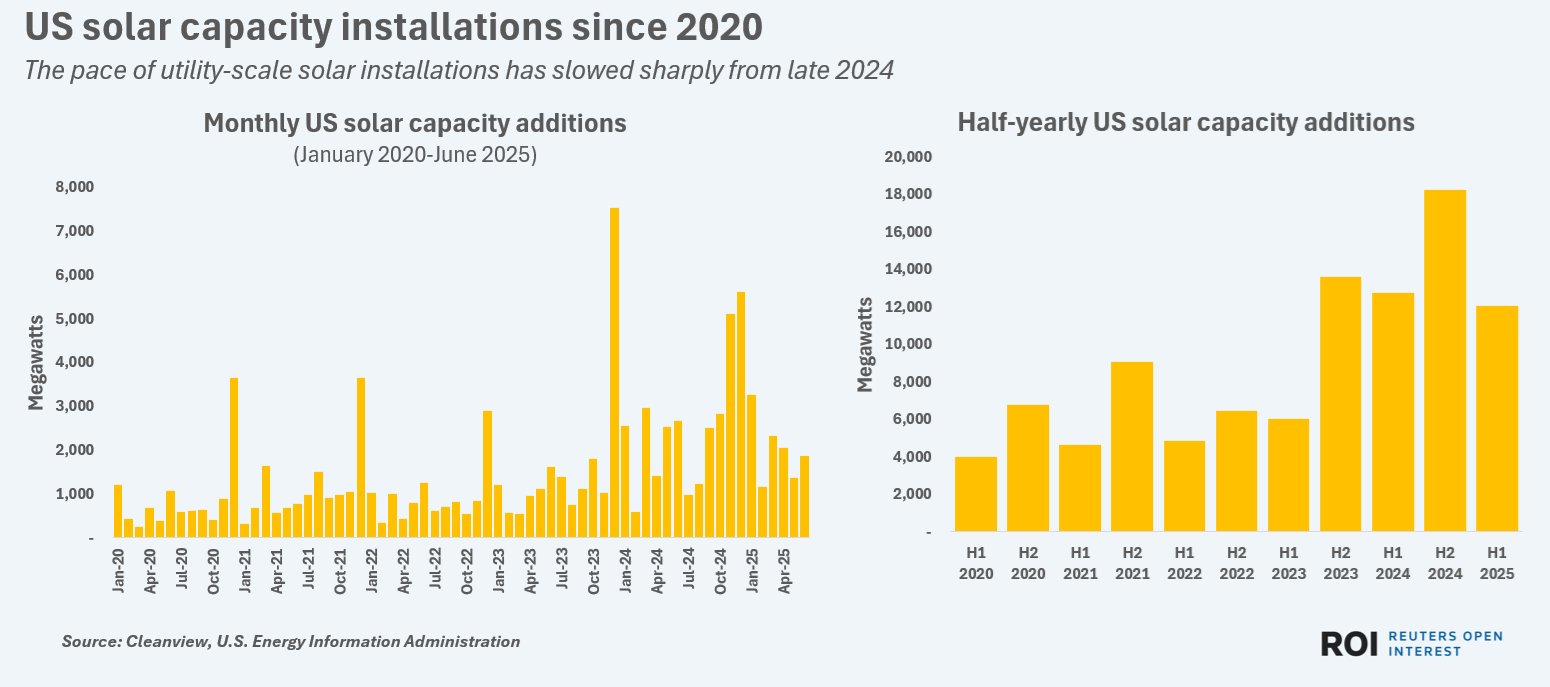
Core Insights - Despite the cancellation of subsidies and tax breaks for renewable energy developers by President Trump, the growth of solar power capacity in the U.S. has slowed but not completely derailed [1] - The federal solar tax credit is set to reduce in 2026, prompting developers to accelerate solar system deployments to complete projects before the deadline, potentially boosting overall growth rates for solar capacity [4] Growth Trends - As of mid-2025, the U.S. utility-scale solar capacity has seen a year-on-year growth of approximately 10%, significantly lower than the 33% growth in 2024 and the 29% average annual growth since 2015 [1] - Texas, the largest state for solar capacity, has experienced a 14% growth in utility-scale solar capacity in 2025, indicating robust demand despite reduced federal support [5] - In contrast, California, the second-largest solar market, has only seen a 2% growth in 2025, raising concerns about future demand for solar systems nationwide [5] - Florida, the third-largest solar market, reported an 8% increase in capacity, but has not added any new utility-scale solar capacity since January, suggesting a halt in expansion efforts [7] Regional Performance - Arizona has shown strong performance with a 24% increase in utility-scale solar capacity in 2025, providing some balance to the overall market [8] - Other states such as Wisconsin, Pennsylvania, Idaho, Missouri, Michigan, Arkansas, Oklahoma, Ohio, and Indiana have also outpaced the national average in capacity growth, indicating that solar growth is not entirely stagnant [12]

浙商证券:转型政策驱动 绿电绿证溢价有望提升
智通财经网· 2025-08-06 05:57
智通财经APP获悉,浙商证券发布研报称,当前我国绿证市场全体系已经基本建设完成。后续绿证供给 的弹性在于绿证核发覆盖率进一步提升,供给上升空间有限。需求端,省级政府考虑能耗双控考核、可 再生能源消纳考核的压力,会将目标分解至省内企业,促使企业购买绿证;可持续报告披露制度日益完 善、海外绿色贸易壁垒落地临近两大因素也提高了绿证的需求。综合来看,绿证供需差收敛,过剩压力 缓解,价格有望进一步提升。此外,海外绿色贸易壁垒认可度上,绿电直连>绿电交易>证电分离,有 望推进绿电直连模式在我国的发展。 浙商证券主要观点如下: 我国绿证体制机制建设基本完善 贸易认可度绿电直连>绿电交易>证电分离,开启直连新模式 在关注的海外主要绿色贸易壁垒中,欧盟《新电池法》仅认可物理直连模式为绿电使用,而CBAM认可 绿电交易协议和物理直连。而绿证主要应用在以RE100为核心的供应链企业绿电核算中。贸易认可度绿 电直连>绿电交易>证电分离。2025年5月发改委也推出新政策支持绿电直连模式发展,绿电直连模式有 望成为绿电消纳中快速增长的新业态。 风险提示 政策变化风险;市场情绪与偏好波动风险;数据变化风险。 展望后市,绿证供需差收敛,价格 ...

工信部开展多晶硅节能监察,宁德时代预计固态2027年小规模量产 | 投研报告
Zhong Guo Neng Yuan Wang· 2025-08-06 02:41
Industry Overview - The performance of the Shenwan Electric New Energy sector decreased by 2.62%, ranking 24th among 31 industries, while the Shenwan Public Utilities sector fell by 1.84%, ranking 13th [1][2] - During the same period, the CSI 300 index declined by 1.75%, and the Wind Information All A index dropped by 1.09% [2] Key Developments - The Ministry of Industry and Information Technology (MIIT) has initiated energy-saving inspections for 41 polysilicon companies to promote energy conservation and green development in the polysilicon industry [2] - Abu Dhabi Future Energy Company (Masdar) and Spanish company Iberdrola have partnered to invest in the UK's largest offshore wind project with a capacity of 1.4 GW, setting a new reference for international cooperation in renewable energy [2] Company Insights - CATL (Contemporary Amperex Technology Co., Limited) anticipates small-scale production of solid-state batteries by 2027, with larger-scale production expected around 2030 [3] - Guangdong Province has decided to raise the capacity price for coal and gas power plants, with coal power capacity price set at 165 yuan per kilowatt per year starting January 1, 2026 [3] Investment Recommendations - The report maintains a "recommended" rating for the electric new energy and public utility sectors, suggesting to focus on leading photovoltaic companies such as Aiko Solar, Longi Green Energy, and Tongwei Co., Ltd. [4] - In the wind power sector, it is advised to pay attention to component manufacturers like Jinlei Co., Ltd. and Dayun Heavy Industry [5] - For lithium battery investments, companies in the iron-lithium and anode segments such as Hunan Youneng and Shanghai Xiba are highlighted [5]





韩确定下一代电网建设方向
Ke Ji Ri Bao· 2025-08-05 23:42
Core Insights - The South Korean Ministry of Trade, Industry and Energy has announced a plan for the construction of the "next-generation power grid," focusing on the expansion of renewable energy utilization and transitioning to decentralized small-scale grids for more efficient power production and consumption [1] Group 1: Government Initiatives - President Yoon Suk-yeol emphasized the need to build a renewable energy-centered power grid infrastructure during a recent meeting [1] - The new grid system will differ from traditional models by enabling two-way energy flow, allowing locally produced renewable energy to be delivered to nearby consumers and excess power to be fed back into the transmission network [1] Group 2: Pilot Projects and Investments - Jeollanam-do, which has abundant solar and wind resources, has been designated as the first demonstration area for this initiative, becoming a "distributed energy special zone" [1] - The government plans to invest approximately 200 billion KRW in microgrid demonstration projects, which will be included in the 2026 budget [1]