
AI大模型

Search documents
中科创达(300496)季报点评:三季度业绩持续高增长 智能物联网业务发展势头强劲
Xin Lang Cai Jing· 2025-11-07 08:42
Core Viewpoint - The company reported strong financial performance for the first three quarters of 2025, with significant year-on-year growth in revenue and net profit, indicating a robust business trajectory [1][2]. Financial Performance - For the first three quarters of 2025, the company achieved revenue of 5.148 billion yuan, a year-on-year increase of 39.34% [1][2]. - The net profit attributable to shareholders reached 229 million yuan, reflecting a year-on-year growth of 50.72% [1][2]. - The net profit after deducting non-recurring items was 200 million yuan, up 57.58% year-on-year [1][2]. - In Q3 2025, the company recorded revenue of 1.848 billion yuan, a 42.87% increase compared to the same quarter last year [2]. - The net profit for Q3 was 70.568 million yuan, growing by 48.26% year-on-year [2]. - The net profit after deducting non-recurring items for Q3 was 63.622 million yuan, marking a 64.76% increase year-on-year [2]. Business Development - The company launched the Drip AI OS and AI BOX, positioning itself to capitalize on the automotive industry's shift towards AI-driven smart ecosystems [3]. - The Drip OS 1.0 Evo, introduced at the 2025 Shanghai Auto Show, integrates AI large model technology to enhance vehicle interactivity and decision-making capabilities [3]. - The AI BOX, developed in collaboration with Geely, utilizes NVIDIA's platform to enable real-time operation of large AI models in vehicles, marking a significant advancement in automotive technology [3]. - The company's IoT business has shown strong momentum, contributing significantly to overall revenue growth, with a reported income of 1.27 billion yuan in the first half of 2025, a substantial increase of 136.14% year-on-year [4]. - The IoT segment includes various products such as handheld devices, smart visual and edge computing solutions, and AI robots, which have been successfully implemented in multiple industries [4]. Profit Forecast and Investment Recommendations - Based on the Q3 2025 report, the company adjusted its profit forecasts, expecting net profits of 562 million yuan, 677 million yuan, and 831 million yuan for 2025, 2026, and 2027 respectively [5]. - The expected earnings per share (EPS) for the same years are projected to be 1.22 yuan, 1.47 yuan, and 1.80 yuan, with corresponding price-to-earnings ratios of 54.9x, 45.5x, and 37.1x [5]. - The company maintains a strong outlook for its automotive and IoT business lines, which are anticipated to drive future growth [5].

家电品牌AI应用加速,深度融入中国本土供应链
2 1 Shi Ji Jing Ji Bao Dao· 2025-11-07 08:41
Core Insights - The global home appliance industry is undergoing a deep restructuring driven by "AI + supply chain" dynamics, with AI applications evolving from individual product intelligence to integrated scene solutions [1] - The Chinese market is becoming a key player in supply chain and technology development, shifting multinational brands' local strategies from simple production and sales to a model focused on "smart ecosystems + local innovation" [1] - China is transforming from a mere production and consumption market to an essential source of innovation, altering the traditional flow of technology and product development [1] AI Applications - The home appliance and home goods sector is experiencing significant innovation driven by AI, which has become a core engine for industry upgrades and market competition [2] - Panasonic showcased its Alpha G5 washing and drying machine, featuring 76 smart chips that utilize AI algorithms to identify fabric types and analyze stains for optimal washing parameters [2] - Sony presented AI enhancements for elderly care devices, including a fall detection sensor that analyzes skeletal motion data to identify falls and trigger automatic alerts [2] Smart Home Solutions - Samsung introduced its AI Home solution at the expo, which includes modules for various scenarios such as home living, entertainment, and health management, creating an interconnected smart ecosystem [3] - Panasonic's "1+N+X Smart Home System" connects various AI smart appliances and customizes additional needs through its core α-Watch [3] Local Supply Chain Integration - Many overseas brands have established manufacturing facilities in China, reflecting the increasing integration of foreign brands with local supply chains and the deepening of their operational strategies [4] - Sony's "China Star Program" supports local game developers by providing technology and supply chain assistance, aiming to build a robust gaming ecosystem in China [5] Global Strategy and Innovation - Panasonic's strategy emphasizes leveraging China's strengths in product design and manufacturing to expand into Southeast Asia and other markets [5] - Panasonic is also enhancing its supply chain capabilities to meet the growing demand for generative AI servers, positioning itself as a key supplier of essential components [6] R&D and Innovation in China - The Chinese government's initiatives aim to foster innovation in the home appliance sector, with a focus on smart, green, and healthy products by 2025 [7] - Sony's image sensor business is experiencing rapid growth, particularly in the automotive sector, driven by the demand from Chinese manufacturers for advanced driving assistance systems [7] - Panasonic has established a large local R&D team, with significant resources dedicated to developing smart appliances and systems [8] Emerging Trends - The 2025 expo is set to showcase 461 new products and technologies, highlighting a trend of "China R&D - China Validation - Global Replication" in the home appliance and consumer electronics industry [9]
家电品牌AI应用加速,深度融入中国本土供应链丨进博观察
2 1 Shi Ji Jing Ji Bao Dao· 2025-11-07 08:33
Core Insights - The global home appliance industry is undergoing a deep restructuring driven by "AI + supply chain" dynamics, with a shift from single product intelligence to integrated scene solutions [1][2] - China's market is becoming a crucial hub for supply chain and technology development, with multinational brands transitioning to a model of "smart ecosystem + local innovation" [1][4] - The demand for AI applications in home appliances is a key engine for industry upgrades and market competition [2][3] AI Applications - AI has become a core driver of innovation in the home appliance sector, exemplified by Panasonic's Alpha G5 washing and drying machine, which utilizes 76 smart chips for real-time fabric and stain analysis [2] - Sony showcased AI enhancements in elderly care devices, such as fall detection sensors that analyze skeletal motion data to provide timely alerts [2] - Companies are increasingly focusing on scene-based and systematized solutions rather than just individual smart devices [2][3] Local Supply Chain Integration - Many foreign brands have established manufacturing facilities in China, enhancing their integration with local supply chains and responding to diverse market demands [4][5] - Sony's "China Star Program" aims to support local game developers, fostering a robust ecosystem for console gaming in China [5] - Panasonic's strategy includes exporting Chinese products and designs to Southeast Asia, leveraging China's manufacturing capabilities [5][6] R&D and Innovation - The Chinese government's initiatives aim to cultivate innovation centers in the home appliance sector by 2025, promoting green, smart, and healthy product development [7] - Sony's image sensor business is experiencing rapid growth, particularly in the automotive sector, driven by demand from Chinese manufacturers [7][8] - Panasonic has established a large local R&D team, with significant resources dedicated to smart appliances and automotive systems [8] Market Trends - The 2025 Import Expo will feature 461 new products and technologies, highlighting a trend of "China R&D - China Validation - Global Replication" in the home appliance and consumer electronics sectors [9]
“全勤生”再赴进博之约 九家外资车企秀本土化成果
Yang Shi Xin Wen· 2025-11-07 07:48
Core Insights - The auto exhibition at the China International Import Expo (CIIE) has attracted significant attention, with 12 foreign car manufacturers participating, 9 of which have been present for 8 consecutive years [1] Group 1: Sustainable Development and Localization - A Swedish automotive company showcased its latest achievements in sustainable development, including battery recycling and the repurposing of metal components, which have turned waste materials into fashionable products [1] - The company has participated in the CIIE for 8 years, consistently introducing new materials, concepts, and products, gaining a positive reputation among Chinese consumers and localizing its production lines [1] - Volvo's Asia-Pacific Vice President emphasized the importance of localizing advanced products in China, particularly in the context of the country's leading electric vehicle market [1] Group 2: Technological Advancements - BMW's product expert highlighted that future electric vehicles will feature multiple "brains" for enhanced driving data management, integrating AI capabilities to expand the digital ecosystem within vehicles [2] - The company noted that the platform effect from 8 years of participation in the CIIE has strengthened, allowing for collaboration with Chinese partners on new technologies [2] - Another foreign automotive company has successfully introduced hydrogen fuel cell heavy trucks in China, demonstrating the evolution from concept to practical application in logistics [2] Group 3: Industry Trends and Collaboration - Toyota's marketing head in China mentioned that the company has evolved its focus from passenger vehicles to commercial vehicles, reflecting a richer usage scenario for hydrogen fuel [3] - The CIIE's automotive exhibition has showcased the industry's transition from traditional fuel to electric and intelligent vehicles, serving as a platform for global automotive technology and fostering collaboration and innovation among multinational companies and the Chinese market [3]
物流三巨头抢滩具身智能赛道
Mei Ri Shang Bao· 2025-11-06 22:24
Group 1 - The core viewpoint of the articles highlights the increasing integration of humanoid robots in the logistics sector, driven by major players like Hangcha Group, Jingsong Intelligent, and Zhongli Co., which are launching innovative robotic solutions to enhance operational efficiency [1][2][3] - Hangcha Group's "Hangcha X1 series logistics humanoid robot" is designed for various tasks such as box handling and stacking, featuring human-like movements and high navigation precision, which allows it to operate in unstructured environments [1][2] - Jingsong Intelligent's humanoid robot supports a 30kg load and is capable of performing tasks like sorting and inventory, with a design that allows it to navigate complex environments such as stairs [2][3] Group 2 - The entry of logistics equipment giants into the humanoid robotics field signifies a shift towards advanced automation solutions, as traditional automated equipment struggles to meet the growing demands of logistics transportation [3][4] - The evolution of humanoid robots, aided by advancements in AI and multimodal technologies, enables these robots to understand, make decisions, and interact, marking a significant leap from traditional automated guided vehicles [3] - The introduction of humanoid robots is expected to enhance the construction of intelligent logistics systems, addressing gaps in automation for specific tasks and environments that current solutions cannot effectively manage [4]

智驾双雄港股遇冷 行业仍在分化期
Bei Jing Shang Bao· 2025-11-06 16:26
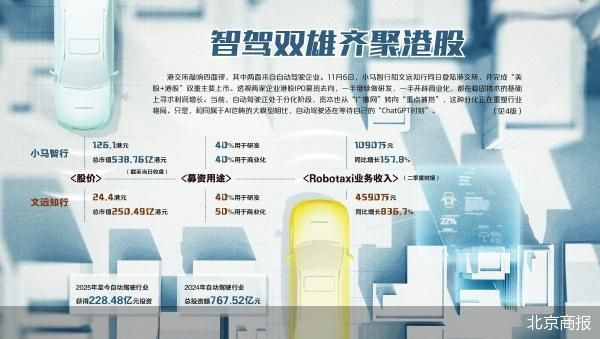
Core Viewpoint - The recent IPOs of autonomous driving companies Pony.ai and WeRide on the Hong Kong Stock Exchange have seen disappointing stock performances, indicating a shift in market sentiment towards a more rational approach to the autonomous driving sector [1][3][4]. Company Performance - Pony.ai opened at HKD 124, down 10.8% from its IPO price of HKD 139, while WeRide opened at HKD 24.98, down 7.8% from its IPO price of HKD 27.1 [3][5]. - Despite the initial drop, both companies have continued to make business progress, with ongoing exposure in the market since late October [1]. Market Sentiment - The autonomous driving sector is currently experiencing a phase of differentiation, with some companies like Didi and Hello attracting investments, while others like Zhongzhixing face bankruptcy [1][7]. - Analysts suggest that the market is transitioning from a broad investment approach to a more focused strategy, emphasizing the importance of technology routes, business models, and data handling [8]. Investment and Funding - The autonomous driving industry has seen significant investment, with a total of CNY 228.48 billion from 2025 to the present, and CNY 767.52 billion in 2024 [7]. - Pony.ai plans to allocate 50% of its IPO proceeds to market entry strategies and 40% to R&D for L4 autonomous driving technology, while WeRide intends to use 40% for technology development and 40% for commercial scaling [10]. Future Outlook - Industry experts believe that the autonomous driving sector is still in a transitional phase, waiting for a breakthrough similar to the "ChatGPT moment" in AI, with the potential for significant market shifts as technology matures [11].

301181,终止筹划控制权变更!
Zheng Quan Shi Bao Wang· 2025-11-06 16:09
Market Performance - The A-share market saw all three major indices rise, with the Shanghai Composite Index surpassing 4000 points, increasing by 0.97% [1] - The Shenzhen Component Index rose by 1.73%, and the ChiNext Index increased by 1.84% [1] - The total market turnover reached 2.08 trillion yuan, an increase of over 180 billion yuan compared to the previous trading day [1] - More than 2800 stocks closed higher, with 72 stocks hitting the daily limit up [1] Sector Performance - The phosphorus chemical sector led the gains, with stocks like Qing Shui Yuan, Chengxing Co., and Batian Co. hitting the daily limit up [1] - Other sectors that saw gains included industrial metals, state-owned fund holdings, and agricultural chemical products [1] - Conversely, sectors such as Hainan Free Trade Zone, horse racing concepts, and film and television line concepts experienced significant declines [1] Historical Highs - A total of 63 stocks reached historical closing highs, excluding newly listed stocks from the past year [2] - The electric equipment, electronics, and machinery equipment industries had a concentration of stocks reaching new highs, with 17, 11, and 7 stocks respectively [2] - The average increase for stocks that reached historical highs was 5.55%, with stocks like Liande Co., Chunzong Technology, and Zhenhua Co. hitting the daily limit up [2] Institutional Activity - In the top stocks by net buying, 9 stocks were net bought, with 8 stocks seeing net purchases exceeding 10 million yuan [3] - Hai Ke Xin Yuan topped the list with a net buying amount of 176 million yuan, followed by Huasheng Lithium Battery, Zhongneng Electric, and Maigemi Te, each with net purchases over 30 million yuan [3] - On the selling side, Weichai Power faced the highest net selling at 143 million yuan, followed by N Daming and Dawi Co. with net sales of 105 million yuan and 90 million yuan respectively [4] Northbound Capital - Northbound capital saw net buying in 14 stocks, with Yuanjie Technology and Dongshan Precision leading with amounts exceeding 440 million yuan [4] - Conversely, 6 stocks experienced net selling, with popular stocks like Yue Media and Weichai Power seeing net outflows exceeding 37 million yuan [5] Corporate Announcements - Marking Co. announced the termination of control change planning and resumed trading [6] - Zhi Yuan Heng Yue completed a tender offer acquisition, increasing its stake to 58.62% and will independently develop its business in intelligent robotics [7] - Zhenhua Co. reported that three directors collectively reduced their holdings by 64,000 shares during a period of abnormal stock trading [8] Business Developments - Weichai Power plans to establish production lines for batteries and stacks for fixed power generation markets, targeting AI data centers [9] - Baijishenzhou reported a net profit of 1.139 billion yuan for the first three quarters of 2025 and adjusted its revenue forecast to between 36.2 billion yuan and 38.1 billion yuan [9] - Lichong Group's subsidiary is set to introduce strategic investors to accelerate its business layout in solid-state batteries [9] - Zhidong Technology has developed dual-screen AR glasses with a target energy density for solid-state batteries exceeding 500 Wh/kg [10]
公司互动丨这些公司披露在机器人、通信等方面最新情况
Di Yi Cai Jing· 2025-11-06 14:26
Robotics - Yuexin Health has established a joint venture with Jinshi Robotics to jointly develop robots in the health and wellness sector [1] - BYD is actively focusing on the field of embodied intelligent robots and is laying out future industries [1] - Huayang Group is advancing its supporting cooperation business in the robotics sector [1] - Lianchuang Electronics has shipped optical products related to humanoid robots, but sales remain low [1] Battery - Haimuxing has completed the entire process for mass production of lithium metal solid-state batteries [1] Communication - Fenghuo Communication is in the pilot verification and small-scale commercial use phase for hollow-core optical fibers [1] - Tianfu Communication faced production and delivery challenges in the third quarter due to personnel or material shortages and is actively coordinating to increase output [1] PCB - Shiyun Circuit plans to build a new generation PCB intelligent manufacturing base project, expected to be operational by mid-2026 [2] - Shennand Circuit has HDI process capabilities in its PCB business [2] Electrical Equipment - Zhenjiang Co. continues to ship steel structure products such as gas turbine generator bases and shells for overseas gas turbine customers [1] - KOTAI Power can produce gas generator sets [1] Other - Rockchip has multiple clients launching AI toy products based on the company's main control chips [1] - Fu'ao Co. has no plans for A and B share mergers [1] - Water Co.'s special PTFE materials have been used in nuclear power facilities and ultra-high voltage fields [1] - Fuwei Co. has no plans to acquire Hongqi Automobile [1] - Xinheng has begun sales of liquid methionine products [1] - Changchun Gaoxin focuses on traditional advantages and innovative directions in endocrine metabolism, with over 40 candidate drugs in clinical stages or submitted for IND [1] - Huasen Pharmaceutical's special medical food production line will gradually release capacity [1]

瑞芯微(603893.SH):公司的主要芯片产品是通用型SoC 可应用在AI玩具产品上
Ge Long Hui· 2025-11-06 11:06
Core Viewpoint - The company, Rockchip (瑞芯微), is focusing on its general-purpose SoC chips, which are being utilized in AI toy products by multiple clients [1] Group 1 - The main chip products of the company are general-purpose SoC [1] - Several clients are launching AI toy products based on Rockchip's main control chips that integrate AI large models [1]

瑞芯微:有多家客户基于公司主控芯片推出接入AI大模型的AI玩具产品
Zheng Quan Shi Bao Wang· 2025-11-06 10:48
Core Viewpoint - The company, 瑞芯微 (Rockchip), has announced that its main chip products are general-purpose SoCs, which can be applied in AI toy products, with multiple clients launching AI toy products based on Rockchip's main control chips [1] Group 1 - The primary products of the company are general-purpose SoCs [1] - The company's chips are being utilized in AI toy products [1] - Several clients are developing AI toy products that integrate AI large models using Rockchip's main control chips [1]