全国统一大市场

Search documents
2025中国国际矿业大会将创设矿业权转让大市场
Xin Hua Wang· 2025-10-15 13:44
新华社北京10月15日电(记者王立彬)2025中国国际矿业大会将于10月23日至25日在天津举办,本届大 会创设了矿业权转让大市场,并将首次举办现场拍卖活动。 程利伟说,专场拍卖将设置"后核查"规则,给标的项目质量"托底",为竞买人消除后顾之忧。拍卖确定 买受人后,给予项目买受人不超过180天的项目质量核查期,核查结果决定成交与否。举办这样一场别 开生面的展拍活动,为矿业权找市场、为资本找项目,探索激活国内矿业权交易市场的路径与模式。 当前,国内矿业权流转受限于行政边界,交易规则差异和地方保护因素导致跨省交易成本高企。探索统 一的矿业权转让大市场,统一交易规则与信息披露机制,有助于促进东部资本与西部资源高效对接,实 现资本与矿业权精准匹配,提升国家资源安全保障能力。 【纠错】 【责任编辑:谷玥】 中国矿业联合会主办的这一展会将刷新创办以来的规模纪录,预计27个国家和地区的近500家国内外企 业将参展,占地超5万平方米。作为世界四大矿业展会之一,本届大会将展现全球矿业发展活力与前沿 方向,参展矿业权推介板块涵盖非洲、中东、中亚以及亚太等全球主要矿产资源富集区域,为全球矿业 投资与合作搭建高效对接桥梁。 中国矿业 ...
财经聚焦丨核心CPI重回1%,9月物价数据透出哪些信号?
Xin Hua Wang· 2025-10-15 13:01
Core Insights - The core Consumer Price Index (CPI) has returned to a 1% year-on-year increase in September, marking the first time in 19 months that the growth rate has reached this level, indicating a stabilization in prices [2][4] - The Producer Price Index (PPI) shows a 2.3% year-on-year decline in September, but the rate of decline has narrowed by 0.6 percentage points compared to the previous month, reflecting improvements in market conditions [5][6] Group 1: CPI Analysis - The CPI increased by 0.1% month-on-month in September, with food prices rising by 0.7%, contributing approximately 0.13 percentage points to the CPI increase [2] - The year-on-year CPI decline of 0.3% was primarily influenced by base effects from the previous year, with the tail effect accounting for approximately -0.8 percentage points [4] Group 2: PPI Insights - The narrowing decline in PPI is attributed to the effectiveness of macroeconomic policies and the ongoing development of a unified national market, which has improved price stability in various industries [5][6] - Specific industries such as coal processing and black metal smelting have shown price increases, with coal processing prices rising by 3.8% month-on-month [6] Group 3: Emerging Industries and Consumption Trends - New emerging industries are thriving, with innovative consumption models driving positive price changes in related sectors [7][10] - The demand for quality consumption is increasing, with significant price increases in sectors such as arts and crafts (14.7% year-on-year) and sports equipment (4% year-on-year) [10]


9月份核心CPI连续5个月回升 PPI环比持平
Yang Shi Wang· 2025-10-15 12:26
央视网消息(新闻联播):国家统计局10月15日发布的数据显示,9月份,我国消费市场运行总体平稳,居民消费价格指数(CPI)环比上涨0.1%。扣除食 品和能源价格的核心CPI同比上涨1.0%,涨幅连续第5个月扩大。其中,扣除能源的工业消费品价格上涨1.8%,服务价格上涨0.6%。 现代化产业体系加快构建,制造业高端化、智能化、绿色化发展向好,市场需求稳步扩大,带动飞机制造、电子专用材料制造等行业价格同比上涨。 随着全国统一大市场建设纵深推进,市场竞争秩序持续优化,带动部分行业价格明显企稳,工业生产者出厂价格指数(PPI)环比继续持平,同比降幅比上 月收窄0.6个百分点。 ...

李强主持国务院第十六次专题学习:强化人工智能等数字技术赋能,系统推进标准制定修订
Hua Er Jie Jian Wen· 2025-10-15 11:36
Group 1 - The core viewpoint emphasizes the need to optimize standard supply closely aligned with the actual economic and social development, prioritizing urgent needs and gradually enhancing standards [1] - The implementation of standards should be strengthened through strict supervision and optimized services, utilizing inspection, testing, and certification to promote adherence to standards [1] - There is a focus on enhancing the internationalization of standards, deepening international cooperation, and steadily expanding the openness of standard systems [1] Group 2 - The importance of reform and innovation as a driving force for continuous improvement in standardization work systems and overall standard levels is highlighted [1] - The relationship between government and market should be managed effectively, with government departments playing a guiding role while supporting market forces in standard development [1] - Clarification of the roles of national and local standards is necessary to streamline standard levels and eliminate barriers to a unified national market [1]
1%!近19个月首次!
Zheng Quan Shi Bao Wang· 2025-10-15 03:28
Core Insights - The overall consumer market in September remained stable, with CPI rising 0.1% month-on-month and falling 0.3% year-on-year, while core CPI excluding food and energy prices increased by 1.0%, marking the fifth consecutive month of growth [1][2][3] CPI Analysis - The year-on-year decline in CPI of 0.3% was primarily due to the tail effect, with a contribution of approximately -0.8 percentage points from this effect, while new price changes contributed about 0.5 percentage points [1][3] - Food prices decreased by 4.4% year-on-year, significantly impacting CPI, with pork prices down 17.0% and fresh vegetables down 13.7% [3][8] - Core CPI's year-on-year increase of 1.0% is the first time it has returned to 1% in nearly 19 months, indicating a potential stabilization in consumer prices [1][3] PPI Analysis - The PPI remained flat month-on-month for two consecutive months, with a year-on-year decline of 2.3%, which is a narrowing of the decline by 0.6 percentage points compared to the previous month [1][6][10] - The improvement in supply-demand structure has led to price stabilization in certain industries, such as coal processing and black metal smelting, which saw price increases of 3.8% and 0.2% respectively [4][6] - Input factors, particularly the decline in international oil prices, have negatively impacted domestic oil-related industry prices [4][5] Price Changes by Category - In September, food and beverage prices fell by 2.6% year-on-year, contributing approximately 0.74 percentage points to the CPI decline [8] - The prices of various goods and services showed mixed results, with some categories like other goods and services, and clothing prices increasing by 9.9% and 1.7% respectively [8][9] - The prices of industrial producer goods showed a decline in production materials by 2.4%, with significant drops in mining and raw materials sectors [11][12]
核心CPI同比涨幅连续5个月扩大,“反内卷”带动相关行业价格改善
Di Yi Cai Jing· 2025-10-15 02:16
Core Insights - The Consumer Price Index (CPI) and Producer Price Index (PPI) have shown a narrowing decline in September, benefiting from low base effects and the effectiveness of anti-involution and consumption promotion policies [1][3]. CPI Analysis - In September, the CPI increased by 0.1% month-on-month, while the year-on-year decline was 0.3%, a reduction of 0.1 percentage points from the previous month [1]. - The core CPI, excluding food and energy, rose by 1.0% year-on-year, marking the first return to a 1% increase in nearly 19 months [1][3]. - Food prices fell by 4.4%, contributing significantly to the overall CPI decline, with the tail effect accounting for approximately -0.8 percentage points of the CPI change [3]. PPI Analysis - The PPI remained flat month-on-month for two consecutive months, with a year-on-year decline of 2.3%, narrowing by 0.6 percentage points from the previous month [1][5]. - Factors contributing to the PPI's performance include improved supply-demand structures and the impact of international oil price declines on domestic oil-related industries [5]. - Certain industries, such as coal processing and black metal smelting, saw reduced year-on-year price declines, contributing to a decrease in the overall PPI decline by approximately 0.34 percentage points [5]. Industry Trends - The modernization of the industrial system and the release of consumption potential have led to price increases in related industries, with aircraft manufacturing prices rising by 1.4% and electronic materials by 1.2% year-on-year [6]. - Policies aimed at boosting consumption are showing effects, with significant price increases in high-quality and upgraded consumer goods, such as a 14.7% rise in arts and crafts products [6]. - Analysts predict that the year-on-year decline in PPI may narrow to below -2.0% in the fourth quarter due to various supportive policies and market conditions [6].
国家统计局:9月份核心CPI同比涨幅持续扩大 PPI同比降幅继续收窄
Sou Hu Cai Jing· 2025-10-15 01:51
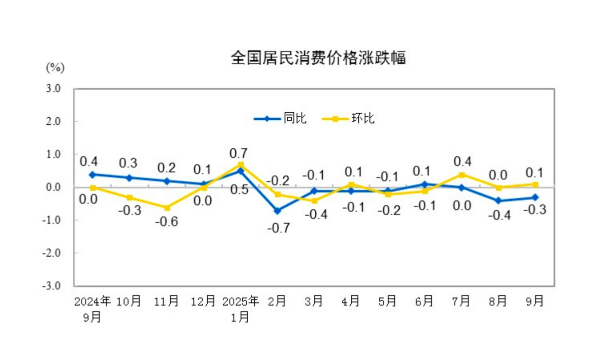
Group 1: CPI Analysis - The Consumer Price Index (CPI) increased by 0.1% month-on-month in September, marking a shift from the previous month where it was flat [2] - Year-on-year, the CPI decreased by 0.3%, with the decline narrowing by 0.1 percentage points compared to the previous month [3] - Core CPI, excluding food and energy, rose by 1.0% year-on-year, marking the fifth consecutive month of growth [3] Group 2: PPI Analysis - The Producer Price Index (PPI) remained flat month-on-month, continuing a trend for two months [4] - Year-on-year, the PPI decreased by 2.3%, with the decline narrowing by 0.6 percentage points compared to the previous month [5] - Improvements in supply-demand structure have stabilized prices in certain industries, such as coal processing and black metal smelting, which saw price increases [4][5]
核心CPI同比上涨1.0%,涨幅连续第5个月扩大
Guo Jia Tong Ji Ju· 2025-10-15 01:50
Group 1: CPI Analysis - The Consumer Price Index (CPI) increased by 0.1% month-on-month in September, marking a shift from the previous month where it was flat [2] - Year-on-year, the CPI decreased by 0.3%, with the decline narrowing by 0.1 percentage points compared to the previous month [3] - Core CPI, excluding food and energy, rose by 1.0% year-on-year, marking the fifth consecutive month of growth and the first time in 19 months that it returned to a 1% increase [3] Group 2: Food and Energy Prices - Food prices rose by 0.7% month-on-month, contributing approximately 0.13 percentage points to the CPI increase, with seasonal price increases observed in fresh vegetables, eggs, fresh fruits, lamb, and beef [2] - Year-on-year, food prices fell by 4.4%, primarily driven by significant declines in pork, fresh vegetables, eggs, and fresh fruits, which collectively impacted the CPI by approximately 0.78 percentage points [3] - Energy prices decreased by 2.7% year-on-year, contributing to a 0.20 percentage point decline in the CPI [3] Group 3: PPI Analysis - The Producer Price Index (PPI) remained flat month-on-month for two consecutive months, with a year-on-year decline of 2.3%, which is a reduction of 0.6 percentage points compared to the previous month [4][5] - The stabilization in PPI is attributed to improved supply-demand dynamics in certain industries, with notable price increases in coal processing and black metal smelting [4] - Input factors, particularly the decline in international oil prices, have led to decreased prices in domestic oil-related industries [5] Group 4: Industry-Specific Insights - The ongoing construction of a unified national market has contributed to a narrowing of price declines in various sectors, with significant improvements noted in coal processing, black metal smelting, and photovoltaic equipment manufacturing [5] - Upgrading industrial structures and releasing consumer potential have led to price increases in high-end manufacturing sectors, such as aircraft manufacturing and electronic materials [5]
人民日报丨加快建设全国统一电力市场
国家能源局· 2025-10-14 11:58
电力市场是全国统一大市场的重要组成部分。2021年,习近平总书记在中央全面深化改革委员会第二十二次会议上指 出:"要遵循电力市场运行规律和市场经济规律,优化电力市场总体设计,实现电力资源在全国更大范围内共享互济和优化 配置,加快形成统一开放、竞争有序、安全高效、治理完善的电力市场体系。"这是构建现代能源体系、推动能源高质量发 展的重大部署,同时也为构建全国统一大市场提供了重要基础。我们要以习近平经济思想为指引,加快建设全国统一电力 市场,促进电力资源优化配置、构建现代能源体系、推动能源高质量发展,为以中国式现代化全面推进强国建设、民族复 兴伟业提供有力支撑。 建设全国统一电力市场是建设全国统一大市场、推动高质量发展的探索实践 建设全国统一大市场是发挥我国超大规模市场优势的内在要求。习近平总书记在《关于构建新发展格局》中指出:"从供给 看,我国基于国内大市场形成的强大生产能力,能够促进全球要素资源整合创新,使规模效应和集聚效应最大化发挥。"电 力是经济社会发展的基础性支撑,电力资源的优化配置关乎能源安全与高质量发展大局。建设全国统一电力市场是深化电 力体制改革的重要举措,有利于促进电力资源优化配置、保障电力供应 ...

理响中国丨全国统一大市场的“那些事”
Xin Hua Wang· 2025-10-14 05:35
Core Insights - The construction of a nationwide unified market in China is crucial for countering uncertainties in international circulation by leveraging the certainty of domestic circulation [2][3] - The achievements during the "14th Five-Year Plan" period highlight the acceleration of building a unified market, showcasing the internal circulation advantages of a large economy [3][5] Summary by Sections Importance of the Unified Market - The unified market is essential as it addresses the need for a stable domestic economy amidst changing external conditions, promoting the smooth flow of resources across regions [2][3] - The market resources are identified as a significant advantage for China, which must be fully utilized to support the new development pattern [2] Achievements During the "14th Five-Year Plan" - The construction of the unified market has gained momentum, with significant contributions from both supply and demand sides, enhancing market vitality [3] - The establishment of a unified electricity market has been a notable achievement, with market-based trading accounting for 63% of total electricity consumption by 2024 [5] Infrastructure and Logistics Development - The development of high-standard infrastructure has accelerated, significantly reducing transaction costs across the economy [6] - The logistics network has expanded, with the total operational mileage of the national transportation network increasing by over 300,000 kilometers compared to the previous five-year plan [6] Consumer Market Dynamics - Consumer spending has contributed an average of 56.2% to economic growth during the "14th Five-Year Plan," with retail sales expected to exceed 50 trillion yuan by 2025 [6] - New consumption trends are emerging, including digital consumption and AI-driven purchasing, indicating a shift towards innovative market dynamics [6] Reform and Open Market Strategies - The key to achieving the unified market's goals lies in reforming the relationship between government and market, fostering a fair competitive environment [7] - The government has streamlined market access regulations, reducing the negative list of market entry by one-third, thus enhancing efficiency [7][10] - The focus on high-level institutional openness aims to create a world-class business environment, facilitating international trade and investment [10]