
宏观审慎管理

Search documents
央行重磅发文:稳妥有序推进金融领域人工智能大模型应用
Di Yi Cai Jing· 2025-11-11 11:23
Core Viewpoint - The People's Bank of China (PBOC) has implemented a moderately accommodative monetary policy in 2023, aiming to create a favorable monetary and financial environment for economic recovery and market stability [1][2]. Group 1: Monetary Policy Implementation - The PBOC has maintained reasonable growth in monetary credit by utilizing various tools such as open market operations and medium-term lending facilities to ensure ample liquidity [1][2]. - The central bank aims to reduce the overall financing costs in society by enhancing the market-oriented interest rate adjustment framework, leading to a decline in both deposit and loan rates [1][2]. - The PBOC is focusing on optimizing the credit structure by utilizing 500 billion yuan for consumer services and elderly care, as well as increasing the loan quotas for technological innovation and transformation [1][3]. Group 2: Financial Stability and Risk Management - The PBOC emphasizes the importance of risk prevention and resolution, enhancing the monitoring and assessment systems for financial risks [2][6]. - The central bank plans to maintain a reasonable growth of financial aggregates while ensuring that social financing conditions remain relatively loose [2][6]. - A comprehensive macro-prudential management system is being constructed to monitor and manage systemic financial risks effectively [6]. Group 3: Interest Rate and Exchange Rate Management - The PBOC is advancing interest rate marketization reforms to improve the transmission channels of monetary policy and enhance the pricing capabilities of financial institutions [4]. - The central bank aims to maintain the stability of the RMB exchange rate by ensuring that the market plays a decisive role in its formation [4][5]. Group 4: Financial Market Development - The PBOC is promoting the development of a multi-tiered bond market and enhancing the legal framework for corporate bonds to support financing for private technology enterprises [5]. - Efforts are being made to internationalize the RMB and expand its use in cross-border trade and investment [5].
央行披露下一阶段货币政策主要思路
Wind万得· 2025-11-11 09:35
Core Viewpoint - The People's Bank of China (PBOC) emphasizes the need for a balanced monetary policy that supports economic growth while managing risks, focusing on enhancing financial support for consumption and developing the bond market to aid private technology enterprises [5][6][8]. Group 1: Monetary Policy Direction - The PBOC aims to maintain reasonable growth in financial aggregates and implement a moderately loose monetary policy to ensure social financing conditions remain relatively relaxed [5][6]. - The central bank will closely monitor changes in overseas monetary policies and adjust its strategies accordingly to maintain liquidity in the banking system [5][6]. Group 2: Financial Support for Key Areas - The PBOC plans to enhance financial support for technology, green finance, inclusive finance, and the elderly finance sectors, focusing on supporting national strategic initiatives and addressing weak links in the economy [6][9]. - There will be a push to expand financial supply in the consumption sector and implement policies to support personal credit repair, aiming to unlock consumption potential [6][9]. Group 3: Interest and Exchange Rate Management - The PBOC will deepen interest rate marketization reforms and improve the transmission channels of monetary policy, ensuring that market forces play a decisive role in interest rate formation [7][9]. - The central bank will also work on stabilizing the RMB exchange rate at a reasonable equilibrium level while enhancing the risk management capabilities of enterprises and financial institutions [7][9]. Group 4: Development of Financial Markets - The PBOC is focused on developing a "technology board" in the bond market to support private technology enterprises and improve the legal framework for corporate bonds [8]. - There will be efforts to expand the multi-tiered bond market and enhance the regulation of issuance, pricing, and underwriting practices [8]. Group 5: Financial Risk Management - The PBOC aims to establish a comprehensive macro-prudential management system to monitor and mitigate systemic financial risks, enhancing the resilience of the financial market [9]. - The central bank will also work on improving the regulatory framework for systemically important financial institutions and expand the coverage of additional regulatory measures to non-bank sectors [9].


央行:拓展丰富中央银行宏观审慎与金融稳定功能
Zheng Quan Shi Bao Wang· 2025-11-11 09:30
Core Viewpoint - The People's Bank of China emphasizes the importance of actively and prudently preventing and resolving financial risks, while enhancing the macro-prudential management system and mechanisms for systemic financial risk prevention and disposal [1] Group 1: Macro-Prudential Management - The report highlights the need to strengthen monitoring, assessment, and early warning of systemic financial risks from macro, counter-cyclical, and contagion perspectives [1] - It calls for the expansion of the macro-prudential policy toolbox and the continuous broadening of its coverage [1] Group 2: Financial Stability and Innovation - The central bank aims to enhance its macro-prudential and financial stability functions by innovating financial tools to maintain stable financial market operations [1] - There is a focus on strengthening macro-prudential management for systemically important financial institutions and advancing the construction of an additional regulatory system [1] Group 3: Risk Management and Reform - The report emphasizes the need for systemically important banks to improve recovery and disposal plans and to explore the proactive role of risk management guidance [1] - It advocates for the gradual expansion of additional regulatory coverage to the non-bank sector and the prudent advancement of reforms for small and medium-sized financial institutions [1] Group 4: Crisis Management and Resource Allocation - The establishment of a cross-border crisis management group mechanism for globally systemically important banks is highlighted, along with the need for enhanced cross-border regulatory cooperation and information sharing [1] - The report suggests increasing risk disposal resources, expanding the accumulation of deposit insurance funds and financial stability guarantee funds, and exploring the establishment of backup financing mechanisms [1]
央行:拓展丰富中央银行宏观审慎与金融稳定功能 创新金融工具
Feng Huang Wang· 2025-11-11 09:23
Core Viewpoint - The People's Bank of China emphasizes the need for proactive and prudent measures to prevent and resolve financial risks in the upcoming phase, focusing on a comprehensive macro-prudential management system and mechanisms for systemic financial risk prevention and resolution [1] Group 1: Macro-Prudential Management - A comprehensive macro-prudential management system will be constructed to monitor, assess, and warn against systemic financial risks from macro, counter-cyclical, and contagion perspectives [1] - The toolbox for macro-prudential policies will be enriched, and the coverage of macro-prudential measures will be continuously expanded [1] Group 2: Financial Stability - The central bank will enhance its macro-prudential management functions and innovate financial tools to maintain stable financial market operations [1] - Systemically important financial institutions will undergo strengthened macro-prudential management, with a focus on advancing the additional regulatory framework [1] Group 3: Risk Management and Cooperation - The additional regulatory framework for systemically important banks will be further solidified, guiding selected banks to continuously improve their recovery and resolution plans [1] - A cross-border crisis management group mechanism for globally systemically important banks will be established to enhance cross-border regulatory cooperation and information sharing [1] Group 4: Non-Bank Financial Institutions - The coverage of additional regulation will be gradually expanded to the non-bank sector [1] - The reform of small and medium-sized financial institutions will be cautiously advanced under market-oriented and rule-of-law principles, with a focus on improving risk disposal responsibility mechanisms [1] Group 5: Risk Disposal Resources - Resources for risk disposal will be enriched, including the continued expansion of the deposit insurance fund and financial stability guarantee fund [1] - Exploration of establishing a backup financing mechanism will be undertaken [1]
央行:拓展丰富中央银行宏观审慎与金融稳定功能,创新金融工具,维护金融市场平稳运行
Sou Hu Cai Jing· 2025-11-11 09:23
Core Viewpoint - The People's Bank of China (PBOC) emphasizes the need to actively and prudently prevent and resolve financial risks, aiming to enhance the macro-prudential management system and the mechanisms for systemic financial risk prevention and resolution [1] Group 1: Macro-Prudential Management - The PBOC plans to strengthen the monitoring, assessment, and early warning of systemic financial risks from macro, counter-cyclical, and contagion perspectives [1] - There will be an expansion of the macro-prudential policy toolbox and an increase in the coverage of macro-prudential measures [1] Group 2: Financial Stability - The central bank aims to enhance its macro-prudential and financial stability functions, innovate financial tools, and maintain stable operation of financial markets [1] - Systemically important financial institutions will undergo strengthened macro-prudential management, with a focus on advancing the additional regulatory framework [1] Group 3: Risk Management and Cooperation - The PBOC will guide selected banks to continuously improve their recovery and resolution plans, exploring the proactive role of risk management [1] - There will be improvements in the cross-border crisis management group mechanism for globally systemically important banks, enhancing cross-border regulatory cooperation and information sharing [1] Group 4: Non-Bank Financial Institutions - The additional regulatory coverage will gradually expand to the non-bank sector, with a focus on reforming and mitigating risks in small and medium-sized financial institutions under market-oriented and rule-of-law principles [1] - A responsibility mechanism that aligns incentives and accountability will be established to strictly prevent moral hazards [1] Group 5: Risk Disposal Resources - The PBOC plans to enrich risk disposal resources, continue to expand the accumulation of the deposit insurance fund and the financial stability guarantee fund, and explore the establishment of a backup financing mechanism [1]
覆盖全面的宏观审慎管理体系加速构建
Shang Hai Zheng Quan Bao· 2025-11-03 18:16
Core Viewpoint - The construction of a comprehensive macro-prudential management system is crucial during the "14th Five-Year Plan" period to enhance risk monitoring and prevention capabilities in the financial sector [2][3]. Group 1: Macro-Prudential Management System - The People's Bank of China (PBOC) is focusing on strengthening the monitoring and assessment of systemic financial risks, improving risk prevention measures for key institutions and sectors, and expanding the macro-prudential management toolbox [3][4]. - The macro-prudential management system aims to address structural risks such as real estate and local government debt, as well as risks associated with small and medium-sized financial institutions [3][4]. - The PBOC plans to split the Macro-Prudential Assessment (MPA) framework into two parts: one focusing on monetary policy execution and the other on macro-prudential and financial stability assessments [4]. Group 2: Tools and Mechanisms - There is a potential exploration of providing liquidity support mechanisms to non-bank financial institutions under specific scenarios, which could enhance financial stability [4][5]. - Future developments may include dynamic leverage ratio tools based on risk exposure, cross-border capital flow adjustment taxes, and dynamic adjustments to mortgage prudential coefficients [5]. - The introduction of new tools such as climate-related financial risk assessments and cybersecurity stress tests is anticipated to be integrated into the broader macro-prudential framework [5].
阻断金融风险跨机构跨市场传染 覆盖全面的宏观审慎管理体系加速构建
Shang Hai Zheng Quan Bao· 2025-11-03 18:16
Core Viewpoint - The construction of a comprehensive macroprudential management system will be a key focus for China's financial development during the 14th Five-Year Plan period, as highlighted in the Central Committee's suggestions for the 14th Five-Year Plan [1][5]. Summary by Relevant Sections Macroprudential Management - Macroprudential management focuses on maintaining the overall stability of the financial system and mitigating systemic risks that can spread across institutions and markets [2][3]. - It differs from monetary policy, which targets macroeconomic demand, and microprudential regulation, which focuses on the stability of individual financial institutions [1][2]. Current Economic Context - The complexity and interconnectedness of the global financial system have increased, necessitating a comprehensive macroprudential management system to prevent financial contagion [1][6]. - China's transition to a high-quality development phase requires enhanced monitoring and early warning systems for financial cycles, macro leverage ratios, and risks associated with key financial institutions and markets [6][7]. Existing Framework and Tools - China has established a macroprudential assessment (MPA) framework, which includes tools for assessing systemic importance, cross-border financing adjustments, and real estate financial management [4][6]. - The MPA effectively guides banks in rational credit allocation and risk control through multi-dimensional assessments of capital adequacy, leverage ratios, liquidity, and asset quality [4][6]. Future Directions - The People's Bank of China plans to enhance the macroprudential management toolbox by focusing on monitoring systemic risks, improving risk prevention measures for key institutions, and developing a more systematic and practical governance mechanism [7][8]. - Potential new tools may include dynamic leverage ratio tools, cross-border capital flow adjustment taxes, and mechanisms for providing liquidity support to non-bank financial institutions under specific conditions [8].
金融行业周报:十五五规划建议发布,金融街论坛年会召开-20251103
Ping An Securities· 2025-11-03 07:34
Investment Rating - The industry investment rating is "Outperform the Market," indicating an expected performance that exceeds the CSI 300 index by more than 5% over the next six months [38]. Core Insights - The report emphasizes the continuous advancement of financial power construction as outlined in the 14th Five-Year Plan, focusing on enhancing the central bank's role and promoting financial stability and risk management [3][11]. - The Financial Street Forum highlighted key policy signals from major financial regulators, including the People's Bank of China, which will maintain liquidity and support economic recovery [5][14]. - The report notes a significant increase in weekly stock trading volume, with average daily transactions reaching 28.83 trillion yuan, reflecting a 23.7% increase from the previous week [26][24]. Summary by Sections 1. Focus Areas - The 14th Five-Year Plan suggests a deepening of financial reforms, including the enhancement of the central bank's system and the promotion of direct financing through capital market development [11]. - The plan also emphasizes the importance of developing technology finance, green finance, and digital currency, alongside improving financial infrastructure and regulatory frameworks [11][12]. 2. Industry Data - Banking sector: The central bank's open market operations resulted in a net injection of 1.2008 trillion yuan, with SHIBOR rates showing slight increases [22]. - Securities sector: The average daily trading volume of stock funds reached 28.83 trillion yuan, marking a significant increase [26]. - Insurance sector: The yield on ten-year government bonds decreased by 5.32 basis points, indicating a favorable environment for insurance investments [34]. 3. Market Performance - The banking, securities, and insurance indices experienced declines of -2.16%, -0.53%, and -0.89% respectively, while the fintech index rose by 1.92% [10][16]. - Notable performers included Xiamen Bank and Dongxing Securities, which saw increases of 5.54% and 6.03% respectively [18][19].
货币市场日报:10月31日
Xin Hua Cai Jing· 2025-10-31 11:29
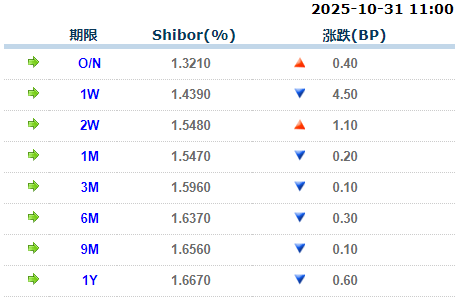
Monetary Policy Operations - The People's Bank of China (PBOC) conducted a 7-day reverse repurchase operation of 355.1 billion yuan at an interest rate of 1.40%, maintaining the previous rate [1] - With 168 billion yuan of reverse repos maturing on the same day, the net injection into the market was 187.1 billion yuan [1] - This week, the PBOC executed a total of 2.068 trillion yuan in reverse repos and 900 billion yuan in one-year Medium-term Lending Facility (MLF) operations, resulting in a total net injection of 1.4008 trillion yuan due to maturing repos and MLFs [1] Interbank Rates - The Shanghai Interbank Offered Rate (Shibor) showed slight fluctuations, with the overnight Shibor rising by 0.40 basis points to 1.3210%, while the 7-day Shibor fell by 4.50 basis points to 1.4390% [2][3] - The 14-day Shibor increased by 1.10 basis points to 1.5480% [2] Repo Market - In the interbank pledged repo market, the overnight rate slightly increased, while the 7-day and 14-day rates decreased [4] - The weighted average rate for DR001 rose by 0.7 basis points to 1.3184%, while DR007 and DR014 rates fell by 4.7 and 1.4 basis points, respectively [4] Market Liquidity - The funding environment was reported to be loose, with overnight funding rates declining throughout the day, reaching a range of 1.40% to 1.45% by the end of trading [9] - A total of 53 interbank certificates of deposit (CDs) were issued, amounting to 79.28 billion yuan [9] CD Market - In the primary CD market, trading was subdued, with rates for various maturities declining, particularly for the 1-month CD which fell by 7 basis points to around 1.41% [10] - The yield curve showed a widening in the spread between 1-year and 1-month CDs, indicating changes in market sentiment [10]
潘功胜:研究和储备应对宏观经济、金融市场波动等领域的政策工具,持续整治金融业“内卷式”竞争、资金空转
Hua Er Jie Jian Wen· 2025-10-31 05:35
Core Viewpoint - The article emphasizes the need for a scientific and robust monetary policy system and a comprehensive macro-prudential management framework to enhance the effectiveness of monetary policy in China [1] Group 1: Monetary Policy Mechanisms - The central bank aims to strengthen the role of policy interest rates and narrow the width of the short-term interest rate corridor to improve the transmission of monetary policy to market interest rates [2] - There is a focus on optimizing the monetary policy intermediate variables and maintaining reasonable growth in financial aggregates, while shifting attention from quantity targets to more observational and reference indicators [3] Group 2: Financial Sector Competition and Coordination - The article highlights the need to address "involution" competition and capital churn in the financial sector, while enhancing the effectiveness of monetary policy transmission [4] - It calls for better coordination between monetary policy and fiscal, industrial policies in managing demand and structural adjustments [4] Group 3: Macro-Prudential Tools - The central bank is encouraged to enrich and refine the toolbox of macro-prudential policy instruments to address issues in key areas such as systemically important financial institutions and cross-border capital flows [5] - A standardized and regulated management mechanism for the creation, implementation, evaluation, feedback, and optimization of these tools is proposed [5] Group 4: Exchange Rate Management - The article stresses the importance of allowing the market to play a decisive role in the formation of the RMB exchange rate while maintaining its flexibility to support macroeconomic stability [6] - It emphasizes the need for bottom-line thinking and expectation management to prevent excessive fluctuations in the exchange rate [6] Group 5: Risk Prevention and Economic Stability - The need for comprehensive risk prevention measures in key sectors to avoid significant fluctuations that could impact high-quality economic and financial development is highlighted [7] - The article advocates for timely interventions to correct market "herding effects" and promote a positive cycle between the real economy and financial markets [7] - It also emphasizes the importance of maintaining stability in the real estate market and balancing risk prevention with innovation in internet finance [8]