
开源模型

Search documents
X @外汇交易员
外汇交易员· 2025-12-10 14:18
AI Model Strategy Shift - Meta is shifting its focus from open-source AI models to closed-source AI models with profit potential [1] - Meta plans to launch a new closed-source model, codenamed "Avocado (牛油果)", next year to compete with OpenAI [1] Leadership & Team - Zuckerberg is becoming more involved in the daily operations of the AI team after assembling one of the most expensive teams in tech history [1] - Meta's new Chief AI Scientist, Alexandr Wang (汪滔), is an advocate for closed-source models [1]

20个企业级案例揭示Agent落地真相:闭源模型吃掉85%,手搓代码替代LangChain
3 6 Ke· 2025-12-10 12:12
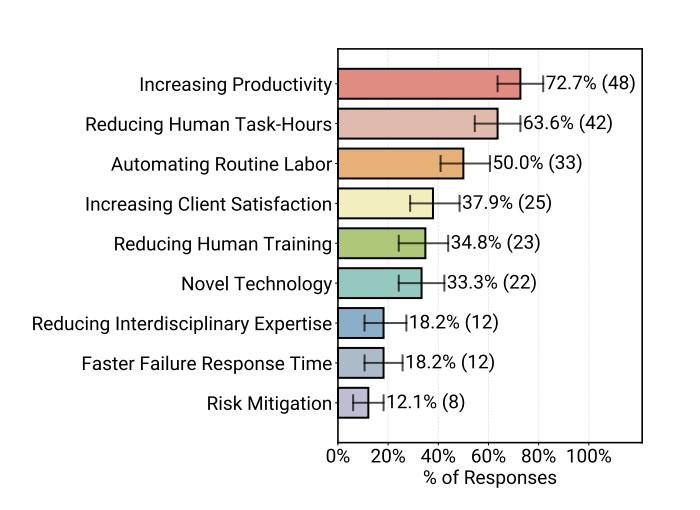
Core Insights - The report titled "Measuring Agents in Production" from UC Berkeley represents the largest empirical study in the AI Agent field, based on in-depth surveys of 306 practitioners and 20 enterprise-level deployment cases across 26 industries [1] Group 1: Purpose of AI Agents - 73% of practitioners indicate that the primary goal of deploying agents is to "increase productivity" [2] - Other practical motivations include 63.6% aiming to reduce manual labor hours and 50% for automating routine tasks, while qualitative benefits like "risk avoidance" (12.1%) and "accelerating fault response" (18.2%) rank lower [4] Group 2: Industry Applications - The financial and banking sector is the primary battleground for AI agents, accounting for 39.1%, followed by technology (24.6%) and enterprise services (23.2%) [9] - AI agents are also being utilized in unexpected areas such as automating insurance claims processes, biomedical workflow automation, and internal corporate operations support [9] Group 3: User Interaction and System Design - 92.5% of agents directly serve human users, with 52.2% serving internal employees, as errors are more manageable within organizations [11] - In production environments, 66% of systems allow for response times of minutes or longer, as this is still a significant efficiency gain compared to human task completion times [11] Group 4: Development Philosophy - The construction philosophy for production-grade AI agents emphasizes simplicity and reliability, with a preference for closed-source models like Anthropic's Claude and OpenAI's GPT series, used in 85% of cases [12][13] - 70% of cases utilize existing models without weight fine-tuning, focusing instead on crafting effective prompts [12][13] Group 5: Evaluation and Reliability Challenges - 75% of teams abandon benchmark testing due to the unique nature of each business, opting instead for custom benchmarks [21] - Reliability is identified as the primary challenge, with 37.9% of respondents citing it as a core technical issue, overshadowing compliance and governance concerns [26] Group 6: Constrained Deployment - The concept of "constrained deployment" is highlighted as a key to overcoming reliability challenges, involving environmental constraints and limiting agent autonomy to predefined workflows [28][29] - Human oversight remains crucial, with experts acting as final validators of agent outputs, ensuring a robust safety net [29]

100万亿Token揭示今年AI趋势,硅谷的这份报告火了
3 6 Ke· 2025-12-09 03:21
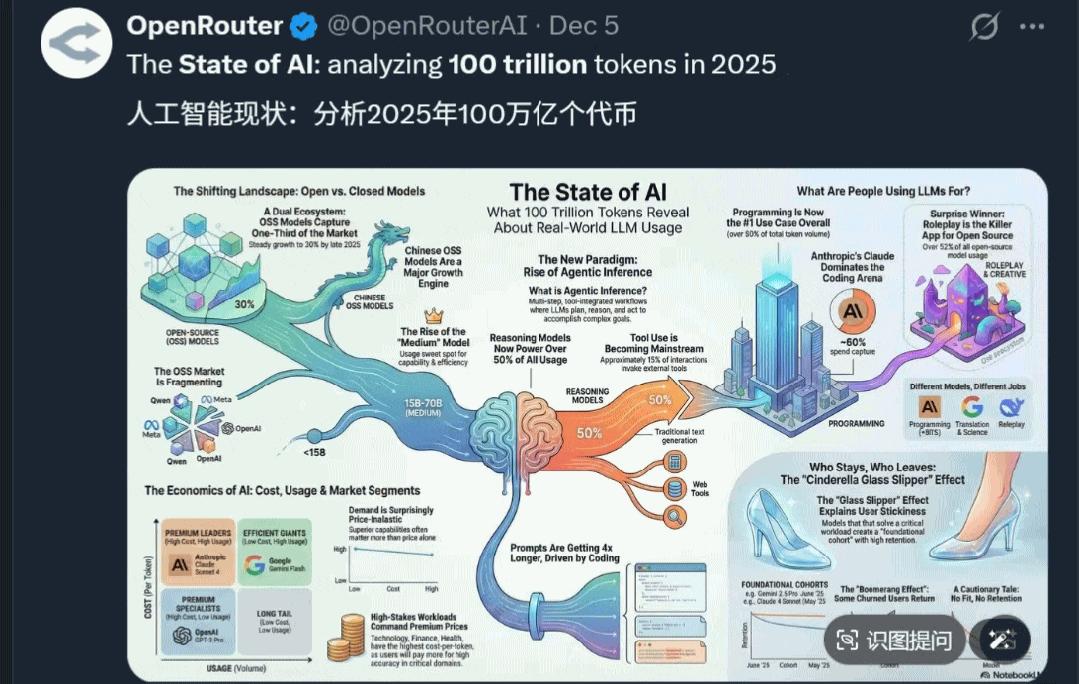
Core Insights - The report titled "State of AI: An Empirical 100 Trillion Token Study with OpenRouter" analyzes the usage of over 300 models on the OpenRouter platform from November 2024 to November 2025, highlighting significant trends in AI development and the growing importance of open-source models [3][5]. Group 1: Open Source vs. Closed Source Models - Open-source models are expected to reach approximately one-third of total usage by the end of the year, complementing rather than competing with closed-source models [5][7]. - The share of Chinese open-source models surged from 1.2% to 30% in weekly usage, indicating a strong preference for domestic models [9]. - The dominance of DeepSeek as the largest contributor is diminishing as more open-source models enter the market, leading to a more diversified landscape by mid-2025 [12]. Group 2: Model Characteristics and Trends - The report categorizes models into large (700 billion parameters or more), medium (150 to 700 billion), and small (less than 150 billion), noting a shift towards medium and large models as small models lose popularity [15]. - Language models are evolving from dialogue systems to reasoning and execution systems, with reasoning token usage exceeding 50% [18][19]. - The use of tools within models is increasing, indicating a more competitive and diverse ecosystem [24]. Group 3: Usage Patterns and User Retention - AI model usage has shifted from simple tasks to more complex problem-solving, with average input prompts increasing fourfold [26][30]. - The concept of "Cinderella effect" describes how users may quickly adopt new models that perfectly meet their needs, leading to high retention rates for successful models [57][59]. - Programming and role-playing are now the primary use cases for AI models, with programming queries rising from 11% to over 50% [36][40]. Group 4: Market Dynamics and Regional Insights - The paid usage of AI in Asia has doubled from 13% to 31%, while North America's market share has fallen below 50% [61]. - English remains the dominant language in AI usage at 82%, with Simplified Chinese holding a 5% share [61]. - The impact of model pricing on usage is minimal, with a 10% price drop resulting in only a 0.5%-0.7% increase in usage [61].
100万亿Token揭示今年AI趋势!硅谷的这份报告火了
Xin Lang Cai Jing· 2025-12-08 12:28
Core Insights - The report titled "State of AI: An Empirical 100 Trillion Token Study with OpenRouter" analyzes the usage of over 300 AI models on the OpenRouter platform from November 2024 to November 2025, focusing on real token consumption rather than benchmark scores [3][5][67] - It highlights the significant rise of open-source models, particularly from China, which saw weekly token usage share increase from 1.2% to 30%, indicating a shift towards a complementary relationship between open-source and closed-source models [2][10][74] - The report emphasizes the transition of AI models from language generation systems to reasoning and execution systems, with reasoning models becoming the new paradigm [18][83] Open-Source vs Closed-Source Models - Open-source models are no longer seen merely as alternatives to closed-source models; they have carved out unique positions and are often preferred in specific scenarios [6][70] - By the end of 2025, it is expected that open-source models will account for approximately one-third of total usage, reflecting a more integrated approach by developers who utilize both types of models [5][70] - The dominance of DeepSeek is diminishing as more open-source models enter the market, leading to a diversified landscape where no single model is expected to exceed 25% of token usage by the end of 2025 [13][77] Model Characteristics and Trends - The report identifies a shift towards medium-sized models, which are gaining market favor, while small models are losing traction [16][80] - The classification of models is as follows: large models (700 billion parameters or more), medium models (150 to 700 billion parameters), and small models (less than 150 billion parameters) [20][85] - The usage of reasoning tokens has surpassed 50%, indicating a significant evolution in how AI models are utilized for complex tasks [18][83] User Behavior and Model Utilization - AI model usage has evolved from simple tasks to more complex problem-solving, with user prompts increasing in length and complexity [27][92] - The concept of "crystal shoe effect" is introduced, where certain models lock in a core user base due to their unique capabilities, making it difficult for competitors to attract these users later [55][120] - Programming and role-playing have emerged as the primary use cases for AI models, with programming queries rising from 11% to over 50% [27][100] Market Dynamics - The report notes that the paid usage share of AI in Asia has doubled from 13% to 31%, while North America's share has fallen below 50% [129] - English remains the dominant language in AI usage at 82%, with Simplified Chinese holding nearly 5% [129] - The impact of model pricing on usage is less significant than anticipated, with a 10% price drop leading to only a 0.5%-0.7% increase in usage [129]

100万亿Token揭示今年AI趋势!硅谷的这份报告火了
量子位· 2025-12-08 11:36
Core Insights - The report titled "State of AI: An Empirical 100 Trillion Token Study with OpenRouter" analyzes the usage of over 300 models on the OpenRouter platform from November 2024 to November 2025, focusing on real token consumption rather than benchmark scores [3][6][8]. Group 1: Open Source vs. Closed Source Models - Open source models (OSS) have evolved from being seen as alternatives to closed source models to finding their unique positioning, becoming the preferred choice in specific scenarios [9]. - The relationship between open source and closed source models is now more complementary, with developers often using both types simultaneously [10]. - The usage of open source models is expected to reach approximately one-third by the end of 2025, with Chinese models experiencing significant growth from 1.2% to 30% in weekly usage share [12][13]. Group 2: Market Dynamics and Model Diversity - The dominance of DeepSeek as the largest contributor to open source model usage is diminishing as more models enter the market, leading to a diversified landscape [16]. - By the end of 2025, no single model is expected to maintain over 25% of token usage, with the market likely to be shared among 5 to 7 models [17][18]. - The report indicates a shift towards medium-sized models, which are gaining market favor, while small models are losing traction [20][21]. Group 3: Evolution of Model Functionality - Language models are transitioning from dialogue systems to reasoning and execution systems, with reasoning token usage surpassing 50% [22]. - The use of model invocation tools is increasing, indicating a more competitive and diverse ecosystem [29][31]. - AI models are evolving into "intelligent agents" capable of independently completing tasks rather than just responding to queries [43]. Group 4: Usage Patterns and User Retention - The complexity of tasks assigned to AI has increased, with users now requiring models to analyze extensive documents or codebases [35]. - The average input to models has quadrupled, reflecting a growing reliance on contextual information [36]. - The "glass slipper effect" describes how certain users become highly attached to models that perfectly meet their needs upon release, leading to high retention rates [67][70]. Group 5: Regional Insights and Market Trends - The share of paid usage in Asia has doubled from 13% to 31%, indicating a shift in the global AI landscape [71]. - North America's AI market share has declined to below 50%, while English remains dominant at 82%, with Simplified Chinese holding nearly 5% [80]. - The impact of model pricing on usage is less significant than expected, with a 10% price drop resulting in only a 0.5%-0.7% increase in usage [80].
a16z 100万亿Token研究揭示的真相:中国力量重塑全球AI版图
3 6 Ke· 2025-12-08 08:33
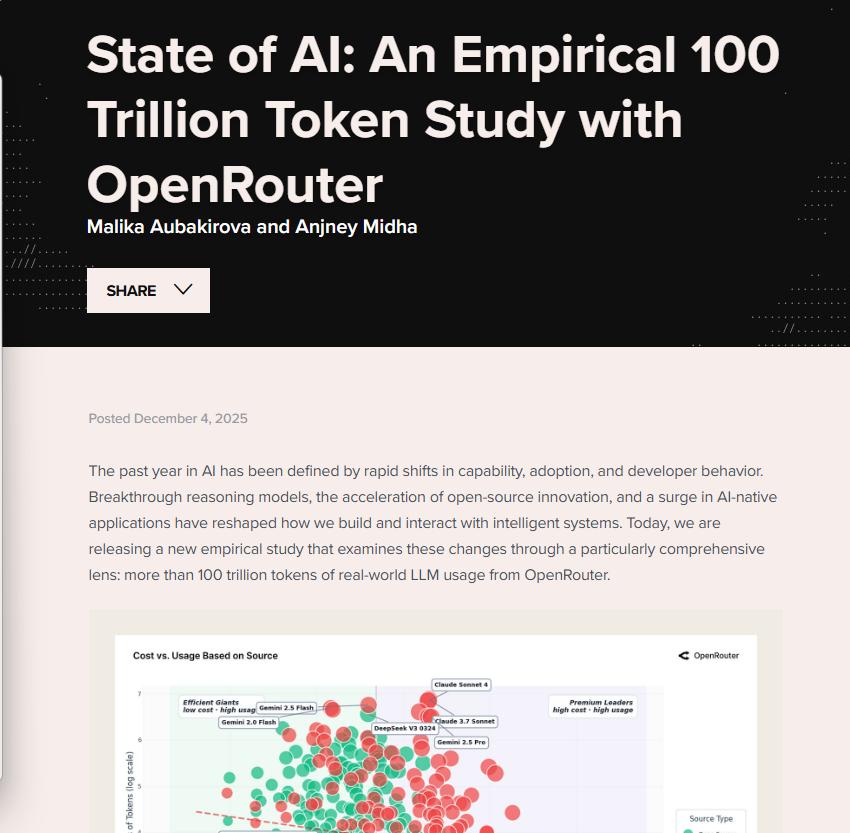
Core Insights - The report titled "State of AI: An Empirical 100 Trillion Token Study" by a16z analyzes over 100 trillion tokens from real-world applications on the OpenRouter platform, revealing the actual usage landscape of large language models (LLMs) [3] - The AI field is undergoing three fundamental shifts: moving from single model competition to a diversified ecosystem, transitioning from simple text generation to intelligent reasoning paradigms, and evolving from a Western-centric to a globally distributed innovation landscape [3] Group 1: Key Findings - The rise of open-source models, particularly from China, is notable, with market share increasing from 1.2% at the end of 2024 to nearly 30% in certain weeks by late 2025 [4][9] - Over half of the usage of open-source models is directed towards creative dialogue scenarios such as role-playing and story creation [4] - The volume of tokens processed by reasoning models has reached 50% of the total token volume [4] Group 2: Technological Advancements - The release of OpenAI's reasoning model o1 on December 5, 2024, marks a pivotal point in AI development, shifting from text prediction to machine reasoning [6] - The introduction of multi-step reasoning and iterative optimization in the o1 model significantly enhances capabilities in mathematical reasoning, logical consistency, and multi-step decision-making [6] Group 3: Open-Source Ecosystem - The open-source model ecosystem is becoming increasingly diverse, with no single model expected to dominate more than 25% of the market share by the end of 2025 [11] - The total token usage by various model developers shows a significant shift towards a more balanced distribution among multiple competitors [11][12] Group 4: User Engagement and Application - More than half of the open-source model usage is directed towards role-playing and creative tasks, indicating a strong demand for emotional connection and creative expression [15][17] - Programming-related queries are projected to grow steadily, with their share of total token volume increasing from approximately 11% at the beginning of 2025 to over 50% by the end of the year [17] Group 5: Global Trends - Asia's share of global AI usage has risen from about 13% to 31%, reflecting accelerated adoption of AI technologies and the maturation of local innovation ecosystems [23] - Chinese open-source models like DeepSeek and Qwen are gaining international recognition, contributing to the global AI landscape [24] Group 6: Market Dynamics - The AI market exhibits a complex value stratification rather than a simple cost-driven model, with high-end models maintaining significant usage despite high costs [29][30] - Open-source models are exerting pressure on closed-source providers, compelling them to justify their pricing through enhanced integration and support [32] Group 7: User Retention - The "Cinderella Glass Slipper" effect describes how users become deeply integrated with models that meet their high-value workload needs, leading to strong retention rates [33][35] - The DeepSeek model demonstrates a "boomerang effect," where users return after exploring other options, indicating its unique advantages in certain capabilities [35] Group 8: Future Outlook - The emergence of reasoning as a service is reshaping the AI infrastructure requirements, emphasizing the need for long-term dialogue management and complex functionality [22][36] - The report serves as a reference for future technological evolution, product design, and strategic planning based on real-world data [36]
“美国造个数据中心要三年,中国……”
Guan Cha Zhe Wang· 2025-12-07 13:00
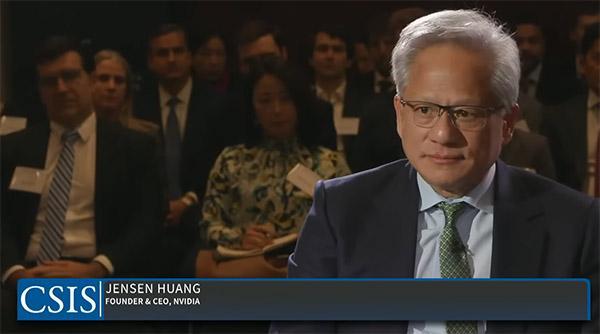
【文/观察者网 陈思佳】近些年,随着人工智能(AI)产业规模持续扩大,对数据中心的需求空前高 涨,英伟达等美国科技巨头掀起建设数据中心的热潮。但由于美国正面临基础设施老化、建设进程缓慢 等问题,数据中心的建设并不顺利。 据美国《财富》杂志网站12月6日报道,英伟达首席执行官黄仁勋近日与美国智库战略与国际问题研究 中心(CSIS)负责人约翰·哈姆雷对话时表示,尽管美国目前仍在AI领域领先,但美国的基础设施建设 能力远不如中国,可能在"AI竞赛"中被中国反超。 黄仁勋将AI产业简化为"五层蛋糕",分别为能源、芯片、基础设施、模型和应用。他指出,在最底层的 能源领域,"中国拥有的能源是美国的两倍"。他表示,美国政府正推动制造业回流,"但没有能源,我 们要如何建设芯片工厂、超级计算机工厂和AI数据中心?" 黄仁勋不忘借机吹捧美国总统特朗普,他宣称,特朗普意识到能源增长的重要性,正在"顶住压力恢复 美国的能源"。但他也承认,美国的能源成本依然远高于中国。 谈及芯片问题,黄仁勋表示,目前美国在这一领域具有优势,英伟达等美国科技企业拥有领先的AI芯 片技术,但中国已展现出巨大的潜力。他说:"我们拥有领先的技术,但不能自满。 ...

观察| 100万亿Tokens的:AI正在发生你看不见的巨变
未可知人工智能研究院· 2025-12-07 03:02
Core Insights - The report reveals that AI is undergoing a significant revolution, characterized by a shift from traditional models to reasoning models that can think and plan in multiple steps [3][11][12]. Group 1: OpenRouter and Its Importance - OpenRouter is likened to "Meituan" in the AI world, connecting over 500 million developers to more than 300 AI models, making its data highly credible [5][6]. - OpenRouter's daily token processing volume has surpassed 1 trillion, indicating a rapid growth from approximately 100 trillion tokens annually from early 2024 to mid-2025, marking a tenfold increase [8][6]. Group 2: Reasoning Revolution - The report identifies a "reasoning revolution," where AI models evolve from simple response machines to complex reasoning machines capable of multi-step thinking [11][12]. - The launch of OpenAI's o1 reasoning model (codename Strawberry) is a pivotal event, as it incorporates internal reasoning processes that enhance its problem-solving capabilities [18][19]. - Users are increasingly engaging in complex tasks, leading to longer prompts and more dialogue rounds, indicating a shift towards training AI for intricate tasks [20][21][23]. Group 3: Agentic AI - Agentic AI represents a transformation where AI can autonomously plan, execute, and verify tasks, moving from passive response to active engagement [27][30]. - The report highlights that agentic reasoning is the fastest-growing behavior on OpenRouter, indicating a shift in user expectations from simple answers to task completion [34][35]. Group 4: Rise of Open Source Models - Open source models, particularly from Chinese teams like DeepSeek R1 and Kimi K2, are rapidly gaining market share, challenging the dominance of closed-source models [44][47]. - DeepSeek R1 offers significant cost advantages, with a cost of $0.003 per 1K tokens compared to $0.03 for GPT-4, making it attractive for developers [52]. Group 5: Real-World AI Usage - The primary applications driving token usage are creative writing and programming, with AI becoming indispensable for developers [71][72]. - Users are not merely relying on AI for content generation but are engaging in co-creation, indicating a shift in the role of AI from a tool to a creative partner [77][78]. Group 6: Model Personality - Users' choices of AI models are influenced by the "personality" of the models, which affects user retention and engagement [88][95]. - The report suggests that models with unique personalities can outperform those with higher benchmark scores in terms of user loyalty [96][100]. Group 7: Implications for the Chinese AI Industry - The success of Chinese models like DeepSeek R1 and Kimi K2 in the global market indicates that they have competitive capabilities [109]. - The report emphasizes the importance of focusing on reasoning and agentic capabilities as key technological directions for the Chinese AI industry [115].
蔡崇信|港大演讲全记录:中国AI必将超越美国,因为有四张底牌
Sou Hu Cai Jing· 2025-12-05 18:41
Group 1: AI Development in China - China is making significant strides in AI, with models like DeepSeek-V3.2 performing at levels comparable to GPT-5 and surpassing other international models in competitions [1] - Alibaba's Qwen3-VL and Qwen2.5-VL models have excelled in spatial reasoning benchmarks, outperforming top models like Gemini 3 and GPT-5.1 [1] - The Chinese government has set ambitious goals for AI adoption, aiming for a 90% penetration rate by 2030, which reflects a pragmatic and goal-oriented approach [21][46] Group 2: Alibaba's Strategic Position - Alibaba has transformed from a B2B e-commerce platform to a leading player in AI and cloud computing, leveraging its infrastructure to support AI applications [9][30] - The company emphasizes an open-source strategy for its AI models, allowing broader access and adoption, which contrasts with the proprietary models of competitors like OpenAI [26][30] - Alibaba's cloud computing business is positioned to benefit from the growing demand for AI infrastructure, as companies increasingly rely on cloud services for AI model training and deployment [30][38] Group 3: Competitive Advantages in AI - China has a significant advantage in energy supply for AI development, with lower electricity costs and substantial investments in clean energy infrastructure [22] - The country produces a large number of STEM graduates, providing a robust talent pool for AI engineering and development [23] - The open-source approach adopted by many Chinese AI companies accelerates innovation and adoption, making AI tools more accessible to a wider audience [26][46] Group 4: Future Outlook - The future of China's economy is closely tied to technological advancements, particularly in AI, which is seen as the primary driver of growth over the next decade [45] - The emphasis on manufacturing and technological self-reliance is expected to sustain China's position as a global manufacturing hub while fostering innovation in high-tech sectors [15][17] - The integration of AI into various industries is anticipated to reshape business practices and consumer behavior, with AI evolving from a tool to a collaborative partner in various applications [34]


AI泡沫要破?巨佬颠覆认知的观点来了!
Ge Long Hui· 2025-12-04 07:29
大模型的决战越来越激烈了!谷歌的崛起令OpenAI感到恐惧,并酝酿新的大动作! OpenAI直接拉响警报,推迟赚钱的广告业务,也要把所有资源梭哈到ChatGPT的改进上。 现在的AI圈子,像是星球大战前夜,由于恐惧,每个人都把手指扣在了扳机上。 兵荒马乱的年代,蔡崇信在香港大学炉边对话中,抛出了非常反直觉的观点: 现在美国人定义谁赢得AI竞赛的方式,纯粹是看大型语言模型,我们不看美国定义的AI竞赛。 当所有人都在盯着谁的模型参数大、谁的算力强时,蔡崇信却认为——胜负手根本不在这里。 如果不看模型,这场万亿赌局的赢家到底看什么?中国手里到底还有没有牌? 看完发现,原来大佬眼里的世界,和我们看到的完全不一样。 1 中国AI的真正优势 现在美国硅谷大模型怎么算输赢?很简单:看谁的"大语言模型"更强、更聪明、参数更多。 今天是OpenAI遥遥领先,明天Anthropic发个新版本追平,后天谷歌又搞个大新闻。大家都在卷模型, 仿佛谁的模型智商高了一点,谁就统治了世界。 但在蔡崇信看来,事实未必如此。 他在演讲中说了这么一句极具穿透力的话: "The winner is not about who has the bes ...