指数投资

Search documents
关注市场震荡蓄势下布局机会,A500ETF易方达(159361)今日净申购超5亿份
Mei Ri Jing Ji Xin Wen· 2025-11-21 11:32
Market Overview - The market continues to experience fluctuations, with the CSI A500 index dropping over 2%, and the A500 ETF from E Fund seeing a net subscription exceeding 500 million units throughout the day [1] - For the week, the CSI A50 index fell by 3.8%, the CSI A100 index by 3.9%, and the CSI A500 index by 4.3% [1] Index Performance - The CSI A500 index consists of 500 securities with large market capitalization and good liquidity, covering 91 out of 93 sub-industries [3] - The CSI A100 index includes 100 representative securities, covering 46 sub-industries, reflecting the overall performance of major listed companies [3] - The CSI A50 index is made up of the 50 largest stocks from leading companies across 50 sub-industries, highlighting a large-cap style [3] ETF Tracking and Fees - Currently, there are 40 ETFs tracking the CSI A500 index, 14 for the CSI A100 index, and 16 for the CSI A50 index, with varying fee rates and tracking errors [3] - Low-fee products have a management fee of 0.15% per year and a custody fee of 0.05% per year [3] Historical Index Returns - Recent performance shows the CSI A500 index with a 1-month decline of 3.1%, a 3-month increase of 2.4%, and a year-to-date increase of 15.6% [5][6] - Over the past year, the CSI A500 index has increased by 16.6%, while the CSI A100 and A50 indices have increased by 18.3% and 12.0%, respectively [6] - Since inception, the CSI A500 index has seen a cumulative increase of 432.6% [6] Market Sentiment - According to Everbright Securities, the market may still be in a bull phase, but is likely entering a wide-ranging fluctuation period in the short term [1] - Compared to previous bull markets, there is still significant room for index growth, but the duration of the bull market may be more important than the magnitude of the increase [1]


市场本周承压,持续关注A500ETF易方达(159361)、沪深300ETF易方达(510310)等产品配置价值
Mei Ri Jing Ji Xin Wen· 2025-11-21 11:30
Market Overview - The market remains under pressure this week, with all three major A-share indices experiencing collective adjustments [1] - The Shanghai Composite Index fell by 3.8%, the CSI 500 Index decreased by 4.3%, the ChiNext Index dropped by 6.2%, the STAR Market 50 Index declined by 5.5%, and the Hang Seng China Enterprises Index decreased by 5.1% [1][3] Sector Performance - Active sectors included China Shipbuilding, cultural media, and cloud office, while sectors such as batteries, coal, photovoltaic equipment, industrial metals, and pharmaceutical commerce saw significant declines [1] - In the Hong Kong market, bank stocks rose against the trend, while pharmaceutical and technology stocks continued to adjust [1] Index Performance Metrics - The rolling price-to-earnings (P/E) ratios for the indices are as follows: - CSI 300 Index: 14.1 times - CSI 500 Index: 16.6 times - ChiNext Index: 39.2 times - STAR Market 50 Index: 149.8 times - Hang Seng China Enterprises Index: 10.5 times [3][4] Historical Performance - The cumulative performance over the past month shows declines across the indices, with the CSI 300 Index down by 3.0%, the CSI 500 Index down by 3.1%, and the ChiNext Index down by 4.6% [6] - Year-to-date performance indicates positive growth for all indices, with the CSI 300 Index up by 13.2%, the CSI 500 Index up by 15.6%, and the ChiNext Index up by 36.4% [6]

爆发式增长!突破2500亿元
Zhong Guo Zheng Quan Bao· 2025-11-21 04:25
Core Insights - Domestic index investment has experienced explosive growth this year, with ETF product issuance entering a "fast lane" [1] - As of November 20, the number of newly established domestic ETFs and the total issuance scale have reached historical highs, surpassing 250 billion yuan, representing a doubling compared to 2024 [2] Group 1: ETF Product Growth - A total of 328 new ETFs have been established this year, with a combined issuance scale exceeding 250 billion yuan, marking a historical high [2] - The newly launched bond ETFs include 24 and 8 public fund institutions participating in the Sci-Tech Bond ETF and Benchmark Market Credit Bond ETF, with issuance scales of 69.773 billion yuan and 21.710 billion yuan respectively [2] - Equity ETFs focusing on themes such as "Double Innovation" and Hong Kong technology have gained popularity among public fund institutions, leading to significant increases in related index product allocations [2] Group 2: Performance of Newly Established ETFs - Newly established ETFs tracking themes like "Double Innovation," cash flow, and Hong Kong innovative pharmaceuticals have generally seen scale growth, with new scales exceeding 5 billion yuan for several products [3] - ETFs tracking the Sci-Tech Composite Index and the CSI A500 have seen a reduction in scale, with decreases of over 12 billion yuan and 7 billion yuan respectively [3] Group 3: Market Dynamics and New Entrants - The "Matthew Effect" continues in the ETF business, with major index firms actively expanding their ETF product lines while other public fund institutions explore differentiated and specialized strategies [4] - Major fund companies like E Fund, Fortune Fund, and Huaxia Fund have established over 20 new ETFs this year, with issuance scales of 18.828 billion yuan, 15.994 billion yuan, and 15.581 billion yuan respectively [4] - Smaller public fund institutions are also entering the ETF market, with companies like Changjin Heixin and Great Wall Fund launching their first ETFs this year [6]
最近24小时内,春立医疗、网易-S、金山科技工业等4家港股上市公司公告分红预案!
Mei Ri Jing Ji Xin Wen· 2025-11-21 03:30
Group 1 - Spring Medical announced a dividend of HKD 0.2304 per share, with an ex-dividend date of November 24, 2025, and a payment date of January 19, 2026. It is classified under the medical devices and supplies sector and is not part of the CSI Central Enterprises Dividend Index or the Hang Seng High Dividend Yield Index [1] - NetEase-S declared a dividend of USD 0.114 per share, with an ex-dividend date of December 4, 2025, and a payment date of December 16, 2025. It falls under the gaming software sector and is excluded from both the CSI Central Enterprises Dividend Index and the Hang Seng High Dividend Yield Index [1] - Kingsoft Technology Industrial announced a dividend of HKD 0.018 per share, with an ex-dividend date of December 24, 2025, and a payment date of January 8, 2026. It is categorized under consumer electronics and is not included in the CSI Central Enterprises Dividend Index or the Hang Seng High Dividend Yield Index [1] - Sa Sa International declared a dividend of HKD 0.0115 per share, with an ex-dividend date of December 3, 2025, and a payment date of December 19, 2025. It is classified in the skincare and cosmetics sector and is not part of the CSI Central Enterprises Dividend Index or the Hang Seng High Dividend Yield Index [1] Group 2 - The CSI Central Enterprises Dividend Index (931233.CSI) selects 50 listed companies with stable dividend levels and high dividend yields from the Hong Kong Stock Connect. As of November 20, the index has a one-year dividend yield of 5.63%, surpassing the 10-year government bond yield of 3.81%. The largest investment vehicle tracking this index is the Hong Kong Central Enterprises Dividend ETF (513910) [3] - The Hang Seng Mainland Enterprises High Dividend Yield Index (HSMCHYI.HI) includes high dividend stocks listed in Hong Kong from mainland companies. As of November 20, this index has a one-year dividend yield of 5.30%, which is higher than the 10-year government bond yield of 3.48%. The only ETF tracking this index is the Hang Seng Dividend ETF (159726) [3]

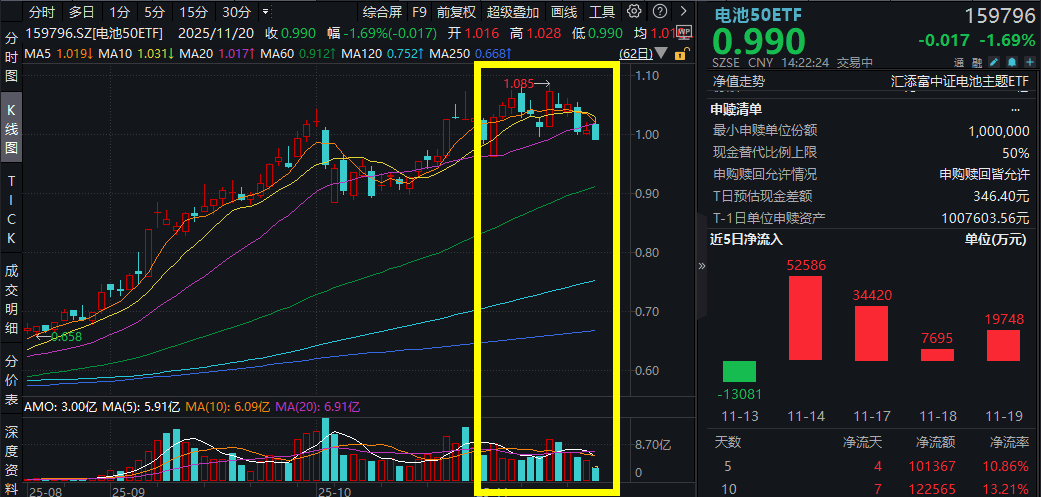
电池冲高回落!多氟多大跌超7%,电池50ETF(159796)跌超1%,连续4日疯狂吸金超11亿元!碳酸锂期货主力合约持续冲高,电池产业链全线回暖!
Sou Hu Cai Jing· 2025-11-20 06:46
Core Viewpoint - The battery sector is experiencing fluctuations, with the Battery 50 ETF (159796) showing a net inflow of 1.144 billion yuan over the past four days, despite a recent decline of 1.69% after an early gain of over 2% [1][3]. Market Performance - The performance of the Battery 50 ETF's constituent stocks is mixed, with notable gains from companies like Sungrow Power (up 1.58%) and Greeenme (up 1.20%), while companies like CATL and Aoxin Wanda saw declines exceeding 2% [3][4]. - The lithium carbonate futures price surged by 4.22%, reaching 102,500 yuan per ton, driven by a significant increase in demand for energy storage solutions [5]. Industry Trends - The lithium battery industry is showing signs of recovery, with production of batteries and lithium iron phosphate cathode materials in China significantly exceeding last year's figures [6]. - The demand for lithium carbonate is projected to grow by 30% by 2026, with supply expected to increase by only 25,000 tons, indicating a potential imbalance and upward pressure on prices [5][6]. Technological Developments - Solid-state batteries are nearing mass production, with major global battery manufacturers set to begin production between 2027 and 2028, offering advantages such as higher energy density and improved safety [7][8]. Investment Opportunities - The Battery 50 ETF (159796) is highlighted as a strong investment vehicle due to its high exposure to the energy storage sector (26%) and solid-state battery technology (42%), positioning it well to benefit from upcoming market trends [8][10]. - The ETF's management fee is notably low at 0.15% per year, making it an attractive option for investors looking to capitalize on the battery sector's growth [12].


赋能指数投资普惠化,科技驱动金融服务升级
Zhong Guo Jing Ji Wang· 2025-11-19 02:46
作为境内最早成立的公募基金管理人之一,华夏基金始终致力于通过科技赋能与业务创新,打造真正意 义上的多资产全能型投资平台。依托"红色火箭"小程序平台,华夏基金以开放合作的姿态,与多家股份 制商业银行、互联网销售机构达成深度合作,将平台核心功能嵌入合作伙伴的APP中,构建起跨机构、 多终端的指数投资服务生态,切实推动"普惠金融"理念的落地。 在资本市场开放与居民理财需求多元化的背景下,指数化投资因其分散风险、透明度高、成本低等优 势,日益成为大众理财的重要选择。"红色火箭"通过将专业的资产管理能力产品化、工具化、可视化, 有效解决了普通投资者"不会投、不敢投"的痛点,推动了指数投资的全民化进程。 当前,全球科技竞争格局深度调整,产业链加速重构,科技创新已成为大国博弈的核心战场。近年来, 国家层面发布的有关政策多次明确提出,要构建同科技创新相适应的科技金融体制,加强对国家重大科 技任务和科技型中小企业的金融支持,完善长期资本"投早、投小、投长期、投硬科技"的支持政策。作 为金融"五篇大文章"之首,科技金融的发展既呼应我国现代化产业体系建设导向,也为新质生产力培育 注入关键动能。 11月18日,第二十届中国经济论坛平 ...
如何寻觅指数投资的“主动灵魂”?来看这份样本
券商中国· 2025-11-17 00:18
Core Viewpoint - The article discusses how Huatai Fund, known for its active investment research, is leveraging its expertise to enhance index investment, positioning itself as a proactive player in a competitive market [2][3]. Group 1: Index Investment Growth - As of September, Huatai Fund's equity index fund scale exceeded 177 billion, with equity ETFs surpassing 100 billion, reaching 128.865 billion [1]. - The net inflow of Huatai's index business this year has reached 48.116 billion, indicating strong growth momentum [1]. Group 2: Active Selection Strategy - Huatai Fund emphasizes "active selection" in index investment, focusing on long-term sectors like consumption, pharmaceuticals, energy, and finance [3][4]. - The company aims to differentiate itself by not just replicating indices but by designing products that reflect deep market insights and strategic foresight [3][5]. Group 3: Product Design and Operation - The "smile curve" theory guides Huatai's focus on high-value product design and operation, ensuring each product serves a distinct purpose without overlapping risks [6][7]. - The company adopts a patient approach to nurturing products, as seen with the Consumer ETF, which grew from 7 billion to 22 billion despite market pressures [8]. Group 4: Solution-Oriented Approach - Huatai Fund aims to provide comprehensive index product solutions, driven by actual client needs rather than merely promoting its own products [11][12]. - The firm emphasizes in-house development of strategies to maintain control over its core capabilities, ensuring continuous improvement and adaptation to market conditions [12].

共迎指数投资大时代!“中泰财富30”品牌发布,李迅雷等大咖发声
券商中国· 2025-11-14 15:03
Core Viewpoint - The "Zhongtai Wealth 30" brand launch signifies a new paradigm in wealth management, emphasizing the importance of capital markets in promoting common prosperity and addressing complex wealth management needs through a buyer-oriented advisory model [3][4]. Group 1: Event Overview - The "Wealth Management and ETF Ecological High-Quality Development Summit Forum" was held in Qingdao, guided by the Qingdao Municipal Financial Office and hosted by Zhongtai Securities, with over 70 asset management institutions and industry experts in attendance [2][6]. - The event featured speeches from key figures, including Zhongtai Securities' General Manager Feng Yidong, who highlighted the role of capital markets in achieving common prosperity [2][3]. Group 2: Brand Launch and Strategy - The "Zhongtai Wealth 30" brand aims to create a comprehensive wealth management ecosystem, serving nearly 11 million clients and offering impactful products [3][4]. - The brand consists of three sub-brands: Quantitative 30, Myfund 30, and ETF 30, focusing on transforming complex wealth management needs into clear, trustworthy solutions [4]. Group 3: Economic Insights - Chief Economist Li Xunlei provided insights on China's macroeconomic outlook, emphasizing the importance of accelerating technological self-reliance and enhancing consumer spending during the "14th Five-Year Plan" period [8][10]. - Li noted that the current low interest rate environment and increased asset volatility necessitate a diversified asset allocation strategy to mitigate risks [10]. Group 4: Industry Collaboration and Development - The event included discussions on the collaborative ecosystem in wealth management, emphasizing the need for industry institutions to enhance research capabilities and optimize product offerings to improve investor satisfaction [12]. - A private ETF strategy forum was held, focusing on innovative strategies that enhance market liquidity and provide investors with efficient asset allocation tools [12]. Group 5: Future Directions - Zhongtai Securities aims to strengthen its professional capabilities and internal resource integration, fostering an open and collaborative platform for wealth management services [12].

分红“港”知道|最近24小时内,长安民生物流、德昌电机控股、鹰美等3家港股上市公司公告分红预案!
Mei Ri Jing Ji Xin Wen· 2025-11-13 02:36
Group 1 - Chang'an Minsheng Logistics announced a dividend of RMB 0.050000 per share, with an ex-dividend date of December 2, 2025, and a payment date of December 31, 2025. It is part of the Hang Seng primary industry of air freight and logistics, and is included in the CSI Central Enterprises Dividend Index [1] - Dechang Motor Holdings declared a dividend of HKD 0.17 per share, with an ex-dividend date of December 3, 2025, and a payment date of January 6, 2026. It belongs to the automotive parts sector and is also part of the CSI Central Enterprises Dividend Index [1] - Eagle Beauty announced a dividend of HKD 0.24 per share, with an ex-dividend date of November 25, 2025, and a payment date of December 11, 2025. It is categorized under the clothing industry and is included in the CSI Central Enterprises Dividend Index [1] Group 2 - The CSI Central Enterprises Dividend Index (931233.CSI) selects 50 listed companies with stable dividend levels and high dividend yields from the Hong Kong Stock Connect. As of November 12, the index has a one-year dividend yield of 5.49%, surpassing the 10-year government bond yield of 3.67%. The largest investment vehicle tracking this index is the Hong Kong Central Enterprises Dividend ETF (513910) [2] - The Hang Seng Mainland Enterprises High Dividend Yield Index (HSMCHYI.HI) focuses on high dividend stocks among mainland companies listed in Hong Kong. As of November 12, this index has a one-year dividend yield of 5.20%, which is higher than the 10-year government bond yield of 3.38%. The only ETF tracking this index is the Hang Seng Dividend ETF (159726) [2]
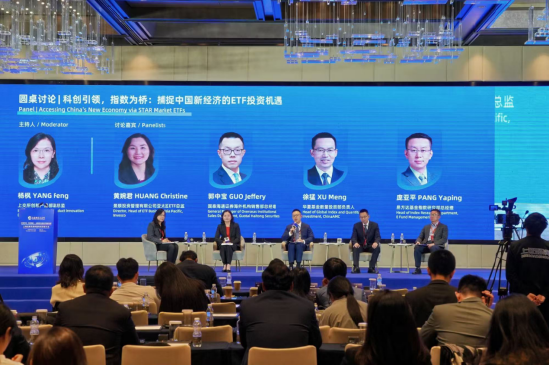
景顺投资黄婉君、国泰海通郭中宝、华夏基金徐猛、易方达庞亚平热议:借道ETF捕捉中国新经济投资机遇
Xin Lang Zheng Quan· 2025-11-12 09:56
Core Insights - The Shanghai Stock Exchange International Investors Conference highlighted the growing importance of ETFs in capturing investment opportunities in China's new economy [1][11] - Industry experts discussed the integration of technology in index development, emphasizing the shift towards more innovative and dynamic indices [3][11] Group 1: ETF Innovation and Development - Future index development will incorporate artificial intelligence and big data, moving away from traditional market capitalization or factor-weighted models [3] - ETFs are seen as crucial tools for global asset allocation, providing international investors with transparent and convenient access to the Chinese market [5] Group 2: Investment Trends and Opportunities - There is a high level of interest from global investors in the Chinese market, particularly in hard technology-themed ETFs that can effectively narrate China's innovation story [7] - The focus on "technology innovation + index investment" reflects the role of ETFs as a vital link between China's new economic drivers and global investors [11]