
乘用车及零部件

Search documents
报告丨中国上市公司高端制造业发展报告
Xin Lang Cai Jing· 2025-12-08 01:33
Industry Overview - As of the end of 2024, the number of high-end manufacturing listed companies in A-shares reached 2,503, accounting for 46.50% of the total A-share companies, with a compound annual growth rate (CAGR) of 10.80% over the past five years [2][19] - The total asset scale reached 27.24 trillion yuan, and total revenue was 15.41 trillion yuan, with CAGRs of 13.98% and 13.27% respectively, indicating strong expansion capabilities [2][19] - Private enterprises accounted for 71.87% of the industry, while state-owned enterprises, though only 17.58% in number, contributed 34.31% of the revenue [2][19] - The industry is primarily concentrated in southeastern coastal provinces such as Guangdong, Jiangsu, and Zhejiang [2][19] - The tax contribution of the industry in 2024 was 253.9 billion yuan, with an employee count of 10.35 million and an average salary of 189,500 yuan, reflecting stable employment and income growth [2][19] Core Development Metrics - In 2024, total R&D expenditure was 934.12 billion yuan, with a CAGR of 18.51%, and R&D spending accounted for 6.06% of revenue [3][20] - The number of R&D personnel reached 1.8464 million, with a CAGR of 12.07%, achieving multiple technological breakthroughs in sectors like power equipment, semiconductors, and passenger vehicles [3][20] - The total market capitalization was 32.47 trillion yuan, with a CAGR of 3.91% [3][20] - The total scale of IPOs and refinancing was 115.54 billion yuan, showing a decline due to regulatory policy adjustments, although financing activity remained high in mechanical manufacturing and electronics [3][20] - Overseas revenue reached 4.3113 trillion yuan, with a CAGR of 19.81%, accounting for 27.98% of total revenue [3][20] Key Industry Characteristics - The mechanical manufacturing, electronics, power equipment, and passenger vehicles and parts sectors contributed 73.78% of the total assets and major revenue of the high-end manufacturing industry [4][20] - The medical industry led with a net profit margin of 13.19% and a return on assets of 5.03% [4][20] - The semiconductor industry benefited from the growth in AI and new energy vehicle demand, with a price-to-earnings ratio of 118.09 [4][20] - The aerospace and defense sector saw steady market capitalization growth driven by defense construction demand, with R&D investment accounting for 6.75% [4][20] - The power equipment sector faced a 66.43% decline in net profit due to overcapacity, while the pharmaceutical industry experienced a continuous decline in market capitalization due to policy adjustments, despite a high R&D investment ratio of 11.65% [4][20] Industry Trends and Policies - The government has introduced policies such as the "New National Nine Articles" and "Science and Technology Innovation Sixteen Articles" to support technological innovation, promoting equipment upgrades and the replacement of consumer goods [5][21] - The integration of AI and manufacturing has been widely applied in R&D design, production, and intelligent scheduling, leading to new business models [5][21] - New demands for computing power and smart terminals are emerging, with companies like SANY Heavy Industry and GAC Group leading practical implementations [5][21] - Efforts to revise the "Anti-Unfair Competition Law" and promote industry self-regulation have effectively addressed issues of low-price competition and disorderly expansion, guiding resources towards innovation [5][21] - The focus is on intelligent, green, and integrated development, with an emphasis on nurturing emerging industries such as low-altitude economy and humanoid robots, while tackling critical technology challenges in integrated circuits and industrial mother machines [5][21] Challenges and Future Outlook - Some industries are facing issues of overcapacity and profit fluctuations, with core technology bottlenecks persisting [6][22] - International market competition and geopolitical risks have intensified [6][22] - The future strategy includes increasing R&D investment, deepening industrial cluster development, and advancing international strategic layouts, aiming to transition from a "manufacturing giant" to a "manufacturing power" [6][22]

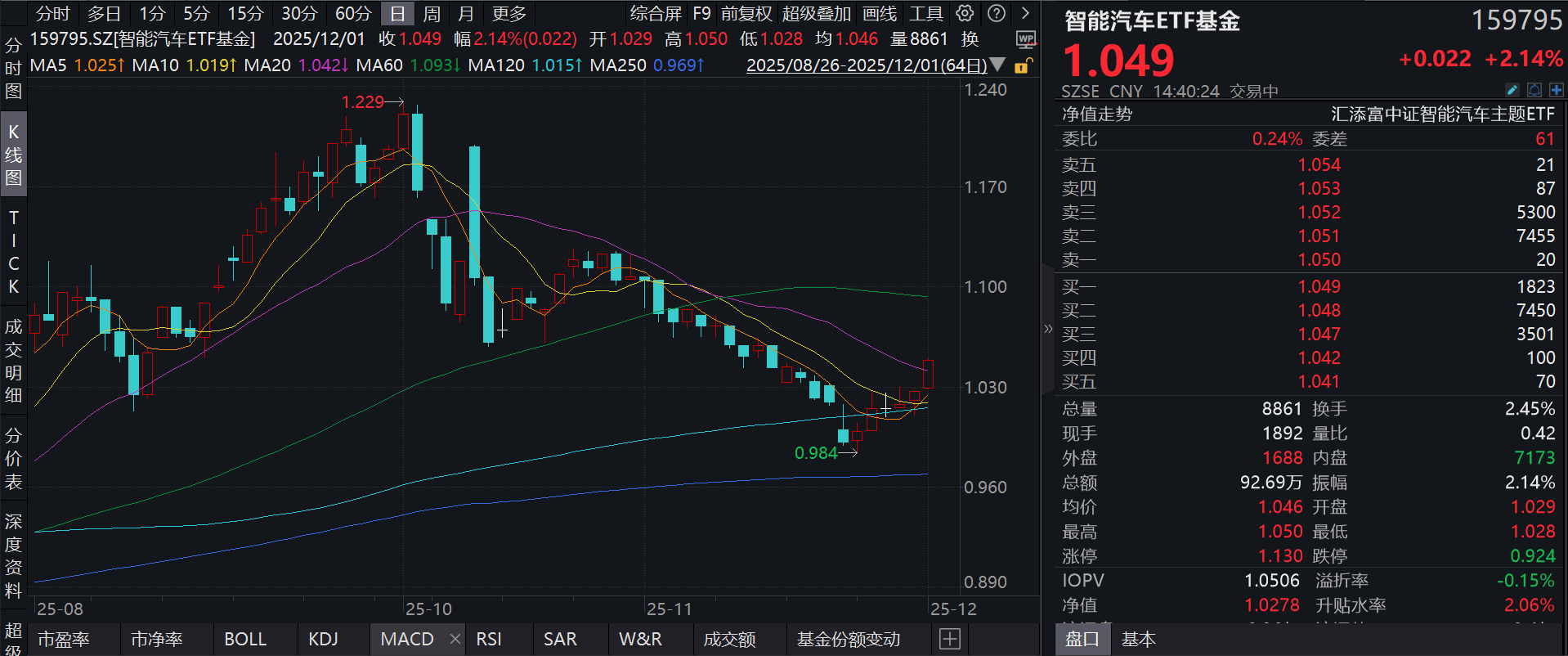
智能车板块走强,广和通20cm涨停,拓普集团涨超4%,智能汽车ETF基金(159795)涨超2%冲击3连涨,中国智能汽车产业链迎来全球化机遇
Sou Hu Cai Jing· 2025-12-01 07:03
Group 1: Market Performance - The China Securities Intelligent Vehicle Theme Index (930721) rose by 2.20% as of December 1, 2025, with component stocks such as Guanghetong (300638) increasing by 20.01% and Beijing Junzheng (300223) by 17.04% [1] - The Intelligent Vehicle ETF Fund (159795) also saw a rise of 2.14%, marking its third consecutive increase, with a latest price of 1.05 yuan [1] - Over the past week, the Intelligent Vehicle ETF Fund has accumulated a rise of 3.63% [1] Group 2: Company Developments - Leap Motor reported a record high delivery of 70,327 units in November, representing a year-on-year growth of over 75%, maintaining a growth trend for nine consecutive months [3] - Xiaomi Group announced the launch of its embodied AI model MiMo-Embodied, which integrates autonomous driving and embodied intelligence, with Xiaomi's vehicle deliveries exceeding 40,000 units in November [3] - Great Wall Motors introduced the VLA auxiliary driving model and previewed a new generation of the auxiliary driving system, CPMaster [3] Group 3: Investment Insights - Ideal Auto plans to invest 12 billion yuan in R&D for 2025, with over 6 billion yuan allocated to AI [4] - According to GF Securities, as overseas automakers lose market share, they are accelerating their smart technology advancements to enhance competitiveness, while Chinese brands are positioned to benefit from global opportunities in the intelligent vehicle supply chain [4] - The integration of intelligent vehicles and robotics is expected to expand the valuation ceiling of the sector, with the Intelligent Vehicle ETF Fund closely tracking the performance of leading companies in intelligent vehicle applications [4] Group 4: Index Composition - As of September 9, 2025, the top ten weighted stocks in the China Securities Intelligent Vehicle Theme Index (930721) include Chipone (688521), Luxshare Precision (002475), and Top Group (601689), collectively accounting for 48.47% of the index [4][5]





半导体ETF交易热度下滑,5只港股通汽车ETF半日涨幅超2%
Mei Ri Jing Ji Xin Wen· 2025-11-11 05:57
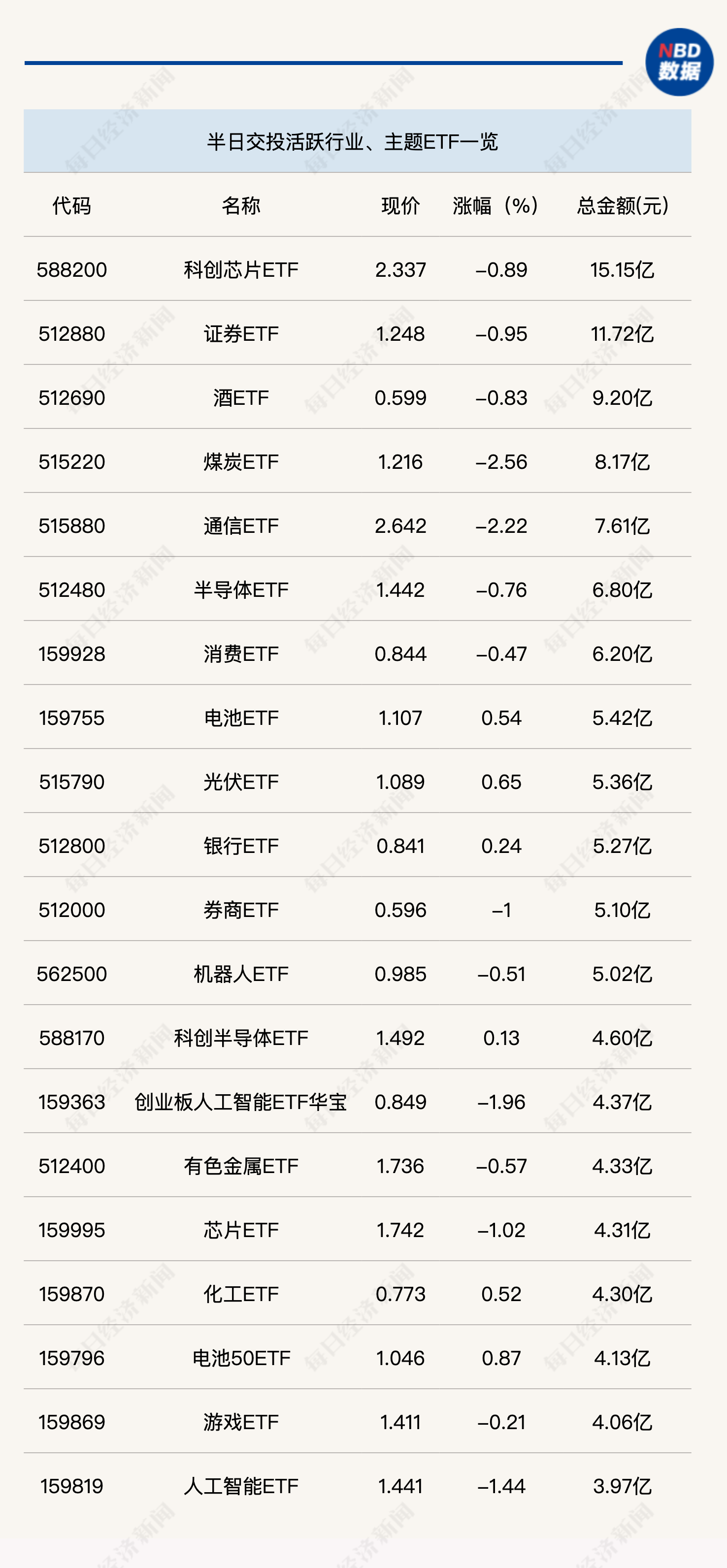
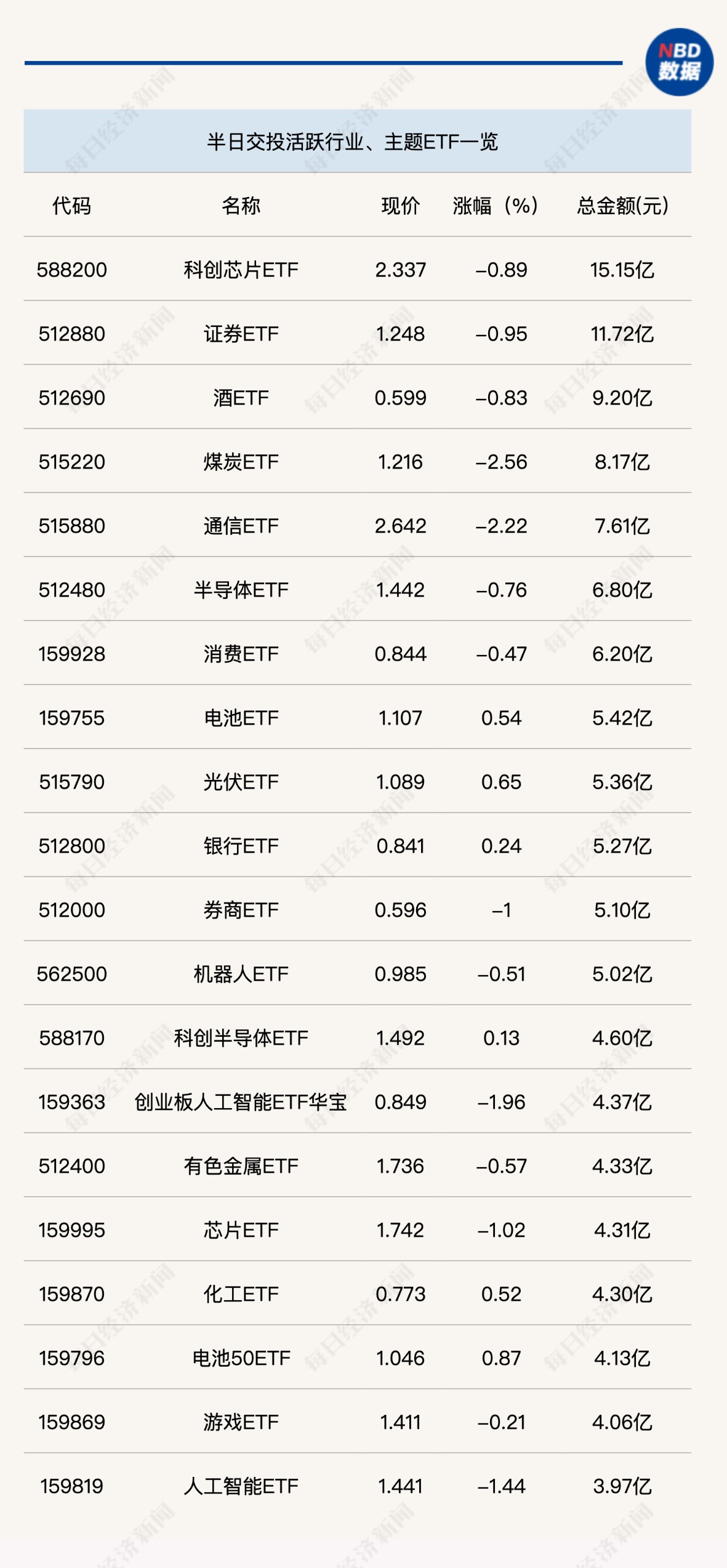
Core Viewpoint - The trading activity of semiconductor-related ETFs has significantly decreased, while defensive ETFs in sectors like alcohol, coal, and consumer goods have maintained higher trading volumes [1] Group 1: ETF Trading Activity - The only semiconductor-related ETF with significant trading volume is the Sci-Tech Chip ETF (588200), which had a half-day trading amount of 1.515 billion [1] - Defensive ETFs such as alcohol, coal, and consumer-related ETFs maintained half-day trading amounts above 500 million [1] - Among cross-border ETFs, only the Hong Kong Securities ETF (513090) exceeded 5 billion in half-day trading volume [1] Group 2: ETF Performance - The Sci-Tech Chip ETF (588200) experienced a price of 2.337 with a decline of 0.89% [3] - The Hong Kong Securities ETF (513090) had a price of 2.212 with a decrease of 0.81% [6] - The Hong Kong Automotive ETFs saw significant gains, with the Hong Kong Automotive ETF (520600) rising by 2.38% and the Hong Kong Automotive ETF Fund (159237) increasing by 2.35% [7][8] Group 3: Industry Insights - The penetration rate of new energy vehicle sales has increased in the first three quarters of the year, providing strong growth momentum for the overall industry [8] - Continuous high growth in new energy vehicle exports is expected to become a new growth point [8] - The China Securities Hong Kong Stock Connect Automotive Industry Theme Index selects 50 listed companies involved in the automotive industry to reflect the overall performance of automotive stocks within the Hong Kong Stock Connect [9]
行业ETF风向标丨半导体ETF交易热度下滑,5只港股通汽车ETF半日涨幅超2%
Mei Ri Jing Ji Xin Wen· 2025-11-11 05:45
Core Insights - The trading volume of semiconductor-related ETFs has significantly decreased, with only the Sci-Tech Chip ETF (588200) exceeding 1.015 billion yuan in half-day trading volume, reaching 1.515 billion yuan [1] - Defensive ETFs such as those related to alcohol, coal, and consumer goods maintained a half-day trading volume above 500 million yuan [1] - The Hong Kong Securities ETF (513090) was the only cross-border ETF to exceed 5 billion yuan in half-day trading volume [1] ETF Trading Activity - The Sci-Tech Chip ETF (588200) had a trading volume of 1.515 billion yuan, with a price of 2.337 and a decline of 0.89% [2] - The Securities ETF (512880) recorded a trading volume of 1.172 billion yuan, with a price of 1.248 and a decline of 0.95% [2] - The Alcohol ETF (512690) had a trading volume of 920 million yuan, with a price of 0.599 and a decline of 0.83% [2] - The Coal ETF (515220) had a trading volume of 817 million yuan, with a price of 1.216 and a decline of 2.56% [2] - The Communication ETF (515880) had a trading volume of 761 million yuan, with a price of 2.642 and a decline of 2.22% [2] - The Semiconductor ETF (512480) had a trading volume of 680 million yuan, with a price of 1.442 and a decline of 0.76% [2] - The Consumer ETF (159928) had a trading volume of 620 million yuan, with a price of 0.844 and a decline of 0.47% [2] Hong Kong Market Performance - The Hong Kong Securities ETF (513090) had a price of 2.212 and a decline of 0.81% [4] - The Hong Kong automotive ETFs saw significant gains, with the Hong Kong Automotive ETF (520600) rising by 2.38% and the Hong Kong Automotive ETF Fund (159237) rising by 2.35% [6] - The automotive sector's growth is driven by increased penetration of new energy vehicles and high export growth, indicating a strong growth potential for the industry [6][7] Index Composition - The CSI Hong Kong Stock Connect Automotive Industry Theme Index includes 50 listed companies involved in the automotive industry, reflecting the overall performance of these companies within the Hong Kong Stock Connect [7] - Major weighted stocks in the index include Xpeng Motors (15.83%), BYD (10.53%), and Geely Automobile (9.87%) [8]
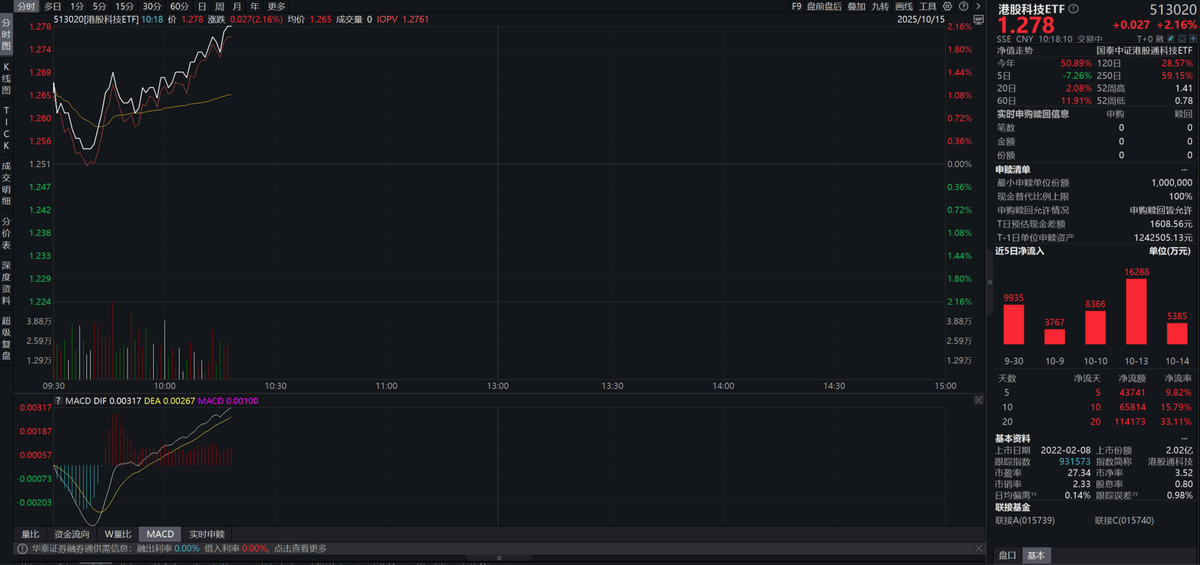
鲍威尔发言提振降息预期,港股科技ETF(513020)盘中涨超2%
Sou Hu Cai Jing· 2025-10-15 03:00
Group 1 - Federal Reserve Chairman Jerome Powell's speech on October 14 indicated a potential end to the balance sheet reduction in the coming months, supporting investor expectations for another rate cut this month [2][3] - Powell noted a deterioration in the labor market, with evidence showing low levels of layoffs and hiring, which further bolstered the outlook for a rate cut [3] - The Hong Kong stock market has seen significant activity this year, particularly in sectors like innovative pharmaceuticals, renewable energy, and technology, with the Hong Kong Technology ETF (513020) rising over 50% year-to-date [2][3] Group 2 - The Hong Kong Technology ETF (513020) tracks the CSI Hong Kong Stock Connect Index, including major stocks like Alibaba, Tencent, and BYD, making it a quality investment option for exposure to the Hong Kong market [4] - The top ten constituents of the Hong Kong Technology ETF include Alibaba (11.93%), Tencent (10.79%), and Xiaomi (8.08%), among others, indicating a diverse portfolio in the technology sector [5] Group 3 - The Hong Kong Technology Connect Index has outperformed the Hang Seng Technology Index and the Hong Kong Internet Index, with a cumulative increase of 76.06% since 2018, compared to 7.18% and 16.50% for the latter two indices [6] - The expectation of continued rate cuts by the Federal Reserve may enhance the attractiveness of Hong Kong technology stocks, as lower interest rates typically boost the valuation of growth sectors [8]
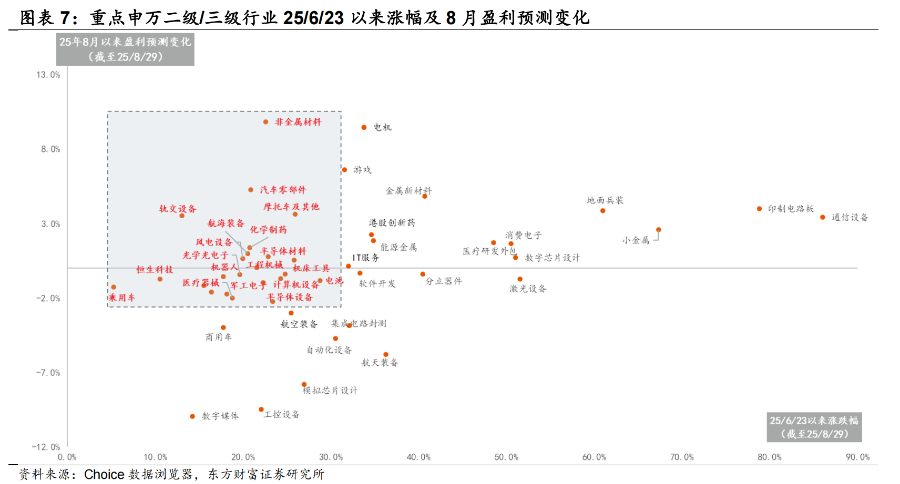
机器人指数ETF(560770)逆市翻红,当前科技行情进展到哪里了?
2 1 Shi Ji Jing Ji Bao Dao· 2025-09-02 06:17
Core Viewpoint - The A-share market experienced a pullback with all three major indices declining, while the robotics sector showed resilience with significant gains in related stocks and ETFs [1][2]. Market Performance - As of September 2, the A-share market saw a rapid increase in trading volume, surpassing 2 trillion yuan, marking the 15th consecutive trading day above this threshold [1]. - The TMT (Technology, Media, and Telecommunications) sector accounted for approximately 40% of total trading volume, indicating strong market interest [1]. Robotics Industry Insights - The robotics industry is accelerating due to continuous technological advancements and the realization of industrial orders, with significant orders such as a 124 million yuan contract from China Mobile marking a shift towards large-scale production [3][6]. - The integration of AI language models and multi-modal sensor technology is enhancing the capabilities of humanoid robots, improving their understanding and perception [3]. Investment Opportunities - The robotics sector is highlighted as a potential area for investment, particularly in sub-sectors like semiconductors and battery technology, which have shown resilience and potential for future growth [6]. - The Robot Index ETF (560770) tracks the robotics industry and includes major companies such as Huichuan Technology and iFlytek, indicating a diversified exposure to the sector [6][7]. Future Projections - According to forecasts, the number of humanoid robots in use in China could exceed 100 million by 2045, with a market size reaching approximately 10 trillion yuan, covering various applications from industrial manufacturing to healthcare [7]. Fund Management Perspective - The fund manager of the Robot Index ETF believes that the robotics industry is in a rapid development phase, with increasing capital allocation, suggesting a positive outlook for future investments [8].

中国低碳指数报6191.56点,前十大权重包含长江电力等
Jin Rong Jie· 2025-08-26 08:43
Core Viewpoint - The China Low Carbon Index has shown significant growth, reflecting the performance of 40 representative companies in the low carbon economy sector, with a notable increase in its value over various time frames [1][2]. Group 1: Index Performance - The China Low Carbon Index closed at 6191.56 points, with a 4.90% increase over the past month, a 12.64% increase over the past three months, and a 9.68% increase year-to-date [1]. - The index is based on a starting point of 1000.0 points as of December 31, 2006 [1]. Group 2: Index Composition - The top ten weighted companies in the China Low Carbon Index include: - Sungrow Power Supply (7.05%) - Contemporary Amperex Technology (5.22%) - LONGi Green Energy (5.09%) - TBEA Co., Ltd. (4.87%) - China National Nuclear Power (4.32%) - Everbright Environment (4.24%) - Yangtze Power (4.15%) - Three Gorges Energy (4.09%) - Eve Energy (4.03%) - BYD Company (3.91%) [1]. - The index's market distribution shows that the Shanghai Stock Exchange accounts for 42.18%, the Shenzhen Stock Exchange for 36.73%, and the Hong Kong Stock Exchange for 20.51% [1]. Group 3: Industry Breakdown - The industry composition of the index includes: - Power Equipment (58.17%) - Utilities (27.13%) - Environmental Protection (8.05%) - Passenger Vehicles and Parts (3.91%) - Machinery Manufacturing (2.16%) [2]. - The index samples are adjusted biannually, with adjustments occurring on the next trading day after the second Friday of June and December [2].
中国低碳指数报5709.54点,前十大权重包含比亚迪股份等
Jin Rong Jie· 2025-08-11 11:06
Core Points - The China Low Carbon Index is currently at 5709.54 points, reflecting a low opening and fluctuations in the Shanghai Composite Index [1] - The index has increased by 2.89% over the past month, 7.53% over the past three months, and 1.14% year-to-date [2] Index Composition - The China Low Carbon Index consists of 40 representative companies in the low-carbon economy sector, selected from domestic and international listings [2] - The top ten weighted companies in the index are: - Sungrow Power Supply (5.83%) - LONGi Green Energy (5.17%) - CATL (5.07%) - TBEA (4.83%) - China National Nuclear Power (4.56%) - China Everbright Environment (4.52%) - Yangtze Power (4.38%) - Three Gorges Energy (4.34%) - BYD Company (4.01%) - Conch Venture (3.90%) [2] Market Distribution - The market distribution of the China Low Carbon Index shows that the Shanghai Stock Exchange accounts for 43.40%, the Shenzhen Stock Exchange for 34.47%, the Hong Kong Stock Exchange for 21.52%, the Singapore Stock Exchange for 0.33%, and the Nasdaq Global Select Market for 0.28% [2] Industry Breakdown - The industry composition of the index is as follows: - Power Equipment: 55.99% - Utilities: 28.90% - Environmental Protection: 8.42% - Passenger Vehicles and Parts: 4.01% - Machinery Manufacturing: 2.06% [2] Index Adjustment - The index samples are adjusted biannually, with adjustments occurring on the next trading day after the second Friday of June and December [3] - Weight factors are generally fixed until the next scheduled adjustment, with special circumstances allowing for temporary adjustments [3]

中证沪港深500可选消费指数报3748.96点,前十大权重包含理想汽车-W等
Jin Rong Jie· 2025-07-29 09:30
Group 1 - The CSI Hong Kong-Shanghai-Shenzhen 500 Consumer Discretionary Index reported a rise of 3.62% over the past month, 3.14% over the past three months, and 9.71% year-to-date [1] - The index is categorized into 11 industries based on the classification standards of the CSI Hong Kong-Shanghai-Shenzhen 500, reflecting the overall performance of different industry securities [1] - The top ten holdings of the CSI Hong Kong-Shanghai-Shenzhen 500 Consumer Discretionary Index include Alibaba-W (10.26%), BYD Company (9.43%), Meituan-W (8.71%), and Midea Group (7.74%) [1] Group 2 - The index's holdings are primarily composed of the automotive and parts sector (38.88%), durable goods (27.99%), consumer services (15.45%), retail (12.06%), and textiles, apparel, and jewelry (5.63%) [2] - The index samples are adjusted biannually, with changes implemented on the next trading day following the second Friday of June and December [2] - In special circumstances, temporary adjustments may be made to the index samples, such as when a sample company is delisted or undergoes mergers or acquisitions [2]



中证沪港深互联互通中小综合可选消费指数报2636.75点,前十大权重包含北汽蓝谷等
Jin Rong Jie· 2025-07-16 08:52
Group 1 - The core index, the CSI Hong Kong-Shanghai-Shenzhen Connect Small Cap Consumer Index, reported a value of 2636.75 points, with a monthly increase of 2.98%, a three-month increase of 4.82%, and a year-to-date increase of 3.68% [1] - The index is categorized into 11 industries based on the classification standards of the CSI Hong Kong-Shanghai-Shenzhen index series, which includes the CSI 500, CSI Hong Kong-Shanghai-Shenzhen Connect Small Cap, and CSI Hong Kong-Shanghai-Shenzhen Connect Composite Index [1] - The top ten weighted stocks in the index include: Laopu Gold (2.32%), Leap Motor (1.91%), Fuyao Glass (1.63%), Great Wall Motors (1.43%), Tongcheng Travel (1.38%), BAIC Blue Valley (1.31%), Chao Feng Power (1.31%), Gongxiao Daji (1.29%), Wanfeng Aowei (1.23%), and Magpow (1.19%) [1] Group 2 - The market share of the index's holdings is distributed as follows: Shenzhen Stock Exchange 42.90%, Shanghai Stock Exchange 31.40%, and Hong Kong Stock Exchange 25.70% [2] - The industry composition of the index's holdings includes: Passenger Cars and Parts 44.98%, Durable Consumer Goods 16.70%, Textiles, Apparel, and Jewelry 13.19%, Consumer Services 12.62%, and Retail 12.51% [2] - The index samples are adjusted biannually, with adjustments occurring on the next trading day after the second Friday of June and December each year [2]
