
煤炭清洁高效利用

Search documents
石化化工反内卷稳增长系列之十:煤化工:结构性调整与产业升级并行,供需有望持续优化
EBSCN· 2025-07-30 12:53
Investment Rating - The report maintains an "Overweight" rating for the coal chemical industry [1] Core Viewpoints - The "anti-involution" initiative is fully underway, with supply-side reforms ongoing, indicating a focus on optimizing the market competition landscape [5] - The government is emphasizing the development of modern coal chemical industries, aiming for a clean and efficient utilization of coal by 2030 [4] - Structural adjustments and industrial upgrades are expected to proceed in parallel, with a balanced supply-demand situation anticipated for 2025 [5] Summary by Sections Section 1: Anti-Involution Actions - The central government has been vocal about preventing "involution" in industry competition, emphasizing market mechanisms for eliminating inefficient capacities and promoting self-discipline among industries [5] Section 2: Government Support for Coal Chemical Development - The government has issued guidelines to enhance the clean and efficient use of coal, aiming to establish a comprehensive clean utilization system by 2030 [4] Section 3: Industry Structural Adjustments - The coal chemical industry is expected to see a shift towards higher capacity concentration and accelerated smart technology adoption, with a balanced supply-demand dynamic and a downward price trend [5] - In 2024, the coal chemical industry is projected to achieve a revenue of approximately 202.66 billion yuan, a year-on-year increase of 4.2%, with total profits expected to reach about 11.93 billion yuan, reflecting a significant year-on-year growth of 178.1% [5][6] Section 4: Investment Recommendations - The report suggests focusing on companies such as Baofeng Energy, Hualu Hengsheng, Luxi Chemical, Chengzhi Co., and China Xuyang Group, as they are likely to benefit from the ongoing structural adjustments and industry upgrades [7]
国家能源集团党组书记、董事长邹磊会见内蒙古自治区党委常委、包头市委书记陈之常
Zheng Quan Shi Bao Wang· 2025-07-29 12:52
Core Viewpoint - The meeting between the chairman of the National Energy Group and the mayor of Baotou focuses on enhancing cooperation in coal and new energy resource development, aiming for high-quality development and mutual benefits [1] Group 1: Cooperation and Development - The National Energy Group aims to strengthen communication and cooperation with Baotou to deepen the development of high-quality coal and new energy resources [1] - There is a specific emphasis on accelerating the construction of the Baotou chemical coal-to-olefins upgrade demonstration project [1] - Both parties are looking to promote clean and efficient utilization of coal resources [1] Group 2: Strategic Alignment - The Baotou municipal government expresses a desire to enhance communication and advance key energy project construction [1] - The focus is on leveraging resource endowments and industrial foundations to identify strategic alignment for development [1] - There is an intention to further explore cooperation potential and expand collaboration areas for mutual benefits [1]
研判2025!中国半无烟煤行业政策汇总、产业链、产量、竞争格局及发展趋势分析:在环保政策的作用下,半无烟煤行业需求不断增加[图]
Chan Ye Xin Xi Wang· 2025-07-21 01:14
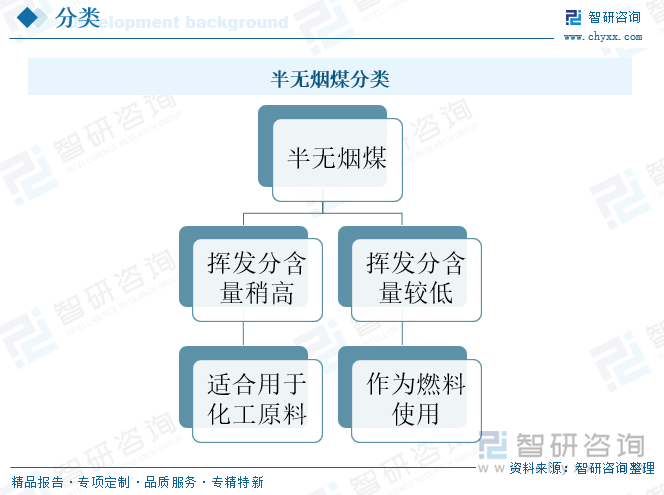
Core Viewpoint - The semi-anthracite coal industry in China is experiencing robust growth due to increasing environmental policies and demand for clean energy, with production expected to rise from 375 million tons in 2019 to 476 million tons by 2024, reflecting a compound annual growth rate of 4.90% [1][14]. Industry Overview - Semi-anthracite coal, positioned between anthracite and bituminous coal, has high energy density and low sulfur content, making it environmentally friendly and widely used in power generation, industrial boilers, and chemical industries [3]. - The classification of semi-anthracite coal based on volatile matter content allows for tailored applications in various industries, enhancing resource utilization efficiency [3]. Policy Influence - The Chinese government has implemented multiple policies to promote low-carbon development in the coal industry, emphasizing clean and efficient utilization of coal, with specific targets set for 2030 [5][7]. - Recent policies include the "2024-2025 Energy Conservation and Carbon Reduction Action Plan" and the "Opinions on Strengthening Clean and Efficient Utilization of Coal," which aim to enhance coal's green and intelligent development [5][7]. Industry Chain - The semi-anthracite coal industry chain includes upstream activities such as coal mining and washing, midstream production and processing, and downstream applications in various sectors [8]. Production and Demand - China's raw coal production is projected to increase from 3.746 billion tons in 2019 to 4.759 billion tons in 2024, with a 6.00% year-on-year increase in early 2025 [10]. - The demand for electricity is rising, driven by economic growth and increased consumption in various sectors, with total electricity generation expected to grow from 7,417 billion kWh in 2020 to 9,418 billion kWh in 2024 [12]. Competitive Landscape - The semi-anthracite coal market in China is relatively concentrated, dominated by large state-owned enterprises like China Shenhua and China Coal Energy, which leverage resource reserves and advanced production technologies [16][17]. - Emerging companies are gradually diversifying the competitive landscape through technological innovation and product optimization [16]. Future Trends - Environmental policies are expected to drive demand for semi-anthracite coal in key sectors such as power generation, metallurgy, and chemicals, as it offers lower emissions compared to other coal types [21]. - The application of semi-anthracite coal is expanding into new areas, including clean fuel production and chemical feedstock, indicating significant potential for future growth [22]. - Technological advancements will enhance production efficiency and reduce emissions, contributing to the industry's upgrade and market expansion [23].

煤化工产业趋势展望
2025-07-16 06:13
Summary of Conference Call on Coal Chemical Industry Industry Overview - The conference focused on the coal chemical industry, particularly in Xinjiang, China, discussing regulatory frameworks, project approvals, and development strategies for modern coal chemical projects [1][2][3][4][5][6][7][8][9][10][11][12][13][14][15][16][17][18][19][20][21][22][23][24][25][26][27][28][29][30][31][32][33][34][35][36][37][38][39][40][41]. Key Points and Arguments 1. **Regulatory Framework**: The approval process for coal chemical projects includes project approval, environmental impact assessments, and carbon emission standards. The latest guidelines emphasize the need for projects to comply with ecological and environmental regulations [1][2][3][4]. 2. **Project Location Requirements**: New coal chemical projects must be located in legally established industrial parks and avoid sensitive ecological areas, such as within 1 kilometer of certain riverbanks [2][3]. 3. **Carbon Emission Management**: The government has set stringent carbon emission standards for coal chemical projects, requiring the establishment of carbon management systems and regular reporting [4][5]. 4. **Energy Efficiency and Clean Utilization**: There is a strong push for improving energy efficiency and reducing carbon emissions in coal chemical processes, with specific methodologies outlined for different products [4][5][6]. 5. **Development of Xinjiang's Coal Chemical Industry**: Xinjiang is highlighted as a key area for coal chemical development due to its abundant coal resources. Several projects have been established, focusing on clean and efficient utilization of coal [7][8][9][10]. 6. **Investment Trends**: The conference noted a significant interest in coal chemical projects, particularly in coal-to-gas and coal-to-liquid technologies, with various companies planning to invest in these areas [11][12][13][14]. 7. **Challenges in Water Resources**: The coal chemical industry faces challenges related to water scarcity, particularly in Xinjiang, where water-intensive processes are required [19][20]. 8. **Technological Innovations**: There is ongoing exploration of new technologies for low-carbon transitions in coal chemical processes, although many companies are still in the experimental phase [20][21]. 9. **Market Dynamics**: The market for coal chemical products is influenced by international prices and domestic supply-demand dynamics, with a focus on maintaining economic viability amid regulatory pressures [28][29][30]. 10. **Strategic Importance**: The coal chemical industry is viewed as strategically important for national energy security, with projects being prioritized based on their potential to enhance energy independence [28][29][30]. Other Important but Overlooked Content - The conference discussed the need for a balanced approach to resource management, considering environmental impacts alongside economic benefits [36][37]. - There is a recognition of the competitive landscape among coal chemical projects, with varying levels of progress and approval timelines across different regions [24][25][26]. - The importance of integrating coal chemical projects with existing coal mining operations was emphasized, highlighting the need for collaboration between coal and chemical sectors [31][32][33]. This summary encapsulates the critical insights and discussions from the conference call regarding the coal chemical industry, particularly focusing on regulatory frameworks, project developments, and market dynamics in Xinjiang.
镌刻煤化工发展“新坐标” ——宝丰能源全球最大煤制烯烃项目实现重大工业化突破
Zhong Guo Hua Gong Bao· 2025-07-01 02:28
Core Viewpoint - The successful operation of Baofeng Energy's coal-to-olefins project in Inner Mongolia marks a significant milestone in China's coal chemical industry, showcasing advancements in clean and efficient coal utilization and modern coal chemical technology [1][2][3]. Group 1: Project Significance - The project represents a breakthrough in the clean and efficient utilization of coal, addressing resource constraints and environmental challenges, and is a key component of China's energy security strategy [2][3]. - The production of olefins from coal can replace petroleum-based materials, reducing crude oil imports significantly, thus enhancing energy security [2]. - The project has achieved a continuous stable production of over 200 days, demonstrating its operational reliability and technological success [1]. Group 2: Technological Advancements - The project employs the world's first "green hydrogen coupled coal-to-olefins" process, which reduces carbon emissions significantly compared to traditional methods [2]. - It has set new industry benchmarks by achieving a comprehensive energy consumption that is 15% lower than the industry standard [2]. - The project has been recognized for its use of domestically produced equipment, with 23 items reaching leading domestic and international standards, marking a shift from being a follower to a leader in coal chemical equipment [3][4]. Group 3: Economic Impact - The project is expected to generate an industrial output value of approximately 30 billion yuan and contribute over 3 billion yuan in taxes by 2025, while creating nearly 6,000 jobs [6]. - Baofeng Energy aims to expand its coal-to-olefins capacity to over 10 million tons, contributing to the replacement of high-end chemical imports and enhancing national energy security [6]. Group 4: Future Prospects - There are aspirations for further research and development in areas such as ultra-supercritical power generation and low-grade coal utilization, aiming to innovate within the coal chemical sector [7]. - The project is seen as a model for future coal chemical standards, with hopes to transform the "Baofeng model" into a "Chinese standard" for global energy transition [7].

金之钧:宝丰能源内蒙古项目投产 书写能源安全新答卷
Xin Lang Cai Jing· 2025-06-24 02:48
Core Viewpoint - The successful launch of Baofeng Energy's coal-based new materials project in Inner Mongolia marks a significant milestone in China's clean and efficient utilization of coal and the modernization of the coal chemical industry [4][11]. Group 1: Project Overview - Baofeng Energy has invested 67.3 billion to build the world's largest coal-based new materials demonstration project, which produces polyethylene and polypropylene, with an annual output of 3 million tons of olefins [11]. - The project has achieved stable production for 4,800 hours, with an average daily production of 9,000 tons of polyolefins and a stable olefin gross margin of 30% [11]. - The project is expected to generate an industrial output value of approximately 30 billion by 2025 and contribute over 3 billion in taxes, creating nearly 6,000 jobs [11]. Group 2: Technological Innovations - Baofeng has pioneered the "green hydrogen coupling coal-to-olefins" process, which reduces carbon emissions by 1.8 tons for every ton of olefins produced [5][6]. - The project utilizes a fully integrated industrial chain from coal mining to power generation, hydrogen production, chemical processing, and energy storage, significantly lowering green hydrogen costs [6][7]. - The project employs domestic equipment, achieving 23 items that meet or exceed international standards, marking a shift from reliance on imports to self-sufficiency in modern coal chemical equipment [11][13]. Group 3: Environmental and Social Responsibility - Baofeng Energy integrates social responsibility into its business model, with a cumulative donation of 4.4 billion for educational initiatives and ecological restoration practices [7]. - The project aims to reduce carbon emissions significantly through technologies like carbon capture and storage (CCUS), targeting a near-zero carbon footprint [8]. Group 4: Future Expectations - The company is encouraged to continue investing in research and development to achieve breakthroughs in areas such as ultra-supercritical power generation and low-grade coal utilization [8]. - There is a call for further exploration of integrated models combining wind, solar, hydrogen, and coal to create a zero-carbon system [8]. - The establishment of low-carbon technology standards is recommended to transform the "Baofeng model" into a "Chinese standard," contributing to global energy transition efforts [9].
行业研究、行业周报:关税博弈落地,煤炭重回供需逻辑
Shanxi Securities· 2025-05-19 11:45
Investment Rating - The coal industry maintains a rating of "Synchronize with the Market-A" [1] Core Viewpoints - The coal market is returning to supply-demand logic following the resolution of tariff disputes, with expectations of improved demand as summer approaches [1][8] - The report highlights that while coal prices are under pressure due to seasonal factors and inventory adjustments, the potential for recovery in non-electric coal demand exists as the international trade environment improves [8][81] Summary by Sections 1. Coal Industry Dynamic Data Tracking - **Thermal Coal**: Inventory levels are decreasing, and summer stocking demand is anticipated. As of May 16, the spot reference price for thermal coal in the Bohai Rim is 629 CNY/ton, with a weekly change of -2.18% [3][23] - **Metallurgical Coal**: The external trade environment is improving, and metallurgical coal continues to deplete inventories. The price for main coking coal at Jingtang Port is 1320 CNY/ton, unchanged from the previous week [4][35] - **Coking Steel Chain**: Increased operational rates have led to a slight decline in coking coal prices. The average price for first-grade metallurgical coke is 1480 CNY/ton, down 3.27% [5][54] - **Coal Transportation**: Increased stocking demand has stabilized coastal transportation prices, with the coastal coal transportation index at 661.75 points, up 3.34% [6][64] - **Coal-related Futures**: Downstream operational rates have decreased, leading to a decline in double焦期价 [66] 2. Coal Sector Market Review - The coal sector has rebounded alongside the broader market, outperforming major indices. The CITIC coal index closed at 3244.52 points, with a weekly change of +1.65% [7][71] 3. Industry News Summary - Recent government initiatives emphasize strengthening domestic circulation and enhancing the coal industry's clean and efficient utilization [79][80] - The construction of a new cross-border railway between China and Mongolia is expected to significantly boost coal exports from Mongolia, reshaping trade dynamics [80] 4. Important Announcements from Listed Companies - Major companies in the coal sector are actively managing operational challenges and pursuing strategic initiatives, including asset restructuring and safety measures following incidents [81][83] 5. Next Week's Outlook and Investment Recommendations - The report suggests that while coal prices may face downward pressure, the upcoming summer stocking demand and improved tariff conditions could support price stability. Investors are advised to focus on undervalued companies with solid performance support [8][81]




行业研究、行业周报:关税博弈落地,煤炭重回供需逻辑-20250519
Shanxi Securities· 2025-05-19 07:52
Investment Rating - The coal industry maintains a "Synchronize with the Market" rating [1] Core Viewpoints - The coal market is returning to supply-demand logic following the resolution of tariff disputes, with expectations of improved non-electric demand as summer approaches [1][10] - The report highlights that while coal prices have seen some decline, the potential for further decreases is limited due to upcoming summer stocking demands and improved international trade conditions [10] Summary by Sections 1. Coal Industry Dynamic Data Tracking - **Thermal Coal**: Inventory levels are decreasing, and summer stocking demand is anticipated. As of May 16, the spot reference price for thermal coal in the Bohai Rim is 629 CNY/ton, with a weekly change of -2.18% [3][25] - **Metallurgical Coal**: The external trade environment is improving, leading to continued inventory reduction. The price for main coking coal at Jingtang Port is 1320 CNY/ton, unchanged from the previous week [4][37] - **Coke and Steel Industry Chain**: Increased operational rates have led to a slight decline in coke prices. The average price for first-grade metallurgical coke at Tianjin Port is 1480 CNY/ton, down 3.27% week-on-week [5][55] - **Coal Transportation**: There is an increase in stocking demand, with the coastal coal transportation price index at 661.75 points, up 3.34% [8][66] - **Coal-related Futures**: Downstream operational rates have decreased, leading to a decline in both coking coal and coke futures prices [68] 2. Coal Sector Market Review - The coal sector has rebounded alongside the broader market, outperforming major indices. The CITIC Coal Index closed at 3244.52 points, with a weekly change of +1.65% [9][73] 3. Industry News Summary - Recent government initiatives emphasize strengthening domestic circulation and enhancing the coal industry's clean and efficient utilization [80][81] - The construction of a new cross-border railway between China and Mongolia is expected to significantly boost coal exports from Mongolia, reshaping trade dynamics [82] 4. Important Announcements from Listed Companies - Several companies have reported operational updates, including production adjustments and strategic asset acquisitions, reflecting ongoing developments in the coal sector [83][85] 5. Next Week's Outlook and Investment Recommendations - The report suggests focusing on undervalued companies with strong performance support, particularly those with minimal non-coal business exposure, such as Xinjie Energy and Huohua Energy [10]
2025年中国煤炭行业市场政策、产业链、发展现状、竞争格局及发展趋势研判:CR7原煤产量占比高达44.34%[图]
Chan Ye Xin Xi Wang· 2025-05-12 01:36
Overview - In 2024, China's coal supply capacity continues to improve, with coal production reaching 4.759 billion tons, a year-on-year increase of 2.17% [1] - The top ten provinces, including Inner Mongolia, Shanxi, Shaanxi, and Xinjiang, account for over 94.52% of the total production, with the four major production areas contributing 3.886 billion tons, or 81.66% of the national output [1] - Coal demand is projected at approximately 5.295 million tons, reflecting a year-on-year growth of 3.24%, despite weak demand from the steel and construction sectors due to a sluggish real estate market [1][14] - The coal industry market size is expected to decline to 3.52334 trillion yuan due to soft non-electric demand and price declines [1] Market Policies - The Chinese government has implemented various policies to promote the clean and efficient use of coal, including plans for water resource conservation, air quality improvement, and the promotion of green manufacturing [5][7] - Policies emphasize the importance of safety in coal mining and the transition towards a greener, high-quality development model for the coal industry [5][7] Industry Chain - The coal industry chain consists of upstream activities such as coal resource exploration and equipment manufacturing, midstream activities including coal mining and washing, and downstream consumption across various sectors like electricity, manufacturing, and residential heating [8][10][12] Competitive Landscape - In 2024, 16 major coal enterprises produced over 500 million tons of raw coal, accounting for 57.36% of the national total, with seven companies producing over 100 million tons each [16] - Major players include China Shenhua Energy, China Coal Energy, and Shanxi Coking Coal, which dominate the market with significant production volumes [16][18][20] Development Trends - The coal production capacity structure is expected to continue optimizing, with policies supporting the development of large modern coal mines and phasing out smaller, less efficient mines by 2025 [22] - The pricing mechanism is anticipated to improve, with a dual-track system for long-term contracts and market prices, aiming to stabilize coal prices while ensuring supply [22]
航天工程(603698):一季度业绩同比大幅增长,新签订单稳步推进
Changjiang Securities· 2025-05-01 05:44
Investment Rating - The investment rating for the company is "Buy" and is maintained [8]. Core Views - The company reported a significant year-on-year increase in performance for Q1 2025, with operating revenue reaching 847 million yuan, up 256.78% compared to the previous year. The net profit attributable to the parent company was 34 million yuan, an increase of 163.97%, while the net profit excluding non-recurring items was 33 million yuan, up 172.17% [2][6]. Summary by Sections Financial Performance - In Q1 2025, the company achieved operating revenue of 847 million yuan, representing a year-on-year growth of 256.78%. The net profit attributable to the parent company was 34 million yuan, reflecting a 163.97% increase, and the net profit excluding non-recurring items was 33 million yuan, up 172.17% [2][6]. Market Position and Projects - The company has signed 36 new design and consulting contracts for coal chemical projects throughout the year. The operation of the "Aerospace Furnace" has surpassed 100 units, achieving long-term stable operation for 50 projects with 105 gasification units, with the longest record reaching 489 days, significantly exceeding the industry average [11]. - The company has secured contracts for major projects, including a total contract value of 10.1 billion yuan for a project in Xinjiang and 1.9 billion yuan for a project in Fujian [11]. Technological Advantages - The company maintains a leading position in the coal gasification technology sector, with its gasification technology being recognized for its high thermal efficiency (up to 95%) and carbon conversion rate (up to 99%). The company holds over 50% market share in the coal gasification sector [11]. Future Profit Forecast - The company is expected to achieve net profits attributable to the parent company of 230 million yuan, 370 million yuan, and 450 million yuan for the years 2025, 2026, and 2027, respectively. The corresponding price-to-earnings ratios based on the closing price on April 29, 2025, are projected to be 38.9X, 23.8X, and 19.8X [11].
