
AI推理

Search documents
GPU直连技术引关注,美股存储巨头大爆发
Xuan Gu Bao· 2026-01-06 23:31
Group 1 - U.S. storage companies experienced a significant surge, with SanDisk rising over 20% and Western Digital and Seagate Technology increasing by more than 10% [1] - Analysts suggest that NVIDIA is exploring new technology for direct connection between GPUs and SSDs, which could impact the storage market [1] - GF Securities believes that the demand for SSDs will grow due to AI inference RAG vector databases, which require high throughput and low latency for large-scale vector data and indexing structures [1] Group 2 - Domestic developments include TOS launching Vector Bucket, which utilizes a self-developed Cloud-Native vector indexing library and a multi-tier local caching architecture, significantly lowering the barrier for enterprises to use vector data [1] - The transition of RAG vector database storage media from "memory participation in retrieval" to "full SSD storage architecture" is expected to drive sustained demand for high-bandwidth and large-capacity SSDs [1] - Company updates indicate that Lianyun Technology focuses on data storage control chips specifically for the SSD sector [2] - Haima Data has released the Vastbase G100 V3.0 product, integrating vector database capabilities for AI applications, providing various algorithms for approximate and nearest neighbor searches in large multidimensional data scenarios [2]
AI竞赛转向推理,如何影响国际科技竞争格局?
2 1 Shi Ji Jing Ji Bao Dao· 2026-01-06 22:41
Core Insights - The release of NVIDIA's next-generation AI chip platform "Rubin" at CES 2026 marks a significant shift in the global AI competition from "training-driven" to "inference-driven" [2][4] - This transition indicates a major evolution in the AI industry ecosystem, infrastructure layout, and international technological competition [2] Group 1: Inference vs. Training - In recent years, large model training has been the focal point of AI development, with models like GPT and Llama driving exponential demand for computing power [2] - However, the true value of AI lies in inference, which is the ability of models to respond in real-time to user inputs in practical applications [2][3] Group 2: Characteristics of Inference Scenarios - Inference scenarios require high frequency, low latency, high concurrency, and cost sensitivity, demanding greater hardware efficiency and energy consumption ratios than training [3] - NVIDIA's Rubin platform is designed specifically for the inference era, achieving up to a 10x reduction in inference token costs and integrating multiple chip types for extreme system collaboration [3] Group 3: Global AI Development Trends - The emergence of Rubin highlights the "Matthew effect" in global AI development, where entities with strong computing power and advanced inference systems will commercialize AI faster, creating a positive feedback loop [3][4] - Conversely, participants lacking foundational infrastructure will increasingly depend on external platforms, leading to a situation of "application prosperity but weak foundations" [3] Group 4: China's AI Industry Challenges and Opportunities - China's AI industry faces both challenges and opportunities as it progresses towards the inference stage, despite significant advancements in large model development [4] - Domestic GPUs have made some breakthroughs, but improvements are still needed in software ecosystems, system collaboration, and energy efficiency [4] Group 5: Recommendations for China's AI Infrastructure - China should accelerate the development of a full-stack inference solution encompassing chips, networks, storage, security, and development frameworks [4][5] - Emphasis should be placed on collaborative design in the development of domestic CPU, DPU, and AI-native storage components, alongside partnerships with cloud service providers [4] Group 6: Focus on Optimization and New Applications - There is a need to advance inference optimization technologies and establish an open-source ecosystem to support core technologies like low-bit quantization and dynamic batching [5] - China should also seize opportunities in physical AI and edge inference, leveraging rich application scenarios in robotics and autonomous driving [5] Group 7: Conclusion on AI Paradigm Shift - The launch of Rubin and similar AI products signifies a milestone in technological iteration and a declaration of the shift in the AI industry paradigm [5] - As AI evolves from merely answering questions to understanding the world and executing tasks, inference capability will become a key metric of national AI competitiveness [5]



纳指高开0.22%,英伟达涨1.3%,禾赛涨近8%
Ge Long Hui· 2026-01-06 14:37
Market Overview - The U.S. stock market opened with mixed results, with the Nasdaq up by 0.22%, the S&P 500 rising by 0.1%, and the Dow Jones down by 0.03% [1] Company Highlights - Nvidia, selected as one of the "Top 10 Core Assets with Global Vision" for 2026, saw its stock increase by 1.3%. The Vera Rubin platform has fully launched, enhancing AI inference performance by five times while reducing costs to one-tenth [1] - Novo Nordisk's stock rose by 4.3% following the official launch of the world's first oral GLP-1 medication for adult weight loss in the U.S. [1] - Hesai Technologies experienced a nearly 8% increase in stock price, with plans to double its production capacity to 4 million units by 2026 and being selected as a lidar partner by Nvidia [1] - NIO's stock increased by 2.3%, marking the rollout of its one-millionth vehicle, with CEO Li Bin stating that future annual sales are expected to grow by 40% to 50% [1]



黄仁勋罕见提前宣布:新一代GPU全面投产
2 1 Shi Ji Jing Ji Bao Dao· 2026-01-06 05:27
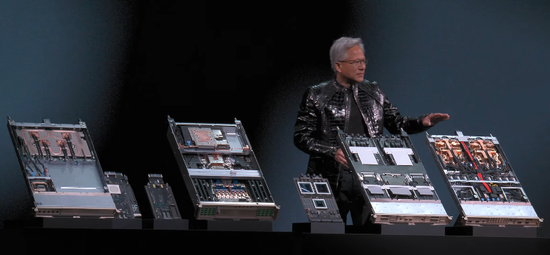
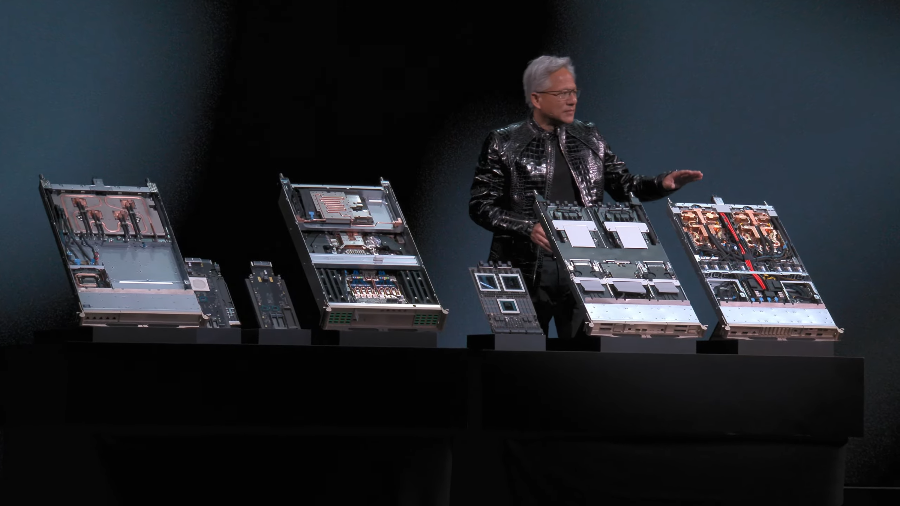
Core Insights - NVIDIA has accelerated its product release schedule by unveiling the next-generation AI chip platform "Rubin" earlier than usual at CES 2026, breaking its traditional March GTC announcement timeline [2][3] - The Rubin platform is designed to meet the increasing computational demands of AI for both training and inference, featuring a collaborative design of six new chips [5][6] Group 1: Rubin Platform Details - The Rubin platform integrates six chips: NVIDIA Vera CPU, Rubin GPU, NVLink 6 switch chip, ConnectX-9 SuperNIC, BlueField-4 DPU, and Spectrum-6 Ethernet switch chip, covering multiple layers from computing to networking, storage, and security [5] - Compared to the previous Blackwell architecture, Rubin accelerators improve AI training performance by 3.5 times and operational performance by 5 times, with a new CPU featuring 88 cores [5] - The Rubin platform can reduce inference token costs by up to 10 times and decrease the number of GPUs required for training MoE (Mixture of Experts) models by four times compared to the Blackwell platform [5] Group 2: Ecosystem and Market Response - The NVL72 system, which includes 72 GPU packaging units, was also announced, with each unit containing two Rubin dies, totaling 144 Rubin dies in the system [6] - Major cloud providers and model companies, including AWS, Microsoft, Google, OpenAI, and Meta, have responded positively to the Rubin platform and are among the first adopters [6][7] Group 3: Strategic Shift in AI Focus - NVIDIA's presentation at CES included a broader AI ecosystem strategy, shifting focus from "training scale" to "inference systems," with the introduction of an Inference Context Memory Storage Platform designed for efficient management of KV Cache [9] - The company is also advancing its long-term vision of physical AI, releasing open-source models and frameworks aimed at extending AI capabilities into robotics, autonomous driving, and industrial edge scenarios [9][10] - The introduction of the Alpamayo open-source model family for autonomous driving, along with a high-fidelity simulation framework, indicates NVIDIA's commitment to enhancing inference-based autonomous driving systems [13]
AI竞赛转向推理,英伟达宣布Rubin芯片平台全面投产
2 1 Shi Ji Jing Ji Bao Dao· 2026-01-06 00:40
Core Insights - NVIDIA has accelerated its AI chip platform release schedule by unveiling the next-generation AI chip platform "Rubin" earlier than usual at CES on January 5, 2026, breaking its traditional March GTC announcement pattern [1][2] Group 1: Rubin Platform Overview - The Rubin platform, which includes six new chips, is designed for extreme collaboration and aims to meet the increasing computational demands of AI for both training and inference [4] - Compared to the previous Blackwell architecture, Rubin accelerators improve AI training performance by 3.5 times and operational performance by 5 times, featuring a new CPU with 88 cores [4] - Rubin can reduce inference token costs by up to 90% and decrease the number of GPUs required for training mixture of experts (MoE) models by 75% compared to the Blackwell platform [4] Group 2: Ecosystem and Market Response - The NVL72 system, which includes 72 GPU packaging units, was also announced, with each unit containing two Rubin dies, totaling 144 Rubin dies in the system [5] - Major cloud providers and model companies, including AWS, Microsoft, Google, OpenAI, and Meta, have responded positively to Rubin, indicating strong market interest [5] - NVIDIA aims to provide engineering samples to ecosystem partners early to prepare for subsequent deployment and scaling applications [5] Group 3: AI Strategy and Product Launches - NVIDIA's focus is shifting from "training scale" to "inference systems," as demonstrated by the introduction of the Inference Context Memory Storage Platform, designed specifically for inference scenarios [6] - The company is also advancing its long-term strategy in physical AI, releasing open-source models and frameworks that extend AI capabilities to robotics, autonomous driving, and industrial edge scenarios [6] - The launch of the Cosmos and GR00T series models aims to enhance robotic learning, reasoning, and action planning, marking a significant step in the evolution of physical AI [7] Group 4: Autonomous Driving Developments - NVIDIA introduced the Alpamayo open-source model family for autonomous driving, targeting "long-tail scenarios," along with a high-fidelity simulation framework and an open dataset for training [9] - The first autonomous vehicle from NVIDIA is set to launch in the U.S. in the first quarter, with plans for expansion to other regions [9] - The overall strategy emphasizes that the competition in AI infrastructure is moving towards "system engineering capabilities," where the complete delivery from architecture to ecosystem is crucial [9]
英伟达200亿美元“押注”背后的深意
美股研究社· 2026-01-05 12:54
Core Viewpoint - NVIDIA's acquisition of Groq for $20 billion highlights a significant investment in AI inference technology, emphasizing the growing importance of non-GPU architectures in the AI landscape [4][5][24]. Group 1: Acquisition Details - NVIDIA's purchase of Groq marks the largest acquisition in its history, focusing on Groq's unique LPU chip technology, which is designed for low-latency processing and is considered an advanced version of Google's TPU [4][5]. - The acquisition cost represents nearly one-third of NVIDIA's cash reserves, indicating a strategic move towards enhancing its AI capabilities [6][9]. - Groq's recent funding rounds and valuation suggest it was not under pressure to sell, with a post-funding valuation of approximately $6.9 billion and a revenue target of $500 million for 2025 [10][8]. Group 2: Technology Insights - Groq's LPU chip architecture is designed for inference workloads, achieving peak performance of 750 TOPS at INT8 precision, which significantly enhances real-time processing capabilities [13][11]. - The chip utilizes a Tensor Streaming Processor (TSP) architecture, allowing for software-defined hardware that can dynamically adjust to various computational needs, thus overcoming the limitations of traditional GPU architectures [15][18]. - Groq's technology promises to deliver 5-18 times faster inference latency and 10 times better energy efficiency compared to GPUs, making it a compelling option for AI applications [18][23]. Group 3: Market Implications - The acquisition signals a shift in the AI chip market, with NVIDIA and Intel investing heavily in alternative architectures, leading to the emergence of three main technology paths: GPU, ASIC/DSA, and reconfigurable chips [17]. - The growing interest in reconfigurable chips, exemplified by Groq and other companies like SambaNova, indicates a competitive landscape where energy efficiency and adaptability are becoming critical [24][23]. - The domestic market in China is also evolving, with companies like Qingwei Intelligent preparing for IPOs, aiming to establish themselves in the reconfigurable chip sector, which is seen as a vital area for achieving self-sufficiency in computing power [20][22].
瀚博半导体:争做全球AI推理芯片的领导者
Xin Lang Cai Jing· 2026-01-04 12:25
Core Viewpoint - Nvidia plans to acquire core technology assets from AI chip startup Groq for approximately $20 billion, signaling a shift in focus from "training" to "inference" in AI computing, as real-time, low-cost, and deployable inference capabilities become the new competitive focus in the industry [1][9]. Group 1: Nvidia's Acquisition and Market Shift - Nvidia's acquisition of Groq is seen as a clear signal that the focus of AI computing is shifting towards inference capabilities [1][9]. - The move is expected to help Nvidia cover a broader range of AI inference and real-time workloads [1][9]. Group 2: Insights from Hanbo Semiconductor - Hanbo Semiconductor was founded in 2018 with the insight that cloud AI inference would have greater explosive potential than AI training chips [4][10]. - The CEO of Hanbo, Qian Jun, emphasizes the vast and untapped market potential for cloud AI inference and rendering in the era of AGI [4][12]. Group 3: Hanbo's Product Development and Market Position - Hanbo has launched two series of AI inference and rendering chips, SV and SG, achieving commercial success with major internet companies and operators in China [4][12]. - The SV series chips can achieve data throughput speeds twice that of general-purpose GPUs while requiring lower bandwidth, and they are among the few products in China that natively support FP8 large model inference [6][14]. Group 4: Strategic Focus and Future Outlook - Hanbo focuses on specific applications, such as video processing and AI acceleration, to create value through hardware and software collaboration [5][13]. - The company aims to become a global leader in AI inference chips, with a prediction that 2027 will be a key year for the large-scale replacement of domestic AI inference chips [8][16].

英伟达仍是王者,GB200贵一倍却暴省15倍,AMD输得彻底
3 6 Ke· 2026-01-04 11:13
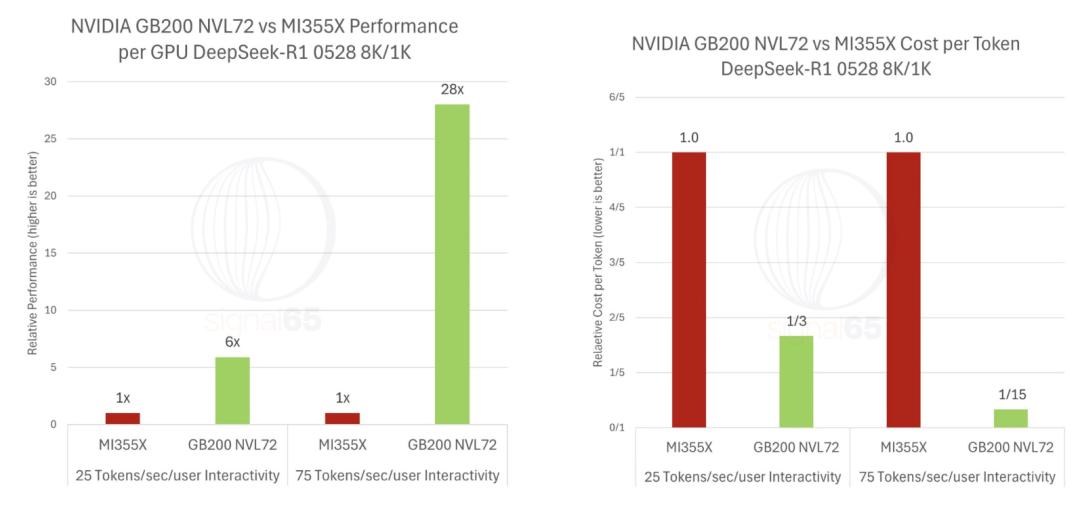
Core Insights - The report highlights a significant shift in AI inference economics, where the focus has moved from raw chip performance to the intelligence output per dollar spent [1][4][46] - NVIDIA continues to dominate the market, with its GB200 NVL72 outperforming AMD's MI350X by a factor of 28 in throughput [1][5][18] AI Inference Economics - The key metric for evaluating AI infrastructure has transitioned to "how much intelligence can be obtained for each dollar" [4][6][46] - In high-interaction scenarios, the cost per token for DeepSeek R1 can be reduced to 1/15th of other solutions [2][20] Model Architecture - The report discusses the evolution from dense models to mixture of experts (MoE) models, which activate only the most relevant parameters for each token, improving efficiency [9][11][46] - MoE models are becoming the standard for top open-source large language models (LLMs), with 12 out of the top 16 models utilizing this architecture [11][14] Performance Comparison - In terms of performance, the GB200 NVL72 shows a significant advantage over AMD's MI355X, achieving up to 28 times the performance in certain scenarios [18][24][30] - The report indicates that as interaction rates increase, the performance gap between NVIDIA and AMD platforms widens, with NVIDIA's solutions becoming increasingly efficient [30][37] Cost Efficiency - Despite the higher hourly cost of the GB200 NVL72, its advanced architecture and software capabilities lead to a lower cost per token, making it more economical in the long run [20][41][45] - The analysis shows that the GB200 NVL72 can achieve a performance per dollar advantage of approximately 12 times compared to its competitors [42][44] Future Trends - The future of AI models is expected to lean towards larger and more complex MoE architectures, with platform-level design becoming a critical factor for success [46][47] - Companies like OpenAI, Meta, and Anthropic are likely to continue evolving their flagship models in the direction of MoE and inference, maintaining NVIDIA's competitive edge [46]

大手笔背后的焦虑,英伟达用200亿美元购买Groq技术授权
Sou Hu Cai Jing· 2026-01-01 10:19
Core Viewpoint - Nvidia announced a significant deal worth $20 billion to acquire technology licensing from AI chip startup Groq, marking its largest transaction in history, comparable to the total of all previous acquisitions [1][3]. Group 1: Transaction Structure - The deal is structured as a non-exclusive technology licensing agreement rather than a full acquisition, which is a strategic move to avoid antitrust scrutiny [3][4]. - Nvidia's market capitalization is approaching $3.5 trillion, making it a target for regulatory oversight on major actions [4][6]. Group 2: Strategic Rationale - The $20 billion investment not only secures technology but also the expertise and patents of Groq's team, particularly its founder, a key figure in AI chip architecture [6][8]. - By attracting Groq's talent, Nvidia effectively removes a critical competitor from the market while gaining access to advanced technology [8][22]. Group 3: Technology Insights - Groq's core product, the Language Processing Unit (LPU), is designed specifically for AI inference, distinguishing it from Nvidia's GPUs, which dominate the training market [9][11]. - Groq claims its LPU offers significantly faster inference speeds and lower costs compared to Nvidia's H100, which could disrupt Nvidia's current market position [11][13]. Group 4: Competitive Landscape - The AI chip market is becoming increasingly competitive, with major players like Google, Amazon, and AMD aggressively pursuing market share in inference technology [19][27]. - Nvidia's acquisition of Groq can be seen as a strategic insurance policy to maintain its competitive edge in the evolving AI landscape [22][29]. Group 5: Market Implications - The integration of Groq's LPU technology into Nvidia's existing product line could enhance its distribution capabilities and accelerate market penetration [25][27]. - This transaction reflects Nvidia's urgency to adapt to a rapidly changing market where it faces significant competition, indicating a shift in the AI chip industry dynamics [27][29].
电子行业周报:领益智造收购立敏达,持续关注端侧AI-20251231
East Money Securities· 2025-12-31 08:24
Investment Rating - The report maintains a rating of "Outperform" for the industry, indicating an expected performance that exceeds the market average [2]. Core Insights - The report emphasizes the dominance of AI inference in driving innovation, particularly in areas related to operational expenditure (Opex) such as storage, power, ASIC, and supernodes [31]. - The acquisition of 35% of Limin Da by Lingyi Zhi Zao for 875 million RMB is highlighted, positioning the company to leverage advanced thermal management technologies in the AI sector [25]. - The report identifies significant growth opportunities in the domestic storage industry, particularly with the anticipated expansion of NAND and DRAM production in the coming year [32]. Summary by Sections Market Review - The Shanghai Composite Index rose by 1.88%, while the Shenzhen Component Index increased by 3.53%, and the ChiNext Index saw a rise of 3.9%. The Shenwan Electronics Index increased by 4.96%, ranking 4th among 31 sectors, with a year-to-date increase of 48.12% [12][18]. Weekly Focus - Lingyi Zhi Zao's acquisition of Limin Da is noted for its strategic alignment with AI computing and thermal management solutions [25]. - NVIDIA's non-exclusive licensing agreement with Groq is discussed, highlighting its potential to enhance NVIDIA's position in high-performance computing and AI chips [26]. Weekly Insights - The report forecasts a significant increase in demand for storage solutions driven by advancements in products from Yangtze Memory Technologies and Changxin Memory Technologies, suggesting a focus on the domestic storage supply chain [31]. - The report also highlights the importance of power supply innovations, recommending attention to both generation and consumption technologies [33]. - ASIC technology is expected to gain market share, with a focus on key domestic and international cloud service providers [33]. - The report anticipates growth in supernode technologies, including high-speed interconnects and liquid cooling solutions [33].