普惠金融

Search documents
麦高证券深耕金融“五篇大文章” 厚植行业专业发声
Zheng Quan Shi Bao Wang· 2025-11-17 04:42
Group 1 - The core viewpoint of the articles is to showcase the comprehensive research and professional influence of the company in various frontier fields, including financial strategies, mergers and acquisitions in technology firms, and consumption stimulation during economic transformation [1] - The series of articles reflects the company's commitment to serving the real economy and national strategies while promoting the construction of a financial culture with Chinese characteristics [1] Group 2 - The article titled "Based on Functional Positioning, Highlighting Professional Characteristics, Deepening and Solidifying the Financial 'Five Major Articles'" provides a clear action framework for small and medium-sized securities firms to leverage policy and technology opportunities for differentiated development [2] - The research on the special institutional needs of technology firms in mergers and acquisitions offers professional support for the deepening of technology finance [3] - The analysis of the structural characteristics and challenges of the current consumption market demonstrates the company's ongoing focus on significant issues such as inclusive finance and livelihood security [3] Group 3 - The continuous publication of these four significant articles highlights the company's culture of "research-driven, professional foundation, serving the real economy, and adhering to innovation" [4] - The company aims to deepen research and practice in various fields, including technology finance, green finance, inclusive finance, pension finance, and digital finance, while transitioning from "red ocean competition" to "blue ocean cultivation" [4] - The goal is to become an important professional force in the capital market that serves the real economy and to write a new chapter on the path of high-quality development [4]
普惠保险供给体系进一步健全
Zhong Guo Jing Ji Wang· 2025-11-17 02:09
保险在普惠金融领域发挥的作用越来越大,也是一个值得关注的趋势。根据报告,2024 年,全国保险 密度为4044.86 元/人,同比增长11.26%,同比多增约2个百分点;保险深度为4.22%,较上年稳中有升。 近四成受访人士表示持有保险产品和服务。 2024年6月,金融监管总局印发《关于推进普惠保险高质量发展的指导意见》,引导保险行业健全普惠 保险产品供给体系,加大特定领域和特定风险群体保障力度。根据报告,过去一年,一些创新实践在全 国多地开花,有效弥补了特定风险群体保障空白或不足问题。 来源:中国银行保险报 许予朋 11月7日,中国人民银行发布《中国普惠金融指标分析报告(2024—2025年)》(以下简称"报告"),从使用 情况、可得性、质量等多维度反映普惠金融发展情况。报告显示,从2024年综合指标数据和相关情况来 看,各有关部门多措并举提升普惠金融发展质效。在加大普惠信贷支持力度、完善普惠保险产品供给等 方面,金融业均取得了一定进展。 特定风险群体保障力度持续加大 报告指出,2024年,我国普惠金融在延续较好发展势头的基础上,呈现出一些新特点,包括金融支持乡 村振兴更加有力,民营和小微企业信贷支持力度持 ...
深耕中国市场!瑞银以国际视野书写普惠金融实践
券商中国· 2025-11-17 00:18
Core Viewpoint - The article emphasizes the role of the securities industry in promoting inclusive finance as part of China's high-quality development strategy, highlighting UBS's commitment to integrating international experience with local market needs to provide diverse financial services [1][2]. Group 1: Financial Technology and Services - UBS Securities has established itself as the first fully licensed foreign securities company in China, focusing on enhancing financial accessibility and coverage through financial technology [2]. - The launch of the "UBS e-Da" mobile app aims to simplify trading processes and improve investor education, providing global market insights and a dedicated investor protection section [2]. - UBS Securities collaborates with Wind Information to innovate digital research services, making high-quality analysis accessible to domestic professional investors [3]. Group 2: Wealth Management - Since 2020, the average wealth of adult residents in mainland China has increased by 26.75%, yet financial assets account for less than 53%, indicating significant growth potential in wealth management [5]. - UBS has launched the "UBS Wealth Management" digital platform to extend its wealth management expertise to a broader audience, allowing investors to complete account setup in just three minutes and access global market insights [5]. - The platform utilizes big data analytics to match clients' risk levels and offers a diverse range of fund products to meet varying client needs [5][6]. Group 3: Social Responsibility and Rural Revitalization - UBS Securities is committed to serving underserved areas and vulnerable groups, participating in China's rural revitalization initiatives [7]. - The company has implemented financial literacy education programs for rural students and entrepreneurship empowerment projects for rural women, benefiting over 13,600 individuals [7]. - UBS emphasizes that the ultimate goal of inclusive finance is to enhance social welfare while promoting economic development, integrating social impact into its corporate strategy [8].



深耕中国市场 瑞银以国际视野书写普惠金融实践
Zheng Quan Shi Bao· 2025-11-16 22:32
Core Insights - UBS is committed to promoting inclusive finance in China, aligning with the country's shift towards "high-quality development" in the financial sector [1] - The company leverages technology to enhance financial service accessibility and transparency, addressing the complexities of the securities market [2] - UBS has launched digital wealth management platforms to cater to the growing demand for diversified investment services among Chinese investors [4][5] - The firm emphasizes social responsibility by engaging in rural revitalization projects and financial literacy education [6][7] - UBS aims to integrate social welfare into its financial services, promoting a "finance for good" strategy [8] Group 1: Technology and Financial Services - UBS Securities has established a comprehensive organizational structure and utilizes fintech to expand its service boundaries, enhancing accessibility for market participants [2] - The launch of the "UBS e-Da" mobile app simplifies trading processes and focuses on investor education, providing global market insights [2] - UBS collaborates with Wind Information to innovate digital research services, making high-quality analysis accessible to domestic investors [3] Group 2: Wealth Management - The UBS Global Wealth Report indicates a significant increase in wealth among Chinese adults, with an average growth of 26.75% since 2020, highlighting the potential for wealth management services [4] - The "Rui Fu Zhong" digital wealth management platform was introduced to provide broader access to UBS's wealth management expertise, allowing investors to complete account setup in just three minutes [4] - The platform employs big data analytics to match clients' risk profiles and offers a diverse range of fund products to meet varying client needs [4] Group 3: Social Responsibility and Rural Revitalization - UBS Securities aims to serve underrepresented groups in the financial system, contributing to rural revitalization efforts in China [7] - The company has initiated financial literacy programs for rural students and entrepreneurship support for women, significantly impacting over 13,600 individuals [7] - UBS's "Finance for Good" strategy integrates social impact into its business model, exploring innovative financing structures to attract private capital for greater social and environmental benefits [8]
基金申购门槛调整呈现“全渠道、多品类”特征
Zheng Quan Ri Bao· 2025-11-16 17:13
Core Insights - The public fund industry is witnessing a significant reduction in subscription thresholds, with institutions like Tianhong Fund and Vanguard Fund lowering their minimum investment amounts to attract a broader range of investors [1][2][3][4] Group 1: Subscription Threshold Adjustments - Tianhong Fund has unified the subscription threshold for 56 of its products to 0.1 yuan, while Vanguard Fund has reduced the minimum investment for its Vanguard Day Add Benefit B from 5 million yuan to 0.01 yuan [1][2] - Other funds, including E-Fonda Fund, Debang Fund, and Dachen Fund, have also followed suit, indicating a trend towards "fractional" investment thresholds [1][3] - The adjustments are seen as a response to the evolving needs of different investor types and the push for inclusive finance [1][2][4] Group 2: Channel Strategies - The adjustments in subscription thresholds are characterized by a "multi-channel, multi-category" approach, with both distribution and direct sales channels actively participating [2] - For instance, on November 14, Galaxy Fund announced that some of its funds would have a minimum investment of just 0.01 yuan through Minsheng Securities [2] - Direct sales channels have also seen significant changes, with Tianhong Fund lowering minimum subscription amounts across various fund types to 0.1 yuan [2] Group 3: Market Trends and Implications - The trend of lowering subscription thresholds is not isolated, as other funds like Debang Fund and Guotou Ruijin Fund have also set minimums as low as 0.01 yuan for certain products [3] - The push for lower thresholds is driven by the need to adapt to channel changes and business innovations, particularly through internet distribution channels [4] - The concept of inclusive finance is reinforced by these changes, allowing more investors to participate in the market with lower entry costs [4] Group 4: Investor Considerations - While lower thresholds reduce participation costs, investors are advised to focus on the fundamental aspects of the funds, such as scale, historical performance, and management capabilities [4] - Industry experts emphasize that the true competitive advantage lies in long-term performance and service quality, rather than just low entry barriers [4] - The ongoing evolution of the fund market towards lower thresholds is expected to enhance both scale and quality in the industry [4]
从中部农博会看普惠金融助农惠农新实践
Xin Hua Wang· 2025-11-16 14:36
Group 1 - The article highlights the role of inclusive finance in supporting agricultural modernization and rural development during the 26th Central China Agricultural Expo held from November 14 to 17 [1][3] - Financial institutions and enterprises presented various solutions to address financing difficulties for farmers, including specialized loan products like "Huinong Loan" series by Hunan Agricultural Credit Financing Guarantee Co., which has a guarantee balance of 12.406 billion yuan and has supported over 18,500 clients [1][3] - China Post, in collaboration with Postal Savings Bank, utilizes its extensive network to provide inclusive financial services to rural clients, with 70% of personal customers located in county-level areas and below [3] Group 2 - Hunan Province has implemented a series of policies to enhance financial support for rural revitalization, including loan interest subsidies and risk compensation measures, with plans for further initiatives in 2024 focusing on food security and agricultural industry revitalization [3][4] - Agricultural enterprises, such as Yiyang Fujia Technology Co., benefit from financial support like "Agricultural Machinery Loans" from China Agricultural Bank, which has facilitated over 5 million yuan in loans for agricultural cooperatives and farmers [4] - The financial support has lowered the purchasing threshold for agricultural machinery, enabling farmers and cooperatives to improve production efficiency and generate returns within a year, thus creating a positive cycle of investment in research and development for agricultural enterprises [4]
轻资本模式受冲击,互联网银行“一哥”微众银行新帅的新挑战
Bei Jing Shang Bao· 2025-11-16 14:01
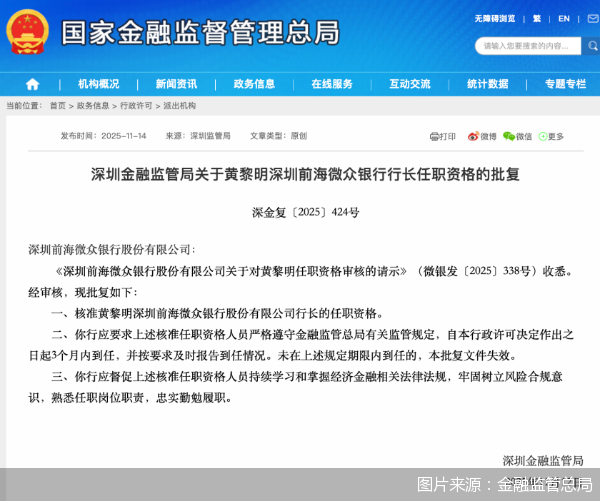
Core Viewpoint - The appointment of Huang Liming as the new president of WeBank marks a significant leadership transition as the bank faces challenges in performance, asset quality, and structural transformation amid a tightening regulatory environment and shrinking consumer loans [1][2]. Leadership Transition - Huang Liming will be the third president of WeBank, following the tenure of Li Nanqing, who led the bank for ten years and significantly expanded its asset scale [2]. - Huang has been with WeBank since its inception and has a deep understanding of its operations, having previously served as the deputy president [2][3]. Business Performance - As of mid-2025, WeBank's total assets reached 714.72 billion yuan, maintaining its position as the leading internet bank, but it reported a decline in both operating income (189.63 billion yuan, down 3.44%) and net profit (55.66 billion yuan, down 11.86%) for the first time [4]. - The proportion of personal consumer loans has decreased, with total loans and advances amounting to 435.976 billion yuan, a year-on-year increase of 5.18%, while consumer loans fell by 5.53% [4]. Regulatory Environment - The new lending regulations have compressed the leverage space for joint loans, impacting WeBank's reliance on products like "Weilidai" that depend on external funding [5][6]. - The regulations require internet banks to assume more risk capital in joint loans and restrict outsourcing of core risk control functions, challenging WeBank's "light capital" operational model [6]. Strategic Adjustments - WeBank is undergoing a transformation focusing on cost reduction, structural optimization, and technology-driven growth, with an emphasis on corporate loans and wealth management as new growth areas [7][8]. - The bank has established partnerships with numerous financial institutions for wealth management and has developed a comprehensive AI infrastructure to enhance its digital banking capabilities [8][9]. Future Outlook - Analysts suggest that WeBank's strategic adjustments should focus on enhancing middle-income through high-value services, leveraging technologies like blockchain for risk control, and exploring new financial sectors [9]. - Huang Liming's leadership is expected to strengthen the integration of WeBank's consumer and business ecosystems, fostering innovation and compliance in product development [9].
公募REITs,有望修复!
Zhong Guo Ji Jin Bao· 2025-11-16 13:40
Core Viewpoint - Public REITs are evolving from financial innovation tools to significant drivers of infrastructure construction and high-quality economic development in China, with over 100 REITs projects recommended by the National Development and Reform Commission, expected to mobilize over 1 trillion yuan in new investments [2][3]. Group 1: Role of Public REITs - Public REITs play a crucial role in revitalizing a vast amount of existing assets, facilitating a sustainable path for new investments of over 1 trillion yuan [3]. - The development of the secondary market for public REITs provides a pricing benchmark for the primary market, attracting various social capital, including private enterprises, to explore infrastructure construction needs [3]. - The structure of infrastructure securities investment funds creates a virtuous cycle of investment, operation, exit, and reinvestment, guiding capital towards major national strategic areas [3]. Group 2: Financial Structure Optimization - Public REITs improve corporate balance sheets and alleviate debt financing pressures for original equity holders [4]. - They broaden social capital investment channels and enhance asset diversification, reducing concentration risks [4]. - Policy support for private investment projects in issuing REITs has simplified the fundraising process and encouraged healthy market development [4]. Group 3: Operational Efficiency - Public REITs compel infrastructure operators to shift focus from construction to operation, enhancing operational efficiency [5]. - Strict information disclosure and market scrutiny of operational quality promote efficiency improvements in infrastructure projects [5]. - The mechanism linking value and operational efficiency drives the transformation of the infrastructure sector towards specialization and precision [5]. Group 4: Market Expansion and Future Outlook - The public REITs market is expected to expand further, with increased liquidity anticipated [6]. - The inclusion of public REITs in the investment scope of long-term funds, such as social security funds and pension funds, is expected to enhance market participation [6]. - The investment structure of public REITs is primarily composed of institutional funds, with potential for increasing the proportion of trading-type investors to improve market liquidity [6]. Group 5: Current Market Conditions - The public REITs market has experienced a downturn, with the CSI REITs Total Return Index dropping over 6% from its mid-year peak [18][20]. - Factors contributing to this adjustment include profit-taking by investors, declining distribution rates, and a shift of funds to the stock market [20][21]. - Despite the recent downturn, there is optimism for market recovery, driven by the inherent cash flow characteristics of public REITs and the potential for long-term value [21][23]. Group 6: Investment Strategies - Investors are advised to focus on stable, defensive, and policy-supported REITs assets in the current market environment [14][16]. - Emphasis should be placed on assets with stable cash flows, such as toll roads and clean energy projects, as well as growth-oriented assets that have been undervalued [14][16]. - The importance of assessing asset quality, valuation rationality, and operational capabilities is highlighted for making informed investment decisions [24].
金融活水润万家 普惠答卷暖城乡
Jiang Nan Shi Bao· 2025-11-16 13:23
Core Insights - Jiangnan Rural Commercial Bank focuses on inclusive finance to support various sectors, including small and micro enterprises, agriculture, and rural development, providing tailored financial services to meet core funding needs [1][4]. Group 1: Financial Support for Local Businesses - Jiangnan Rural Commercial Bank has successfully provided operational loans to local businesses, such as a guesthouse in Tianmuhu Town, helping them overcome funding shortages and enabling business transformations [2][3]. - The bank has issued 67,774 personal operational loans in Liyang, with a total loan balance of 8.1 billion, significantly contributing to the local economy [2]. Group 2: Agricultural Financing Solutions - The bank addresses the challenges of long investment cycles and high upfront costs in agriculture by offering customized loan products, such as a 500,000 loan to an ecological farm owner, facilitating the establishment of a successful pick-your-own fruit business [3][4]. - In Liyang, agricultural and small micro-loan increments reached 2.5 billion, with a growth rate of 6.2%, supporting various agricultural sectors [4]. Group 3: Comprehensive Financial Services - Jiangnan Rural Commercial Bank has developed a "Financial + Livelihood + Government Affairs" service ecosystem, enhancing its product offerings and extending services to meet community needs [5]. - The bank has launched innovative products like "Xinyi Loan" and "Rongchuang Loan" to support small businesses and veterans, respectively, simplifying approval processes and optimizing interest rates [5][6]. Group 4: Community Engagement and Accessibility - The bank has established 172 convenient service points in Liyang, processing 340,000 transactions worth 170 million, making financial services more accessible to rural residents [6]. - Regular community service days and the inclusion of non-financial services, such as social security and healthcare processing, demonstrate the bank's commitment to enhancing the quality of life for local residents [6]. Group 5: Future Commitment - Jiangnan Rural Commercial Bank aims to continue refining its product design and service models, focusing on addressing urgent community needs and supporting rural revitalization and industrial upgrades [6].
央行前瞻普惠金融发展趋势|政策与监管
清华金融评论· 2025-11-16 08:36
Core Viewpoint - The report from the People's Bank of China emphasizes the transformation of global financial landscapes, driven by digital revolutions that integrate billions into formal financial systems, shifting the focus of inclusive finance towards service quality and depth [1][3]. Group 1: International Trends in Inclusive Finance - The G20's Global Partnership for Financial Inclusion (GPFI) has released a new action plan for financing small and micro enterprises, highlighting the importance of traditional credit infrastructure and the role of financial technology in diversifying funding sources [3]. - Various organizations, including the G20 Digital Economy Working Group and the World Bank, promote the concept of Digital Public Infrastructure (DPI) to enhance cross-border payments and data security, which is crucial for developing low- and middle-income countries [4]. - The impact of climate change on vulnerable groups has escalated from a risk warning to a policy action, with organizations like the World Bank and FAO focusing on inclusive green finance to support sustainable development [4]. Group 2: Development Outlook for Inclusive Finance - Future strategies will be guided by Xi Jinping's thoughts, aiming to create a high-level inclusive financial system that aligns with the goals of building a modern socialist country, focusing on enhancing financial services for key sectors and groups [7][8]. - The optimization of inclusive finance policies will involve improving the monetary policy framework and ensuring financial institutions increase lending to agriculture, small enterprises, and vulnerable groups [8]. - Financial products and services will be enriched to meet the diverse needs of small and micro enterprises, with a focus on supporting rural revitalization and enhancing financial inclusion in various sectors [9]. Group 3: Strengthening Financial Services and Capabilities - The report emphasizes the need to enhance the service capabilities of financial institutions, particularly in rural areas, to ensure a comprehensive financial service system that supports high-quality economic development [10]. - The establishment of a robust financial service system will involve leveraging large financial institutions while encouraging smaller ones to focus on local needs and specialties [10]. - The integration of technology and digital transformation in financial services is crucial for improving accessibility and efficiency in delivering inclusive finance [10][11]. Group 4: Optimizing Basic Financial Services - There is a focus on improving financial service accessibility in remote areas, ensuring that financial institutions expand their presence to provide services in underserved regions [11]. - Initiatives to simplify account opening processes and reduce transaction fees are being promoted to enhance financial inclusion for vulnerable groups [11]. - The development of inclusive insurance products is highlighted to address the basic insurance needs of specific risk groups, ensuring broader coverage and protection [11]. Group 5: Enhancing the Financial Environment - The report calls for improved credit information sharing and the development of diverse credit products to meet various financial service needs [12]. - The expansion of financing guarantee systems and the protection of financial consumers' rights are essential for fostering a transparent and inclusive financial environment [12].