能源转型

Search documents
赵文智院士:川渝地区建“气大庆”有四大有利条件
Di Yi Cai Jing· 2025-12-02 04:07
Core Insights - Natural gas plays a crucial bridging role in the energy transition, facilitating the shift from fossil fuels to renewable energy sources [1][2] - The Sichuan-Chongqing region is becoming increasingly important for national energy security, with significant potential for natural gas development [1][5] Group 1: Natural Gas Development - During the 14th Five-Year Plan, the Sichuan-Chongqing region has accumulated proven natural gas geological reserves of 540 million cubic meters, with an average annual increase of 452 billion cubic meters [2][5] - The region's natural gas production is experiencing rapid growth, with significant breakthroughs in shale oil production, marking a transition from a "natural gas basin" to an "oil and gas symbiotic basin" [2][5] Group 2: Strategic Importance of Sichuan-Chongqing - The Sichuan basin holds 72.4 trillion cubic meters of natural gas resources, accounting for 32.3% of the national total, making it the largest onshore gas basin in China [5] - The region's development is supported by clear strategic directions, with a focus on accelerating the exploration and production of both natural gas and oil [5][6] Group 3: Future Prospects - The construction of the "Gas Daqing" initiative in the Sichuan-Chongqing region is expected to enhance energy structure transformation and support the Chengdu-Chongqing economic circle [6] - The initiative aims to position the southwestern oil and gas fields among the largest in China and globally, driving growth in related industries such as exploration, development, and sales [6]

德龙汇能2025年12月2日涨停分析:国资入主+治理优化+新能源布局
Xin Lang Cai Jing· 2025-12-02 02:59
Group 1 - The core viewpoint of the article highlights the reasons behind Delong Huineng's stock surge, including state-owned capital entry, governance optimization, and new energy layout [1] Group 2 - Delong Huineng is undergoing a significant transformation, with Dongyang Nuoxin's indirect 49% stake bringing government resource support and a transaction amount of 1 billion yuan, indicating the new shareholder's recognition of the company's value [1] - The company has revised its articles of association and decision-making rules, eliminating the supervisory board to enhance decision-making efficiency [1] - Delong Huineng has proactively mitigated risks by fully provisioning for a 222 million yuan impairment related to Guojun's advance payments, thereby reducing future financial risks [1] - New regulations have strengthened the management of raised funds, improving transparency in fund usage [1] - The company primarily engages in clean energy supply, focusing on natural gas, while also actively expanding into hydrogen energy and photovoltaic sectors, aligning with current energy transition trends [1] Group 3 - The energy sector has recently attracted capital attention, with some natural gas and new energy-related stocks performing actively, contributing to Delong Huineng's stock limit-up potentially due to sector linkage [1] - Data from Dongfang Caifu indicates a certain inflow of funds into the energy sector on the day of the stock surge [1] Group 4 - On the technical front, if the MACD indicator forms a golden cross or breaks through the upper Bollinger Band, it may attract technical investors' attention, further driving up the stock price [1] - Tonghuashun's capital monitoring shows that large orders presented a net buying state on that day, with main funds flowing in to support the stock price limit-up [1]

能源转型,正在加入“新内容”
Zhong Guo Hua Gong Bao· 2025-12-02 02:25
Group 1 - The traditional energy system is rapidly transitioning to a new energy system dominated by renewable energy, necessitating a green and low-carbon transformation of energy to meet national economic development goals [1] - Artificial Intelligence (AI) is identified as a key technology for enhancing energy management efficiency, with applications already being implemented in various domestic power plants, coal mines, and oil fields [1] - AI can significantly reduce energy costs, ensure energy security, and promote technological advancements in the energy sector [1] Group 2 - AI large models are considered crucial for the next generation of artificial intelligence, improving decision-making quality and efficiency in industrial management [2] - The "AI Purple Collar" model developed by Kunlun Data has been successfully applied in nuclear power plants, enabling real-time data response and autonomous maintenance decision-making [2] - AI can enhance the management of renewable energy generation bases by intelligently scheduling energy storage systems to address short-term fluctuations in power supply [2] Group 3 - New energy storage technologies are becoming vital indicators for the transformation of energy structures, playing significant roles in generation, transmission, and consumption [3] - Energy storage technologies can address the intermittency and unpredictability of renewable energy generation, stabilize grid frequency, and balance supply and demand [3] - There is an urgent need to develop long-duration, large-scale energy storage technologies, as current systems primarily rely on electrochemical storage, which has limitations in efficiency and environmental impact [3] Group 4 - Innovative energy storage solutions, such as lava thermal energy storage and solar calcium cycle power generation, are being researched to improve energy conversion efficiency and environmental safety [3][4] - Carbon dioxide energy storage technology is also being developed, which can store energy in the form of CO2 internal energy and pressure potential, providing high-density and efficient energy storage [5] Group 5 - Hydrogen energy is recognized as a key pathway for decarbonization, with liquid hydrogen offering superior economic performance compared to gaseous hydrogen for large-scale applications [6] - The density of liquid hydrogen is significantly higher than that of gaseous hydrogen, making it a critical economic indicator for hydrogen energy applications [6] - The development of liquid hydrogen refueling stations is expected to enhance refueling efficiency, reduce costs, and improve land utilization [7]
第三届中国-巴伊亚州合作论坛在巴西举办
Xin Hua She· 2025-12-02 01:04
Group 1 - The third China-Bahia Cooperation Forum was held in Salvador, Brazil, focusing on sustainable economic development and poverty reduction cooperation between China and Brazil [1][2] - Over 2.4 million people in Brazil have escaped poverty due to China's poverty alleviation experience, with 1 million from Bahia state, highlighting the significant impact on Brazil [1] - China has played a crucial role in infrastructure development in Bahia, and there is close cooperation in energy transition, particularly in hydrogen, wind, and solar energy [1] Group 2 - The China-Brazil relationship is at its historical best, with deepening strategic alignment and practical cooperation in infrastructure, industrial chain development, and ecological transition [2] - Bahia state is highlighted as an important region in Brazil with unique advantages in energy, ports, innovation, agriculture, and tourism, providing a solid foundation for cooperation with China [2] - Several Chinese projects in Bahia have made progress this year, including the production launch of BYD's electric vehicle factory and the signing of a supplementary agreement for the Salvador-Itaparica bridge project [2]
绿色氢氨醇成为我国能源转型重要支点
Zhong Guo Chan Ye Jing Ji Xin Xi Wang· 2025-12-02 00:09
Core Insights - The report titled "China Green Hydrogen Ammonia and Alcohol Industry Development Report 2025" presents a comprehensive overview of China's green hydrogen ammonia and alcohol industry, highlighting its potential for high-quality development in the hydrogen energy sector [1][2] Industry Overview - The green hydrogen ammonia and alcohol sector is emerging as one of the most commercially viable segments within the hydrogen value chain, driven by global energy transitions towards cleaner and low-carbon solutions [1] - In 2024, China's total hydrogen production is expected to exceed 36.5 million tons, with green hydrogen capacity accounting for approximately 1%, but showing significant growth, as the country has established green hydrogen capacity of 125,000 tons per year, representing over 50% of the global total [1] Market Dynamics - The demand for green hydrogen during the 14th Five-Year Plan period is projected to reach between 2.4 million and 4.3 million tons per year, indicating an accelerated expansion phase for the industry [1] - Green hydrogen ammonia and alcohol are being integrated into various sectors, including energy fuels, chemical raw materials, shipping, and power storage, becoming crucial for China's energy transition [2] Regional Development - The industry is witnessing a clustering effect, with a spatial pattern emerging where northern resource-rich provinces lead, eastern coastal regions serve as demonstration areas, and central and western regions accelerate their development [2] - Inner Mongolia, Jilin, Ningxia, and Xinjiang are identified as key areas for industry development, leveraging abundant wind and solar resources, with several large-scale green ammonia and alcohol projects underway [2] Future Outlook - The next decade is seen as a strategic window for the large-scale development of green hydrogen ammonia and alcohol, with expectations of decreasing costs, optimized industry chain collaboration, and increasing international demand for sustainable shipping fuels [3] - China is positioned to take a leading role in setting technical standards, engineering capabilities, and supply chain scale in the green hydrogen ammonia and alcohol industry [3]
希拉里:中国在太阳能和电动车等领域的优异成绩令人深刻
Zhong Guo Xin Wen Wang· 2025-12-01 17:04
Core Insights - China has made impressive achievements in solar energy and electric vehicles, positioning itself as a significant player in these sectors [1][3] - The international legal and governance systems established post-World War II are undergoing profound changes, with China having the potential to play a crucial role in reshaping these international rules [3] - The shift in policies from the US and EU towards inward-looking strategies in green energy presents substantial development opportunities for China [3] Industry Developments - The focus on large-scale development in green sectors such as solar energy and electric vehicles is deemed critical, with China already demonstrating significant progress in these areas [3] - The application of technological innovations in energy sectors can further enhance China's role in global energy development [3] - Artificial intelligence is recognized as a vital component in future energy policies and transitions, suggesting a trend towards smarter energy solutions globally [3]


石油天然气2026年展望:寻找供应周期的线索
2025-12-01 16:03
Summary of Key Points from the Conference Call Industry Overview - **Oil and Gas Industry Outlook for 2026**: The oil market is expected to transition from a state of oversupply to a more balanced situation by 2026. Key factors influencing this transition include OPEC+ production policies and new supply from U.S. shale oil and South American offshore projects [1][2][4]. Core Insights and Arguments - **OPEC Production Policies**: OPEC completed its first round of production increases in April to September 2025, achieving a compliance rate of approximately 70%. A second round began in October 2025, but low compliance due to Russian pipeline disruptions is noted. A potential pause in production increases is expected in Q1 2026 due to seasonal demand and capacity constraints [2][4]. - **U.S. Shale Oil Dynamics**: The cost of drilling new shale oil wells in the U.S. is between $60-70 per barrel. A decline in WTI prices below $70 has led to a reduction in active drilling rigs from 300 to 250. The inventory of DUC (drilled but uncompleted) wells is at a historical low, and new well productivity has not improved, suggesting that U.S. shale oil production may peak by the end of 2025 and decline in 2026 [1][2][8]. - **Supply from South America**: New offshore projects in Brazil and Guyana are expected to increase oil supply, but this will not significantly alter the current oversupply situation. The oil market is anticipated to remain oversupplied in the first half of 2026, with potential improvements in the second half [1][4][10]. - **Coal Market Trends**: The domestic thermal coal market in China is expected to experience a decline followed by a recovery in 2025, with a relatively balanced market in 2026. Electricity demand is projected to grow by about 0.6%, while the metallurgy and construction sectors may see negative growth. The average price is expected to fluctuate between 700-800 RMB [5]. - **Natural Gas Market Influences**: The natural gas market is affected by geopolitical factors, weather changes, and energy transitions. Increased LNG exports from North America and rising European demand are driving growth, but uncertainties remain due to production and weather variability. The demand for natural gas is expected to continue growing, supported by new LNG projects [6][7][13]. Additional Important Insights - **Geopolitical Risks**: Geopolitical factors, such as U.S. sanctions on Russia, are impacting oil supply dynamics. The actual supply from countries like Iran and Venezuela remains uncertain, and these risks have not yet fully reflected in current price levels [12]. - **Global Oil Demand Trends**: Global oil demand is projected to grow slowly, with an increase of about 900,000 to 1 million barrels per day, primarily driven by non-OECD countries like China, India, and Southeast Asia. OECD countries are expected to see zero growth [11]. - **LNG Price Projections**: The global LNG supply expansion is set to begin, with European and Asian spot prices expected to decrease. The price range for Dutch TTF gas is projected to be between $9-10 per MMBtu next year, with Nymex natural gas prices expected to range from $4-5 per MMBtu [3][13]. - **Long-term Natural Gas Demand**: The demand for natural gas is anticipated to grow due to energy transitions and new LNG projects, although weather changes and geopolitical situations will remain significant variables affecting the supply chain [7][14].
“煤炭产量第一省”,即将再度易主?
Mei Ri Jing Ji Xin Wen· 2025-12-01 15:21
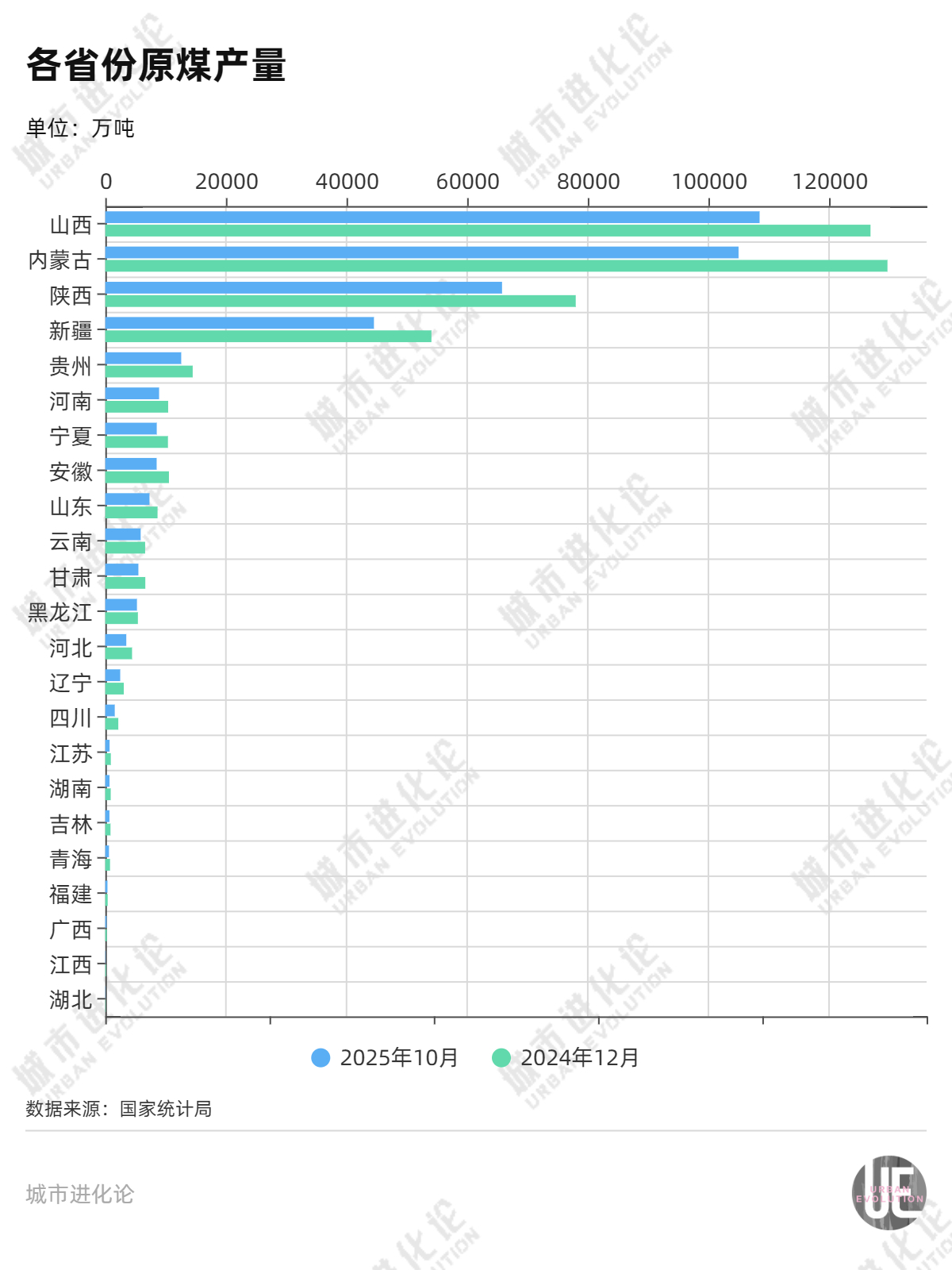
国家统计局最新数据显示,1—10月,内蒙古原煤产量104996.7万吨,山西原煤产量108485.8万吨,比内蒙古多出约3500万吨。这也意味着,今年山西有望重 回第一。 解读:煤炭是我国能源安全保障的"压舱石"。梳理历年数据,过去十余年间,山西和内蒙古你追我赶,轮流把持"煤炭产量第一省"的位置。 不过众所周知,煤炭周期性变化给煤炭主产区经济带来重大影响。以山西为例, 2021年山西一度因煤价飞涨成为"经济增量明星";但到2024年,受安全监 管加码和煤炭价格下调影响,山西煤炭产量被内蒙古超过,GDP增速也仅2.3%,在31个省份中排名垫底。 而今年以来,经过去年的"三超"专项整治,山西煤炭工业产量逐步回升,对经济支撑作用明显。山西省统计局数据显示,1—10月,山西规上工业增加值增 长4.6%。从主要行业看,煤炭工业增长5.1%,对工业增长的贡献率达70%;非煤工业增长3.7%,其中炼焦(11.8%)、有色(15.0%)、装备制造(7.1%) 等行业较快增长。 不过,山西也并非没有压力。此前有分析指出,山西始终没有摆脱"煤炭依赖", "脱煤"进程太慢。反观与山西长期并驾齐驱的能源大省内蒙古,已经逐步 走出"一 ...
城市24小时 | “煤炭产量第一省”,即将再度易主?
Mei Ri Jing Ji Xin Wen· 2025-12-01 15:19
Coal Production Trends - In the first ten months of the year, Inner Mongolia's raw coal production reached 104,996.7 million tons, while Shanxi's production was 108,485.8 million tons, indicating that Shanxi is likely to reclaim its position as the top coal-producing province this year [1][3] - For 2024, projections show Inner Mongolia's coal production at 129,686.9 million tons, surpassing Shanxi's 126,873.8 million tons, marking a shift in leadership in coal production [3] Economic Impact of Coal Industry - Shanxi's GDP growth rate is projected to be only 2.3% in 2024, ranking it at the bottom among 31 provinces, largely due to increased safety regulations and declining coal prices [3][4] - In contrast, Shanxi's industrial output value increased by 4.6% from January to October, with the coal industry contributing significantly to this growth at 5.1%, accounting for 70% of the industrial growth [3] Transition and Diversification Efforts - Shanxi is under pressure to reduce its reliance on coal, with calls for a transition to a more diversified energy structure, as highlighted by the provincial government's recent initiatives [4] - Inner Mongolia is showing a more diversified industrial growth, with significant increases in emerging industries, such as equipment manufacturing (21.2% growth) and high-tech manufacturing (16.5% growth) [4]
我国或将成为全球,乃至人类历史上,第一个“电力王国”
Sou Hu Cai Jing· 2025-12-01 14:01
Core Insights - China's electricity generation reached approximately 9.85 trillion kilowatt-hours in 2023, surpassing the combined output of G7 countries and exceeding the total generation of the US and India [3] - The energy structure in China is undergoing significant transformation, with coal's share in power generation decreasing from 75% in 2007 to 44% in 2024, while clean energy sources are rapidly expanding [5][20] - The development of ultra-high voltage (UHV) transmission technology has been crucial for efficiently transporting electricity from resource-rich western regions to the demand-heavy eastern cities [7] Group 1: Electricity Generation and Consumption - In 2024, China's electricity generation is projected to approach 10 trillion kilowatt-hours, accounting for nearly one-third of the global total [1] - The industrial electricity consumption in China matches the total industrial electricity consumption of all OECD member countries [3] Group 2: Energy Structure and Transition - By 2024, non-fossil fuel power generation capacity has surpassed 60% of total installed capacity, with clean energy sources like wind and solar playing a significant role [5] - The installed capacity of clean energy has reached 1.41 billion kilowatts, marking a shift towards a diversified energy mix that includes coal, oil, gas, and nuclear [5] Group 3: Technological Advancements - China has built 42 UHV transmission lines by the end of 2024, creating a flexible and extensive energy network that connects energy sources to consumers across the country [7] - The country has made significant advancements in power generation technology, transitioning from learning from foreign technologies to developing its own leading-edge capabilities [11] Group 4: Electrification and Future Trends - In 2024, over 40% of passenger vehicles sold in China are expected to be electric, indicating a rapid shift towards electrification in transportation [15] - The new energy storage industry is growing rapidly, with a 130% year-on-year increase in installed capacity, primarily driven by lithium-ion batteries [16] - China is also making strides in hydrogen energy, with a clean hydrogen production capacity exceeding 120,000 tons in 2024, supported by a growing number of hydrogen refueling stations [18] Group 5: Global Impact and Responsibility - China's solar photovoltaic manufacturing has seen a 90% reduction in costs over the past decade, enabling many developing countries to access clean energy at affordable prices [20] - The commitment to electrifying rural areas has been fulfilled, with all citizens now having access to electricity, showcasing China's dedication to equitable energy distribution [22]