全国统一大市场建设

Search documents
再放宽!新版市场准入负面清单发布!这些新业态被纳入→
21世纪经济报道· 2025-04-24 01:32
Core Viewpoint - The newly released "Market Access Negative List (2025 Edition)" indicates a further relaxation of market access restrictions in China, reducing the number of restricted items from 117 to 106 compared to the 2022 version [1][2]. Group 1: Changes in Market Access - The 2025 edition of the negative list has lowered entry barriers by removing 8 national access restrictions, such as changing the public seal engraving industry from a licensing system to a filing system [1]. - The list has also opened up 8 national measures in sectors like new telecommunications services, TV production, and pharmaceutical wholesale and retail, streamlining the access process while maintaining necessary management [1]. - Additionally, 17 local measures have been removed, promoting a unified national market by canceling local licensing requirements in areas like transportation logistics and vehicle rental services [1]. Group 2: Equal Access for Enterprises - According to the National Development and Reform Commission, all types of business entities, whether state-owned or private, large or small, can enter the market equally and legally, with no illegal access barriers set by the government outside the list [2]. - The 2025 edition maintains a balance by ensuring that while access is widened, certain sectors like unmanned aerial vehicle operations and new tobacco products are still included in the negative list for regulatory purposes [2]. Group 3: Historical Context - Since the first version of the market access negative list was introduced in 2018, there have been four revisions, reducing the number of restricted items from 151 to the current 106, representing a reduction of approximately 30% [2].


最高法举行知识产权宣传周新闻发布会
Ren Min Wang· 2025-04-22 01:03
Core Points - The Supreme People's Court of China held a press conference to release the "Judicial Protection Status of Intellectual Property by Chinese Courts (2024)" and typical cases related to intellectual property [1] - In 2023, Chinese courts received nearly 530,000 intellectual property cases and concluded over 540,000, indicating a steady increase in case resolution rates and judicial efficiency [2] - The courts have implemented punitive damages in 460 civil infringement cases, with a year-on-year increase of 44.2%, highlighting a strict approach to intellectual property protection [2] - The Supreme People's Court has introduced comprehensive guidelines to enhance judicial protection for technological innovation, aiming to safeguard the rights of innovation entities [2] Group 1: Judicial Efficiency and Case Management - Chinese courts have seen a stable rise in the number of concluded intellectual property cases, with a case resolution rate that continues to improve [2] - The establishment of 30 specialized intellectual property courts and 558 grassroots courts with jurisdiction over intellectual property cases has optimized the judicial landscape [4] - The implementation of a "three-in-one" trial mechanism across various courts has further enhanced the efficiency of intellectual property judicial protection [4] Group 2: Protection of Innovation and Technology - The Supreme People's Court has actively protected technological innovation by issuing opinions that provide systematic guidance for cases involving high-tech intellectual property [2] - A notable case involving punitive damages for a technology secret infringement in the "new energy vehicle chassis" case resulted in compensation exceeding 640 million yuan, showcasing the court's commitment to protecting innovation [2] - The court has also opened hearings for patent ownership disputes related to "osteoarthritis drugs," reinforcing the protection of research entities [2] Group 3: International Cooperation and Global Governance - The Supreme People's Court has engaged in international cooperation by participating in global governance discussions on intellectual property, including hosting seminars with the World Intellectual Property Organization [7] - The court has actively participated in bilateral and multilateral exchanges, enhancing China's international influence in intellectual property law [8] - In 2024, the courts received 8,252 new foreign-related intellectual property cases, reflecting a commitment to fair treatment of both domestic and foreign parties [7]
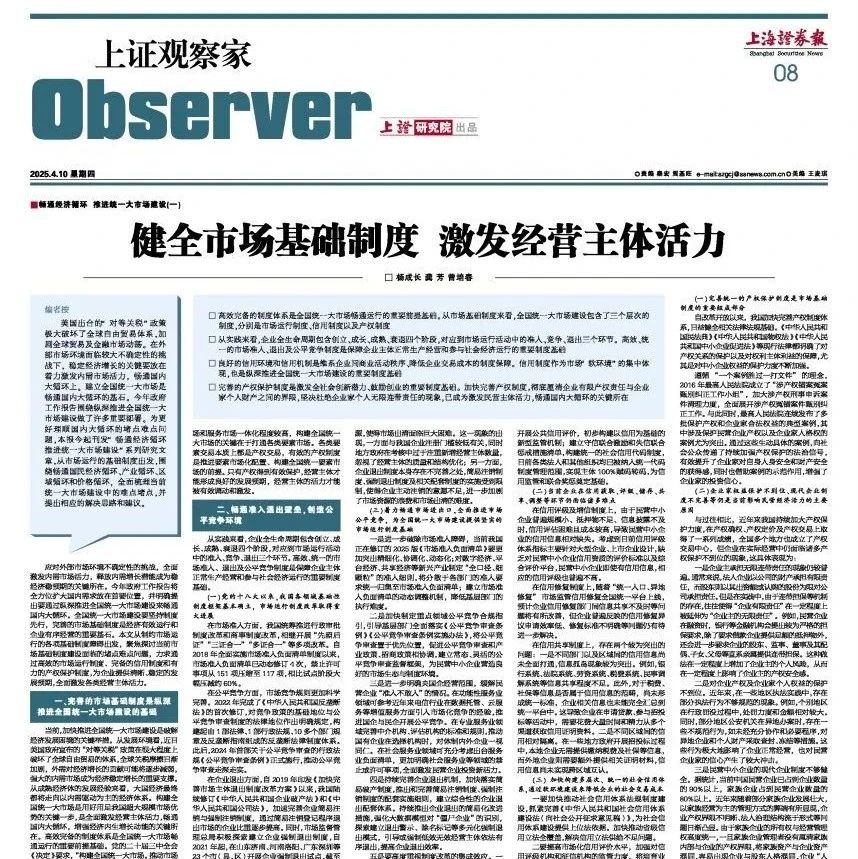
健全市场基础制度 激发经营主体活力
申万宏源研究· 2025-04-18 11:49
畅通经济循环 推进统一大市场建设(一) 杨成长 龚 芳 曾培春 高效完备的制度体系是全国统一大市场畅通运行的重要前提基础。从市场基础制度来看,全 国统一大市场建设包含了三个层次的制度,分别是市场运行制度、信用制度以及产权制度 从实践来看,企业全生命周期包含创立、成长、成熟、衰退四个阶段,对应到市场运行活动 中的准入、竞争、退出三个环节。高效、统一的市场准入、退出及公平竞争制度是保障企业主体 正常生产经营和参与社会经济运行的重要制度基础 良好的信用环境和信用机制是维系企业间商业活动秩序、降低企业交易成本的制度保障。信 用制度作为市场"软环境"的集中体现,也是纵深推进全国统一大市场建设的重要制度基础 完善的产权保护制度是激发全社会创新潜力、鼓励创业的重要制度基础。加快完善产权制 度,彻底厘清企业有限产权责任与企业家个人财产之间的界限,坚决杜绝企业家个人无限连带责 任的现象,已成为激发民营主体活力,畅通国内大循环的关键所在 应对外部市场环境不确定性的挑战,全面激发内需市场活力,释放内需增长潜能成为稳经济 稳预期的关键所在。今年政府工作报告将全方位扩大国内需求放在首要位置,并明确提出要通过 纵深推进全国统一大市场建设 ...
申万宏源杨成长:健全市场基础制度 激发经营主体活力
申万宏源证券上海北京西路营业部· 2025-04-11 02:12
Core Viewpoint - The article emphasizes the importance of establishing a unified national market to stimulate domestic demand and ensure stable economic growth, especially in the face of external uncertainties such as the U.S. "reciprocal tariff" policy [5][8]. Group 1: Market Foundation System - A comprehensive market foundation system is essential for the smooth operation of a unified national market, which includes market operation systems, credit systems, and property rights systems [7][9]. - The market operation system is crucial, involving market access, fair competition, and exit mechanisms that correspond to the lifecycle of enterprises [9][12]. - A robust credit system serves as the "soft support" for the market, reducing transaction costs and enhancing trust among business entities [10][17]. - The property rights system is the "hard constraint" that protects the rights of entrepreneurs and clarifies the boundaries between personal and corporate liabilities, which is vital for encouraging innovation and entrepreneurship [11][23]. Group 2: Market Access and Competition - The article discusses the need to eliminate barriers to market access and create a fair competitive environment, highlighting reforms in market entry and exit mechanisms [12][15]. - Significant progress has been made in market access reforms, including the reduction of prohibited licensing items from 151 to 117, representing a 60% decrease [12]. - The competition rules have been improved, with the first revision of the Anti-Monopoly Law completed in 2022, establishing a comprehensive legal framework for fair competition [12][13]. Group 3: Credit Environment - The establishment of a sound credit environment is crucial for reducing social transaction costs and maintaining order in commercial activities [17][18]. - Recent reforms have led to the development of a social credit system, with over 1.8 billion credit records collected, facilitating better access to financing for businesses [18][20]. - Challenges remain in credit acquisition and sharing, particularly for small and medium-sized enterprises (SMEs), which often face high costs and difficulties in obtaining credit ratings [19][21]. Group 4: Property Rights Protection - Strengthening property rights protection is essential for fostering innovation and entrepreneurship, with ongoing efforts to clarify the responsibilities and rights of entrepreneurs [23][25]. - Despite improvements, issues such as unlimited joint liability for entrepreneurs persist, which can deter investment and innovation [23][24]. - The article calls for the establishment of a unified property rights protection system and the promotion of modern enterprise systems to enhance the vitality of the private economy [25].
逆周期调控加码:申万期货早间评论-20250324
申银万国期货研究· 2025-03-24 00:37
Core Viewpoint - The Chinese government is committed to implementing more proactive macro policies and increasing counter-cyclical adjustments to support stable economic growth and reform [1][5]. Group 1: Economic Policies - Premier Li Qiang emphasized the need for more active macro policies and counter-cyclical adjustments to ensure sustained economic improvement [1][5]. - The government aims to deepen economic reforms and promote a unified national market to facilitate smoother economic circulation [1][5]. Group 2: Industry Insights - The China Iron and Steel Association highlighted that supply-demand imbalance is the main issue affecting the steel industry, advocating for the closure of new production capacity and the exit of outdated capacity [1]. - In the glass industry, inventory levels have decreased, with a reported reduction of 2.02 million heavy boxes week-on-week, indicating a potential recovery in demand [2][15]. Group 3: Commodity Market Trends - Gold prices reached new highs, driven by expectations of future monetary easing and geopolitical uncertainties, although upward momentum may slow after surpassing $3000 per ounce [3][18]. - Aluminum prices are under pressure due to high levels, affecting downstream consumption, while demand is gradually recovering post-holiday [3][21]. Group 4: Agricultural Products - The domestic apple cold storage inventory decreased by 234,500 tons, indicating a slight improvement in market dynamics, while prices remain stable [32]. - The domestic pig price continues to decline, with expectations of increased supply in the coming months due to recovering breeding stock [33].

集中力量抓好一批带动性强的重点事项
Zheng Quan Shi Bao Wang· 2025-03-14 18:12
Group 1 - The core viewpoint emphasizes the need for the government to act as an executor of the Central Committee's decisions, highlighting the importance of being proactive and results-oriented in governance [1][2] - The government has outlined specific tasks for economic and social development, including actions to boost consumption, promote a unified national market, and advance the "Artificial Intelligence +" initiative [2] - There is a focus on enhancing high-level opening up, stabilizing foreign trade and investment, and effectively responding to external shocks [2] Group 2 - The meeting involved key officials from various ministries, including the National Development and Reform Commission and the Ministry of Human Resources and Social Security, indicating a collaborative approach to policy implementation [3][4] - The government aims to deepen reforms and improve the legal and credit environment to stimulate the initiative of various business entities [2] - The emphasis is placed on achieving higher standards in development, particularly in areas such as domestic circulation, green transformation, and improving people's livelihoods [2]
立规拆篱建设开放畅通大市场
Zhong Guo Jing Ji Wang· 2025-03-09 22:56
Group 1 - The construction of a unified national market is emphasized as a crucial requirement in the government work report, with the metaphor of "self-harming" if not pursued [1] - China's vast market, projected to generate nearly 50 trillion yuan in consumption and investment in 2024, is highlighted as a significant advantage, with any 1% demand equating to a market of over 14 million people [2] - The central government has prioritized the establishment of a unified market, implementing various policies to eliminate local protectionism and market fragmentation, aiming for a stable and fair competitive environment [2][3] Group 2 - Despite the reduction of visible barriers to a unified market, hidden barriers still exist, causing challenges for businesses in cross-regional operations and investments [3] - The shift in the government work report's language from "accelerate" to "deepen" indicates a stronger commitment to reforming the unified market, with specific prohibitions outlined in the guidelines [3] - The importance of an open and fair market environment is underscored, as approximately 24,000 new enterprises are established daily, which are vital for the vitality of the Chinese economy [4]
中国宏观经济研究院院长黄汉权:以新质生产力为驱动的发展态势在形成,稳住楼市股市有助于提振消费
21世纪经济报道· 2025-03-08 04:26
Core Viewpoint - The government aims for a GDP growth target of around 5% for 2025, emphasizing the need for stable employment, risk prevention, and improving people's livelihoods, supported by economic growth potential and favorable conditions [1][6]. Group 1: Economic Growth and Conditions - The economic growth target of 5% for 2025 is supported by several favorable conditions, including more proactive macroeconomic policies, particularly in fiscal and monetary areas [6][10]. - The government plans to increase the scale of new government debt to 11.86 trillion yuan, a rise of 2.9 trillion yuan from the previous year, which will positively impact investment and consumption [6][10]. - The balance of contributions from exports, investment, and consumption to economic growth is noted, with significant advancements in strategic emerging industries driven by technological innovation [5][6]. Group 2: Fiscal and Monetary Policies - The fiscal policy will see a deficit rate increase to around 4%, with a total deficit scale of 5.66 trillion yuan, marking a nearly 40% increase from last year [10]. - The monetary policy will be more accommodative, maintaining ample liquidity and supporting sectors like technology innovation and consumption [10][11]. Group 3: Consumption and Investment - To boost consumption, the government will implement special actions, including increasing income for low- and middle-income groups and stabilizing asset values in real estate and stock markets [11][12]. - Investment efficiency will be improved by selecting key projects for government investment and encouraging private sector participation in infrastructure projects [12][14]. Group 4: Key Industries and Reforms - Focus areas for new quality productivity include digital economy, green economy, life sciences, and low-altitude economy, with significant technological breakthroughs expected [15][16]. - Key reforms to be pushed include enhancing the vitality of business entities, accelerating the construction of a unified national market, and deepening fiscal and tax reforms to increase local financial autonomy [17][18].

政府工作报告丨综合整治“内卷式”竞争
证券时报· 2025-03-05 02:10
责编:万健祎 校对:刘星莹 版权声明 2025年3月5日(星期三)上午9时,十四届全国人大三次会议在人民大会堂举行开幕会。 政府工作报告在提到纵深推进全国统一大市场建设时说,加快建立健全基础制度规则,破除地方保护和市 场分割,打通市场准入退出、要素配置等方面制约经济循环的卡点堵点,综合整治"内卷式"竞争。 来源:新华社 END 点击关键字可查看 潜望系列深度报道丨 股事会专栏 丨 投资小红书 丨 e公司调查 丨 时报会客厅 丨 十大明星私募访谈 丨 今夜,军工股集体暴涨! 丨 深圳市委书记走访调研人工智能与机器人企业 丨 冲高回落! 605100,尾盘"天地板"! 丨 金价,大跳水!每克骤降近20元,有人"刚买就亏"丨记者实探 丨 巴菲 特批评美政府! 丨 多股盘中30cm涨停!这一板块,大爆发! 丨 特朗普重大宣布!这一品种暴涨超 70%! 丨 比亚迪+大疆,大动作! 丨 利好!深圳发布"创业大礼包" 丨 宇树科技王兴兴,亲自"代 言"! 证券时报各平台所有原创内容,未经书面授权,任何单位及个人不得转载。我社保留追 究相关 行 为主体 法律责任的权利。 转载与合作可联系证券时报小助理,微信ID:Securi ...