
城乡融合

Search documents
培育城乡发展新动能 专家解读要这样“联动”
Yang Shi Xin Wen Ke Hu Duan· 2025-12-14 06:57
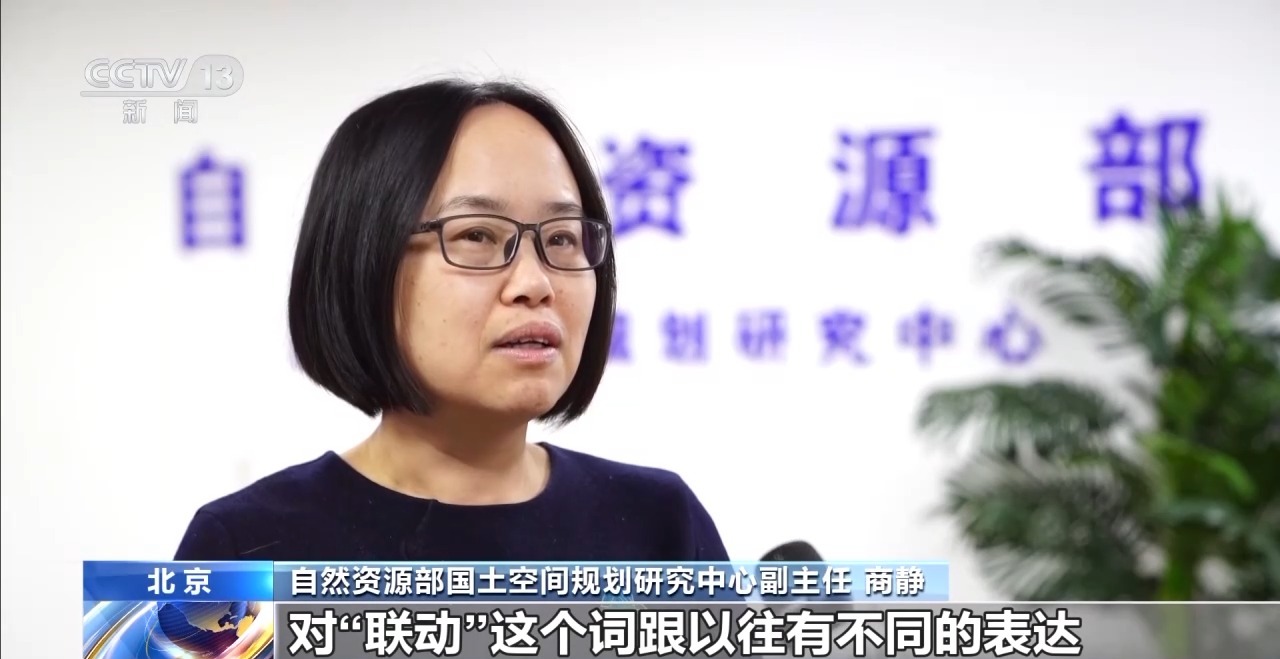
今年的中央经济工作会议明确,要坚持协调发展,促进城乡融合和区域联动。对明年我国自然资源领域工作提出了新部署、新要求。这意味着什么? 专家表示,这意味着我国区域间的协同合作与共同发展将进入新阶段。 自然资源部国土空间规划研究中心副主任商静:今年对"联动"这个词跟以往有不同的表达,实际上是在全国一盘棋的思想指导下,以各地的资源禀赋和资源 环境承载能力为基础,发挥协同效应,提升整体的竞争力,在时序安排上和空间安排上进一步协调起来。 同时,中央经济工作会议还明确,要统筹推进以县城为重要载体的城镇化建设和乡村全面振兴,推动县域经济高质量发展。 此外,会议还强调,要加强重点城市群协调联动,深化跨行政区合作。专家表示,随着《长三角国土空间规划》等国家级国土空间专项规划的批复实施,我 国空间发展格局优化正系统推进。 自然资源部国土空间规划研究中心副主任商静:特别聚焦重点都市圈的发展,研究针对它们的国土空间需求、重大项目落地,通过规划和政策赋能的方式, 支持这些地区的发展。 (总台央视记者 崔霞 金晓曦) [ 责编:杨煜 ] 自然资源部国土空间规划研究中心副主任商静:这里面有两个方面的重要工作要做。一方面是要以城市群、都市圈这 ...

共绘城乡融合新画卷!2025广东乡村振兴·千村论坛在暨南大学成功举办
Nan Fang Nong Cun Bao· 2025-12-13 15:03
共绘城乡融合新 画卷!2025广东 乡村振兴·千村 论坛在暨南大学 成功举办_南方 +_南方plus 12月12日,由暨 南大学主办、暨 南大学乡村振兴 研究院承办 的"2025广东乡 村振兴·千村论 坛"在暨南大学 石牌校区曾宪梓 科学馆圆满举 行。本次论坛汇 聚了来自中国农 业大学、华南农 业大学等高校、 机构的30余位知 名专家学者及一 线实务工作者。 广东省农业农村 厅二级巡视员陈 荣,广东省工商 联原二级巡视 员、省老区建设 促进会常务副秘 书长潘丽珍等相 关部门同志出席 会议。论坛紧扣 广东省"百县千 镇万村高质量发 展工程"实施三 果,为广东城乡 区域协调发展建 言献策。新华 网、南方日报、 羊城晚报等多家 主流媒体对本次 论坛进行了深入 报道。论坛由暨 南大学经济与社 会研究院、乡村 振兴研究院院长 冯帅章教授主 持。 在主旨演讲环 节,多位重量级 专家围绕乡村振 兴的深层逻辑展 开了深入探讨。 浙江之江乡村振 兴研究院首席专 家、广东省"百 千万工程"首席 智库专家顾益康 教授首先发言。 顾教授结合浙江 经验与广东实 践,以"深化'千 万工程'推进城 乡融合与共同富 裕"为题分享了 关于高质 ...

中央经济工作会议:2026年加快新型能源体系建设,扩大绿电应用
Xin Lang Cai Jing· 2025-12-12 01:37
Core Viewpoint - The Central Economic Work Conference held on December 10-11, 2025, emphasized the need for a stable and progressive economic policy, focusing on quality improvement and efficiency enhancement in the economic work for 2026 [5][21]. Economic Policy Direction - The conference highlighted the importance of maintaining stability while seeking progress, enhancing the effectiveness of macroeconomic governance, and integrating existing and new policies [3][18]. - It was decided to implement a more proactive fiscal policy, ensuring necessary fiscal deficits and optimizing fiscal expenditure structures [8][24]. Key Tasks for 2026 - The conference outlined several key tasks for 2026, including: - Promoting a strong domestic market and enhancing consumer spending through targeted actions [9][25]. - Fostering innovation and developing new growth drivers, particularly in technology and education [10][26]. - Strengthening reforms to boost high-quality development and addressing issues in state-owned enterprises and private sector regulations [10][26]. - Expanding international cooperation and trade, particularly in digital and green sectors [10][26]. - Coordinating urban and rural development, ensuring food security, and maintaining poverty alleviation efforts [11][27]. - Leading with a "dual carbon" approach to promote green transformation and environmental protection [11][27]. Emphasis on People's Livelihood - The conference stressed the importance of improving people's livelihoods, including stabilizing employment for key groups and enhancing education and healthcare services [12][28]. - It also highlighted the need to address risks in key sectors, particularly in the real estate market, and to manage local government debt effectively [12][28]. Overall Economic Confidence - The conference called for unity and confidence in the economic outlook, emphasizing the need to adapt to new challenges while leveraging existing strengths [22][29]. - It underscored the importance of aligning actions with the central government's strategic vision and ensuring effective implementation of economic policies [30][31].
推动经济实现质的有效提升和量的合理增长——从中央经济工作会议看“十五五”开局之年中国经济着力点
Shang Hai Zheng Quan Bao· 2025-12-11 18:40
Core Points - The Central Economic Work Conference held on December 10-11, 2023, emphasized the importance of economic work for the year 2025, marking the end of the 14th Five-Year Plan and setting the direction for the 15th Five-Year Plan [1][2] - The conference highlighted the need for a comprehensive understanding of economic work under new circumstances, focusing on maximizing economic potential, combining policy support with reform, and ensuring effective management alongside flexibility [1][2] Economic Policy Direction - The conference called for a more proactive macroeconomic policy, emphasizing stability and quality improvement, and increasing counter-cyclical and cross-cyclical adjustments [3][4] - It was decided to maintain necessary fiscal deficits and optimize fiscal expenditure structures while addressing local fiscal difficulties [4] - Monetary policy will remain moderately loose, utilizing various tools like reserve requirement ratio cuts and interest rate reductions to support economic growth [4] Domestic Market Development - Building a strong domestic market is prioritized, with a focus on enhancing domestic demand and addressing the current insufficient effective demand [6][7] - Specific measures include boosting consumption, expanding the supply of quality goods and services, and optimizing policies to stimulate consumer spending [6][7] Innovation and New Growth Drivers - The conference stressed the importance of innovation-driven development, proposing a series of initiatives to enhance education, technology, and talent development [8][9] - It aims to strengthen the role of enterprises in innovation and promote the integration of technological and industrial innovation [8][9] Reform and Opening Up - The conference outlined reforms to enhance high-quality development, including establishing a unified national market and addressing competitive practices [10][11] - It emphasized the transition from a commodity and factor flow-oriented opening to a rules-based opening, focusing on service sector expansion and digital trade [11] Regional Development and Urban-Rural Integration - Coordinated regional development is essential, with a focus on urban-rural integration and promoting high-quality county-level economic development [12][13] - The conference highlighted the importance of maintaining poverty alleviation efforts and integrating them into rural revitalization strategies [12][13] Green Transition - The conference called for a comprehensive green transition, emphasizing carbon reduction and environmental protection measures [14] - Specific actions include energy system construction and pollution control initiatives to support sustainable development [14] Social Welfare and Employment - The conference underscored the importance of social welfare, focusing on employment stability for key groups and enhancing educational opportunities [16] - It aims to improve public services and ensure the supply of essential goods, particularly during the year-end period [16] Risk Management - The conference addressed the need to stabilize the real estate market and manage local government debt risks [17][18] - It proposed measures to control real estate supply and promote the construction of affordable housing [17][18]
从中央经济工作会议看“十五五”开局之年中国经济着力点
Xin Hua Wang· 2025-12-11 16:50
中央经济工作会议12月10日至11日在北京举行。习近平总书记出席会议并发表重要讲话,总结2025年经济工作,分析当前 经济形势,部署2026年经济工作,为实现"十五五"良好开局定向领航。 不断深化新形势下做好经济工作的规律性认识 2025年是"十四五"规划收官之年,在中国式现代化进程中具有重要意义。 会议总结今年经济运行情况,指出"经济社会发展主要目标将顺利完成""'十四五'即将圆满收官,第二个百年奋斗目标新征 程实现良好开局"。 会议认为,通过实践,我们对做好新形势下经济工作又有了新的认识和体会:必须充分挖掘经济潜能,必须坚持政策支持 和改革创新并举,必须做到既"放得活"又"管得好",必须坚持投资于物和投资于人紧密结合,必须以苦练内功来应对外部挑 战。 新时代以来的中央经济工作会议,一贯重视理论总结,用以指导经济发展实践。随着形势变化,中央经济工作会议持续深 化对经济工作的规律性认识,2021年提出"四个必须",2022年提出"六个坚持",2023年提出"五个必须",2024年提出"根本保 证""五个必须统筹"。 原标题:新华全媒头条·聚焦中央经济工作会议|推动经济实现质的有效提升和量的合理增长——从中央经 ...
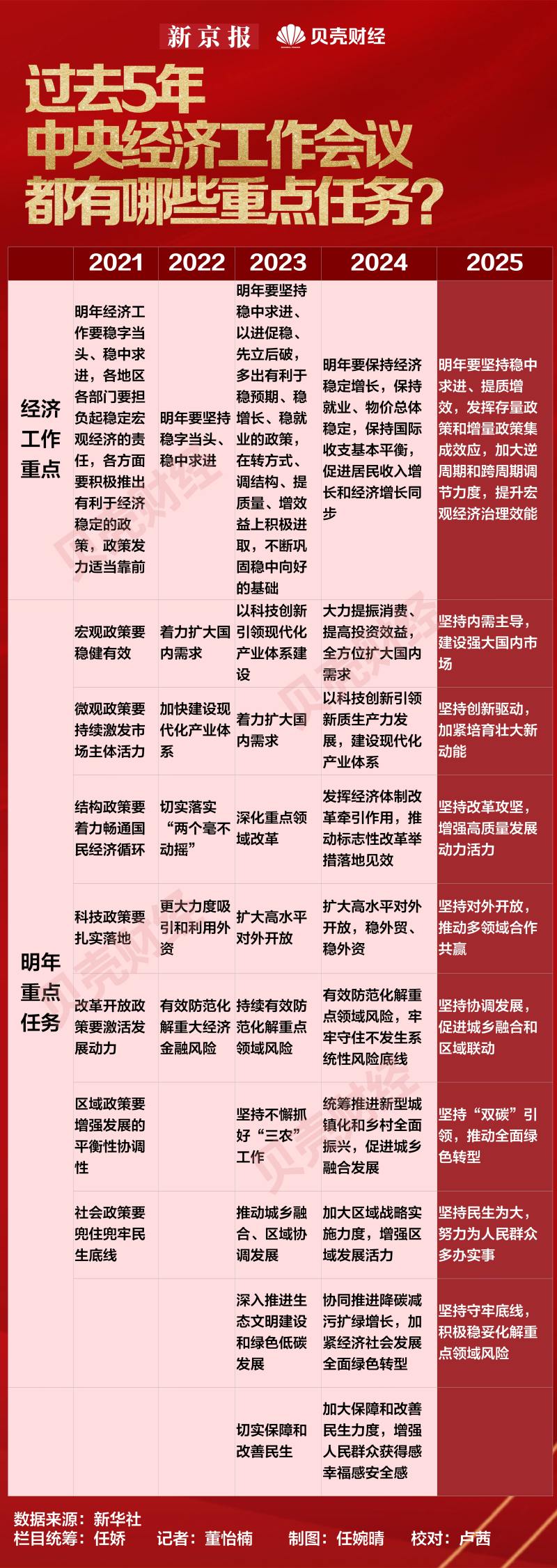
过去5年 中央经济工作会议重点任务有何变化
Xin Jing Bao· 2025-12-11 11:34
Core Insights - The Central Economic Work Conference held on December 10-11 in Beijing emphasized the need for economic work in the coming year to focus on stability while seeking progress, enhancing quality and efficiency, and leveraging both existing and new policies to improve macroeconomic governance [1][3] Group 1: Economic Policy Focus - The conference outlined eight key tasks for the upcoming year, highlighting a shift towards prioritizing "quality and efficiency" alongside domestic demand [1] - There is a strong emphasis on innovation-driven growth and risk prevention, indicating a balanced approach to economic development [1] Group 2: Policy Implementation Strategies - Microeconomic policies will aim to stimulate market vitality and enhance the effectiveness of national economic circulation [3] - Structural policies will focus on ensuring the implementation of reforms and enhancing the momentum for high-quality development [3] - Technological policies will prioritize attracting foreign investment and expanding high-level openness to stabilize foreign trade and investment [3] Group 3: Risk Management and Coordination - The conference stressed the importance of effectively preventing and resolving major economic risks while maintaining a focus on coordinated development [3] - Regional policies will aim to enhance balanced and coordinated development, promoting urban-rural integration and regional synergy [3] Group 4: Social Policies and Public Welfare - Social policies will focus on safeguarding the bottom line of people's livelihoods and enhancing regional development vitality [3] - There will be a commitment to improving public welfare and ensuring that the population feels a sense of security and happiness [3]
总结山东乡村振兴发展经验,《城乡融合重塑乡村空间》出版
Qi Lu Wan Bao· 2025-12-11 10:58
Core Viewpoint - The publication "Rural Space Restructuring through Urban-Rural Integration" focuses on the reconstruction of rural space from the perspective of urban-rural integration, summarizing the "Shandong experience" in promoting rural revitalization through various innovative practices and theoretical frameworks [1][4]. Group 1: Book Overview - The book systematically summarizes Shandong's theoretical logic and practical patterns in areas such as regional promotion, industrial integration, digital governance, and cultural revitalization [1]. - It presents typical case studies that illustrate the internal logic of urban-rural factor reorganization, industrial system reshaping, and governance mechanism upgrading, providing a paradigm for urban-rural integration development nationwide [1]. Group 2: Case Selection Activity - In 2024, Shandong Provincial Rural Revitalization Research Association organized a case selection activity to summarize the province's experiences in rural revitalization, evaluating over 900 submitted cases [2]. - A total of 40 outstanding cases were selected based on criteria such as completeness, innovation, representativeness, and replicability, covering four categories: "Comprehensive," "Industrial Integration," "Thousands of Millions Project," and "Special Contribution" [2]. Group 3: Diverse Practices in Urban-Rural Integration - Shandong's urban-rural integration practices showcase a diverse array of models, including "smart trading" for agricultural digitalization and "all-region tourism" for cultural and agricultural synergy [3]. - Various regions have innovated in areas such as cultural tourism, ecological livability, and digital governance, demonstrating multidimensional scenarios of urban-rural collaborative development [3]. Group 4: Insights from Shandong's Experience - Shandong's experience indicates that urban-rural integration involves not only spatial restructuring but also profound changes in development logic, emphasizing scale efficiency, dual flow of factors, digital empowerment, and cultural revitalization [4]. - The initiatives undertaken have reshaped urban-rural relationships and expanded new spaces for rural modernization, forming a replicable "Shandong model" for other regions [4].
中央经济工作会议:加强重点城市群协调联动 深化跨行政区合作
Xin Lang Cai Jing· 2025-12-11 09:46
Core Viewpoint - The meeting emphasizes the importance of coordinated development, promoting urban-rural integration and regional collaboration [1] Group 1: Urbanization and Rural Revitalization - The focus is on advancing urbanization with counties as key carriers and comprehensively revitalizing rural areas to drive high-quality county economic development [1] - Strict adherence to the farmland red line is highlighted, ensuring food production is prioritized and maintaining reasonable prices for essential agricultural products [1] Group 2: Poverty Alleviation and Economic Support - Continuous consolidation and expansion of poverty alleviation achievements are essential, with regular assistance integrated into the rural revitalization strategy to prevent large-scale return to poverty [1] - Support for major economic provinces to take on significant roles is encouraged [1] Group 3: Regional Cooperation and Marine Economy - Strengthening coordination among key urban agglomerations and deepening inter-administrative cooperation is a priority [1] - Emphasis on overall planning for major bays to promote high-quality development of the marine economy is noted [1]
中央经济工作会议:坚持协调发展,促进城乡融合和区域联动
Xin Lang Cai Jing· 2025-12-11 09:46
中央经济工作会议12月10日至11日在北京举行。会议确定,坚持协调发展,促进城乡融合和区域联动。 统筹推进以县城为重要载体的城镇化建设和乡村全面振兴,推动县域经济高质量发展。严守耕地红线, 毫不放松抓好粮食生产,促进粮食等重要农产品价格保持在合理水平。持续巩固拓展脱贫攻坚成果,把 常态化帮扶纳入乡村振兴战略统筹实施,守牢不发生规模性返贫致贫底线。支持经济大省挑大梁。加强 重点城市群协调联动,深化跨行政区合作。加强主要海湾整体规划,推动海洋经济高质量发展。 ...
强化内需主导!年末政治局会议楼市再度“隐身”,城乡融合连续三年被提及
Hua Xia Shi Bao· 2025-12-10 12:00
Group 1: Economic Policy Signals - The Central Political Bureau meeting on December 8 emphasized urban-rural integration and regional coordinated development for economic work in 2026, without directly mentioning real estate, contrasting with previous meetings that highlighted stabilizing the real estate market [1][2] - The meeting reiterated the importance of maintaining a strong domestic market driven by internal demand, which is closely related to the real estate sector [1] Group 2: Real Estate Risk Management - Despite the lack of direct mention of real estate in the recent meeting, the focus on risk prevention in the real estate sector remains a consistent theme in previous meetings, indicating its importance in addressing systemic risks [2] - The Central Economic Work Conference is expected to outline specific tasks related to real estate for 2026, continuing the emphasis on managing risks in this sector [2] Group 3: Urban-Rural Integration and Demand - Urban-rural integration has been highlighted as a core goal of new urbanization, with previous meetings stressing the need to enhance rural development and promote coordinated growth [4][5] - As of 2023, the urbanization rate of the registered population in China was 48.3%, indicating a significant gap of nearly 18 percentage points compared to the overall urbanization rate, suggesting a large number of migrant workers have not yet settled in urban areas [4] Group 4: Future Urbanization Goals - The government aims to achieve a registered urbanization rate of 78% by 2040, which would facilitate the integration of rural populations into urban settings and help balance infrastructure investments [6]