
指数化投资

Search documents
年内ETF发行创新高,QDII型超募4倍
Guo Ji Jin Rong Bao· 2025-12-22 14:14
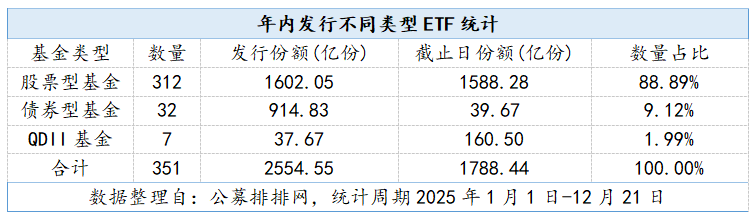
Core Insights - The ETF market is experiencing explosive growth in 2025, with a record issuance of 351 products and a total issuance volume of 2,554.55 billion shares, surpassing the total issuance of the previous two years [1][2]. Group 1: ETF Market Overview - The total number of ETFs issued in 2025 reached 351, with a total issuance volume of 2,554.55 billion shares, marking a historical high [1]. - The issuance of stock ETFs is the primary driver, with 312 products issued, accounting for 88.89% of the total number of ETFs and 62.71% of the total issuance volume [2]. - Bond ETFs also saw significant growth, with 32 new products issued and a total issuance volume of 914.83 billion shares, exceeding historical totals [3]. Group 2: Performance of Different ETF Types - The total shares of bond ETFs reached 39.67 billion, marking a new high, and representing over three times the total from the past four years [3]. - QDII ETFs, although fewer in number with only 7 products issued, experienced substantial growth in issuance volume, reaching 37.67 billion shares, with a final share count of 160.50 billion, indicating strong demand for global asset allocation [3]. Group 3: Issuing Institutions - A total of 47 public fund institutions participated in ETF issuance, with 31 institutions issuing at least 2 products and 15 institutions issuing more than 10 products [3]. - E Fund led the market with 31 products and an issuance volume of 172.41 billion shares, followed by Fuguo Fund with 26 products and 160.12 billion shares [4]. Group 4: Market Dynamics and Trends - The market is characterized by a significant over-subscription phenomenon, with 6 institutions experiencing notable over-subscription, reflecting strong market recognition of quality ETF products [4]. - Factors such as policy support, expedited approval processes, and the popularity of index investing have contributed to the dual breakthroughs in issuance scale and product quantity in 2025 [4]. - The core advantages of ETFs, including low fees, risk diversification, and high transparency, continue to attract both institutional and individual investors [4].

焕然“E”新!近六万亿市场,大变样!
券商中国· 2025-12-22 09:54
Core Viewpoint - The article discusses the rapid evolution of the ETF market in China, highlighting a shift from scale expansion to quality enhancement in index investment, marking 2025 as a pivotal year for high-quality development in the capital market [2]. Group 1: Market Transformation - The release of the "Action Plan for Promoting High-Quality Development of Index Investment in Capital Markets" has initiated a significant transformation in the index investment sector, focusing on optimizing resource allocation and enhancing the quality of listed companies [2][3]. - By 2025, index investment is expected to demonstrate strategic value in five core areas: optimizing resource allocation, improving the quality of listed companies, serving wealth management, guiding long-term capital into the market, and maintaining market stability [2]. Group 2: Institutional Support and Innovation - The implementation of the "Action Plan" provides dual support through institutional guarantees and innovation engines, enhancing the efficiency of ETF registration and issuance processes [3]. - The China Securities Regulatory Commission has streamlined the ETF registration process, allowing fund managers to apply directly for registration, significantly reducing the time required for ETF product approval [3]. Group 3: Product Development and Cost Reduction - A variety of new ETFs have been launched this year, including those focused on hard technology and high-end manufacturing, with efforts to lower investment costs by waiving certain fees associated with ETF operations [4][5]. - The introduction of innovative tools such as ESG indices and Smart Beta strategy indices caters to diverse investor needs, enhancing the vibrancy of the industry [4]. Group 4: Growth of ETF Adoption - The total market size of listed ETFs reached 5.83 trillion yuan, an increase of 2.09 trillion yuan or 56% from the beginning of the year, indicating a growing channel for attracting household wealth [5]. - The proportion of individual investors holding ETFs has been steadily increasing, with ETFs becoming a core component of their investment strategies [5]. Group 5: Enhanced Clarity and Naming Standards - Fund companies have begun to rename their ETFs for clearer identification, aligning with new naming regulations that emphasize the core characteristics of the products [6]. - The revised naming conventions aim to improve product recognition and enhance investment decision-making efficiency [6]. Group 6: Diversification and Thematic Focus - The variety of ETF products has expanded, with a notable increase in narrow-based and thematic ETFs, reflecting a trend towards more specialized investment options [7]. - The focus on specific sectors, such as consumer goods and technology, allows for more precise investment strategies that align with market demands [8]. Group 7: Role of ETFs in Asset Allocation - ETFs are increasingly replacing actively managed equity funds in FOF portfolios, indicating a shift towards quality-focused asset management [9]. - The growth of ETFs is seen as a critical support for the transition of the wealth management industry from product sales to asset allocation [9]. Group 8: Contribution to Market Stability - The development of ETFs has attracted long-term capital, including pension funds and social security funds, which play a vital role in maintaining market stability [9]. - The involvement of state-owned entities in ETF investments has been significant, contributing to the stabilization of the capital market [9]. Group 9: Focus on New Quality Production - ETFs have evolved into essential infrastructure for high-quality development in the capital market, directing capital towards emerging industries such as AI and biotechnology [10]. - The inclusion of high-quality companies in indices is expected to enhance the long-term investment value for investors [11].

2025公募基金十大新闻:《推动公募基金高质量发展行动方案》印发 公募基金费率改革三阶段收官
Xin Lang Cai Jing· 2025-12-22 07:25
Group 1 - The core viewpoint of the article highlights the significant developments in the public fund industry in 2025, including the near 37 trillion yuan fund scale, the resurgence of active equity funds, and the countdown to the announcement of the "champion fund" [1][21] - The "Action Plan for Promoting High-Quality Development of Public Funds" was issued, featuring 25 measures aimed at reshaping the industry ecosystem, focusing on investor-centric development, strong regulation, and risk prevention [1][22][23] - The public fund industry has undergone profound changes since the release of the "Action Plan," transitioning from a focus on scale to quality, enhancing research capabilities, and optimizing investor services [2][23] Group 2 - The public fund fee reform has entered its final stage, with an annual cumulative benefit to investors exceeding 50 billion yuan, achieved through three phases of fee reductions [3][24] - As of October 2025, the total scale of public funds reached 36.96 trillion yuan, marking a historical high and reflecting the ongoing optimization of the industry ecosystem [5][25] - The issuance of new funds in 2025 has been dominated by equity products, with over 50% of new fund issuance being equity funds, indicating a shift in market dynamics [6][26] Group 3 - The ETF market has seen significant growth, with a total scale reaching 5.7 trillion yuan, a 53% increase from the end of 2024, driven by policy support and market demand [7][27] - Bond ETFs have emerged as a highlight in the index investment market, with total scale surpassing 700 billion yuan, and the introduction of innovative products like the Sci-Tech Bond ETF [8][28] - The performance evaluation guidelines for fund management companies have been released, aiming to shift the industry focus from scale expansion to value creation [9][29] Group 4 - The public fund industry is experiencing an intelligent transformation driven by AI, enhancing investment decision-making, risk assessment, and advisory services [13][33] - The public REITs market has expanded significantly, with 77 products listed and a total market value of 216.03 billion yuan, reflecting a diversification of asset types [15][34] - New guidelines for theme fund investment behavior have been established to prevent style drift and ensure alignment with actual investment directions [17][36] Group 5 - The public fund industry is accelerating its internationalization, with over 200 cross-border ETFs and a total scale nearing 920 billion yuan, supported by expanding investment ranges [19][38] - The establishment of overseas subsidiaries by public fund companies has increased, with more than 30 subsidiaries set up in various international markets [20][39]

E目了然 | 指数化投资大时代来临,如何看待ETF的崛起?
Sou Hu Cai Jing· 2025-12-22 06:25
Core Insights - The article highlights the rapid growth and significance of Exchange-Traded Funds (ETFs) in global financial markets, particularly in China, where they are becoming a crucial tool for asset allocation [1][4]. Global ETF Market Growth - The global ETF market has seen continuous high growth, achieving an annualized compound growth rate of over 18% since 2010, with ETFs now accounting for over 15% of the total public fund market [2]. - Factors driving this growth include increasing demand for diversified asset allocation, regulatory encouragement for transparent and low-cost investment tools, and superior long-term performance compared to actively managed funds [2][3]. China's ETF Market Development - China's ETF market began in 2004 and has experienced a remarkable annualized compound growth rate of approximately 33% over the past eleven years, significantly outpacing the global average [5]. - As of mid-2025, ETFs represent about 12% of the total public fund market in China, while stock ETFs account for over 50% of all equity funds, indicating strong penetration in equity investment [8]. Future Prospects for ETFs - Institutional investors hold a significant portion of ETFs, with a holding ratio of 73.86%, which is much higher than that of actively managed funds [10]. - The demand for ETFs is expected to continue growing due to factors such as the need for stable returns in a declining interest rate environment, ongoing product innovation, and supportive policies for market reform and opening [10]. - Investors are encouraged to consider ETFs that align with market trends and offer liquidity and allocation value, such as the 泰康中证A500 ETF and 泰康中证红利低波动 ETF [11].
跨年行情拉开序幕,中证A500ETF南方(159352)连续13日获资金净流入,近5日获净申购101亿元
Xin Lang Cai Jing· 2025-12-22 04:16
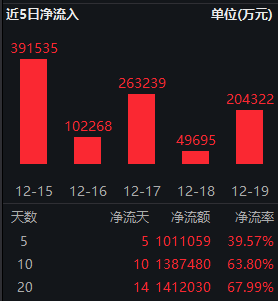
Core Viewpoint - The recent surge in trading volume and scale of the A500 ETF reflects a deepening trend towards institutional and index-based investment, as well as improved access for "patient capital" to enter the market [3][9]. Group 1: Market Performance - On December 22, the three major A-share indices rose collectively, marking the beginning of the year-end market rally, with the A500 ETF Southern (159352) increasing by 0.99% and a trading volume of 5.494 billion yuan [1][7]. - As of December 19, the A500 ETF Southern has seen continuous net inflows over the past 13 days, with a total fund size of 35.684 billion yuan and a latest share count of 29.418 billion [1][7]. Group 2: Investment Trends - Analysts suggest that the increased trading volume of the A500 ETF is influenced by expectations of a year-end market rally and policy catalysts, with a favorable liquidity environment and low interest rates encouraging capital inflow [10][11]. - The A500 index covers large-cap stocks in the Shanghai and Shenzhen markets, providing a balance of stability from large-cap blue chips and growth potential from mid-cap stocks, making it suitable for institutional investors seeking balanced allocation and risk diversification [10][11]. Group 3: Policy and Economic Environment - The shift in macroeconomic policy since last year has altered investor sentiment, creating a supportive environment for market stabilization, with factors such as low interest rates and regulatory support for capital market development contributing to this [10][11]. - There are indications of a classic "year-end to spring" market rally, with significant institutional investors increasing their holdings in broad-based ETFs like the A500 ETF, which is expected to bring stable incremental capital to the market [11]. Group 4: Historical Performance and Cost Efficiency - The A500 index has shown strong historical performance, with a more than 450% increase since its base date (December 31, 2004) and a nearly 20% rise this year [12]. - The A500 ETF Southern offers the lowest fee structure in the industry at 0.15% management fee and 0.05% custody fee, providing a high-precision, low-cost investment channel for investors [12].


2025公募基金十大新闻
Zhong Guo Jing Ji Wang· 2025-12-22 00:48
Group 1: Core Insights - The "Action Plan for Promoting High-Quality Development of Public Funds" was issued by the China Securities Regulatory Commission (CSRC) on May 7, 2025, aiming to reshape the industry ecosystem with 25 key measures focused on investor-centric development, strong regulation, and risk prevention [1] - The public fund industry is transitioning from a focus on scale to a focus on quality, with improvements in investment research capabilities, investor services, and market ecology [2] - The public fund fee reform has entered its final stage, with annual savings for investors exceeding 50 billion yuan, enhancing investor experience and promoting long-term capital market investment [3][4] Group 2: Industry Growth and Trends - As of October 2025, the total scale of public funds reached 36.96 trillion yuan, marking a historical high and reflecting a shift towards high-quality development [5][6] - The proportion of equity products in public funds has significantly increased, with stock and mixed funds reaching a combined scale of 10.18 trillion yuan, up by 22,205.99 billion yuan from the previous year [6] - The ETF market has also seen substantial growth, with a total scale of 5.7 trillion yuan as of October 2025, representing a 53% increase from the end of 2024 [8] Group 3: Regulatory Developments - New performance assessment guidelines for fund management companies were released, emphasizing a shift from scale expansion to value creation, which may lead to a differentiated industry landscape [10] - The introduction of performance comparison benchmarks aims to curb "style drift" and promote capability competition within the public fund industry [11][12] - The establishment of a performance benchmark element library by the China Fund Industry Association is a key measure to enhance industry governance and address issues related to benchmark selection [11] Group 4: Technological Advancements - The fund industry is accelerating its intelligent transformation driven by AI, enhancing investment decision-making, risk assessment, and advisory services [12][13] - AI technologies are being integrated into core investment research processes, providing more accurate and transparent decision-making tools for fund managers [13] Group 5: REITs and Thematic Funds - The public REITs market has expanded significantly, with 77 products listed and a total market value of 216.03 billion yuan, reflecting a 38% increase from the end of 2024 [14][15] - New guidelines for thematic funds have been introduced to prevent style drift and ensure that fund names align with actual investment directions [16] Group 6: Internationalization and Cross-Border Investment - The public fund industry is enhancing its internationalization efforts, with the number of cross-border ETFs reaching 200 and a total scale nearing 920 billion yuan [17] - The establishment of overseas subsidiaries by public fund companies is accelerating, with over 30 subsidiaries set up in various international markets [17]
中国ETF市场年内规模增长超2万亿元【国信金工】
量化藏经阁· 2025-12-22 00:08
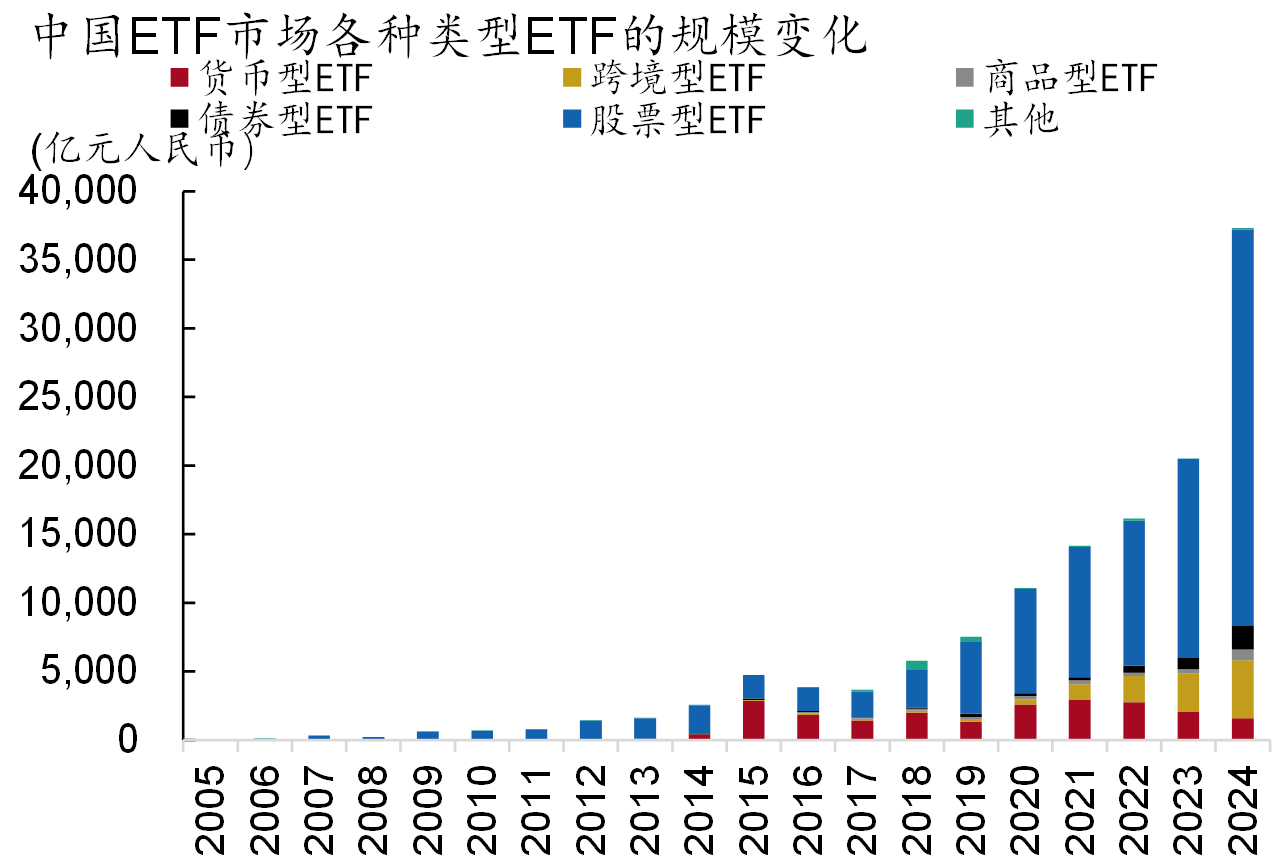
Market Overview - The A-share market showed a mixed performance last week, with the Shanghai Composite Index, CSI 500, and CSI 300 yielding returns of 0.03%, 0.00%, and -0.28% respectively, while the STAR 50, ChiNext, and Shenzhen Component Index had returns of -2.99%, -2.26%, and -0.89% respectively [5][15] - The trading volume of major indices decreased last week, with the average daily trading volume for major indices falling within the historical percentile range of 55%-75% over the past 52 weeks [18][20] - In terms of industry performance, retail trade, consumer services, and non-bank financials led with returns of 6.58%, 4.4%, and 2.99% respectively, while power equipment and new energy, electronics, and machinery lagged with returns of -3.09%, -3.02%, and -1.71% respectively [22][23] Fund Issuance and Performance - A total of 40 new funds were established last week, with a total issuance scale of 183.21 billion yuan, showing an increase compared to the previous week [4] - The number of funds reported for issuance last week was 41, which is a decrease from the previous week, including 1 REITs, 1 QDII, and 2 FOFs [5] - The median performance of alternative funds this year has been the best, with a return of 52.67%, while the median returns for active equity, flexible allocation, and balanced mixed funds were 27.29%, 20.97%, and 15.16% respectively [33][40] ETF Market - As of December 19, 2025, the total scale of China's ETF market reached 5.83 trillion yuan, a significant increase of 56% from 3.73 trillion yuan at the end of 2024, with a net increase of 2.09 trillion yuan [10] - The top ten ETFs with the highest scale growth this year included the CSI 300 Index ETF, which saw a scale increase of over 173.1 billion yuan, and the gold ETF, which increased by over 150 billion yuan [13] - The thematic ETFs performed notably well, with the Hong Kong Stock Connect Innovative Drug Index ETF showing a staggering growth rate of 2923.19%, followed by the Robot Index ETF at 489.63% [13] Asset Management Scale - As of December 17, 2025, the total scale of asset management products from various financial institutions reached 80.03 trillion yuan, with public funds accounting for 36.74 trillion yuan [9] - The scale of private asset management products from securities companies and their subsidiaries was 6.37 trillion yuan, while private funds reached 21.99 trillion yuan [9]

从单一工具变成基础设施 近6万亿ETF市场焕然“E”新
Zheng Quan Shi Bao· 2025-12-21 18:09
Core Viewpoint - The article discusses the transformation of index investment in China's capital market, highlighting its strategic value in optimizing resource allocation, enhancing the quality of listed companies, and attracting long-term capital by 2025, marking the beginning of a new phase in high-quality index investment development [1]. Group 1: Institutional Support and Innovation - The implementation of the "Action Plan" provides dual support for index investment through institutional guarantees and innovation engines, significantly improving the efficiency of ETF registration and issuance [1]. - The China Securities Regulatory Commission has streamlined the ETF registration process, allowing fund managers to apply directly for registration without needing a no-objection letter from the stock exchange, thus expediting the registration process to within five working days [1]. Group 2: Product Development and Cost Reduction - Index companies and fund managers are optimizing index compilation methods, focusing on national strategic directions and developing specialized indices that cater to emerging industries, such as the AI index launched in May 2023 [2]. - The investment costs for index funds have continued to decrease, with the elimination of annual fees for ETF listings and reductions in other operational costs, promoting a lower cost structure for index funds [2]. Group 3: Accessibility and Growth of ETFs - ETFs are rapidly emerging as a key vehicle for inclusive finance, providing ordinary investors with a channel to share in the capital market's growth, with the total market size of ETFs reaching 5.83 trillion yuan, a 56% increase from the beginning of the year [3]. - The proportion of individual investors holding ETFs has been steadily increasing, indicating a shift towards ETFs as a core investment tool among retail investors [3]. Group 4: Enhanced Investment Options - The variety of ETF products has expanded, with a notable increase in narrow-based and thematic ETFs, catering to both individual and institutional investors' diverse needs [5]. - The public fund industry is entering a tool-oriented era, with a focus on narrow-based ETFs that can deliver high performance, aligning with market trends towards active equity fund transformation [5]. Group 5: Strategic Alignment with National Goals - ETFs are becoming essential in guiding capital towards emerging industries such as AI, biomedicine, and aerospace, thus supporting industrial upgrades and enhancing corporate governance through their selection mechanisms [7]. - Major ETF management institutions are intensifying their focus on the Sci-Tech Innovation Board, enriching the toolbox for investing in technological innovation and high-quality development [8]. Group 6: Market Impact and Pricing Power - Some ETFs are replacing active equity funds as the largest institutional investors in listed companies, enhancing their marginal pricing power in the market [9]. - The inclusion of companies in index components has led to significant increases in ETF holdings, surpassing investments from northbound funds and active equity funds [9].
基金周报:国内ETF规模增长超2万亿,全市场首只船舶ETF正式启航-20251221
Guoxin Securities· 2025-12-21 14:02
- The report does not contain any specific quantitative models or factors for analysis[1][2][3][4]
37万亿行业,大消息!年度“十大”来了
Xin Lang Cai Jing· 2025-12-21 10:52
Group 1 - The core viewpoint of the article is the significant developments in the public fund industry in 2025, highlighting reforms, growth in fund size, and the shift towards high-quality development [1][2][3] Group 2 - The "Action Plan for Promoting High-Quality Development of Public Funds" was issued, featuring 25 measures aimed at reshaping the industry ecosystem, focusing on investor-centric development, strong regulation, and risk prevention [2][19] - The plan emphasizes a shift from "scale" to "return" for fund companies and sales institutions, with key areas including optimizing fee structures and enhancing investor services [2][19] Group 3 - The public fund fee reform has entered its final phase, with annual savings for investors exceeding 50 billion yuan, achieved through three stages of fee reductions [3][20][21] - The first phase reduced management and custody fees for active equity funds, saving approximately 14 billion yuan annually [20] - The second phase lowered trading commission fees, saving around 6.8 billion yuan, while the third phase targeted subscription and purchase fees, saving about 30 billion yuan [20][21] Group 4 - The public fund industry reached a record size of 36.96 trillion yuan by the end of October 2025, marking a continuous growth trend [5][22] - The increase in fund size is attributed to improved industry ecology, driven by product innovation and enhanced services [22] - Equity products have become a core focus, with stock and mixed funds reaching a combined size of 10.18 trillion yuan, reflecting a significant structural upgrade [22][23] Group 5 - The ETF market has also seen substantial growth, with total assets surpassing 5.7 trillion yuan, a 53% increase from the previous year [7][24] - The rapid growth of the ETF market indicates a shift towards index-based investment strategies becoming mainstream [24] Group 6 - The introduction of new performance evaluation guidelines for fund companies aims to shift the focus from scale to value creation, promoting a more differentiated and healthy ecosystem [9][26] - The guidelines are expected to accelerate industry differentiation, with larger firms likely to attract more capital and talent [26] Group 7 - The public fund industry is undergoing an intelligent transformation driven by AI, enhancing investment decision-making, risk assessment, and client services [12][29] - AI technologies are being integrated into core investment research processes, providing more accurate market predictions and personalized investment advice [29] Group 8 - The public REITs market has expanded significantly, with 77 products listed and a total market value of 216.03 billion yuan, reflecting a 38% increase from the previous year [30][31] - The asset types for REITs are diversifying beyond traditional infrastructure to include commercial properties, indicating a growing market potential [30][31] Group 9 - The cross-border ETF market has seen rapid development, with nearly 200 products and a total scale approaching 920 billion yuan, highlighting the industry's internationalization efforts [10][33] - The expansion of QDII quotas supports the internationalization of public funds, with over 170.87 billion USD approved for investment [33]