
硬科技

Search documents
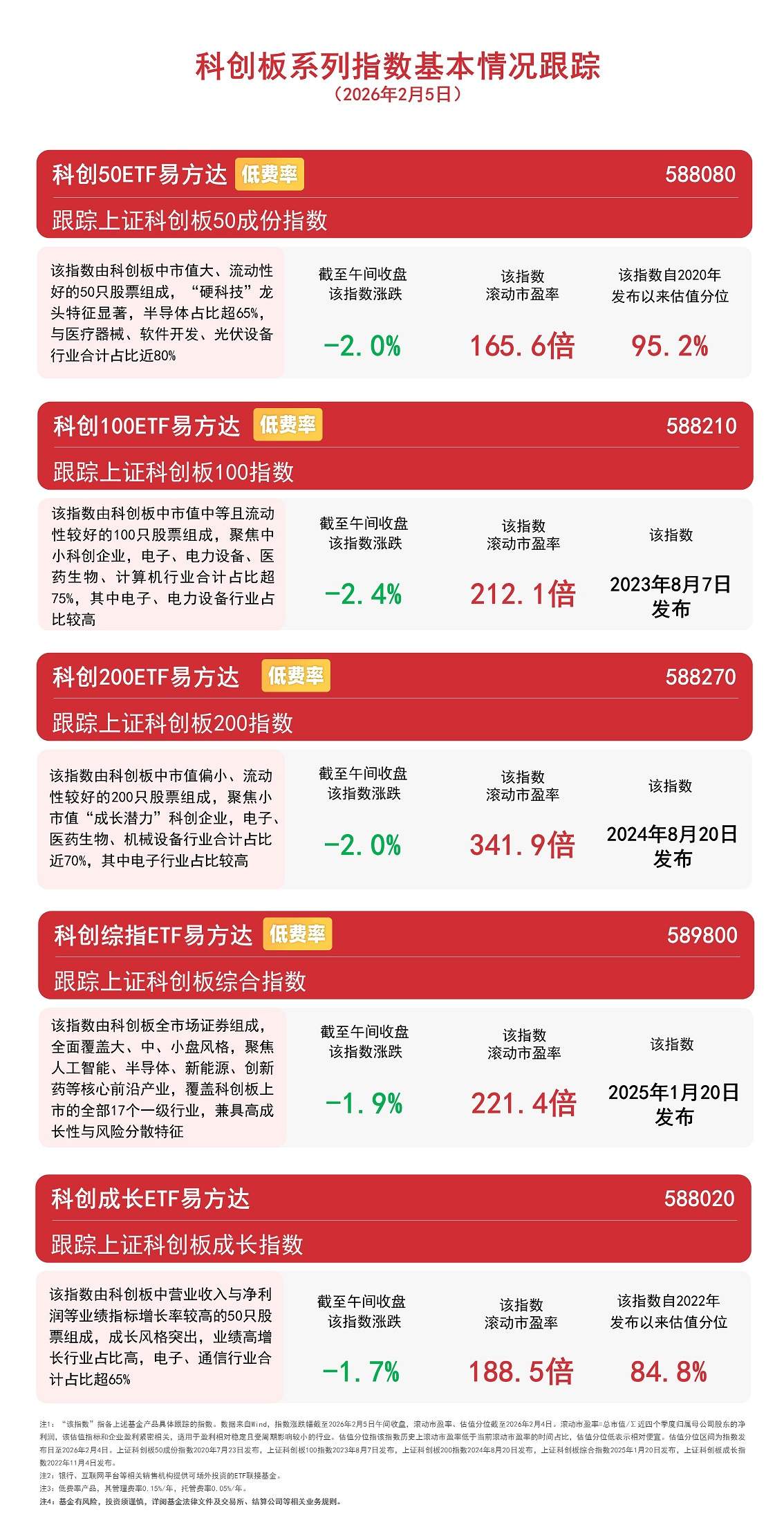
半导体板块持续回调,资金连续3日净流入科创50ETF易方达(588080)
Mei Ri Jing Ji Xin Wen· 2026-02-05 07:43
Group 1 - The article discusses various ETFs tracking the STAR Market indices, highlighting their focus on high-growth technology companies in China [2][3] - The STAR 50 ETF tracks the top 50 stocks by market capitalization and liquidity on the STAR Market, with a significant focus on "hard technology" sectors, particularly semiconductors, which account for over 65% of the index [2] - The STAR 100 ETF focuses on medium-sized companies with good liquidity, with over 75% of its composition in electronics, power equipment, and biomedicine [2] - The STAR 200 ETF targets smaller market cap companies, with nearly 70% of its holdings in electronics, biomedicine, and machinery sectors [2] - The STAR Growth ETF tracks the STAR Growth Index, consisting of 50 stocks with high growth rates in revenue and net profit, with over 65% in electronics and communications [3] Group 2 - The STAR 50 ETF has a rolling price-to-earnings ratio of 165.6 times, with a valuation percentile of 95.2% since its inception in 2020 [2] - The STAR 100 ETF has a rolling price-to-earnings ratio of 212.1 times, reflecting its focus on growth-oriented companies [2] - The STAR 200 ETF has a rolling price-to-earnings ratio of 341.9 times, indicating a high valuation for smaller growth companies [2] - The STAR Growth ETF has a rolling price-to-earnings ratio of 188.5 times, with a valuation percentile of 84.8% since its launch in 2022 [3]

君行健资本落地两支基金
Sou Hu Cai Jing· 2026-02-05 06:32
Core Viewpoint - Junxingjian Capital has accelerated its investment strategy in the biomedical and advanced manufacturing sectors by successfully registering two new funds, expanding its fund matrix to eight [1][2] Group 1: Fund Overview - Junxingjian Capital's new funds include Qingdao Junxingjian Tai Fund, focusing on biomedical fields such as biomedicine, medical devices, and pharmaceutical R&D services [1] - The other fund, Zhaiguang Zhiyuan Fund, targets advanced manufacturing sectors including new materials, high-end equipment, and military technology [1] Group 2: Strategic Focus - The funds aim to discover value in innovative diagnostic technologies and high-end medical devices, particularly targeting companies with core technological barriers that are in critical clinical stages or early commercialization [1] - The advanced manufacturing fund emphasizes investment in innovative companies that enhance supply chain security and achieve import substitution, covering the entire innovation chain from basic materials to end equipment [1] Group 3: Company Growth and Ecosystem - Since its establishment in 2021, Junxingjian Capital has developed a full-cycle service system with over 600 million yuan in managed funds, investing in more than 20 quality enterprises, many of which are entering critical capitalization stages [2] - The dual fund registration reflects an upgrade in the strategic layout for hard technology and health sectors, leveraging the ecosystem of invested enterprises to connect them with supply chains, customers, and capital markets [2]
开创韩国企业先河!三星电子市值突破1000万亿韩元!是泡沫还是硬核实力爆发?
Sou Hu Cai Jing· 2026-02-04 20:15
Group 1 - Samsung Electronics' market capitalization has surpassed 1,000 trillion KRW, equivalent to approximately 4.75 trillion RMB, marking a historic milestone for the South Korean stock market and the global tech industry [1] - The company's stock surged by 34% in less than two months, driven by its pivotal role in the AI era as a supplier of essential components like high-bandwidth memory (HBM) [3][6] - In Q4 2025, Samsung's operating profit skyrocketed by 209%, reaching 20 trillion KRW, with annual sales hitting a record 333 trillion KRW [3][4] Group 2 - The significant profit increase is attributed to a supply-demand imbalance in the memory chip market, exacerbated by the rising demand for AI applications [6] - Citigroup has warned of a severe shortage of general storage chips in 2026, predicting a 38% price increase for DDR5 memory and a 32% increase for NAND flash memory [6] - Samsung's price-to-earnings ratio (PER) stands at 8.5, which is 44% lower than its competitors, indicating that the stock is not overly inflated despite the company's strong earnings [6] Group 3 - Short-term prospects for Samsung appear positive as long as there is a shortage of GPUs and ongoing demand for AI model training [8] - However, long-term risks include competition from Micron Technology, potential declines in PC and smartphone sales, and the impact of a strengthening Korean won on export revenues [9] - Samsung's rise reflects South Korea's successful focus on core semiconductor technology, contrasting with domestic companies that are more application-focused in the AI space [11]
机构:2025年一级市场募投退全方位回暖
Xin Hua Cai Jing· 2026-02-04 07:56
Fundraising - In 2025, the number and scale of newly raised funds in China's equity investment market reached 5,039 and 1.65 trillion yuan, representing year-on-year increases of 26.6% and 14.1% respectively [1] - Government investment funds, local state-owned platforms, insurance capital, and AIC have become the core driving forces behind the recovery of the fundraising market [1] - The dominance of RMB funds has further increased, with a year-on-year growth of 16.1%, while foreign currency funds continued to decline, with only 33 foreign currency funds completing new rounds of fundraising, totaling over 35 billion yuan, down 15.4% and 36.0% year-on-year [1] Investment - In 2025, the number and amount of investment cases reached 10,795 and 928.716 billion yuan, showing year-on-year increases of 28.4% and 45.6% respectively [1] - Hard technology remains the mainstream investment sector, with investment case numbers in IT, semiconductors, biotechnology/healthcare, and machinery manufacturing all exceeding 1,500 [1] - High interest is noted in sub-sectors such as AI, embodied intelligence, GPU, innovative drugs, smart manufacturing, and new energy/new materials [1] - The popularity of investment strategies such as mergers and acquisitions, cornerstone investments, and public offerings has also significantly increased [1] Exits - The number of exit cases in 2025 saw a significant increase, totaling 5,211, which is a year-on-year rise of 41.0% [2] - Nearly 2,000 IPO cases were recorded, marking a year-on-year increase of 46.8% [2] - The number of merger and acquisition exit cases reached 468, reflecting a year-on-year increase of 77.3% [2]
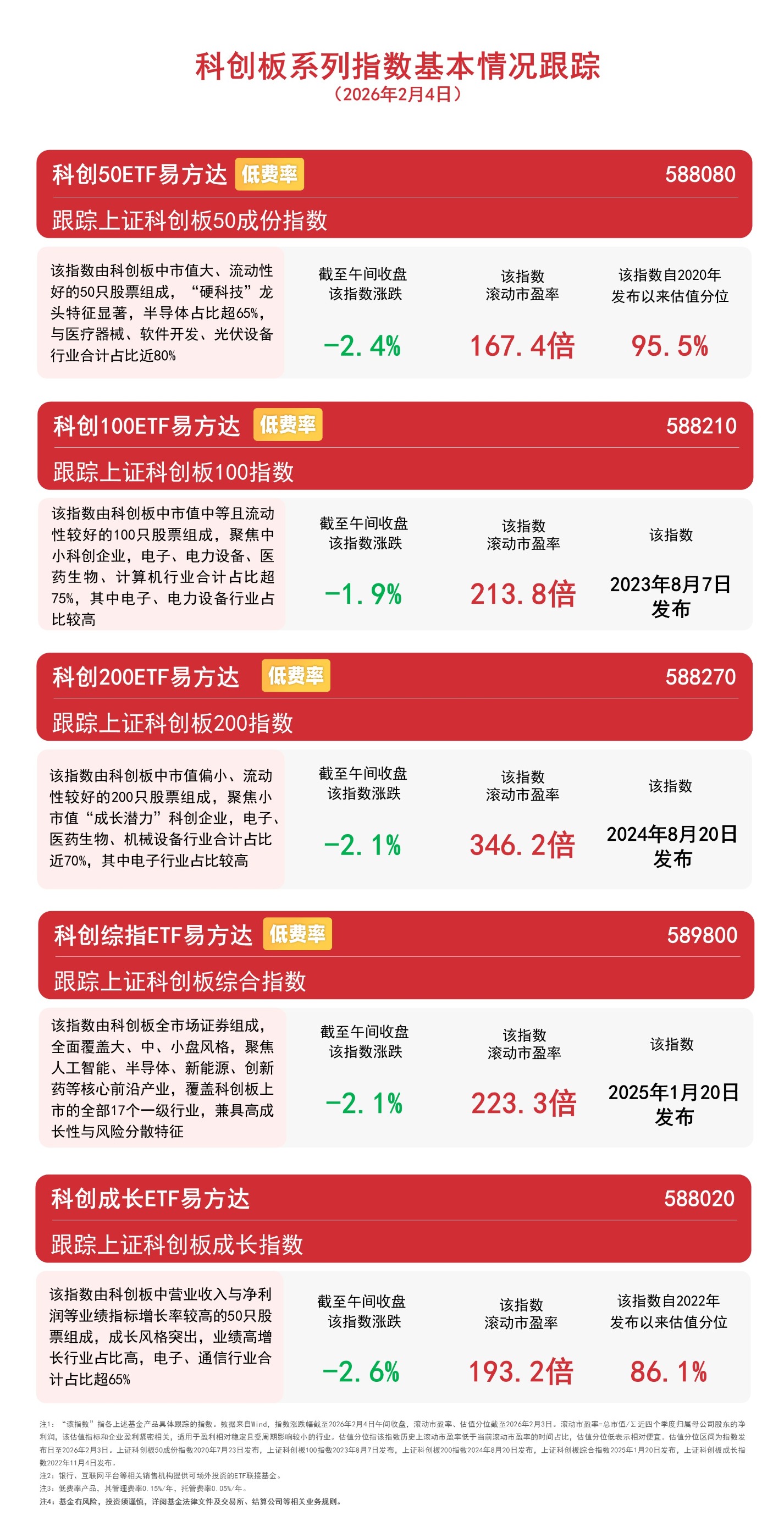
硬科技板块震荡回调,关注科创200ETF易方达(588270)、科创50ETF易方达(588080)等布局机会
Mei Ri Jing Ji Xin Wen· 2026-02-04 05:47
Group 1 - The article discusses the performance and characteristics of various ETFs tracking the STAR Market indices, highlighting their focus on high-tech sectors such as semiconductors, medical devices, and software development [2][3] - The STAR 50 ETF tracks the STAR 50 Index, which consists of 50 stocks with large market capitalization and good liquidity, with over 65% of its composition in semiconductors and nearly 80% in hard technology sectors [2] - The STAR 100 ETF focuses on 100 medium-cap stocks, with over 75% of its composition in electronics, power equipment, and pharmaceutical industries [2] - The STAR 200 ETF targets 200 small-cap stocks, emphasizing growth potential, with significant representation from electronics, biomedical, and machinery sectors [2] - The STAR Composite Index ETF covers all market segments and focuses on core industries such as artificial intelligence, semiconductors, and innovative pharmaceuticals, encompassing all 17 primary industries listed on the STAR Market [3] - The STAR Growth ETF includes 50 stocks with high growth rates in revenue and net profit, with over 65% of its composition in the electronics and communications sectors [3] Group 2 - As of the midday close on February 4, 2026, the STAR 50 Index showed a decline, while the STAR 100 Index had a rolling P/E ratio of 213.8 times, and the STAR 200 Index had a rolling P/E ratio of 167.4 times [2] - The STAR Composite Index had a rolling P/E ratio of 223.3 times, and the STAR Growth Index had a rolling P/E ratio of 193.2 times, indicating varying levels of valuation across these indices [3] - The article notes that the STAR Market indices have been established at different times, with the STAR 50 Index launched on July 23, 2020, the STAR 100 Index on August 7, 2023, the STAR 200 Index on August 20, 2024, and the STAR Composite Index on November 4, 2022 [3]
中国私募股权投资行业市场竞争格局、发展现状及投资前景预测报告(智研咨询发布)
Sou Hu Cai Jing· 2026-02-04 01:35
Core Insights - The private equity investment industry in China is experiencing a dual decline in the number of registered fund managers and existing entities since 2022, indicating a significant industry cleanup [1][3][8] - The market is showing signs of recovery in 2025, with an increase in the number of private equity and venture capital fund registrations and a total scale of 1352.54 billion yuan for private equity funds [1][9] - Investment activity in the VC/PE market has surged in 2025, with 11,015 cases and a total investment scale of 13,396.8 billion yuan, reflecting a 30.6% increase in case numbers and a 23.43% increase in investment scale year-on-year [4][11] - The exit environment for investments is gradually improving, with a total of 2,029 exit cases in the first three quarters of 2025, despite a 29.2% year-on-year decline [15] Fundraising Phase - As of November 2025, there are 11,567 registered private equity and venture capital fund managers in China, a decrease of 516 from the end of 2024, with only 95 new registrations in the first 11 months of 2025 [1][3][8] - The number of private equity fund registrations has significantly decreased in recent years due to stricter compliance requirements and market uncertainties, but there is a recovery trend in 2025 with 1,456 new registrations [9][10] Investment Phase - The investment market in 2025 is characterized by a strong recovery, with significant capital flowing into strategic sectors such as hard technology and clean energy, particularly in electronic information, advanced manufacturing, and healthcare [4][11] - The average investment amount in 2025 is 1.22 million yuan, indicating a robust investment climate supported by stable macroeconomic expectations and government policies [4][11] Exit Phase - The exit landscape is improving, with IPOs remaining the primary exit method, accounting for 49.4% of total exits, while mergers and acquisitions have seen an 84.3% year-on-year increase, highlighting their growing importance [15] - Diverse exit strategies, including private equity secondary market funds and merger funds, are gaining traction among institutions, injecting new vitality into the venture capital industry [15]
2026,港股IPO火爆开局
Xin Lang Cai Jing· 2026-02-03 10:44
导读: 来源:市场资讯 (来源:FOFWEEKLY) 2025年,港交所的锣声格外密集,2026年开年,依然火爆。 作者丨FOFWEEKLY 2026年伊始,港股IPO市场延续了去年的强劲势头,呈现供需两旺的活跃景象。 这波热潮正为一级市场带来了新的活力与期待。 投资升温,递表激增 等多个细分领域。 中国证监会最新披露的备案情况显示,近期多家涉及医药、半导体、新消费等领域的企业赴港IPO备案 材料已被接收,为港股市场储备了丰富的上市资源。 1月30日的集中递表现象尤为引人注目。17家企业在同一天向港交所主板递交上市申请,其中既有新能 源巨头欣旺达电子,也有科技企业奕斯伟和海马云科技等,展现出多个赛道集体冲刺港股的火热态势。 这波热潮有着坚实的基础。回顾2025年,香港新股市场融资额位居全球第一,全年现货市场平均每日成 交金额达2307亿港元,较2024年同期上升43%,为2026年的强劲开局奠定了基石。 2025年的港股堪称绝对的大年,而2026年,不少业内人士认为,港股火爆势头将会持续。 2026年开年,一级市场活力满满。 很多投资机构都在疯狂的出手,而且决策速度明显加快,甚至满市场都是fomo情绪。 日前 ...



《2025年香港IPO及二级市场白皮书》发布:港股强势复苏,硬科技与生物医药成新引擎
Sou Hu Cai Jing· 2026-02-03 10:12
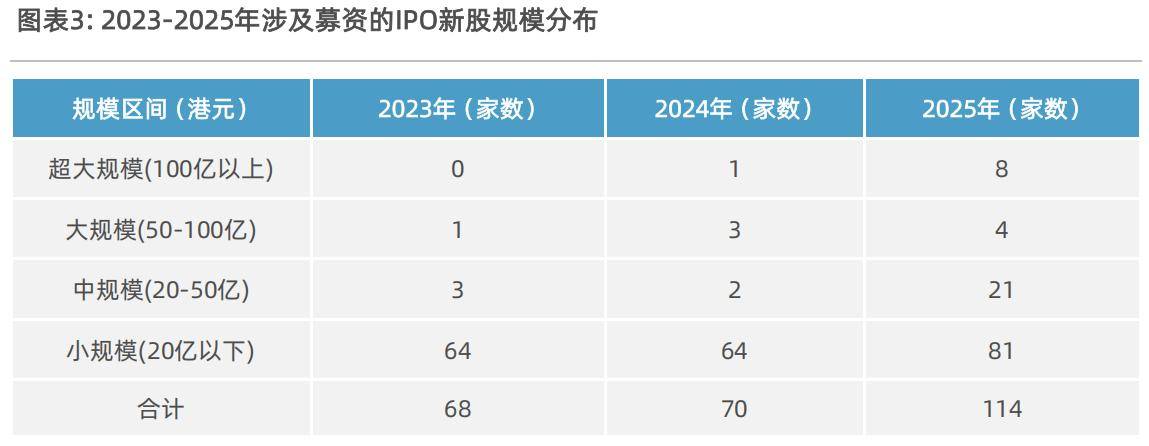
Group 1: IPO Market Performance - In 2025, the Hong Kong IPO market raised HKD 286.7 billion, a significant increase of 225.9% year-on-year, reclaiming the top position globally for fundraising [2] - A total of 114 companies went public in 2025, marking a 62.9% increase compared to 2024 [2] - The number of mega IPOs (raising over HKD 10 billion) reached 8, a sevenfold increase from 2024 [2][3] Group 2: Industry and Regional Insights - The healthcare sector led the IPO market with 28 listings, reflecting a 133.3% year-on-year growth, indicating strong investor interest in biotech companies [5] - Mainland companies dominated the Hong Kong IPO market, with Shanghai surpassing Guangdong as the city with the most IPOs, totaling 18 [5] Group 3: Market Sentiment and Performance - The IPO subscription market saw unprecedented enthusiasm, with 14 million subscriptions, a more than 12-fold increase from the previous year, and an average oversubscription rate of 1,684 times [9] - 90.28% of new stocks were issued at a premium, showcasing strong market confidence [9] - The first-day drop rate for new stocks fell below 30%, with an average first-day increase of 36.95% [11] Group 4: Secondary Market Dynamics - The Hong Kong secondary market outperformed globally, with the Hang Seng Index rising by 27.77% in 2025, leading major global indices [12] - Daily trading volume averaged approximately HKD 248.9 billion, an 88.7% increase year-on-year [12] Group 5: Capital Flow and Structural Changes - Southbound capital became a key source of liquidity for Hong Kong stocks, with total transactions reaching HKD 28.7 trillion and net purchases exceeding HKD 1.4 trillion, both setting historical records [14] - The Hong Kong Stock Exchange implemented reforms to lower barriers for tech companies, facilitating a shift towards hard tech, biotech, and new consumption sectors [15]
A股1月新股数据曝光:首日平均涨幅超180%,公私募打新超15亿
Bei Ke Cai Jing· 2026-02-03 09:16
Group 1 - In January 2026, the A-share new stock market showed remarkable performance, with an average first-day increase of over 180% for 9 newly listed stocks [1][3][6] - The enthusiasm for new stock subscriptions has risen, with public and private funds participating in offline placements, totaling over 1.5 billion yuan, with public institutions accounting for more than 1.2 billion yuan [1][7] - The newly listed stocks include companies from various sectors, primarily manufacturing, with notable mentions being Hengyun Chang and Zhenstone Co., which are highly favored by institutions [4][8] Group 2 - The average first-day increase for the 9 new stocks exceeded 187%, with Hengyun Chang and Kema Materials both experiencing surges of over 300% [6] - The issuance prices varied, with Hengyun Chang at 92.18 yuan per share and the lowest being around 11 yuan for Zhenstone and others [5] - Institutional participation in new stock subscriptions is driven by the low-risk, quick-return nature of offline placements, especially in high-growth sectors like technology and healthcare [10]
500亿活水开闸了
3 6 Ke· 2026-02-03 07:52
Core Viewpoint - The Guangdong-Hong Kong-Macao Greater Bay Area Venture Capital Guiding Fund (referred to as "Guangdong-Hong Kong-Macao Fund") has officially begun the selection of sub-fund management institutions, marking a significant step in promoting innovation and investment in the region [1][2]. Group 1: Fund Overview - The Guangdong-Hong Kong-Macao Fund has a target scale of 50.45 billion yuan, with a maximum duration of 20 years, managed by Shenzhen Capital Group [2]. - The fund aims to invest in early-stage and seed-stage technology companies in strategic emerging industries, focusing on original and disruptive technological innovations [2][3]. - The fund will operate under a "sub-fund + direct investment" model, with at least 70% of the sub-fund's investments directed towards seed and early-stage enterprises [2]. Group 2: Regional Impact - The establishment of the Guangdong-Hong Kong-Macao Fund is seen as a concrete measure to accelerate the construction of an international technology innovation center in the Greater Bay Area, leveraging Shenzhen's role as a reform and opening-up hub [3][5]. - Shenzhen has launched a three-year action plan for its state-owned capital fund matrix, emphasizing support for sectors such as semiconductors, artificial intelligence, and biomedicine [5]. Group 3: Market Trends - The venture capital market in China is experiencing a recovery, with 3,501 new funds raised in the first three quarters of 2025, representing an 18.3% year-on-year increase [7]. - The total amount raised reached 1,161.435 billion yuan, marking an 8.0% increase compared to the previous year [7]. - The year 2026 is anticipated to be a significant year for venture capital, with expectations for increased exit opportunities compared to 2025 [8].