
贸易紧张局势

Search documents
巴菲特继续卖卖卖
2 1 Shi Ji Jing Ji Bao Dao· 2025-08-03 03:40
Core Viewpoint - Berkshire Hathaway's financial results for Q2 showed significant fluctuations, with revenue exceeding market expectations but net profit experiencing a dramatic decline compared to the previous year [2][5]. Financial Performance - Q2 revenue reached $92.515 billion, surpassing market expectations of $91.963 billion, but down from $93.653 billion year-over-year [2][4]. - Net profit for Q2 was $12.370 billion, exceeding market expectations of $10.703 billion, but down 59% from $30.348 billion in the same quarter last year [2][4]. Investment Performance - Investment net income for Q2 was $4.97 billion, a significant drop from $18.75 billion in the same period last year [5]. - Berkshire's top five holdings accounted for 67% of its total portfolio value as of June 30, 2025, including American Express, Apple, Bank of America, Coca-Cola, and Chevron [5]. Market Context - In Q2, U.S. stock indices showed mixed performance, with the Dow Jones up 4.98%, Nasdaq up 17.75%, and S&P 500 up 10.57%, while Berkshire's stock price fell 8.72% [7]. - Trade tensions and concerns over Warren Buffett's retirement have negatively impacted investor sentiment [7]. Stock Trading Activity - Berkshire sold approximately $3 billion worth of stocks in Q2, marking the 11th consecutive quarter of net stock sales [9]. - The company held $344.1 billion in cash and cash equivalents at the end of Q2, slightly down from $347.7 billion in the previous quarter [9]. Strategic Outlook - Buffett emphasized a cautious approach to investing, indicating that while cash levels are high, the company is actively seeking investment opportunities [9]. - The preference for equity investments over cash equivalents remains unchanged, with a focus on acquiring good businesses [9].


伯克希尔二季度净利润暴跌59%,巴菲特继续“卖卖卖”
2 1 Shi Ji Jing Ji Bao Dao· 2025-08-02 15:41
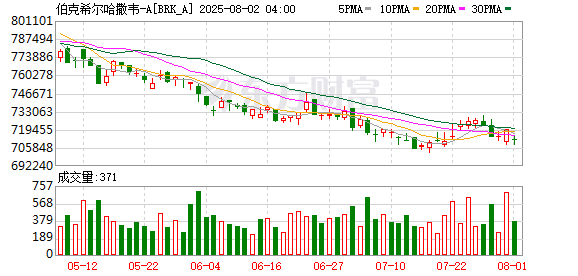
Core Viewpoint - Berkshire Hathaway's financial results for Q2 showed significant fluctuations, with revenue exceeding market expectations but net profit experiencing a dramatic decline compared to the previous year [2][5]. Financial Performance - Q2 revenue reached $92.515 billion, surpassing market expectations of $91.963 billion, but down from $93.653 billion year-over-year [2][4]. - Q2 net profit was $12.370 billion, exceeding market expectations of $10.703 billion, but down 59% from $30.348 billion in the same quarter last year [2][4]. Investment Performance - Investment net income for Q2 was $4.970 billion, a significant drop from $18.750 billion in the same period last year [5]. - The fair value of Berkshire's top five holdings accounted for 67% of its portfolio, including American Express, Apple, Bank of America, Coca-Cola, and Chevron [5]. Market Conditions - In Q2, U.S. stock markets experienced volatility due to tariff uncertainties, with the Dow Jones up 4.98%, Nasdaq up 17.75%, and S&P 500 up 10.57%, while Berkshire's stock price fell 8.72% [6]. - Trade tensions accelerated in the first half of 2025, posing threats to Berkshire's diversified businesses, with revenue declines reported in its clothing and toy brands [6]. Leadership Transition - Warren Buffett announced plans to retire by the end of the year, raising concerns among investors despite having named Greg Abel as his successor in 2021 [7]. Stock Management - In Q2, Berkshire sold approximately $3 billion in stocks, marking the 11th consecutive quarter of net stock sales, and did not engage in stock buybacks [8]. - As of the end of Q2, Berkshire's cash and cash equivalents stood at $344.1 billion, slightly down from $347.7 billion in the previous quarter, with Buffett indicating a cautious approach to investment opportunities [8].
美国对多国加征关税 黄金期货向上冲高
Jin Tou Wang· 2025-08-01 09:28
周五(8月1日)欧盘时段,黄金期货向上冲高,沪金主力重返770元关口,美国对多国加征10-41%关税 引发的贸易紧张局势,为金价提供避险支撑。北京时间周五20:30,美国将于周五公布7月非农就业报 告,黄金大行情箭在弦上! 打开APP,查看更多高清行情>> 【要闻速递】 【技术分析】 基本面上,虽然美联储7月会议保持利率不变,鲍威尔也表示继续观望,打压金价走低,但美联储理事 沃勒、鲍曼投下反对票并主张降息,特朗普也再度呼吁降息,年内也仍存降息概率,只是时间早晚的问 题。 昨夜公布的美国经济与通胀数据具备韧性,黄金价格持续承压。美联储货币政策表态转鹰派,金价短期 将面临较强回调压力,但基于后续就业数据以及关键票委表态所具备的不确定性,暂时观望,沪金主力 合约参考运行区间760-794元/克,今日沪金主力上方阻力关注775-780,下方支撑看750-760。 所以,鲍威尔对于降息泼冷水产生的利空压力,也只是一时的打压。金价下跌之后,也仍是入场看涨机 会。 另外,美国贸易协定8月1日即将到期,并再度对各国开启加征关税政策,即便是欧美及中美等达成协 议,鉴于目前已有所消化,全球贸易也依然处于高关税的政策环境中,而会增 ...
Bekaert: 2025 Half Year Results
Globenewswire· 2025-07-31 05:00
Consolidated sales of € 1.9 billion (-5.2%) Volumes were -2.6% or € -54 million down Impacts from pass-through of lower input costs and price-mix was -2.2% or € -46 million Currency impact of -1.1% or € -24 million Sales from acquisitions +0.8% or € +16 million Underlying gross profit margin was 16.6% (vs 18.4% in H1 2024), with underlying gross profit at € 325 million (vs € 379 million in H1 2024) Robust margin performance in difficult markets EBITDAu of € 259 million (-10.2%), delivering a margin on sales ...

今晚还不降息?美联储恐面临逾30年来最嘹亮“反对声”
凤凰网财经· 2025-07-30 13:21
Core Viewpoint - The Federal Reserve is expected to maintain the interest rate target range at 4.25%-4.5% during the upcoming meeting, with a very low probability of a rate cut at only 3% [1][2] Group 1: External Pressures - President Trump has been vocally critical of the Federal Reserve, questioning its spending on renovations and pressuring for rate cuts to alleviate government debt costs [1] - The White House's proximity to the Federal Reserve has intensified the scrutiny and criticism directed at Chairman Powell [2] Group 2: Internal Dissent - There is a possibility that multiple Federal Reserve governors may vote against the decision for the first time in over 30 years, with the last occurrence dating back to 1993 [2] - Analysts predict that governors Waller and Bowman may cast dissenting votes due to concerns over high interest rates amid rising employment risks [7][8] Group 3: Upcoming Meeting Highlights - Key changes in the Federal Reserve's statement are anticipated, particularly regarding the assessment of economic uncertainty, which may remain at a high level [4][5] - The upcoming GDP data release is expected to influence the Federal Reserve's economic outlook, with a potential downgrade from "solid" to "moderate" growth [6] Group 4: Rate Cut Signals - The likelihood of Powell signaling a September rate cut during the meeting is considered low, but investors will look for clues during his press conference [9][10] - Current market pricing suggests a greater than 60% probability of a rate cut in September, although the Federal Reserve may be cautious about raising these expectations before key economic data is released [12] Group 5: Trade and Tariff Impacts - Powell may face questions regarding the impact of upcoming tariffs on inflation and economic conditions, as uncertainty continues to affect business decisions [14][15] - The delayed implementation of tariffs is expected to have a gradual impact on prices, with businesses currently absorbing some of the costs [15] Group 6: Political Pressures - Powell is likely to be questioned about the influence of political pressures on monetary policy decisions, particularly in light of recent scrutiny from the Trump administration [16][17] - The potential for an internal review of the Federal Reserve's non-monetary policy functions has been suggested, indicating a need for clarity on the institution's mission [17]
高盛:对欧盟的15%基准关税低于经济学家的预期。欧洲经济在应对贸易紧张局势方面也表现出了出人意料的韧性。
news flash· 2025-07-29 09:10
高盛:对欧盟的15%基准关税低于经济学家的预期。欧洲经济在应对贸易紧张局势方面也表现出了出人 意料的韧性。 ...
八月关税大限倒计时
Guo Ji Jin Rong Bao· 2025-07-28 13:44
Group 1 - The global trade situation is tense as the August 1 tariff deadline approaches, with the U.S. Commerce Secretary stating that the deadline will not be extended [1] - The U.S. and EU reached a trade agreement on July 27, where the U.S. will impose a 15% tariff on EU goods, while some countries have yet to reach agreements with the U.S. [1][2] - The EU has made significant concessions, including a commitment to invest $600 billion in the U.S. and purchase $750 billion in U.S. energy products [2] Group 2 - The U.S. is negotiating with Japan, which has agreed to invest $550 billion in exchange for a 15% "preferential" tax rate and increased imports of U.S. rice by 75% [2] - Other countries like the Philippines and Indonesia have accepted a 19% tariff threshold, while Vietnam has secured a 20% tariff threshold by offering zero tariffs on U.S. goods [2] - The U.K. is expected to receive a minimum tax rate of 10%, but details are still pending final agreement between the two countries [3] Group 3 - Ongoing negotiations with countries like South Korea and India are challenging due to the pressure from U.S. tariff policies on their domestic economies [3] - A new round of U.S.-China trade talks is scheduled in Stockholm, with key officials from both sides participating [3] Group 4 - Optimism from easing trade tensions has led to record highs in U.S. stock markets, while European markets have also reached their highest levels since early June [4] - Despite the market rally, concerns remain about the long-term impact of high tariffs on U.S. consumers and the competitive position of EU exporters [4] - Morgan Stanley notes that while the market has not collapsed, there is a 40% probability of economic slowdown due to trade issues, especially if further tariffs are imposed [4]
特朗普拟缩短俄乌停火期限 油价短线拉升
智通财经网· 2025-07-28 13:05
Group 1 - The U.S. President Trump has shortened the deadline for Russia and Ukraine to reach a ceasefire agreement by 50 days, expressing disappointment over Putin's continuation of the war [1] - Trump has threatened severe economic sanctions against Russia if it does not end hostilities with Ukraine, which has heightened the urgency for sanctions as Russia continues its attacks on Ukrainian cities [1] - The market is reacting sensitively to these developments, with concerns over potential chain reactions from sanctions, including energy price volatility, trade disruptions, and increased geopolitical risks [1] Group 2 - Russia, as a significant global energy exporter, has its situation impacting the energy market notably, with WTI crude oil rising by 2.06% to $66.50 per barrel and Brent crude oil increasing by 2.01% to $68.47 per barrel [1] - The Russian Finance Ministry has reported that due to weak oil export prices, Russia's oil and gas revenue is expected to lose 4.47 trillion rubles by 2025, highlighting the uncertainty in the energy market and Russia's economic dependence on energy exports [1] - The International Monetary Fund (IMF) projects a global economic growth rate of 3.2% for 2025, but warns that trade tensions could overshadow this outlook, influenced by Trump's sanctions policy and trade agreements between the U.S. and EU [2] - The EU has reached a trade agreement with the U.S. imposing a 15% tariff on EU goods exported to the U.S., while the U.S. plans to impose tariffs on goods from Mexico and other countries, increasing global market uncertainty [2]
IMF警告英国经济增长面临风险 高储蓄率与贸易局势成阻力
news flash· 2025-07-25 11:51
Core Viewpoint - The International Monetary Fund (IMF) warns that the UK economy's growth may be hindered by high household savings rates and global trade tensions [1] Economic Growth Risks - Economic growth continues to face downside risks due to tighter financial conditions than expected [1] - Increased precautionary savings by households may suppress the rebound in private consumption, slowing down economic recovery [1] Global Trade Uncertainty - Ongoing global trade uncertainties could pressure the UK economy by weakening global economic activity, disrupting supply chains, and suppressing private investment [1] Inflation Pressures - Significant increases in commodity prices may exacerbate inflationary pressures [1]
贵金属有色金属产业日报-20250725
Dong Ya Qi Huo· 2025-07-25 10:28
1. Report Industry Investment Rating No relevant information provided. 2. Core Views of the Report - Gold: The progress of the US - EU tariff agreement eases trade tensions, weakening gold's safe - haven demand. The drop in US initial jobless claims to 217,000 strengthens the expectation of the Fed maintaining interest rates. The breakdown of cease - fire negotiations in the Middle East provides some support, while domestic gold prices are pressured by both the decline in international gold prices and the strengthening of the RMB [3]. - Copper: The "anti - involution" affects the entire non - ferrous metal sector. Copper may be slightly stronger in the short term, but there are potential mid - term risks as there is no significant capacity to be eliminated on the supply side, and the construction of the Yarlung Zangbo River Hydropower Station has a long cycle with low initial copper demand. Also, the increase in copper prices has not significantly driven up positions [13]. - Aluminum: Macroeconomic factors are positive, boosting sentiment. Low inventory continues to support aluminum prices, and SHFE aluminum is expected to fluctuate at a high level in the short term. For alumina, the short - term trend is mainly driven by sentiment, and it may fluctuate, with a risk of significant correction if the fundamentals change. Cast aluminum alloy is affected by high scrap aluminum prices and weak demand [33][34][35]. - Zinc: Under the influence of the "anti - involution" sentiment, SHFE zinc fluctuates at a high level. Fundamentally, the supply is gradually shifting from tight to surplus, and demand is weak during the traditional off - season. The Yarlung River Dam project may bring some demand growth [62]. - Nickel: Nickel ore supply is expected to be loose with narrowing demand and is likely to decline. Nickel pig iron trading has improved, and stainless steel lacks upward momentum. Sulfuric acid nickel is produced based on sales, and attention should be paid to the support of nickel pig iron and large - scale production cuts [78]. - Tin: The rise in tin prices is due to the "anti - involution" impact on the non - ferrous sector, but its fundamentals remain unchanged. In the short term, with the upcoming outflow of Burmese ore and weakening demand, the upward pressure on tin prices is greater than the support [93]. - Lithium Carbonate: The spot market for lithium ore and lithium salts is actively traded, and industry profits are improving. Cost support is strengthened by rising ore prices, but price fluctuations have increased [103]. - Silicon Industry Chain: Market sentiment is hot, and both industrial silicon and polysilicon futures prices have fluctuated significantly. Investors should pay attention to position risks [112]. 3. Summary by Related Catalogs Gold - **Price Influencing Factors**: Trade agreements, US economic data, Middle East situation, and RMB exchange rate affect gold prices [3]. - **Price Charts**: Include SHFE gold and silver futures prices, COMEX gold prices and gold - silver ratios, and the relationship between gold and the US dollar index, US Treasury real interest rates, and long - term fund holdings [4][8]. Copper - **Price Outlook**: Short - term slightly stronger, mid - term potential risks [13]. - **Futures Data**: The latest prices of SHFE copper contracts show a decline, and the trading volume and positions have certain trends [14]. - **Spot Data**: Spot copper prices have decreased, and the basis and spreads have changed [17]. - **Import and Processing**: Copper import losses have increased, and copper concentrate TC remains unchanged [25]. - **Warehouse Receipts and Inventory**: SHFE and LME copper warehouse receipts and inventories have different changes [30][31]. Aluminum - **Aluminum**: Macroeconomic support, low inventory support, and short - term high - level fluctuations [33]. - **Alumina**: High operating capacity, slow inventory accumulation, tight spot supply, and short - term sentiment - driven [34]. - **Cast Aluminum Alloy**: High cost, weak demand, and price following SHFE aluminum [35]. - **Price and Spread Data**: Include prices of various contracts, spreads between different contracts, and basis data [36][41]. - **Inventory Data**: SHFE and LME aluminum and alumina warehouse receipts and inventories have changed [58]. Zinc - **Price Outlook**: High - level fluctuations under "anti - involution" sentiment, with supply gradually becoming surplus and demand weak [62]. - **Price and Spread Data**: Prices of SHFE and LME zinc contracts have declined, and spreads between different contracts have changed [63]. - **Spot Data**: Spot zinc prices have decreased, and the basis and spreads have certain trends [69]. - **Inventory Data**: SHFE and LME zinc warehouse receipts and inventories have increased [74]. Nickel - **Industry Outlook**: Nickel ore supply is loose, nickel pig iron trading improves, stainless steel lacks upward momentum, and sulfuric acid nickel is produced based on sales [78]. - **Price and Position Data**: Prices of SHFE and LME nickel contracts have changed, and trading volume, positions, and warehouse receipts have corresponding trends [79]. - **Related Price Charts**: Include prices of nickel ore, nickel pig iron, and downstream products, as well as profit margins of related production [84][86][88]. Tin - **Price Outlook**: The rise is due to sector - wide influence, with short - term upward pressure greater than support [93]. - **Futures and Spot Data**: Prices of SHFE and LME tin contracts have declined, and spot tin prices and related products have also decreased [94][97]. - **Inventory Data**: SHFE tin warehouse receipts have increased, while LME tin inventory remains unchanged [99]. Lithium Carbonate - **Market Outlook**: Active spot trading, improving industry profits, and strengthening cost support [103]. - **Futures Price Data**: Prices of various lithium carbonate futures contracts have increased, and spreads between different contracts have changed [103]. - **Spot Data**: Prices of lithium ore and lithium salts have risen, and the spreads between different products have also changed [106]. - **Inventory Data**: Exchange and social inventories of lithium carbonate have different changes [110]. Silicon Industry Chain - **Market Outlook**: Hot market sentiment, significant price fluctuations in industrial silicon and polysilicon futures, and investors should pay attention to position risks [112]. - **Industrial Silicon**: Spot prices are stable, futures prices have increased slightly, and basis and spreads have changed [113][114]. - **Related Price Charts**: Include prices of polysilicon, silicon wafers, battery chips, and components, as well as production and inventory data of industrial silicon [120][121][127][133][140].