制度型开放

Search documents
16项新政赋能国家级经开区改革向新
Zhong Guo Qing Nian Bao· 2025-05-28 03:01
Core Points - The national economic and technological development zones have played a crucial role in China's reform and opening-up over the past 40 years, with 232 zones established across 31 provinces, generating a regional GDP of 16.9 trillion yuan [1] - The Ministry of Commerce has introduced a work plan to deepen reforms and innovations in these zones, focusing on high-level opening-up and high-quality development through 16 policy measures [1][2] - The zones are seen as a priority for foreign investment and trade, with over 60,000 foreign enterprises and 99,000 foreign trade companies operating within them, accounting for 23.4% of the nation's actual foreign investment and 24.5% of total imports and exports in 2024 [2] Group 1: Policy Measures - The work plan includes support for foreign investment projects in key sectors such as integrated circuits, biomedicine, and high-end equipment manufacturing [2] - It emphasizes the integration of domestic and foreign trade and the collaboration between national development zones and free trade pilot zones to enhance the quality of the outward-oriented economy [2] Group 2: Business Environment Optimization - The regulatory environment will be improved by streamlining administrative processes, reducing time, steps, materials, and movement required for business operations [3] - The market supervision authority will implement a credit-based regulatory model, adjusting inspection frequencies based on the credit risk of enterprises to alleviate their burdens [3]
在对外开放等四个方面实施十六项政策举措 深化国家级经开区改革创新(权威发布)
Ren Min Ri Bao· 2025-05-27 22:08
Core Viewpoint - The State Council has approved a work plan to deepen the reform and innovation of national economic and technological development zones, aiming to lead high-quality development through high-level openness [1][2]. Group 1: Economic Development and Performance - By 2024, the number of national economic and technological development zones will reach 232, generating a regional GDP of 16.9 trillion yuan [1]. - There are over 60,000 foreign-funded enterprises and 99,000 foreign trade enterprises in these zones, with actual foreign investment expected to be $27.2 billion and imports and exports reaching 10.7 trillion yuan, accounting for 23.4% and 24.5% of the national totals, respectively [1][2]. Group 2: New Quality Productive Forces - The zones host over 4.9 million various business entities, including 73,000 large-scale industrial enterprises and 85,000 high-tech enterprises, along with more than 15,000 provincial-level research institutions [2]. - The work plan emphasizes the importance of enhancing innovation capabilities and supporting the development of industrial technology innovation platforms [3]. Group 3: Management and Institutional Reform - The work plan focuses on optimizing operational models, separating administrative management from development entities, and improving incentive mechanisms [3]. - Key issues addressed include efficient processing of business matters, immediate access to favorable policies, and smart regulation [3]. Group 4: Resource and Factor Assurance - The work plan includes measures to support land, energy, talent, and funding, such as allowing local governments to allocate annual land quotas specifically for these zones and using special bonds for financing [3]. - Encouragement for innovative development models and enhanced resource integration is also highlighted [3].
东方枢纽,“重量级”规划方案正式出炉!
Guo Ji Jin Rong Bao· 2025-05-27 10:05
Core Insights - The approval of the "Shanghai Oriental Hub International Business Cooperation Zone Control Detailed Planning" marks a new phase in the development of this significant area [1] - The Oriental Hub International Business Cooperation Zone is the first of its kind in the country, aimed at deepening institutional openness and facilitating the efficient allocation of global resources [3] Group 1: Development Potential - The cooperation zone leverages its position as a world-class shipping hub, aiming to become a model for "air economy + hub economy" [4] - It will complement the Hongqiao International Central Business District, enhancing Shanghai's international trade capabilities [4] - The transportation planning focuses on integrating multi-modal transport systems, improving connectivity with major transport hubs [4] Group 2: Innovative Spatial Design - The planning introduces a "modular grid system" that allows flexible reconfiguration of space units to adapt to future industrial needs [5] - The spatial structure features a unique layout of "one chain, seven stars, and three rings," balancing functionality and aesthetics [5] Group 3: Core Application Scenarios - The global business exchange center will facilitate high-level business activities with advanced translation and meeting technologies [6] - The international talent training hub aims to cultivate professionals in key sectors through partnerships with top universities [6] - The world-class exhibition destination will enhance the zone's visibility and attract international attention through immersive event experiences [7] Group 4: Service and Operational Efficiency - A "one-stop" service system will be established, including commercial, professional, and public service facilities to support efficient operations [8] - The integration of various professional services will assist companies in navigating global business challenges [8] - Advanced infrastructure will provide comprehensive support for international business activities, enhancing operational efficiency [8] Group 5: Future Outlook - The detailed planning outlines a grand vision for the cooperation zone, positioning it as a key window for institutional openness and a hub for global resource aggregation [9]


支持符合条件的经开区上市融资!商务部等最新发声
证券时报· 2025-05-27 08:00
Core Viewpoint - The article discusses the recent policy framework aimed at enhancing the development and reform of national economic and technological development zones in China, emphasizing their role in stabilizing foreign trade and investment amidst increasing global uncertainties [2][5]. Group 1: Current Economic Environment - The international economic and trade order is facing severe shocks, with rising protectionism and unilateralism, increasing uncertainties and instabilities in the external environment for China's development [2]. - National economic and technological development zones are highlighted as key areas for stabilizing foreign trade and investment [2]. Group 2: Policy Measures - The framework includes 16 policy measures focusing on aspects such as foreign trade, new productive forces, management system reform, and factor assurance [5]. - Specific measures to support industries include encouraging foreign investment in biomedicine and high-end manufacturing, supporting digital service exports, and developing integrated industry clusters and international logistics centers [5]. Group 3: Regulatory and Administrative Improvements - The article emphasizes optimizing a credit-based regulatory model, reducing unnecessary burdens on enterprises, and enhancing the efficiency of administrative services [9][8]. - The establishment of a clear and efficient management system for development zones is also a priority, aiming to improve public service capabilities and market-oriented operations [6][8]. Group 4: Land and Financial Support - The policy framework addresses the need for land, talent, and financial support, proposing measures to enhance land use efficiency and meet the reasonable land demands of advanced manufacturing projects [11]. - It allows local governments to utilize special bonds to support the construction of development zones and industry projects, which is seen as a significant policy by the zones [11][12]. Group 5: Future Directions - The Ministry of Commerce will coordinate the implementation of the policy measures and support development zones in exploring practices to improve investment quality and expand foreign investment sources [6]. - There is a focus on supporting development zone entities in accessing financing through public listings and encouraging financial institutions to provide targeted support for technology-driven SMEs [12].
东西问丨谢宝剑:广交会证明开放公平的自由贸易是大势所趋
Zhong Guo Xin Wen Wang· 2025-05-26 02:58
Core Viewpoint - The Canton Fair exemplifies the trend towards open and fair free trade, demonstrating its resilience and importance in the current global trade landscape [1][9]. Group 1: Historical Context and Significance - The early archives of the Canton Fair serve as a testament to China's efforts to break through Western trade blockades and establish international communication [2]. - The establishment of the Canton Fair in 1957 was a crucial step in overcoming economic sanctions and expanding international markets, reflecting China's commitment to developing foreign trade [2][4]. - The principles of "contract respect" and "quality over quantity" highlighted in the archives underscore the importance of credibility in international trade, which remains relevant today [2][3]. Group 2: Evolution of China's Trade Environment - The development of the Canton Fair mirrors China's transition from a closed economy to a globally open economy, with significant changes occurring at key milestones such as the reform and opening-up policy and China's accession to the WTO [4][5]. - The Canton Fair has evolved through three major phases: 1. "Window-type trade" under a planned economy until 1978, where it played a key role in foreign exchange earnings [4]. 2. "Scale expansion" driven by market reforms from 1979 to 2012, marked by increased participation of private enterprises and a shift towards a more diverse range of export products [4][5]. 3. "Structural optimization" from 2013 onwards, focusing on high-quality development amidst global trade conflicts and technological advancements [5]. Group 3: Role in Global Trade and Economic Cooperation - The Canton Fair acts as a "stabilizing anchor" in the face of global trade tensions, providing an alternative trading channel that bypasses protectionist barriers [10]. - It serves as a "testing ground" for new digital trade rules and standards, enhancing procurement efficiency through innovative models like "online matching + offline transactions" [10][11]. - The fair's ability to attract over 280,000 foreign buyers from 219 countries and regions demonstrates its effectiveness in fostering international trade relationships [10]. Group 4: Future Directions and Policy Implications - The Canton Fair is positioned to further enhance trade facilitation by optimizing the trade environment and reducing barriers, while also sharing its successful practices with other countries [10][11]. - The fair's experience in market-driven rule innovation can inform global economic governance and promote dialogue on trade standards and regulations [11].
新华全媒头条 | 在古丝路起点拥抱世界——陕西打造高能级对外开放平台观察
Xin Hua She· 2025-05-24 11:44
Core Viewpoint - The news highlights the significant progress and development of Xi'an as a key node in the Belt and Road Initiative, emphasizing its role in enhancing international trade and connectivity with Central Asia and Europe through initiatives like the China-Europe Railway Express and the establishment of a free trade zone [1][2][3]. Group 1: International Trade and Connectivity - Xi'an has established a high-level open channel for international trade, with over 2,500 China-Europe Railway Express trains operating this year, facilitating the transport of goods such as automobiles and home appliances to Germany [2]. - The international trade volume from Xi'an reached 687 billion yuan in land transport and 2,409.4 billion yuan in air transport in 2024, marking increases of 37.6% and 17.5% respectively, with trade with Belt and Road countries accounting for 58.1% of the total [3]. - The China-Europe Railway Express has expanded its operations from a weekly schedule to a more frequent service, achieving a record of 1,530 containers loaded in a single day at the Xi'an International Port Station [3]. Group 2: Free Trade Zone and Policy Innovation - The Xi'an Free Trade Zone has played a crucial role in enhancing trade facilitation, reducing export clearance times from 1.6 hours to 48 minutes, and saving logistics costs for enterprises by approximately 30 million yuan annually [5][6]. - The Free Trade Zone has contributed to 70% of the province's total import and export value, with a trade value of 2.31 trillion yuan, showcasing its importance in the region's economic landscape [6]. Group 3: Industry Development and Innovation - The Shaanxi Automobile Group showcased its advancements in the new energy vehicle sector at the Silk Road International Expo, with an expected export of 63,000 vehicles in 2024, reflecting an 11.5% year-on-year growth [7]. - The integration of technology and innovation is evident in companies like Zhongzhi Keyi Technology, which has developed advanced imaging devices, indicating a strong focus on enhancing competitiveness in global markets [7]. Group 4: Silk Road International Expo - The Silk Road International Expo serves as a vital platform for promoting economic development and international cooperation, attracting over 10,000 foreign merchants from more than 190 countries since its inception [8][9]. - The Expo aims to deepen connectivity and expand economic cooperation, positioning Xi'an as a strategic hub for trade and investment in the Belt and Road Initiative [9].
外资独资券商再添新军:信和证券全控背后的中国资本市场开放密码
Sou Hu Cai Jing· 2025-05-20 11:18
Core Viewpoint - The official notification on March 28, 2025, marks Xinhua Securities' entry into the club of wholly foreign-owned brokerages in China, reflecting the deep logic of China's capital market opening [1] Group 1: Shareholding Evolution - The process of Xinhua Securities' transition to full ownership aligns with the opening rhythm of China's securities industry, with foreign ownership limits gradually lifted since China's WTO accession in 2001 [3] - Xinhua Group strategically increased its stake from 51% in 2018 to 67% in 2022, and finally to 100% in 2025, effectively navigating policy risks while seizing market opportunities [3] Group 2: Industry Restructuring - The independent status of Xinhua Securities is part of a broader trend, with the number of foreign-controlled brokerages rising to 11 in early 2025, indicating a strategic focus on three major opportunities in China's capital market: wealth management, technological innovation, and deepening institutional openness [6] - The CEO of Xinhua Group emphasized the company's commitment to investing in China, citing the resilience of the Chinese economy and significant growth in foreign investment in high-tech manufacturing [6] Group 3: Competitive Dynamics - The influx of foreign-owned brokerages is reshaping the Chinese securities industry ecosystem, driving innovation in business models and enhancing service capabilities [6] - Foreign institutions are attracting top talent through global rotation and equity incentives, leading to a talent drain from domestic firms [6] Group 4: Regulatory Response - The regulatory framework is evolving in response to competitive pressures, with the China Securities Regulatory Commission lowering investment thresholds for foreign investors and introducing new mechanisms to facilitate foreign participation in the bond market [7] - The entry of foreign firms is seen as a means to enhance the overall quality and scale of the market, rather than merely redistributing existing resources [7] Conclusion - The transition of Xinhua Securities to full foreign ownership signifies a deeper phase in China's capital market opening, emphasizing the importance of both attracting foreign investment and fostering innovation [7]
2025全球投资者大会举行 与会者表示中国经济确定性与制度型开放为投资中国创造更好生态
Yang Guang Wang· 2025-05-20 01:58
Group 1 - The 2025 Global Investor Conference held by the Shenzhen Stock Exchange highlighted the increasing interest of global investors in the Chinese capital market, emphasizing the certainty of the Chinese economy and institutional openness as key factors for investment [1] - Since September 26 of the previous year, the market value of foreign-held stocks in strategic emerging industries in Shenzhen has increased by 40%, with trading volume rising by 90% [1] - The Vice Chairman of the China Securities Regulatory Commission (CSRC) stated that a stable Chinese economy will provide irreplaceable investment opportunities for global investors, supported by a robust economic foundation [1] Group 2 - Over 90% of newly listed companies in 2024 are high-tech enterprises, indicating a strong focus on innovation within the Chinese market [2] - The CSRC plans to introduce policies to deepen reforms in the Sci-Tech Innovation Board and the Growth Enterprise Market, aiming to provide more suitable and inclusive institutional support for enterprise innovation and growth [2] - As the effects of high-quality economic development and the vitality of reform and opening-up become more evident, the Chinese capital market is expected to become an important platform for more foreign investment [2]
牢记嘱托 奋勇争先丨开放河南向未来
He Nan Ri Bao· 2025-05-19 23:54
Group 1: Economic Growth and Trade - Henan's foreign trade has shown significant growth, with a total import and export value exceeding 270 billion yuan in the first four months of the year, marking a year-on-year increase of 29.5% [2] - The province has implemented 27 measures to stabilize and enhance foreign trade, providing practical support for enterprises to explore new markets [2] - The recent Canton Fair saw 575 enterprises from Henan achieve over 100 million USD in export transactions with 15 countries, injecting new momentum into the province's foreign trade development [2] Group 2: Investment Attraction - Henan has actively promoted investment, forming a delegation to Hong Kong and signing 52 projects with a total investment of 51 billion yuan at the 2025 Global Henan Business Conference [2] - The establishment of a factory by Brazil's BRF company in Xihua County, with an investment of nearly 600 million yuan, marks a significant foreign investment in the province [2] - In the first four months of the year, 148 new foreign enterprises were established in Henan, representing a year-on-year increase of 38.3% [2] Group 3: Infrastructure and Logistics - The Zhengzhou Comprehensive Bonded Zone has attracted major e-commerce companies, enhancing the province's logistics capabilities and connecting it to global markets [4] - Henan is focusing on developing its hub economy by improving transportation networks, including high-speed rail and air transport, to facilitate domestic and international trade [5] - The "Air Silk Road" now covers over 200 cities globally, and the China-Europe Railway Express reaches more than 40 countries and regions, showcasing Henan's expanding logistics network [6] Group 4: Regulatory Innovations - Henan has successfully launched the first cross-border e-commerce TIR card train to Moscow, indicating progress in optimizing regulatory frameworks [8] - The province's Free Trade Zone has produced 615 institutional innovation results since its establishment, with 25 of these being promoted nationwide [8] - A new regulation aimed at supporting institutional innovation in the Free Trade Zone has been implemented, highlighting Henan's commitment to high-level openness [8] Group 5: Overall Development Strategy - Henan is transforming from an inland region to a competitive frontier through continuous openness, aiming to participate more actively in global competition [9] - The province's strategy includes deepening integration into global industrial divisions and enhancing its open economic environment [3][9]
天津 改革试验田成发展新引擎
Jing Ji Ri Bao· 2025-05-19 22:20
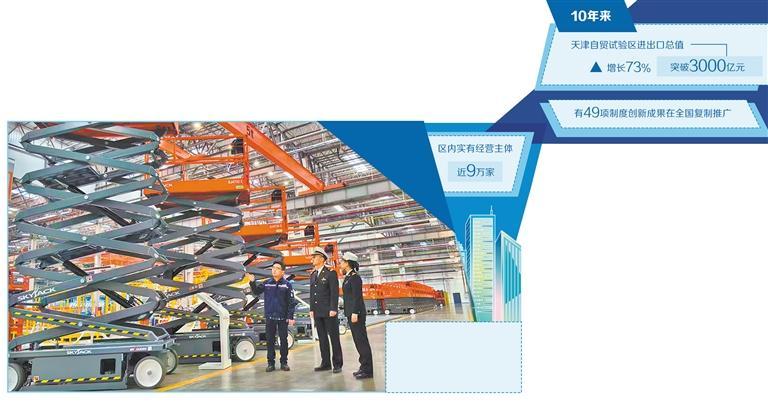
Group 1 - The Tianjin Free Trade Zone has achieved a 73% growth in import and export value over the past 10 years, surpassing 300 billion yuan, with nearly 90,000 operating entities in the area [2] - The zone has implemented 49 institutional innovations that have been replicated nationwide, maintaining a top-three position in the institutional innovation index among 22 free trade zones in China [2][3] - The customs authority has introduced innovative customs clearance models, such as the "one item, one vehicle" sampling method for imported vehicles, enhancing efficiency and reducing costs [3][5] Group 2 - The new "extension of classification pre-determination" policy allows companies to extend the validity of their classification decisions by three years without reapplying, streamlining the process and saving time [4] - In 2024, Tianjin enterprises applied for 59,000 certificates of origin, a 9% increase year-on-year, with export value benefiting from tariff reductions amounting to 26.81 billion yuan [5] Group 3 - The Tianjin customs has facilitated cross-regional art exhibitions through a bonded display model, significantly improving logistics efficiency and reducing costs for high-value items [6] - The introduction of a direct shipping line for cherries from Chile to Tianjin has reduced transportation time by one week, showcasing the effectiveness of the "zero waiting time" measures for fresh produce [7] Group 4 - The launch of bonded mixed ore business at Tianjin port is expected to bring an annual increase of approximately 2 million tons of iron ore imports, translating to nearly 200 million USD in trade value [8] - The "bonded leasing + bonded display + re-leasing" model allows companies to avoid costly return logistics, enhancing operational flexibility and customer engagement [9] Group 5 - The integration of bonded processing, maintenance, leasing, and display trading has fostered the development of new business models in Tianjin, enhancing its open economy [10] - The Tianjin Free Trade Zone has become a hub for the aviation leasing industry, accounting for 90% of the national aircraft leasing business and 80% of the ship leasing business, with financing leasing value reaching approximately 75.77 billion yuan [10][11]