
双碳战略

Search documents
亿纬锂能: 中信证券股份有限公司关于惠州亿纬锂能股份有限公司部分募投项目变更部分建设内容及投资总额的核查意见
Zheng Quan Zhi Xing· 2025-08-21 12:13
Core Viewpoint - The company is undergoing changes in the construction content and total investment of certain fundraising projects, specifically the "23GWh cylindrical lithium iron phosphate energy storage battery project," to enhance fundraising efficiency and meet market demands [1][3][5]. Summary by Sections Overview of Changes in Fundraising Purpose - The company has received approval from the China Securities Regulatory Commission to issue 50 million convertible bonds with a total fundraising amount of RMB 5 billion, netting approximately RMB 4.97 billion after deducting issuance costs [1]. Fundraising Plan and Usage Status - As of June 30, 2025, the total investment for the power battery project is RMB 547,379.00 million, with cumulative investment of RMB 201,504.09 million, of which RMB 193,309.23 million is from the raised funds [2]. Reasons for Project Changes - The changes are driven by the rapid growth in global demand for new energy vehicles, with a 34.3% year-on-year increase in sales in the first half of 2025, necessitating adjustments to meet delivery pressures and improve fundraising efficiency [3][4]. Overview of Changed Project Details - The project will now include both cylindrical and square lithium iron phosphate battery production lines, with adjusted capacities of 11.5GWh and 14.5GWh respectively. The total investment has increased to RMB 579,615.50 million, while the use of raised funds and project duration remain unchanged [4][5]. Impact of Changes on the Company - The adjustments are deemed beneficial for the company's development and do not harm shareholder interests. The company will ensure compliance with relevant regulations and enhance supervision over the use of raised funds [5][6]. Opinions from Independent Directors and Board - The board has approved the changes, and independent directors have confirmed that the adjustments align with the company's operational needs and future development plans, ensuring no detriment to shareholder interests [6][7].


北矿科技: 北矿科技2025年半年度报告
Zheng Quan Zhi Xing· 2025-08-21 11:10
Core Viewpoint - The report highlights the financial performance and operational strategies of BGRIMM Technology Co., Ltd. for the first half of 2025, showcasing growth in revenue and net profit while emphasizing the company's focus on innovation and market expansion in the mining equipment and magnetic materials sectors [1][10][19]. Financial Performance - The company achieved a total revenue of 552.43 million yuan, representing a year-on-year increase of 15.51% compared to 478.27 million yuan in the same period last year [3][10]. - The total profit amounted to 64.01 million yuan, up 11.33% from 57.50 million yuan in the previous year [3][10]. - The net profit attributable to shareholders was 54.31 million yuan, reflecting a growth of 10.59% from 49.11 million yuan in the same period last year [3][10]. - The net cash flow from operating activities decreased significantly by 88.65%, totaling 5.85 million yuan, primarily due to a reduction in cash received from sales [3][10]. Profit Distribution - The company proposed a cash dividend of 0.45 yuan per share (including tax), totaling approximately 8.52 million yuan, which accounts for 15.68% of the net profit attributable to shareholders for the first half of 2025 [1]. Business Overview - BGRIMM Technology operates in two main sectors: mining equipment and advanced magnetic materials, with a focus on R&D, production, sales, and service integration [4][5]. - The mining equipment segment includes products such as flotation equipment, magnetic separation equipment, and environmental protection equipment, serving various industries including steel, non-ferrous metals, and coal [4][5]. - The magnetic materials segment produces sintered permanent ferrite, bonded permanent ferrite, and rare earth permanent magnets, catering to sectors like electronics, aerospace, and renewable energy [5][6]. Market Strategy - The company aims to strengthen its domestic market presence while actively exploring international opportunities, particularly in countries along the Belt and Road Initiative [6][14]. - BGRIMM Technology emphasizes technological innovation and product development to meet evolving market demands and enhance competitiveness [10][19]. Industry Context - The mining equipment industry is crucial for resource development and is expected to benefit from national policies promoting resource security and sustainable practices [6][7]. - The magnetic materials sector is experiencing rapid growth, driven by advancements in technology and increasing demand for high-performance materials in emerging industries [8][9]. Research and Development - The company has a strong focus on R&D, with 17 patents granted in the first half of 2025, including 9 invention patents, and has received multiple provincial and national awards for its technological advancements [11][12]. - BGRIMM Technology is committed to enhancing its product offerings through continuous innovation and optimization of production processes [12][13]. Competitive Advantage - The company boasts a highly qualified workforce, including industry experts and a robust R&D team, which contributes to its leadership in technology and product quality within the mining equipment and magnetic materials sectors [19][20]. - BGRIMM Technology has established a solid customer base, with significant market share in both domestic and international markets, ensuring stable revenue streams and growth potential [24].

AES/LAS产销稳居全国榜首 赞宇科技上半年营收破65亿增逾四成
Quan Jing Wang· 2025-08-21 09:52
Core Viewpoint - Zanyu Technology (002637) reported a significant revenue increase of 41.71% year-on-year, reaching 6.553 billion yuan in the first half of 2025, with a net profit of 97 million yuan, reflecting the company's robust growth amid a complex global economic environment [1] Group 1: Business Performance - The company's main business segments include surfactants, fatty chemical products, and OEM/ODM personal care products, with over 97% of revenue derived from these core areas [1] - In the surfactant industry, the total production is projected to decline by 2.8% in 2024, while anionic surfactants are expected to see sales growth of 10.5% and 14.0% respectively [1] - Zanyu's market share in key products AES and LAS exceeds 70%, solidifying its leading position in the domestic market [1] Group 2: Industry Trends - The fatty chemical products sector is transitioning towards differentiation and high-end products, with a projected annual growth rate of 5% to 8% for major products like fatty acids and alcohols in 2024 [2] - The demand for green and low-carbon fatty chemical products is steadily increasing, supported by national policies [2] - The synthetic detergent production in China is expected to reach 12.246 million tons in 2024, marking a 14.3% year-on-year increase, providing ample space for the OEM business [2] Group 3: Strategic Initiatives - The company has established a comprehensive model integrating surfactant production and personal care product processing, with an OEM/ODM capacity of 1.1 million tons [3] - Zanyu has strategically positioned production bases across multiple regions, including Indonesia, to enhance supply chain efficiency and cost control [3] - The company invested 54.9981 million yuan in R&D during the first half of 2025, a 20.37% increase, focusing on new product development and process optimization [3] Group 4: Corporate Responsibility and Future Outlook - Zanyu actively engages in social responsibility initiatives, including environmental protection projects and compliance with national environmental policies [4] - The company aims to optimize product structure, enhance high-value product ratios, and strengthen supply chain resilience while continuing to innovate [4] - Zanyu is well-positioned to lead high-quality industry development through its comprehensive value chain advantages amid ongoing industry consolidation and upgrades [4]

确成股份: 2025年半年度报告
Zheng Quan Zhi Xing· 2025-08-21 09:09
Core Viewpoint - The report highlights the financial performance and operational status of Quechen Silicon Chemical Co., Ltd. for the first half of 2025, showcasing growth in revenue and net profit, alongside a focus on sustainable practices and innovation in the silica industry. Company Overview and Financial Indicators - The company achieved a revenue of approximately 1.11 billion yuan, representing a year-on-year increase of 3.87% [2] - The total profit reached approximately 322 million yuan, up by 5.67% compared to the previous year [2] - The net profit attributable to shareholders was around 276 million yuan, reflecting a growth of 5.44% [2] - The net cash flow from operating activities increased significantly by 56.38% to approximately 336 million yuan [2] - As of June 30, 2025, the company's total assets amounted to approximately 4.08 billion yuan, a 6.92% increase from the end of the previous year [2] Business Operations and Market Position - The company specializes in the research, development, manufacturing, and sales of precipitated silica, becoming one of the world's leading manufacturers in this field [3] - It operates three domestic production bases in Wuxi, Chuzhou, and Sanming, and one overseas base in Thailand, with a total silica production capacity ranking third globally [3] - The primary markets for the company's products include the rubber industry, particularly for high-performance tires, animal nutrition, toothpaste, and silicone rubber [3] Industry Trends and Developments - The demand for green tires, which utilize high-dispersion silica, is increasing due to their low rolling resistance and enhanced performance, aligning with global sustainability trends [3][4] - The tire industry is shifting towards sustainable materials, with major manufacturers adopting renewable and recycled materials to meet environmental standards [4][5] - The company is actively involved in the development of biomass-based silica production technologies, which significantly reduce carbon emissions and enhance product competitiveness [10] Research and Development - The company has established a New Materials Technology Research Institute to foster innovation and collaboration with research institutions, focusing on new silica applications and other inorganic materials [3] - Continuous investment in R&D has led to significant advancements, including the development of high-dispersion silica production technologies and the establishment of a post-doctoral research station [16] Competitive Advantages - The company maintains a comprehensive supply chain, producing key raw materials such as sodium silicate and sulfuric acid in-house, which stabilizes raw material quality and mitigates cost fluctuations [19][20] - Strong relationships with major international tire manufacturers enhance the company's market presence and recognition, making it the largest exporter of silica in China [17][18]

“两新”政策赋能 兴业银行天津分行 跑出惠民惠企“加速度”
Sou Hu Cai Jing· 2025-08-21 08:21
Group 1 - The "Two New" policy has been strengthened and expanded this year, with the Tianjin branch of Industrial Bank actively integrating into the "new and old kinetic energy conversion" wave, providing comprehensive support for resident consumption upgrades, enterprise technology upgrades, and regional green transformation [1] - The Tianjin branch has launched the "Xing Flash Loan" service targeting high-frequency consumption scenarios such as home appliances and digital products, effectively stimulating demand for new and upgraded consumer goods through flexible service models [2] - The bank has introduced innovative financial products to support technology-driven enterprises, facilitating their financing through methods like intellectual property pledges and R&D investment subsidies [4] Group 2 - The Tianjin branch has initiated the first sustainable development loan for ride-hailing services in Tianjin, supporting the purchase of new energy vehicles and promoting a low-carbon operational system for ride-hailing companies [6] - The bank is building a green financial ecosystem by supporting the development of clean energy and green buildings, aligning with the "dual carbon" strategy [6] - Through product innovation and service upgrades, the Tianjin branch aims to achieve a "two-way rush" between finance and the real economy, injecting financial momentum into high-quality economic development in Tianjin [6]


湘电股份: 湘潭电机股份有限公司2024年度向特定对象发行A股股票证券募集说明书(注册稿)
Zheng Quan Zhi Xing· 2025-08-21 08:19
Company Overview - Xiangtan Electric Manufacturing Co., Ltd. is planning to issue A-shares to specific investors, with a registered capital of RMB 1,325,406,445.00 and listed on the Shanghai Stock Exchange under the stock code 600416 [1][19]. - The company specializes in the manufacturing of electric motors, special products, and urban rail transit equipment, categorized under the electrical machinery and equipment manufacturing industry [19]. Issuance Details - The company intends to issue no more than 30% of its total share capital, amounting to 39,762.19 million shares, to specific investors, with a total fundraising target of up to RMB 200,000.00 million [4][6]. - The issuance will be conducted through a private placement to no more than 35 specific investors, including securities investment funds, securities companies, insurance institutions, and other legal entities [2][3]. Fund Utilization - The raised funds will be allocated to the development and industrialization of aviation electrical systems and magnetic levitation bearing high-speed motor systems, as well as to supplement working capital [5][6]. - The total investment for the aviation electrical system project is estimated at RMB 231,297.13 million, with the fundraising amount planned at RMB 200,000.00 million [5]. Shareholder Structure - As of June 30, 2025, the controlling shareholder, Xiang Electric Group, holds 13.66% of the company's shares, while the combined holdings of Xiang Electric Group and its concerted action partner, Xingxiang Group, amount to 30.70% [17][18]. - The actual controller of the company is the Hunan Provincial State-owned Assets Supervision and Administration Commission [17]. Industry Characteristics - The electric motor manufacturing industry is regulated by the National Development and Reform Commission and the Ministry of Industry and Information Technology, focusing on energy efficiency and technological innovation [19]. - The industry is characterized by a strong emphasis on energy-saving technologies and compliance with national standards for equipment efficiency [19].

交银金租:深度融入临港新片区高水平制度型开放
Ren Min Wang· 2025-08-21 07:27
近年来,交银金租精准把握临港作为"试验田"的先行先试机遇,坚决落实交通银行总行关于上海主 场战略的决策部署,持续深耕重点领域,积极探索金融租赁服务实体经济、助力绿色转型的新路径,为 金融租赁行业充分利用新片区政策红利提供了借鉴参考,积极谱写服务国家"双碳"战略、支持绿色科技 产业化和乡村振兴的新篇章。 未来,交银金租将牢牢把握临港新片区深化高水平制度型开放的历史机遇,持续深耕创新"试验 田",充分发挥金融租赁专业特色和上海主场优势,以更开放的视野、更创新的模式,深度融入临港新 片区制度创新与绿色低碳发展进程。"公司将持续精准对接实体经济绿色科技产业化需求,为临港新片 区打造开放型经济新高地、助力上海提升'五个中心'建设贡献力量。"该负责人说。 8月20日,在中国(上海)自由贸易试验区临港新片区成立六周年之际,交银金租携手TCL光伏科 技,依托此前在临港设立的SPV,再度成功落地户用光伏电站业务。 "这是继此前在临港新片区成功落地全国首单SPV架构户用光伏经营租赁项目和首单工业母机项目 后,交银金租以实际行动坚定支持临港发展的生动实践。"交银金租相关负责人表示。 该负责人介绍,此次项目的投放,依托临港优越政策环 ...
汽车智造进入下半场
Jin Rong Shi Bao· 2025-08-21 02:31
Core Insights - The article emphasizes the transition of the automotive industry towards intelligent manufacturing, highlighting the integration of smart vehicles, intelligent roads, and robust cloud systems as the next phase of development in the sector [1] Group 1: Industry Development - Chongqing is actively implementing the "Collaborative Leap" action for intelligent connected new energy vehicles, supported by a solid industrial foundation [1] - The city has been approved as a pilot for "vehicle-road-cloud integration" applications, as well as for the access and road testing of intelligent connected vehicles [1] - The establishment of a modern manufacturing cluster system, referred to as "33618," aims to enhance three trillion-level pillar industries, three 500 billion-level pillar industries, six thousand billion-level characteristic industries, and eighteen "new star" industries [1] Group 2: Technological Advancements - The intelligent connected vehicle demonstration zone is being developed in phases, with the first phase expected to be operational in 2024, featuring a cloud control platform capable of empowering all types of vehicles [2] - Approximately 50 kilometers of intelligent roads with continuous perception coverage have been constructed, integrating thousands of connected vehicles and various pilot scenarios such as autonomous bus routes and unmanned cleaning vehicles [2] - The "vehicle-road-cloud integration" system allows real-time feedback of information from pedestrians, vehicles, and traffic lights to the vehicle's "brain," enhancing safety and intelligence in vehicle operation [2] Group 3: Collaborative Ecosystem - The demonstration road, equipped with 23 types of intelligent devices, serves as a testing ground for the "vehicle-road-cloud integration" technology, contributing to quantifiable solutions for smart transportation under the "dual carbon" strategy [3] - Twelve automotive companies, including Toyota and Changan, are conducting joint testing and validation in the intelligent connected vehicle demonstration area, accumulating data to drive the iterative development of vehicle-road-cloud collaborative technology [3] - The initiative has fostered collaboration among over 50 upstream and downstream enterprises in the industry chain, providing a testing and commercial environment for these companies [3]
2025年中国微电网监控系统行业政策、产业链全景、发展现状、竞争格局及发展趋势研判:新能源需求跃迁、政策市场双驱动,微电网监控系统前景无限[图]
Chan Ye Xin Xi Wang· 2025-08-21 01:06
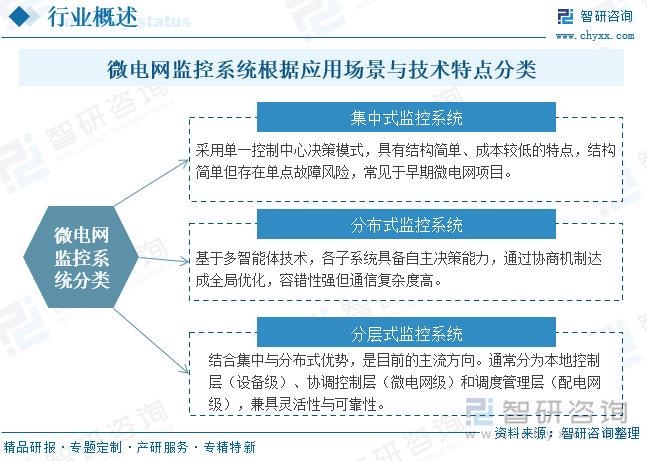
Core Viewpoint - The microgrid monitoring system serves as a crucial hub connecting distributed energy and smart grids, enabling integrated control of generation, grid, load, and storage, ensuring safe and stable operation of microgrids. The industry is expected to see significant growth, with the market size projected to exceed 12 billion yuan by 2025, driven by policy support and technological advancements [1][5][13]. Industry Overview - The microgrid monitoring system is an automated management system that monitors, analyzes, and dispatches distributed power sources, storage devices, loads, and power electronic equipment through real-time data collection and intelligent control [2][11]. - The system can be categorized into centralized, distributed, and hierarchical monitoring systems based on application scenarios and technical characteristics, as well as household, community, and industrial scales [3]. Policy Analysis - Since the "14th Five-Year Plan" emphasized the "dual carbon" strategy, China has accelerated the construction of a clean, low-carbon, safe, and efficient energy system, with microgrid monitoring systems playing a key role in the digital transformation of energy systems [5][6]. - A series of policies have been introduced to support the development of the microgrid monitoring system industry, enhancing its role in the new power system [5][6]. Market Development - The microgrid monitoring system market is expected to exceed 12 billion yuan by 2025, with significant potential for growth driven by increasing demand for energy management systems [13]. - The total market space for microgrid energy management systems could reach 57.1 billion yuan by 2025, with management systems and software accounting for over 90% of this market [13]. Technological Advancements - Recent advancements in microgrid monitoring systems include the integration of AI and digital twin technologies, enabling real-time control and seamless switching between grid-connected and off-grid modes [15][22]. - The system architecture typically adopts a "cloud-edge-end" layered model, achieving millisecond-level control and compatibility with 23 industrial standards [16][22]. Competitive Landscape - The industry is characterized by a tripartite structure involving grid companies, energy enterprises, and technology firms, each occupying different tiers of the market [17][19]. - Companies like Ankerui and Yongfu are leading in specialized automation solutions, while energy companies like State Grid and Haier focus on integrating renewable resources [19][20]. Future Trends - The microgrid monitoring system industry is expected to witness trends of technological intelligence, diversified application scenarios, and globalized business models [22][24]. - The integration of IoT, AI, and new storage technologies will drive the evolution towards fully intelligent systems, enhancing renewable energy consumption and operational efficiency [22][24]. - The market is anticipated to expand into new application areas such as urban emergency power supply and hydrogen energy utilization, with emerging scenarios expected to account for over 40% of the market by 2027 [24][25].



冰轮环境(000811) - 000811冰轮环境投资者关系管理信息20250820
2025-08-21 01:00
Group 1: Financial Performance - In the first half of 2025, the company achieved operating revenue of 3.12 billion CNY, a year-on-year decline of 7% [5] - The net profit attributable to shareholders was 266 million CNY, down 20% year-on-year [5] - Revenue in the second quarter showed a year-on-year increase, with total revenue reaching 2.1 billion CNY [5] - The overseas business grew significantly by 30%, reaching 1.02 billion CNY [5] Group 2: Business Segments and Products - The company focuses on providing advanced system solutions and lifecycle services in the energy and power sectors, with key products including compressors and heat exchangers [5] - The low-temperature refrigeration segment generated revenue of 1.73 billion CNY, accounting for 55% of total revenue, while the HVAC segment contributed 1.2 billion CNY, making up 39% [5] - The company has developed a full range of magnetic levitation compressor products, showcasing significant technological advantages [5] Group 3: Applications and Innovations - The company’s products are widely used in various sectors, including food processing, cold chain logistics, industrial cooling systems, and data centers [5] - The company’s subsidiary, Dunham-Bush, provides cooling equipment for data centers, with products recognized in the national green data center technology directory [6] - Recent innovations include a series of nuclear cooling technologies aimed at enhancing safety and efficiency in nuclear power plants [6] Group 4: Strategic Initiatives - The company is enhancing its overseas business by deploying skilled engineers and expanding its sales network [7] - A focus on industrial heat management aligns with national carbon reduction strategies, promoting clean and efficient energy systems [7]
