
创新药

Search documents
“春躁”行情有望提前演绎 险资增配权益资产“伺机而动”
Shang Hai Zheng Quan Bao· 2025-11-25 03:35
Core Viewpoint - Despite recent market adjustments, insurance asset management institutions remain optimistic about future investment opportunities in the stock market, anticipating a potential early onset of a "spring rally" [1][2]. Market Conditions - Recent market adjustments are primarily reflections of external market fluctuations, including changing expectations regarding Federal Reserve interest rate cuts and concerns over the AI bubble in the U.S. stock market [2]. - The fundamental market conditions have not changed significantly, with adjustments driven by shifts in funding, technology, sentiment, and expectations [2]. Investment Strategies - Insurance institutions are focusing on structural opportunities in the market, particularly in sectors such as finance, telecommunications, and transportation, while also looking for excess return opportunities in AI, new consumption, and innovative pharmaceuticals [2]. - There has been a notable increase in research activities by insurance institutions, with over 70 institutions participating in more than 280 research sessions since November, focusing on technology and pharmaceuticals [2]. Asset Allocation Trends - To cope with the low-interest-rate environment, insurance institutions are consistently increasing their allocation to high-quality equity assets, with stock investment balances reaching approximately 2,086 billion and 34,124 billion for property and life insurance companies, respectively, marking increases of about 30.29% and 50.47% year-on-year [3]. - The proportion of equity asset allocation by insurance institutions has reached a relatively high level of 10%, benefiting from both market growth and increased allocation willingness [3]. Regulatory and Market Drivers - The continuous increase in equity asset allocation by insurance institutions is driven by supportive policies and asset-liability matching requirements, with regulatory encouragement for private fund establishment and risk factor optimization opening up market opportunities [4]. - As traditional fixed-income assets struggle to meet liability cost requirements, increasing equity asset allocation has become a crucial strategy for insurance institutions to enhance investment returns [4].
昭衍新药涨2.02%,成交额1.62亿元,主力资金净流出1810.20万元
Xin Lang Cai Jing· 2025-11-25 02:49
Core Viewpoint - The stock of Zhaoyan New Drug has shown significant volatility, with a year-to-date increase of 70.06%, but recent declines in the short term raise concerns about its performance [1][2]. Group 1: Stock Performance - As of November 25, Zhaoyan New Drug's stock price increased by 2.02% to 28.23 CNY per share, with a trading volume of 162 million CNY and a turnover rate of 0.92%, resulting in a total market capitalization of 21.158 billion CNY [1]. - The stock has experienced a decline of 9.89% over the last five trading days, 15.48% over the last 20 days, and 14.14% over the last 60 days [1]. - The company has appeared on the "Dragon and Tiger List" three times this year, with the most recent occurrence on September 15 [1]. Group 2: Financial Performance - For the period from January to September 2025, Zhaoyan New Drug reported a revenue of 985 million CNY, a year-on-year decrease of 26.23%, while the net profit attributable to shareholders increased by 214.79% to 80.706 million CNY [2]. - The company has distributed a total of 703 million CNY in dividends since its A-share listing, with 356 million CNY distributed over the past three years [3]. Group 3: Shareholder Information - As of September 30, 2025, the number of shareholders for Zhaoyan New Drug reached 96,500, an increase of 57.61% compared to the previous period [2]. - The top ten circulating shareholders include notable funds, with Huabao Zhongzheng Medical ETF holding 12.484 million shares, a decrease of 2.1693 million shares from the previous period, while new shareholders include Guangfa Small Cap Growth Mixed Fund [3].

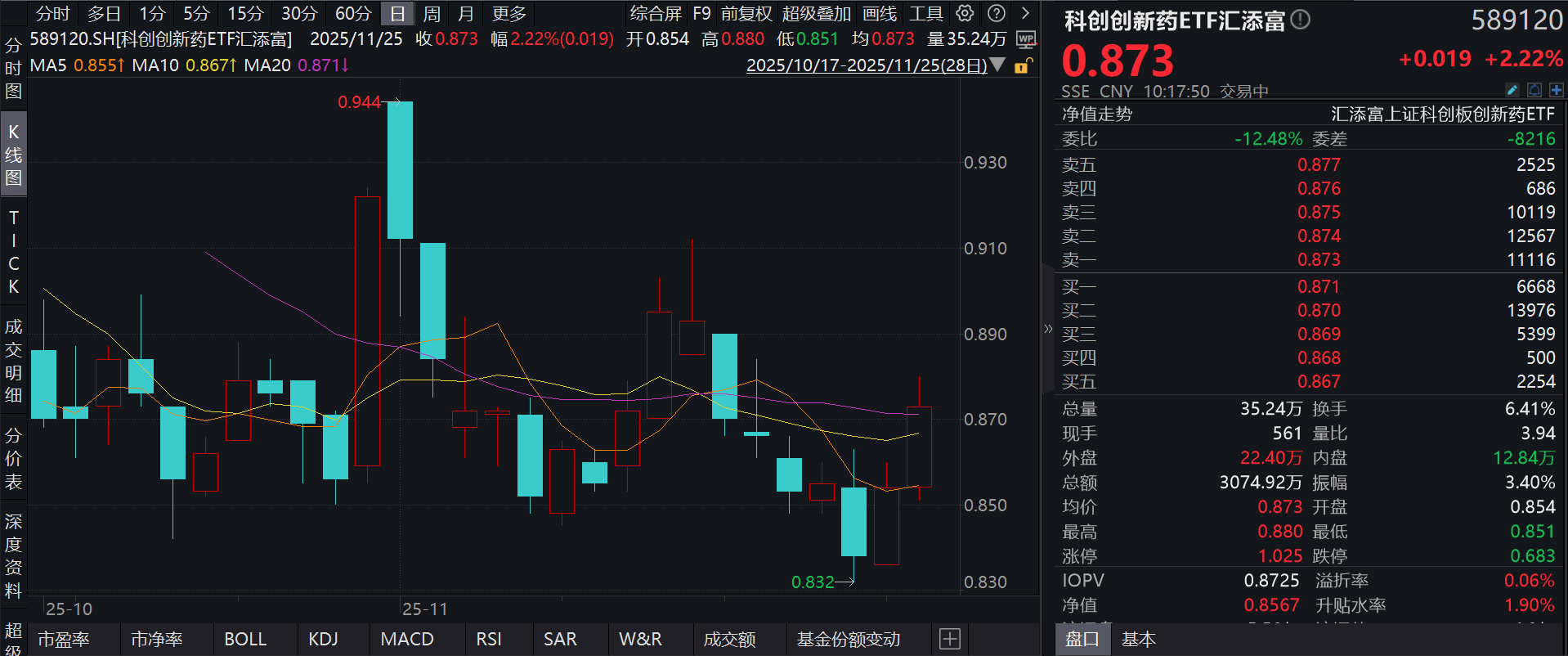
科创创新药走强,百利天恒涨超4%,科创创新药ETF汇添富(589120)强势涨超2%!泽璟制药涨超3%,抗体药纳入CDE突破性治疗品种
Sou Hu Cai Jing· 2025-11-25 02:37
Core Viewpoint - The innovation drug sector in China is experiencing significant growth, driven by policy support, technological advancements, and increased investment interest, particularly in small nucleic acid drugs and innovative therapies [4][5]. Group 1: Market Performance - As of November 25, 2025, the Shanghai Stock Exchange Sci-Tech Innovation Board Innovation Drug Index rose by 1.94%, with notable increases in constituent stocks such as YK Pharma (up 5.35%) and Olin Bio (up 4.97%) [1]. - The Huatai-PineBridge Innovation Drug ETF saw a 2.11% increase, with a latest price of 0.87 yuan, and a trading volume of 30.69 million yuan [1]. - Over the past month, the average daily trading volume of the Huatai-PineBridge Innovation Drug ETF was 55.01 million yuan, indicating strong market interest [1]. Group 2: Company News - Zai Lab announced that its investigational product ZG006 has been included in the list of breakthrough therapies by the National Medical Products Administration, targeting advanced neuroendocrine carcinoma patients [3]. - The company is positioned to benefit from the growing focus on innovative therapies and regulatory support for clinical trials [3]. Group 3: Policy Developments - Beijing's economic and information technology bureau, along with other departments, released measures to promote high-quality development in the medical device industry, emphasizing the adoption of AI-assisted diagnostic technologies [3]. - Shanghai's government has implemented reforms to expedite the review and approval process for innovative drug clinical trials, reducing timelines to 30 working days [4]. Group 4: Industry Trends - The small nucleic acid drug sector is gaining traction, with advancements in delivery technologies and a shift towards commercialization, marking a pivotal moment for the industry [4]. - The combination of policy support, innovation upgrades, and normalization of overseas business development is driving the high growth potential of the innovative drug sector [5].


百奥泰业绩会:预计未来两年会有更多产品加速进入海外市场
Zheng Quan Shi Bao Wang· 2025-11-25 02:35
Core Viewpoint - 百奥泰 reported a revenue of 684 million yuan for the first three quarters of 2025, representing a year-on-year growth of 17.57%, while the net loss narrowed to 224 million yuan, indicating improved financial performance [1] Group 1: Financial Performance - The company achieved a revenue of 684 million yuan in the first three quarters, marking a 17.57% increase year-on-year [1] - The net loss for the same period was 224 million yuan, showing a reduction in losses compared to the previous year [1] Group 2: Product Development and Approvals - Several products have been approved for sale, including Adalimumab and Tocilizumab in China and other regions, and Bevacizumab in multiple countries [1] - BAT1806 (Tocilizumab) and BAT2206 (Ustekinumab) have been approved in Europe, with sales managed by partners [2][3] - The company is advancing its innovative drug pipeline, with BAT5906 and BAT4406F expected to submit applications for market approval soon [2][3] Group 3: Market Expansion and Strategy - The company is preparing for participation in centralized procurement, optimizing production capacity and supply chain to enhance competitiveness [2] - New guidelines in the EU and the US for biosimilars are expected to lower R&D costs, providing a competitive advantage for the company [2] Group 4: Clinical Trials and Research - BAT6026 is currently in Phase II clinical trials for atopic dermatitis, while BAT8008 is set to begin Phase III trials for cervical cancer and HER2-negative breast cancer in mid-2026 [3] - Ongoing clinical research for BAT8008 in combination with BAT1308 has shown positive efficacy signals, leading to an expansion of the sample size [3] - BAT7111 is in Phase I dose escalation studies, progressing smoothly with three doses explored [3]

恒生指数公司季度检讨结果出炉!信达生物纳入恒生指数、恒生中国企业指数
Mei Ri Jing Ji Xin Wen· 2025-11-25 02:34
Core Viewpoint - The innovative drug market has seen a significant surge, with Innovent Biologics experiencing over 150% growth year-to-date and a market capitalization exceeding HKD 160 billion [1] Group 1: Market Performance - The Hang Seng Biotechnology Index, which heavily invests in Innovent Biologics and BeiGene, has risen over 80% this year, ranking among the top in overall market indices [1] - The Hang Seng Medical ETF (159892) leads its category with a scale exceeding HKD 6 billion [1] Group 2: Upcoming Developments - The futures for the Hang Seng Biotechnology Index are set to be listed on the Hong Kong Stock Exchange on November 28, providing new risk hedging tools for investors [1] - Innovent Biologics will be included in the Hang Seng Index and the Hang Seng China Enterprises Index, with changes effective after market close on December 5 and effective on December 8 [1] Group 3: Fund Inflows - According to CICC's estimates, the ETF tracking the Hang Seng Index has a fund scale of approximately USD 29.2 billion, while those tracking the China Enterprises and Hang Seng Technology indices have scales of about USD 7.59 billion and USD 32.61 billion, respectively [1] - Innovent Biologics is expected to see an estimated inflow of over USD 364 million due to its inclusion in these indices [1]
信达生物成功纳入恒生指数等三大主要指数
Xin Lang Cai Jing· 2025-11-25 02:09
Core Insights - The successful inclusion of Innovent Biologics (stock code: 01801.HK) in the Hang Seng Index marks a significant milestone, recognizing its value in the international capital market as a leading biopharmaceutical company [1][2][3] - Innovent Biologics has established a diverse pipeline of innovative drugs targeting major diseases such as cancer, autoimmune disorders, and metabolic diseases, with 16 products already commercialized [2] - The inclusion in the Hang Seng Index reflects the growing recognition and preference for high-quality Chinese innovative pharmaceutical companies in the Hong Kong stock market [2] Company Overview - Innovent Biologics focuses on developing monoclonal antibodies, bispecific antibodies, ADCs, and small molecule drugs, demonstrating continuous leadership in technological innovation and clinical value [2] - The company has optimized its operational efficiency and financial structure, building a solid foundation for long-term development and gaining widespread trust from global investors [2] Market Impact - The inclusion in the Hang Seng Index not only highlights Innovent Biologics' benchmark status in the industry but also serves as a new model for the internationalization of China's biotechnology sector [2] - The founder and CEO of Innovent Biologics emphasized that this milestone will broaden the investor base and enhance international market exposure, providing robust capital support for ongoing innovation and global business expansion [3]
百奥泰涨2.15%,成交额603.33万元,主力资金净流出49.39万元
Xin Lang Cai Jing· 2025-11-25 02:07
百奥泰所属申万行业为:医药生物-生物制品-其他生物制品。所属概念板块包括:创新药、抗癌治癌、 抗癌药物、生物医药、融资融券等。 截至9月30日,百奥泰股东户数9397.00,较上期减少0.89%;人均流通股44065股,较上期增加0.89%。 2025年1月-9月,百奥泰实现营业收入6.84亿元,同比增长17.57%;归母净利润-2.24亿元,同比增长 38.72%。 11月25日,百奥泰盘中上涨2.15%,截至09:39,报25.63元/股,成交603.33万元,换手率0.06%,总市值 106.13亿元。 资金流向方面,主力资金净流出49.39万元,大单买入49.37万元,占比8.18%,卖出98.75万元,占比 16.37%。 百奥泰今年以来股价涨32.25%,近5个交易日跌1.65%,近20日跌6.43%,近60日跌21.60%。 资料显示,百奥泰生物制药股份有限公司位于广东省广州市国际生物岛螺旋二路18号,成立日期2003年 7月28日,上市日期2020年2月21日,公司主营业务涉及从事创新药和生物类似药的研发、生产业务。主 营业务收入构成为:药品销售业务91.90%,授权许可业务6.55%,代加工 ...
新诺威涨2.06%,成交额3198.60万元,主力资金净流出4.85万元
Xin Lang Cai Jing· 2025-11-25 02:07
Core Viewpoint - New Nuo Wei's stock price has shown a significant increase of 21.00% year-to-date, despite recent declines in the short term [1][2]. Company Overview - New Nuo Wei, established on April 5, 2006, and listed on March 22, 2019, is located in Shijiazhuang, Hebei Province. The company specializes in the research, production, and sales of functional foods, with revenue composition as follows: 88.93% from functional foods and raw materials, 8.91% from biopharmaceuticals, and 2.16% from other sources [1][2]. Financial Performance - For the period from January to September 2025, New Nuo Wei reported a revenue of 1.593 billion yuan, reflecting a year-on-year growth of 7.71%. However, the net profit attributable to the parent company was a loss of 24.049 million yuan, a decrease of 117.26% compared to the previous year [2][3]. Shareholder Information - As of October 31, the number of shareholders for New Nuo Wei increased by 32.87% to 21,800, with an average of 57,116 circulating shares per shareholder, down by 24.74% [2][3]. - The top ten circulating shareholders include significant institutional investors, with Hong Kong Central Clearing Limited holding 17.7822 million shares, a decrease of 3.2169 million shares from the previous period [3].
超700亿元资金抄底A股
2 1 Shi Ji Jing Ji Bao Dao· 2025-11-25 01:14
Core Viewpoint - The recent downturn in the A-share market has led to a significant inflow of funds into ETFs, indicating a "buy the dip" mentality among investors despite the market's overall decline [2][6][10]. Market Performance - The A-share market experienced a substantial adjustment from November 17 to 21, with the Shanghai Composite Index falling over 3% and the ChiNext Index dropping more than 6%, marking the largest weekly decline in months [1][4][5]. - As of November 24, signs of stabilization were observed, with all three major indices showing slight increases and a total of 4,228 stocks rising [3]. Fund Inflows - A total net inflow of 701.21 billion yuan was recorded for stock ETFs and cross-border ETFs, with broad-based index ETFs attracting 359.31 billion yuan, highlighting a strong preference for these investment vehicles during market corrections [2][6]. - Specific ETFs such as the CSI 500 ETF, STAR 50 ETF, and ChiNext ETF were particularly favored, with net inflows of 64.29 billion yuan, 56.99 billion yuan, and 55.33 billion yuan, respectively [6]. Investment Trends - The current market adjustment is viewed as a normal correction, with many investors seizing the opportunity to buy into ETFs as a long-term strategy rather than short-term speculation [6][7]. - A notable trend of "high cutting low" has emerged, where funds are flowing out of high-valuation sectors like electronics and into more stable sectors such as banking and consumer goods [8][9]. Sector Preferences - Despite the overall market correction, there remains a strong interest in technology stocks, with significant inflows into sector-specific ETFs such as AI and robotics [9]. - The market is expected to see a shift towards undervalued assets with high dividend yields and positive fundamental outlooks as investors adjust their strategies [10].
申万宏源研究晨会报告-20251125
Shenwan Hongyuan Securities· 2025-11-25 00:45
Core Insights - The report highlights Qingmu Technology (青木科技) as a leading expert in full-domain operation services and brand incubation, driven by data and technology [2][4][14] - The company has established a high-synergy business model encompassing operation services, brand incubation, and technical solutions, serving well-known brands across various sectors [2][4][14] - Financial projections indicate significant revenue growth, with expected revenues of 15.1 billion, 19.0 billion, and 23.4 billion yuan for 2025 to 2027, representing year-on-year growth rates of 30.5%, 26.5%, and 23.0% respectively [4][14] Company Overview - Qingmu Technology was founded in 2009 and has focused on e-commerce operation since 2011, building a comprehensive service model that includes operation, brand incubation, and technology solutions [2][14] - The company has a stable ownership structure, with founders holding 39% of the shares, and a management team with over ten years of industry experience [2][14] - Revenue for 2024 and the first half of 2025 is projected at 1.15 billion and 670 million yuan, with year-on-year growth rates of 19.2% and 22.75% respectively [2][14] Competitive Advantages - Qingmu Technology's competitive edge lies in its data, technology, and brand matrix, which collectively enhance its operational value [3][4][14] - The data layer includes services across major platforms like Tmall, JD.com, Douyin, and Xiaohongshu, allowing the company to accumulate extensive user behavior and transaction data [3][14] - The technology layer features proprietary systems such as the Qingling AI platform and CRM, which streamline operations and reduce costs [3][14] Business Model and Growth Strategy - The company is expanding its service model from a single service fee to a combination of service fees, distribution price differences, and equity returns, thus sharing in brand growth [4][14] - Qingmu Technology is diversifying its product categories beyond apparel to include trendy toys, beauty products, health consumer goods, and pet food, enhancing its growth potential [4][14] - The company aims to maintain its status as a top service provider on platforms like Tmall and Douyin while increasing its international operations, particularly in Southeast Asia [4][14] Financial Projections - The report forecasts a steady increase in net profit, with expected figures of 1.31 billion, 1.85 billion, and 2.59 billion yuan for 2025 to 2027, reflecting growth rates of 45.2%, 40.4%, and 40.4% respectively [4][14] - The projected price-to-earnings (PE) ratios for the same period are 50, 35, and 25 times, indicating a favorable valuation outlook [4][14]
