数字经济

Search documents
激活数据资产价值 服务新质生产力发展
Xin Lang Cai Jing· 2026-01-08 09:40
Group 1 - The global economy is rapidly transitioning into a data-driven digital economy, where data is becoming a new type of production factor that is quantifiable, tradable, and valuable [1] - The financial industry, as a data-intensive sector, faces unprecedented transformation opportunities, requiring a shift from "business generates data" to "data drives business" [1][2] - Data assets possess unique attributes such as non-consumability, strong reusability, and near-zero marginal costs, which can empower core financial processes like risk control, pricing, investment research, and operations [1] Group 2 - The financial industry is tasked with exploring pathways for data assetization, progressing from resource to asset to capital, to support the development of new productive forces [2] - The bond market is actively exploring data capitalization, with data asset-backed securities (ABS) expected to emerge as a significant practice by 2025, providing new financing options for light-asset enterprises [2] - Key challenges remain in fully utilizing data assets, including unclear data ownership, lack of valuation systems, and ambiguous safety and compliance boundaries, necessitating a systematic data asset management framework [2]
国际观察丨非洲2026:在世界变局中厚植“非洲定力”
Xin Hua She· 2026-01-08 08:33
Core Viewpoint - Africa is strengthening its resilience and autonomy in response to global changes, aiming for a peaceful, united, and prosperous future by enhancing governance, economic transformation, and cooperation among developing nations [1] Group 1: Sovereignty Awareness - The uncertainty in the external environment has heightened the awareness of sovereignty among African nations, leading to reciprocal measures against U.S. travel restrictions [2] - African countries are increasingly recognizing that sovereignty and development rights should not be conditional upon external demands, emphasizing mutual respect in international relations [2] Group 2: Political and Economic Resilience - The year 2026 is expected to be a significant election year for Africa, with a mix of stable transitions and localized challenges [5] - Recent elections in countries like Guinea and the Central African Republic demonstrate political resilience, while upcoming elections in Uganda, Ethiopia, and Zambia are shifting voter focus towards governance capabilities rather than identity politics [6] Group 3: Economic Growth Projections - Despite global economic turbulence, Africa's economic growth is projected to exceed 4% in 2026, significantly above the global average, driven by demographic advantages and ongoing economic reforms [7] - The African Continental Free Trade Area is progressing, enhancing regional integration and economic dynamism across multiple sectors [7] Group 4: Energy and Digital Transformation - African nations are seizing opportunities from global energy transitions and the digital economy by moving from raw material exports to value-added processing in critical minerals [8] - Investments in digital infrastructure, such as 5G and submarine cables, are being accelerated to support cross-border payments and reduce reliance on the U.S. dollar [8] Group 5: China-Africa Cooperation - The year 2026 marks the 70th anniversary of diplomatic relations between China and Africa, with cooperation evolving towards more balanced and sustainable models [9] - Key projects like the Mombasa-Nairobi railway and agricultural technology centers exemplify the benefits of this partnership, which includes zero-tariff treatment for African nations [9][12] - Cultural exchanges and people-to-people connections have strengthened the ties between China and Africa, fostering mutual trust and cooperation [12]


国际观察|非洲2026:在世界变局中厚植“非洲定力”
Xin Hua She· 2026-01-08 08:18
Core Viewpoint - The article highlights the increasing awareness of sovereignty and the importance of regional stability in Africa amidst global uncertainties, emphasizing the continent's efforts towards self-reliance and economic transformation as it moves towards a peaceful and prosperous future [1][2]. Group 1: Sovereignty and Regional Stability - African nations are responding to external pressures by reinforcing their sovereignty, as seen in their reciprocal actions against U.S. travel restrictions on certain countries [2]. - The African Union has taken a strong stance on issues like Somaliland, emphasizing the importance of territorial integrity and opposing unilateral actions that threaten regional stability [4]. Group 2: Political and Economic Resilience - The year 2026 is expected to be a significant election year for Africa, with countries like Guinea and the Central African Republic demonstrating political resilience through stable elections [5]. - Upcoming elections in Uganda, Ethiopia, and Zambia are shifting voter focus from identity politics to governance issues, such as digital economy benefits and energy security [6]. Group 3: Economic Growth Projections - The World Bank and IMF predict that sub-Saharan Africa's economic growth will exceed 4% in 2026, driven by demographic advantages and ongoing economic reforms [7]. - The African Continental Free Trade Area is progressing, enhancing regional integration and economic dynamism [7]. Group 4: Energy Transition and Digital Economy - African nations are aiming to capitalize on global energy transitions and digital economy trends by moving from raw material exports to value-added processing [8]. - Investments in digital infrastructure, such as 5G and submarine cables, are crucial for supporting cross-border payments and reducing reliance on the U.S. dollar [8]. Group 5: China-Africa Cooperation - The year 2026 marks the 70th anniversary of diplomatic relations between China and Africa, with cooperation evolving towards more balanced and sustainable models [9]. - Key projects like the Mombasa-Nairobi railway and agricultural technology centers exemplify the mutual benefits of China-Africa collaboration [9][11]. - Cultural exchanges and people-to-people connections have strengthened ties, fostering trust and cooperation between China and African nations [11].

成都国资参投基金再传佳讯 燧原科技已完成IPO辅导
Zheng Quan Shi Bao Wang· 2026-01-08 07:39
Group 1 - Chengdu state-owned assets have successfully targeted key companies in the domestic GPU industry chain, including Haiguang Information, Moore Threads, and Muxi Co., Ltd [1] - Suiruan Technology has completed its IPO counseling work and is expected to enter the capital market in 2026, with CITIC Securities as the counseling institution [1] - Suiruan Technology, established in March 2018, has developed five cloud AI chips across four generations and has a product system covering AI chips, AI accelerator cards, intelligent computing systems, and AI software platforms [1] Group 2 - Suiruan Technology has received 12 rounds of financing from notable investors, including Zhenge Fund and CICC, as well as indirect investments from China Unicom, China Telecom, and Ping An [2] - Chengdu state-owned company Boryu Media invested 50 million yuan in 2022 in the second phase of the Ganbei Fund, which indirectly holds shares in Suiruan Technology [2] - Thunderbird Innovation, a leading AR smart glasses company, recently completed over 1 billion yuan in new financing, led by a fund under China Mobile and CITIC Securities [2] Group 3 - Thunderbird Innovation, founded in October 2021, has made significant advancements in near-eye display optical design and self-developed AI algorithms, with products expected to be available in over 25 countries by mid-2025 [3] - The company’s consumer-grade AR glasses have the highest shipment volume in both domestic and overseas markets, and it introduced the world's first dual-color AR glasses with eSIM functionality at CES 2026 [3] - The investment structure in the chip industry, where listed companies participate in industry funds, is common and allows for dual benefits in investment returns and business synergy [3] Group 4 - Boryu Media's investments in funds have led to significant progress in projects, showcasing its keen insight and positive outcomes in supporting new productive forces [4] - The investment achievements of Chengdu's cultural and creative enterprises reflect an innovative and upgraded operational model of local state-owned cultural capital [4] - Chengdu is actively guiding local capital to enhance industrial capabilities and modern industrial systems, providing effective practices for empowering the real economy [4]
“万里长江第一城”产业焕新擦亮生态底色
Xin Hua She· 2026-01-08 07:39
Core Insights - The article highlights the transformation of Yibin's industrial landscape from traditional coal and liquor industries to emerging sectors like power batteries, crystalline silicon photovoltaics, and smart terminals, reflecting a shift towards green and digital economies [1][2]. Group 1: Industrial Transformation - In 2015, the coal and liquor industries accounted for over 40% of Yibin's industrial output; by the first three quarters of 2025, the new energy and digital sectors are projected to represent nearly half of the city's industrial output [1]. - The power battery industry achieved an output value of 86.07 billion yuan in the first three quarters of 2025, marking a year-on-year growth of 14.6%, with expectations to exceed 130 billion yuan for the entire year [2]. - The crystalline silicon photovoltaic industry saw an increase in value added by 35.1% during the same period, while high-tech manufacturing's value added grew by 13.5% [2]. Group 2: Environmental Improvements - Yibin has established a water environment governance framework that promotes upstream and downstream collaboration, as well as coordinated management of rivers and tributaries [2]. - The proportion of Class II water bodies in the Yangtze River mainstream in Yibin increased from 0% in 2015 to 100% by 2025, with the proportion of water quality meeting national and provincial standards rising from 80% to 100% [2]. - The number of fish species monitored in the Yangtze River segment of Yibin has increased to 92, indicating improved ecological conditions [2].
旗天科技涨2.19%,成交额1.23亿元,主力资金净流出77.61万元
Xin Lang Cai Jing· 2026-01-08 06:38
Group 1 - The core viewpoint of the news is that Qitian Technology's stock has shown fluctuations in price and trading volume, with a current market value of 7.071 billion yuan and a recent increase in stock price [1] - As of January 8, Qitian Technology's stock price increased by 2.19% to 10.73 yuan per share, with a trading volume of 1.23 billion yuan and a turnover rate of 1.88% [1] - The company has experienced a net outflow of 776,100 yuan in main funds, with significant buying and selling activity from large orders [1] Group 2 - For the first nine months of 2025, Qitian Technology reported a revenue of 351 million yuan, a year-on-year decrease of 31.76%, and a net profit attributable to shareholders of -27.89 million yuan, a decrease of 39.23% [2] - The number of shareholders decreased by 21.75% to 53,100, while the average circulating shares per person increased by 27.80% to 11,720 shares [2] - Since its A-share listing, Qitian Technology has distributed a total of 51.35 million yuan in dividends, with no dividends paid in the last three years [3]

威士顿涨2.06%,成交额2.51亿元,主力资金净流出453.73万元
Xin Lang Zheng Quan· 2026-01-08 05:36
Group 1 - The core viewpoint of the news is that 威士顿's stock has shown significant fluctuations in price and trading volume, with a notable increase in the past few days despite a decrease over the past 20 days [1] - As of January 8, 威士顿's stock price increased by 2.06% to 61.84 CNY per share, with a total market capitalization of 5.442 billion CNY [1] - The company has a diverse revenue structure, with software development accounting for 43.04%, operation and maintenance services 24.89%, software product sales and services 19.63%, system integration 10.75%, and other services 1.69% [1] Group 2 - 威士顿 operates in the computer software development sector, specifically in horizontal general software, and is involved in concepts such as digital twins, digital economy, AI agents, ERP concepts, and artificial intelligence [2] - As of November 30, 威士顿 had 18,000 shareholders, a decrease of 4.37% from the previous period, with an average of 2,054 circulating shares per shareholder, an increase of 4.56% [2] - For the period from January to September 2025, 威士顿 reported a revenue of 122 million CNY, a year-on-year decrease of 32.34%, and a net profit attributable to shareholders of 21.49 million CNY, down 28.30% year-on-year [2] Group 3 - 威士顿 has distributed a total of 66 million CNY in dividends since its A-share listing [3]
从硬件竞赛到体验再造,老板电器寻找下一个AI入口
财联社· 2026-01-08 05:18
Core Insights - 2025 is a pivotal year for AI as it transitions from technical breakthroughs to practical applications, with a focus on real-world value rather than just technological advancements [1] - The kitchen, traditionally a functional space, is undergoing a transformation driven by AI, which is reshaping the relationship between people and products [1][2] - The smart kitchen appliance market in China is projected to reach 180 billion yuan in 2024, growing at over 20% annually, yet about 30% of current smart appliances remain basic in functionality [1] Industry Trends - The integration of AI in traditional industries, exemplified by companies like Boss Electric, is addressing the challenge of embedding cutting-edge technology into conventional sectors [2] - Despite the ongoing generative AI trend, there is a gap in practical applications within the kitchen, highlighting the need for AI that understands specific culinary contexts rather than general knowledge [3][6] - The kitchen environment relies heavily on tacit knowledge and sensory feedback, which poses challenges for general AI models that lack the depth of understanding required for cooking [6] Company Strategies - Boss Electric is adopting a unique approach by developing an AI model, "Shishen," rooted in 47 years of industry experience, focusing on personalized cooking solutions [7] - The company reported a 55% year-on-year increase in digital kitchen appliance sales in Q3 2025, with user numbers surpassing 6 million, indicating strong market acceptance [7] - Boss Electric has established three research institutes focused on digital kitchen appliances and AI cooking algorithms, creating a comprehensive R&D ecosystem [7] Data and User Engagement - The establishment of data property rights is crucial for AI commercialization, with Boss Electric obtaining seven data property registration certificates to facilitate compliance and value transformation [8] - A feedback loop is created where increased user engagement enhances AI understanding, leading to a more personalized experience, which in turn encourages further usage [8] - The company is shifting from traditional metrics of success to new indicators such as user activity and service renewal rates, reflecting a changing landscape in value assessment [14] User-Centric Approach - Boss Electric's branding as "your AI cooking partner" signifies a shift from technology-driven to relationship-driven strategies, emphasizing emotional connections with users [9] - The "Shishen" model offers personalized cooking solutions that adapt to individual dietary needs and preferences, addressing the non-standardized nature of food requirements [11][12] - The company's initiatives, such as immersive experiences and collaborations with Michelin, aim to enhance user engagement and create a deeper connection with culinary culture [13] Future Outlook - The ongoing AI wave presents both challenges and opportunities, with successful companies needing to deeply understand their industries and user needs rather than merely chasing trends [17] - Boss Electric's comprehensive strategy serves as a model for the kitchen appliance industry, illustrating how to innovate and create value in the AI era [17]


数据标准“加速跑” 30余项数据领域国家标准将在2026年推出
Zheng Quan Ri Bao Wang· 2026-01-08 03:57
Group 1 - The core viewpoint is that China's data standardization efforts are expected to achieve significant breakthroughs by 2026, with over 30 national standards to be introduced this year, focusing on advanced areas such as intelligent agents and embodied intelligence [1] - The national data standards are seen as essential infrastructure for reshaping the digital economy ecosystem, facilitating efficient development and utilization of data resources [1] - The national data standardization work has established a "top-level planning + pilot verification" model, aiming to complete the national data standard system by the end of 2026 [1] Group 2 - Under the guidance of the National Data Bureau, a series of standards for high-quality data set construction have been developed, including guidelines and evaluation standards, which will be officially released in August 2025 [2] - During the 14th Five-Year Plan period, over 120 national standards in the data field have been developed and published, widely applied in key areas such as artificial intelligence and data trading [2] - The construction of a national data infrastructure is crucial for the effective flow of data and the establishment of a unified national data market [2] Group 3 - The push for data standardization aims to resolve conflicts in the market allocation of data elements, particularly regarding the ownership of public, enterprise, and personal data [3] - The implementation of the "Interim Measures for the Registration and Management of Public Data Resources" in 2025 aims to create a unified public data resource registration system, although cross-departmental data access still requires manual review [3] - The refinement of public data standards is expected to clarify operational norms and provide quantitative references for data pricing mechanisms [3] Group 4 - The standardization of data is anticipated to trigger a chain reaction throughout the industry, enhancing cross-regional computing power scheduling and promoting the development of privacy computing and blockchain infrastructure [3] - The new digital economy paradigm is envisioned to be "data-driven, scenario-enabled, and ecosystem co-built," leading to a transformation from scale expansion to value creation in China's digital economy [4] - The recognition of data protocols and public data asset valuation models on the international market is expected to elevate China's digital economy [4]
市场那些事丨岁末年初,春季行情抢跑在即?
Sou Hu Cai Jing· 2026-01-08 03:19
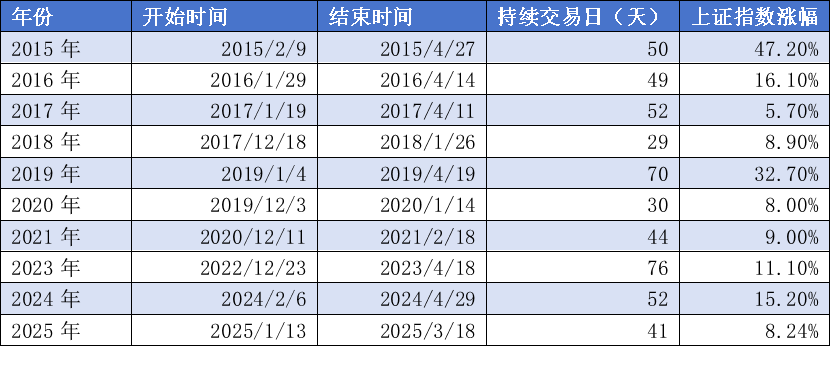
Group 1: Spring Market Dynamics - The spring market is characterized by a combination of policy expectations, liquidity easing, and an earnings vacuum period, creating a stage for market opportunities rather than being solely driven by seasonal factors [1] - The initiation of the spring market has been occurring earlier, with data showing that in the last five years, three instances saw the spring market start in December of the previous year, indicating a new market trend of "year-end sprint" [2] Group 2: Historical Performance - Historical data indicates that the spring market has varied in duration and performance, with the Shanghai Composite Index showing significant gains in various years, such as a 47.20% increase in 2015 and a projected 15.20% increase in 2024 [3] Group 3: External and Domestic Support - On the international front, reduced uncertainties, such as the U.S. Federal Reserve's interest rate cuts and a weaker dollar, are expected to enhance liquidity and attract foreign capital into the A-share market [4] - Domestically, a series of policy measures and early issuance of local government bonds are expected to provide strong support for economic recovery and market growth, with significant inflows into A-share ETFs indicating a favorable liquidity environment [5] Group 4: Investment Strategies - Investors are advised to focus on three main sectors: - The technology sector, which is expected to benefit from policy support in areas like artificial intelligence and semiconductor industries [6] - The cyclical sector, particularly in renewable energy and high-end manufacturing, which is anticipated to gain from global economic recovery and domestic policy initiatives [6]