海底光缆

Search documents
越泰印尼去东京开会,美国突然放话加关税,这背后到底啥意思
Sou Hu Cai Jing· 2026-02-27 11:36
Group 1 - Japan recently hosted a defense dialogue in Tokyo, ostensibly discussing maritime security with Pacific island nations, but also invited seven ASEAN countries, including Vietnam, Thailand, and Indonesia, which attended as observers without signing any agreements or participating in joint statements [1] - Vietnam's participation appears to align with Japan, but it has recently completed cooperation with the US and removed from the entity list, while its trade with China exceeds $70 billion more than with the US [3] - Thailand's military budget has increased by nearly 20% amid ongoing border conflicts, and Japan has pledged ¥50 billion in low-interest loans for port construction, yet Thailand remains reliant on China for practical support, such as a recent ceasefire agreement with Cambodia [3] Group 2 - Indonesia's new government faces security policy divisions, having purchased Japanese P-1 anti-submarine aircraft while receiving $1 billion in credit support from China for undersea cable construction, indicating a strategy to maximize technical support and funding from multiple sources [5] - Japan aims to expand its influence in the region through this meeting, but its economic situation is challenging, with the yen hitting a 53-year low and defense budget growth not keeping pace with inflation [5] - ASEAN countries maintain their stance that security issues should be led by ASEAN itself, reflecting a cautious approach to external influence [9][10]


未知机构:强烈推荐烽火通信光纤扩产星间激光核心龙头20260209光纤-20260210
未知机构· 2026-02-10 02:15
Summary of Conference Call Notes on Fiber Communication Industry Company Overview - The company discussed is **烽火通信 (FiberHome)**, a key player in the fiber optics and laser communication industry. Key Points Fiber Optics Expansion - The company has initiated an expansion of its fiber optic production capacity, with plans to increase optical fiber rod capacity from **2,200 tons to 3,500 tons** within approximately **one year** or slightly more. This expansion is expected to position the company as the **second-largest** manufacturer of optical fiber rods in China, following **长飞 (Yangtze Optical)** at **4,000 tons**, and ahead of **亨通 (Hengtong)** and **中天 (ZTT)**, which are projected to have capacities between **2,500 to 2,800 tons** [1][3] Profitability Outlook - Current prices for scattered fiber remain high, indicating that the profit elasticity for FiberHome's fiber optic products is expected to be significant [2][4] Core Competencies - FiberHome's capabilities in **hollow-core fiber** are second only to Yangtze Optical, and the company ranks second in cumulative bidding amounts for hollow-core fiber in China. The expansion of single-mode, multi-mode, and hollow-core fiber is anticipated to accelerate the company's profit potential [5] Laser Communication Technology - The company has developed a laser communication payload that is one of the only two solutions capable of achieving **100G** speeds autonomously. The main satellite constellation will utilize this **100G** solution, providing FiberHome with a strong competitive advantage and the potential to capture over **40%** of the market share [5] Future Revenue Projections - The total value of the company's inter-satellite laser and routing per satellite exceeds **5 million**, with projections indicating that satellite contributions could generate revenues of **10 billion** by **2030** [5] Other Business Segments - Additional business areas such as **昇腾 (Ascend)** and **鲲鹏 (Kunpeng)** servers, undersea optical cables, and **烽火星空 (FiberHome Sky)** AI applications are expected to experience rapid growth [5]

巴林2025经济报告:宣布价值170亿美元的投资和发展项目
Shang Wu Bu Wang Zhan· 2026-01-12 16:54
Group 1 - Bahrain has announced the launch of over 60 strategic projects with a total value exceeding $17 billion [1] - In the financial services sector, Al Salam Bank has introduced a digital payment platform named ASB Pay Business [2] - The manufacturing sector has seen the establishment of the region's first integrated titanium plant with an investment of $200 million, expected to produce approximately 4,000 tons of titanium plates annually [2] Group 2 - A commercial refrigeration equipment manufacturing plant has been completed with an investment of $9.84 million [2] - In logistics, an Indian capital company is exploring the development of Bahrain as a regional operational hub for Asian aviation [2] - In the telecommunications sector, Beyon announced plans to build a second solar-powered data center and a submarine cable connecting Bahrain and Saudi Arabia [2] Group 3 - Bahrain is planning multiple large-scale projects in the energy sector, including a solar power project with a total installed capacity of 123 megawatts [2] - Saudi ACWA has announced investments in the Al-Ezzel and Al-Dur power plants and plans to develop a solar power plant in Eastern Saudi Arabia to connect with Bahrain [2]
国际观察丨非洲2026:在世界变局中厚植“非洲定力”
Xin Hua She· 2026-01-08 08:33
Core Viewpoint - Africa is strengthening its resilience and autonomy in response to global changes, aiming for a peaceful, united, and prosperous future by enhancing governance, economic transformation, and cooperation among developing nations [1] Group 1: Sovereignty Awareness - The uncertainty in the external environment has heightened the awareness of sovereignty among African nations, leading to reciprocal measures against U.S. travel restrictions [2] - African countries are increasingly recognizing that sovereignty and development rights should not be conditional upon external demands, emphasizing mutual respect in international relations [2] Group 2: Political and Economic Resilience - The year 2026 is expected to be a significant election year for Africa, with a mix of stable transitions and localized challenges [5] - Recent elections in countries like Guinea and the Central African Republic demonstrate political resilience, while upcoming elections in Uganda, Ethiopia, and Zambia are shifting voter focus towards governance capabilities rather than identity politics [6] Group 3: Economic Growth Projections - Despite global economic turbulence, Africa's economic growth is projected to exceed 4% in 2026, significantly above the global average, driven by demographic advantages and ongoing economic reforms [7] - The African Continental Free Trade Area is progressing, enhancing regional integration and economic dynamism across multiple sectors [7] Group 4: Energy and Digital Transformation - African nations are seizing opportunities from global energy transitions and the digital economy by moving from raw material exports to value-added processing in critical minerals [8] - Investments in digital infrastructure, such as 5G and submarine cables, are being accelerated to support cross-border payments and reduce reliance on the U.S. dollar [8] Group 5: China-Africa Cooperation - The year 2026 marks the 70th anniversary of diplomatic relations between China and Africa, with cooperation evolving towards more balanced and sustainable models [9] - Key projects like the Mombasa-Nairobi railway and agricultural technology centers exemplify the benefits of this partnership, which includes zero-tariff treatment for African nations [9][12] - Cultural exchanges and people-to-people connections have strengthened the ties between China and Africa, fostering mutual trust and cooperation [12]
广东隐藏版海岛“天花板”!快来寻找现实版“海上桃源”
Nan Fang Du Shi Bao· 2025-12-26 06:24
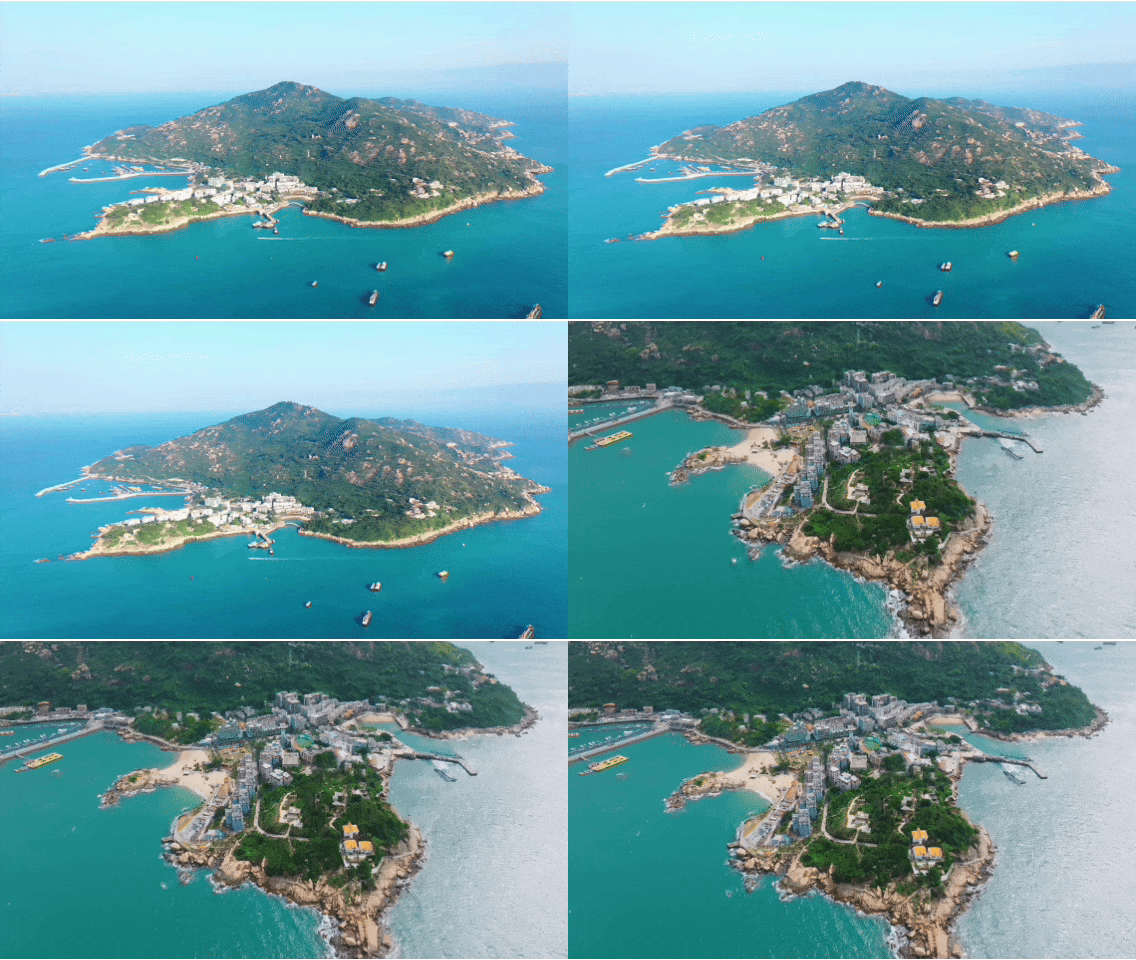
Core Insights - The article highlights the transformation of Xiaolingtang Island from a remote location to a popular vacation destination due to the successful installation of an undersea cable by Guangdong Mobile [1][11]. Group 1: Communication Infrastructure - The undersea cable project, initiated in 2021, spans approximately 25 kilometers and aims to enhance communication between Xiaolingtang Island and Guishan Island, significantly improving the island's connectivity [6]. - Prior to the installation, communication relied on microwave transmission, which was unstable and affected by extreme weather conditions, limiting the island's development potential [5][6]. - The completion of the undersea cable marks the beginning of a new communication era for Xiaolingtang Island, ushering in a "dual-gigabit" network that connects the island more closely with the mainland [11]. Group 2: Environmental and Development Challenges - The construction of the undersea cable faced multiple challenges, including navigating complex environments such as deep-sea aquaculture platforms and coral reefs, as well as busy shipping lanes [8][10]. - The project required careful planning to minimize negative impacts on the ecological environment, navigation, and fishing activities, ultimately taking three years to complete [10]. Group 3: Socioeconomic Impact - The successful installation of the undersea cable has accelerated the overall planning and development of Xiaolingtang Village, improving living conditions for residents and enhancing the tourist experience [13]. - The island is undergoing a transformation into a trendy vacation spot, with ongoing projects aimed at beautifying the village and improving infrastructure [13].
【最全】2025年深海科技行业上市公司全方位对比(附业务布局汇总、业绩对比、区域布局、业务规划等)
Qian Zhan Wang· 2025-12-20 06:11
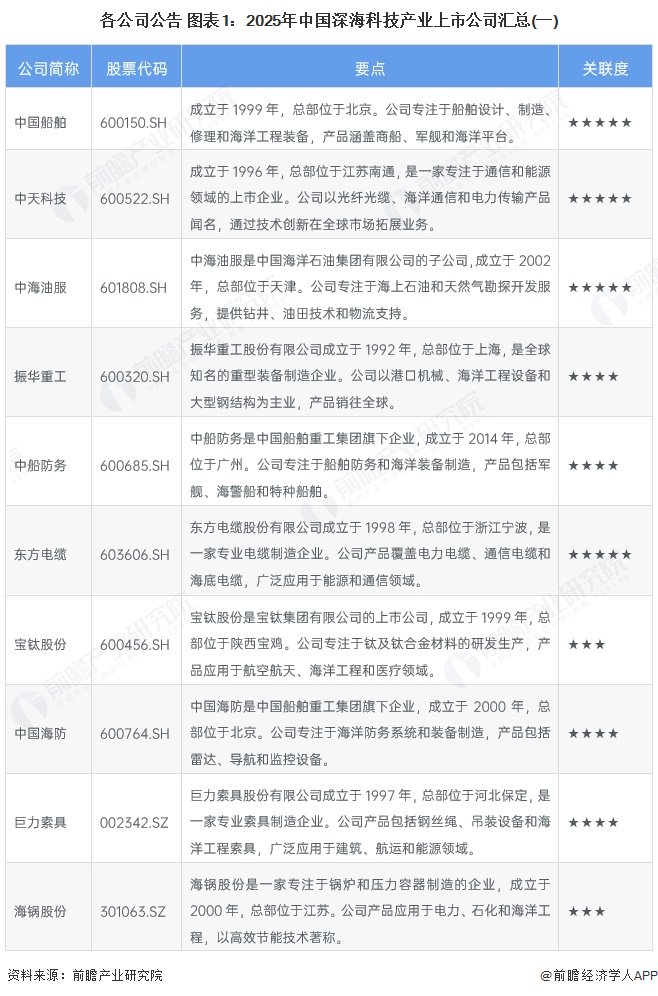
Core Insights - The article discusses the development status and investment strategies of China's deep-sea technology industry, highlighting the competitive landscape and key players in the sector [1][6]. Company Overview - Major listed companies in the deep-sea technology sector include China Shipbuilding (600150.SH), China National Offshore Oil Corporation (601808.SH), and Zhenhua Heavy Industries (600320.SH), among others [1][2]. - These companies cover a wide range of areas including high-end equipment manufacturing, oil and gas exploration services, and underwater communication and detection [1][6]. Financial Performance - In the first three quarters of 2025, China Shipbuilding led the sector with over 100 billion RMB in revenue, although it faced low overall gross margins of 12.6% [5][13]. - Companies like China Haifang and ShenKai Co. demonstrated high gross margins exceeding 35%, indicating strong technical barriers in their niche markets [5][13]. - The financial metrics reveal that many companies have ROE (Return on Equity) concentrated around 3%-4%, while some, like Juyi Rigging and China Haifang, reported ROE below 2% [10][13]. Business Strategies - Companies are focusing on integrating advanced technologies such as AI, big data, and smart manufacturing into their operations [15][17]. - Leading firms are accelerating the intelligent upgrade and green transformation of deep-sea equipment, while smaller companies are innovating in underwater robotics and new marine materials [15][17]. Regional and Global Expansion - Most companies are strategically positioned along China's coast and are expanding their reach globally, particularly in Southeast Asia, Europe, and the Americas [6][7]. - This regional layout aligns with national strategies for marine power and international industrial development [6][7]. Future Development Plans - Companies are planning to invest in new technologies and expand their product lines, focusing on sustainable practices and international market penetration [16][17]. - For instance, China Shipbuilding aims to enhance its market share through mergers and acquisitions, while Zhongtian Technology is expanding its global footprint in submarine cable and marine communication systems [16][17].





张謇企业家精神何以穿越百年
Shang Hai Zheng Quan Bao· 2025-12-14 19:43
Core Viewpoint - The article emphasizes the enduring entrepreneurial spirit of Zhang Jian, a patriotic industrialist from Nantong, and its influence on modern enterprises in the region, showcasing a legacy of innovation, education, and social responsibility that continues to inspire contemporary business practices [6][9][24]. Group 1: Historical Context and Legacy - Zhang Jian's contributions to Nantong include establishing China's first private cotton mill and the first museum run by Chinese nationals, which laid the foundation for a city that integrates industry, education, and culture [6]. - Over a century, Nantong has evolved into a "trillion-yuan city," with Zhang Jian's spirit becoming increasingly prominent through the efforts of modern entrepreneurs who continue to innovate and uphold his values [7][8]. Group 2: Entrepreneurial Spirit and Modern Practices - The essence of Zhang Jian's entrepreneurial spirit is characterized by patriotism, which drives contemporary business leaders to pursue industrial strength and innovation [9][10]. - Modern enterprises in Nantong, such as Tongfu Microelectronics and Zhongtian Technology, embody this spirit by focusing on technological advancements and contributing to national strategic goals, with Zhongtian Technology achieving over 100 billion yuan in revenue by 2024 [13][14][15]. Group 3: Social Responsibility and Community Impact - The commitment to social responsibility has evolved from Zhang Jian's individual efforts to a collective responsibility among modern entrepreneurs, emphasizing the importance of benefiting the community and promoting shared prosperity [24][25]. - Companies like Zhongtian Technology have significantly increased their charitable contributions, reflecting a long-term commitment to social welfare and community development [26][27]. Group 4: Globalization and Open Economy - The spirit of openness initiated by Zhang Jian continues to thrive, with Nantong's business community actively engaging in global markets, evidenced by the international expansion of companies like Tongfu Microelectronics [22][23]. - Nantong's strategic initiatives, such as the "Eight Dragons Crossing the River" plan, aim to enhance connectivity and foster economic growth, further solidifying its position in the global economy [22].



谷歌、亚马逊掀起“海底暗战”,中国企业不应缺席
3 6 Ke· 2025-11-13 23:31
Core Insights - The article discusses the increasing investment by tech giants like Google and Amazon in undersea cables, highlighting their importance for global internet infrastructure and economic development [1][6][14]. Group 1: Investment in Undersea Cables - Google and Amazon are heavily investing in undersea cable projects, with Amazon's "Fastnet" project connecting Maryland, USA, to Cork, Ireland, expected to be operational by 2028 [1]. - Google has signed an agreement with the Chilean government to build a 14,800 km undersea cable connecting Valparaíso, Chile, to Sydney, Australia, with an estimated investment of $300 million to $550 million [2]. - As of November 2025, Google will have invested in or constructed a total of 33 undersea cables, including 6 private ones [3]. Group 2: Strategic Importance of Undersea Cables - Undersea cables are crucial for global internet traffic, carrying over 95% of international data, making them essential for services like video calls and online shopping [1]. - The performance of existing undersea cables is outdated, with the oldest still in service since 1989, prompting tech companies to invest in new technologies for better performance [6][8]. - Amazon's Fastnet cable is designed with a capacity of at least 320 Tb/s, capable of transmitting 12.5 million HD movies per second, showcasing the technological advancements being implemented [8]. Group 3: Economic and Competitive Advantages - Building their own undersea cables allows companies to optimize costs, enhance performance, and gain strategic control over their networks, reducing reliance on third-party bandwidth [8][14]. - Meta's Waterworth project, with an investment of $10 billion, aims to create the world's longest undersea cable, further emphasizing the competitive landscape among tech giants [5]. - The rise of artificial intelligence is increasing the demand for reliable undersea cables, as AI applications require massive data transfers, making high-performance cables a necessity for operational efficiency [9][12]. Group 4: Shift in Industry Dynamics - Traditionally, undersea cables were owned by telecom operators, but tech companies are now becoming direct owners, changing the dynamics of internet infrastructure ownership [15][16]. - This shift allows tech giants to control data flow and infrastructure, positioning them as key players in the digital economy [17][19]. - The competition for dominance in undersea cable construction is seen as a critical factor in determining future advantages in the digital technology sector [18][20].




31899亿元、33446亿元、37858亿元……“数”里行间感知海洋经济新活力、新突破
Yang Shi Wang· 2025-10-30 05:02
Core Insights - The "China Marine Economy Development Report 2025" indicates that the national marine production value is expected to reach 10.5 trillion yuan in 2024, reflecting a continuous expansion of the marine economy [1][3] Marine Economic Growth - In 2024, the three major marine economic zones (Northern, Eastern, and Southern) are projected to have marine production values of 31,899 billion yuan, 33,446 billion yuan, and 37,858 billion yuan respectively, representing nominal growth of 33.1%, 37.7%, and 33.3% compared to 2020 [5] Marine Equipment and Technology - The 2025 China Marine Economy Expo, held from October 28 to 30 in Shenzhen, attracted over 300 leading industry and technology companies showcasing the latest marine equipment and technologies [5] - A newly designed underwater robot for marine engineering detection can counteract sudden ocean currents, demonstrating advanced capabilities with a weight of only 20 kilograms [7] - The "Jiaolong" manned submersible's mechanical arm features force feedback, showcasing improvements in domestic innovation and performance compared to imported equipment [11] Deep Sea Exploration Achievements - Since the 14th Five-Year Plan, China has made historic breakthroughs in deep-sea resource exploration, supported by modern oceanographic research vessels [14][16] - China has established a comprehensive deep-sea detection equipment system, with manned submersibles like "Jiaolong" and "Fendouzhe" leading in global capabilities [17] Communication and Resource Management - China has successfully developed core technologies for high-reliability submarine cable systems, creating a self-controlled "submarine information artery" that supports national information security and the Belt and Road Initiative [18] - The country has built the world's largest deep-sea microbial resource bank, discovering new species that contribute to breakthroughs in biomedicine and green agriculture [20] Environmental Protection and International Cooperation - China emphasizes balancing deep-sea resource development with environmental protection, advocating for international cooperation in marine environmental conservation [22] - The advancements in artificial intelligence are expected to provide new applications for deep-sea scientific exploration, resource development, and protection, supporting the leap in deep-sea technology industries [24]
我国1-6月GDP70强城市排名洗牌:上海突破2.6万亿,苏州约1.3万亿,福州逆袭合肥!
Sou Hu Cai Jing· 2025-10-10 18:43
Core Insights - China's economy demonstrated strong resilience in the first half of 2025, with the top 70 cities contributing over 70% to the national GDP, highlighting their role as key indicators of regional development [1] - The "dual circulation" strategy and industrial upgrading policies are driving growth in regions like the Yangtze River Delta and the Guangdong-Hong Kong-Macau Greater Bay Area, while central and western cities are accelerating by attracting industrial transfers [1] Economic Performance - Shanghai leads with a GDP of 26.22 trillion yuan, followed by Beijing at 25.03 trillion yuan and Shenzhen at 18.32 trillion yuan, showing significant nominal growth rates of 4.61%, 5.5%, and 5.9% respectively [2] - A total of 11 cities exceeded a GDP of 700 billion yuan, with Wenzhou, Hangzhou, and Xi'an achieving double-digit growth rates of 12.42%, 11.5%, and 11.21% respectively [3] Regional Development - The economic total of the Chengdu-Chongqing economic circle is nearing 3 trillion yuan, indicating the effectiveness of regional coordinated development strategies [3] - The top cities are increasingly focusing on technological innovation and industrial transformation, as seen in Shanghai's shift towards innovation-driven growth and Suzhou's transition from traditional manufacturing to intelligent manufacturing [8][11] Sectoral Highlights - Shanghai's economic growth is supported by its international shipping center, with a 8% increase in throughput at the automated terminal of Yangshan Port, contributing to a total import-export volume of 21 trillion yuan [8] - Suzhou's manufacturing sector is evolving, with a 20% reduction in logistics costs due to the collaboration between Taicang Port and Shanghai, and a 23% increase in technology spending [11] - Fuzhou's economy is driven by a "land-sea-air" strategy, with a 33% increase in trade with Taiwan and a 45% rise in investment in the new energy equipment manufacturing sector [12] Conclusion - Cities are shaping their core competitiveness through differentiated paths, with Shanghai focusing on technological innovation, Suzhou on intelligent manufacturing, and Fuzhou on marine economy breakthroughs [14] - The ongoing optimization of regional development policies will favor cities that can effectively position themselves in new production capacity sectors and stimulate endogenous growth [14]