流动性管理

Search documents
央行:将开展8000亿元买断式逆回购操作
Zheng Quan Shi Bao Wang· 2025-11-14 09:08
Core Viewpoint - To maintain ample liquidity in the banking system, the People's Bank of China will conduct a 800 billion yuan reverse repurchase operation on November 17, 2025, with a term of 6 months (182 days) using a fixed quantity, interest rate bidding, and multiple price bidding method [1] Group 1 - The operation aims to ensure sufficient liquidity in the banking system [1] - The reverse repurchase operation will be conducted with a total amount of 800 billion yuan [1] - The term for this operation is set at 6 months, specifically 182 days [1]
央行出手,这类产品要火?
Zhong Guo Ji Jin Bao· 2025-11-10 04:32
Core Viewpoint - The People's Bank of China (PBOC) has resumed government bond trading operations, signaling a positive outlook for the bond market and benefiting long-term interest rate bonds and "fixed income +" wealth management products [1][2][3] Group 1: Market Signals and Economic Impact - The resumption of government bond trading operations is seen as a signal for stabilizing growth, which is expected to boost confidence in the bond market [2][3] - PBOC Governor Pan Gongsheng indicated that the overall operation of the bond market is good, suggesting that current interest rates are within a policy-acceptable range [2][3] - The operation size of 20 billion yuan, while not large, carries significant signal value, enhancing market confidence, especially in medium to long-term interest rate bonds [2][3] Group 2: Interest Rate Trends and Investment Opportunities - Long-term interest rates have begun to decline since late October, and further decreases are anticipated, providing investment opportunities in related wealth management products [3][4] - The bond market's performance is influenced by macroeconomic factors such as economic recovery and U.S.-China negotiations, which could affect market interest rates and bond prices [4][5] - The PBOC's bond purchases directly support interest rate bond prices, and narrowing yield spreads favor medium to long-term investments [5][6] Group 3: Investment Strategies and Recommendations - Investors are advised to prioritize wealth management products that include interest rate bonds and to consider the stability of historical returns [5][6] - There is a recommendation to increase allocations in medium to short-term credit bonds to secure stable coupon income and to adopt a strategy of "buying on dips" to capitalize on long-term interest rate fluctuations [6] - Diversifying investments to include equity assets within "fixed income +" products is suggested to balance risks and enhance returns in a low-interest-rate environment [6]
美联储新动作扩表究竟是救市良策还是隐患再生?
Sou Hu Cai Jing· 2025-11-09 18:58
Core Viewpoint - The Federal Reserve's potential bond-buying is aimed at technical management of bank reserves rather than a broad monetary easing strategy [1][6]. Group 1: Federal Reserve Actions - Over the past two years, the Federal Reserve has been reducing its balance sheet, leading to tightening market liquidity, particularly since October, prompting institutions to frequently use repurchase agreements [3]. - The Federal Reserve's asset size has decreased by $2.2 trillion since June 2022, reducing its GDP ratio from 35% to 21%, making it reasonable to halt the balance sheet reduction [5]. - The Federal Reserve's goal is to maintain smooth market operations by intervening before reserves reach critical levels, thereby reducing the likelihood of liquidity crises [6]. Group 2: Market Reactions and Implications - The bond-buying may not immediately lead to a rebound in yields but could prevent further declines, reflecting a cautious external environment [5]. - There is a risk that market participants may misinterpret the Federal Reserve's bond purchases as a signal of a new easing cycle, which could lead to premature capital flow changes [6][8]. - The Federal Reserve aims to avoid miscommunication similar to the European Central Bank's experience, where reinvestment actions were misinterpreted as easing, causing increased volatility [8]. Group 3: Long-term Considerations - The strategy of providing liquidity in advance reflects the Federal Reserve's emphasis on the resilience of the financial system, which is crucial for preventing economic downturns [16]. - However, prolonged high reserve levels may lead to market dependency on central bank liquidity, potentially undermining risk pricing capabilities [16]. - The Federal Reserve's bond-buying serves as a technical measure that highlights the importance of liquidity management in influencing market sentiment and expectations [16].

央行重启国债买卖
Sou Hu Cai Jing· 2025-11-05 23:17
Core Viewpoint - The People's Bank of China (PBOC) is set to conduct a 700 billion yuan reverse repurchase operation on November 5, indicating a continuation of liquidity support for the economy and stability in financial markets [1][2]. Group 1: Central Bank Operations - The PBOC will implement a fixed-quantity, interest-rate tendering method for a 700 billion yuan reverse repurchase operation with a term of three months (91 days) [1]. - This operation is equivalent to rolling over the 700 billion yuan of three-month products maturing in November, suggesting a stable liquidity environment [1]. - The PBOC has resumed government bond trading operations in October after an eight-month hiatus, with a net injection of 20 billion yuan in the open market [1]. Group 2: Market Implications - Analysts believe that the PBOC's actions are aimed at supporting the real economy and enhancing the coordination between monetary and fiscal policies, which will help stabilize expectations in the stock and bond markets [1][2]. - The relatively small net purchase of 20 billion yuan in government bonds reflects a cautious approach by the PBOC to avoid excessive influence on market expectations [2]. - The PBOC's policy direction is expected to remain stable yet slightly accommodative, with potential for increased net purchases of government bonds to counteract other monetary tool expirations [2].
10月净投放200亿元 央行恢复国债买卖操作
Sou Hu Cai Jing· 2025-11-05 07:04
Core Viewpoint - The People's Bank of China has resumed government bond trading operations, indicating a shift in monetary policy to enhance liquidity management and ensure smooth financial market operations [1] Group 1: Central Bank Operations - On November 4, the People's Bank of China announced a net injection of 20 billion yuan through government bond trading in October, marking the resumption of operations that had been paused since January 2025 [1] - The central bank's governor, Pan Gongsheng, emphasized the need for flexible government bond trading operations to accommodate the demand for base currency and changes in the bond market's supply and yield curve [1] Group 2: Monetary Policy Tools - The resumption of government bond trading aligns with the central financial work conference's directive to expand the monetary policy toolkit by gradually increasing government bond transactions in open market operations [1] - The central bank's government bond trading is positioned as a tool for base currency injection and liquidity management, allowing for both buying and selling to enhance the scientific and precise management of liquidity [1]
重启国债买卖,央行10月净投放200亿元
Huan Qiu Lao Hu Cai Jing· 2025-11-05 03:31
Core Viewpoint - The People's Bank of China (PBOC) has resumed the operation of government bond trading tools, marking a significant shift in monetary policy aimed at stabilizing the bond market and ensuring smooth transmission of monetary policy [1][2]. Group 1: Central Bank Operations - In November, the PBOC achieved a net liquidity injection of 20 billion yuan, with a net injection of 200 billion yuan through Medium-term Lending Facility (MLF) and 400 billion yuan through reverse repos [1]. - The resumption of government bond trading is a strategic move to enhance liquidity management and improve the effectiveness of the government bond yield curve [1]. - The PBOC had previously suspended government bond trading in early 2023 due to market imbalances and accumulated risks, but after nearly 10 months, the yield on 10-year government bonds has risen to around 1.8% [1]. Group 2: Market Expectations and Future Outlook - Analysts suggest that the PBOC's actions reflect a dual objective of maintaining liquidity and stabilizing market expectations, with the relatively low net purchase of 20 billion yuan indicating a cautious approach [2]. - The PBOC plans to conduct a fixed quantity, interest rate tendering, and multi-price bidding for a 700 billion yuan reverse repo operation, which is expected to be a continuation of previous operations [2]. - Future monetary policy may involve a combination of MLF, reverse repos, and government bond trading to maintain a balance between risk prevention and expectation stabilization, with an overall stable liquidity environment anticipated [2].
央行重启国债买卖,专家:11月或适度加大国债买入规模
Sou Hu Cai Jing· 2025-11-05 00:16
Core Viewpoint - The People's Bank of China (PBOC) has resumed the operation of buying and selling government bonds in the open market, with a net injection of 20 billion yuan, indicating a shift in monetary policy to support the real economy and stabilize market expectations [1][3][4]. Summary by Category Monetary Policy Actions - The PBOC's recent actions include a net injection of 20 billion yuan through government bond transactions, marking the resumption of operations that were paused earlier this year [1][4]. - The central bank's operations also include various liquidity tools, such as a 7,000 billion yuan reverse repurchase agreement scheduled for November 5, aimed at maintaining ample liquidity in the banking system [6][7]. Market Conditions - The current 10-year government bond yield is around 1.8%, and the overall bond market is performing well, which supports the decision to resume bond trading [4]. - The net buying of government bonds is seen as a measure to stabilize market expectations and ensure liquidity, with a cautious approach reflected in the relatively low net buying scale of 20 billion yuan [5]. Economic Implications - Analysts suggest that the resumption of bond trading is a signal to support economic growth and stabilize macroeconomic operations for the fourth quarter of this year and the first quarter of next year [4][5]. - The PBOC is expected to continue using a mix of monetary policy tools to enhance liquidity supply and support economic stability, especially given the current low inflation environment [4][5].
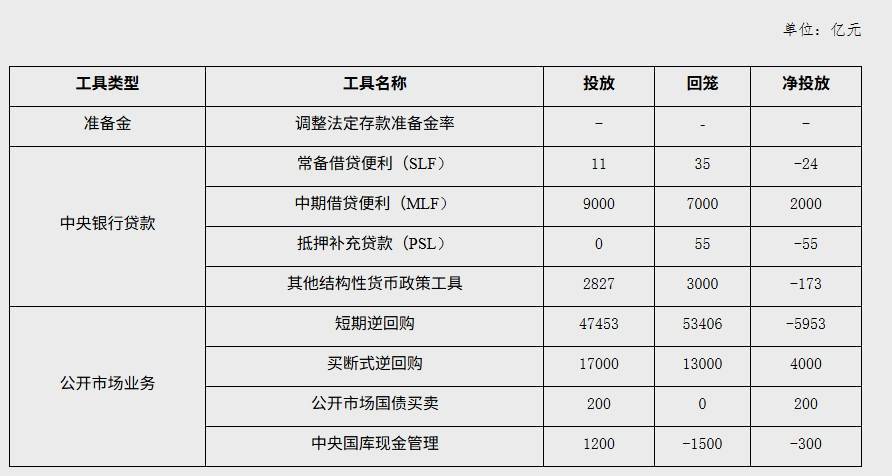
央行最新动作!已重启国债买卖,开展7000亿元买断式逆回购!
券商中国· 2025-11-04 23:47
Core Viewpoint - The People's Bank of China (PBOC) is actively managing liquidity through various monetary policy tools, including reverse repos and government bond transactions, to maintain a stable financial environment amid upcoming liquidity pressures. Group 1: Reverse Repo Operations - On November 5, the PBOC announced a 700 billion yuan reverse repo operation with a term of 3 months, indicating a rollover of the same amount due in November [1] - Despite a total of 1 trillion yuan in reverse repos maturing this month, the PBOC is expected to conduct another 6-month reverse repo operation, maintaining a net injection of liquidity [4] - The PBOC has consistently used reverse repos to supplement medium-term funding gaps since October of last year, with a focus on stabilizing market expectations [5] Group 2: Government Bond Transactions - The PBOC resumed government bond transactions in October, injecting 20 billion yuan, which is seen as a significant signal for the market despite the small amount [4][8] - The resumption of bond buying is expected to improve market sentiment and has already led to a decline in long-term bond yields, with the 10-year government bond yield dropping from 1.8423% to 1.7984% [8] - Analysts suggest that to maintain a stable scale of government bonds held by the PBOC, it may need to purchase between 700 billion to 1 trillion yuan in bonds this year [9] Group 3: Market Impact and Expectations - The PBOC's actions are aimed at countering potential liquidity tightening and ensuring a stable funding environment, reflecting a supportive monetary policy stance [5] - The market is reacting positively to the PBOC's signals, with expectations of improved liquidity conditions and a reversal of bearish sentiment in the bond market [6][8]
央行释放重要信号
智通财经网· 2025-11-04 23:02
Group 1 - The People's Bank of China (PBOC) announced a 700 billion yuan reverse repurchase operation to maintain ample liquidity in the banking system, with a term of 3 months, aimed at stabilizing market liquidity expectations and supporting year-end liquidity management [1] - On the same day, the PBOC conducted a 1,175 billion yuan 7-day reverse repurchase operation at a rate of 1.40%, resulting in a net withdrawal of 357.8 billion yuan due to the maturity of 4,753 billion yuan in reverse repos [1] - The PBOC's liquidity management strategy reflects a "combination of short and long-term measures" to address liquidity needs, as indicated by the simultaneous announcement of the long-term operation [1] Group 2 - The PBOC has implemented a moderately accommodative monetary policy this year, creating a suitable monetary environment for stable economic development, including maintaining reasonable growth in money credit and reducing overall financing costs [2] - According to a report by CITIC Securities, the liquidity gap is expected to narrow to around 100 billion yuan in November, with the PBOC's recent resumption of government bond transactions indicating a clear intention to support year-end liquidity [2] - PBOC Governor Pan Gongsheng emphasized the need to optimize the mechanism for basic currency issuance and enhance the role of policy interest rates in a recent article, aiming to improve the transmission of monetary policy to market interest rates [2]
央行释放重要信号
Wind万得· 2025-11-04 22:31
Group 1 - The People's Bank of China (PBOC) announced a 700 billion yuan reverse repo operation to maintain liquidity in the banking system, with a term of 3 months, indicating a loose monetary policy approach [2] - On the same day, the PBOC conducted a 1,175 billion yuan 7-day reverse repo operation at a rate of 1.40%, resulting in a net withdrawal of 357.8 billion yuan due to the maturity of 4,753 billion yuan in reverse repos [2] - The PBOC's actions reflect a "long-short combination" liquidity management strategy, aiming to stabilize market liquidity expectations while providing support for year-end liquidity management [2] Group 2 - In October, the PBOC achieved a net injection of 20 billion yuan through open market treasury transactions, indicating a gradual restoration of treasury transactions as a regular liquidity adjustment tool [2] - The PBOC's Deputy Governor Lu Lei emphasized the importance of adjusting policy support based on domestic and international economic conditions, ensuring effective implementation of monetary policy tools [2] - According to a report by CITIC Securities, the liquidity gap is expected to narrow to around 100 billion yuan in November, with low volatility in funding rates anticipated due to the PBOC's recent resumption of treasury transactions [3] Group 3 - PBOC Governor Pan Gongsheng highlighted the need to optimize the basic currency issuance mechanism and maintain reasonable growth in financial aggregates in a recent article [3] - The focus is on enhancing the role of policy interest rates and narrowing the width of the short-term interest rate corridor to improve the transmission of monetary policy to market rates [3]