滞胀

Search documents
“美联储传声筒”解析:美联储降息之路为何突然悬了?
Jin Shi Shu Ju· 2025-11-12 03:34
"美联储传声筒"Nick Timiraos最新撰文指出,在美联储主席鲍威尔近八年的任期内,央行内部一场几 乎没有先例的分歧正在浮现,这给未来的降息之路蒙上了一层阴影。 官员们内部产生了裂痕,争论的焦点在于,究竟是持续的通胀还是疲软的劳动力市场构成了更大的威 胁。即便官方经济数据恢复发布,也未必能弥合这些分歧。 尽管投资者普遍认为美联储在下次会议上降息的可能性仍然较大,但这场内部分裂已经让不到两个月前 还看似可行的计划变得复杂起来。 鹰鸽争辩 当政策制定者们在9月份同意降息25个基点时,19名官员中有10人(勉强过半)预计10月和12月还会继 续降息。连续三次会议降息的节奏,将与鲍威尔去年和2019年的降息步伐相呼应。 但一群鹰派官员对进一步降息的必要性提出了质疑。在10月底官员们再次降息,将利率降至目前的 3.75%至4%区间后,他们的抵制立场变得更加强硬。根据公开评论和近期采访,关于12月该如何行动的 辩论尤为激烈,鹰派人士强力反对此前关于第三次降息的预设。 Timiraos强调,事实上,鲍威尔在那天的记者会上如此直白地反驳市场对再次降息的预期,一个关键原 因正是为了管理这个因似乎无法弥合的分歧而四分五裂的 ...
参院押注临时拨款稳场面,戴利警告滞胀重演,黄金破4130美元,人民币走强还能多久?
Sou Hu Cai Jing· 2025-11-11 16:02
Group 1 - The U.S. Senate is advancing a temporary funding bill, indicating a potential end to the prolonged government shutdown, which has lasted for 35 days and caused an estimated loss of $7 billion [3][6] - The temporary funding bill aims to provide funding until January 31, 2024, and includes key projects like food stamps and veterans' affairs [3][6] - The market is reacting positively to the potential passage of the funding bill, which is expected to stabilize basic services and provide a more predictable environment for businesses and consumers [3][6] Group 2 - The Federal Reserve is experiencing internal divisions regarding the potential for interest rate cuts in December, with some members advocating for continued cuts due to low inflation and stable employment, while others express caution [6][8] - Concerns are raised about the U.S. economy potentially facing a stagflation scenario reminiscent of the 1970s, with rising inflation expectations and slowing growth [6][8] - Recent economic data, such as the October ISM manufacturing PMI at 48.7 and a modest increase of only 42,000 jobs in the private sector, indicate a weakening economic landscape [6][8] Group 3 - Gold prices have surged, with spot gold exceeding $4,130 per ounce, reflecting a flight to safety and concerns over long-term monetary credibility [8][11] - Central banks globally, including China's, have been increasing their gold reserves, with China's reserves reaching 74.09 million ounces, marking a continuous increase for 12 months [8][11] - The market is advised to manage gold investments carefully, as while the long-term outlook is bullish, volatility may increase [11][15] Group 4 - The relationship between high interest rates, inflation expectations, and fiscal policy is critical for assessing the attractiveness of U.S. dollar assets [15][16] - The upcoming Senate vote, data releases, and the Federal Reserve's December meeting are pivotal events that will clarify the market's direction regarding gold, the strength of the yuan, and the pricing of dollar assets [16]


【会员观市】中国建设银行:11月交易员汇市观察
Sou Hu Cai Jing· 2025-11-11 10:29
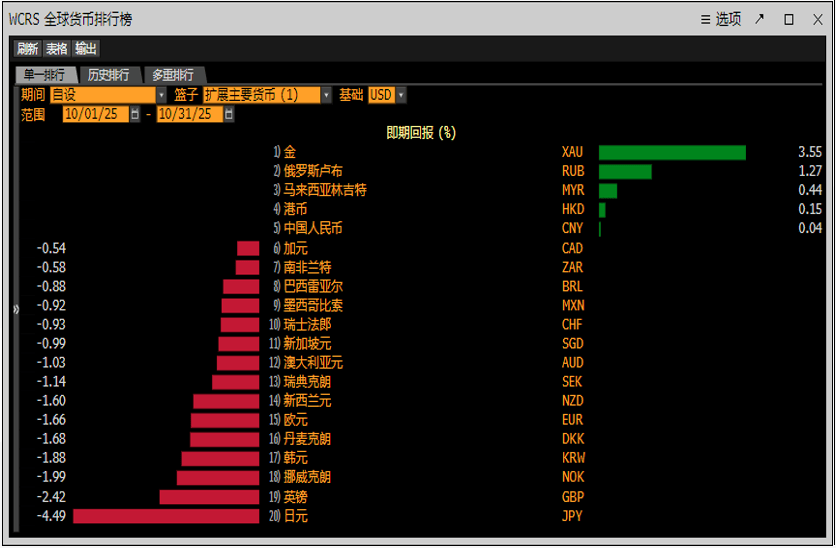
Market Overview - The US dollar index rebounded to 99.55 in October, with a monthly increase of 1.76%. Most non-USD currencies declined, except for the ruble and the ringgit, while gold hit a yearly high before retracing, and commodity prices mostly fell [1]. Economic Data - US inflation data showed a lower-than-expected CPI of 3% year-on-year for September, compared to the expected 3.1%. Core CPI increased by 0.3% month-on-month, below the anticipated 0.4% [4]. - The labor market outlook is concerning, with September's non-farm employment and unemployment rate data delayed due to the government shutdown. The ADP employment report showed a decrease of 32,000 jobs, significantly below the expected increase of 52,000 [5]. - Consumer confidence continues to decline, with the University of Michigan's consumer sentiment index for October at 53.6, below the expected 55, marking a fourth consecutive month of decline [5]. - Manufacturing showed signs of recovery, with the S&P Global Manufacturing PMI for October at 52.5, up from 52.2 previously [5]. Federal Reserve Actions - The Federal Reserve lowered the federal funds rate target range by 25 basis points in October, from 4%-4.25% to 3.75%-4%. There were internal divisions regarding future rate cuts, with Chairman Powell indicating that a December rate cut is not guaranteed due to missing economic data from the government shutdown [10][11]. - The market's expectations for a December rate cut have diminished, with the Fed's hawkish stance providing support for the dollar [10]. Currency Performance - The euro weakened in October, failing to maintain its strength from September, dropping from a high of 1.1733 to 1.1534 by month-end, breaking below an upward channel formed since April 2025 [16]. - The Japanese yen faced pressure, with USDJPY rising 4.7% in October, reaching a high of 153.99, driven by expectations of delayed interest rate hikes from the Bank of Japan [19][20]. - The British pound also declined, down 2.2% in October, influenced by weak economic data and increased expectations for a rate cut from the Bank of England in December [23][24]. - The Malaysian ringgit showed resilience, with a GDP growth of 5.2% in Q3 and a trade surplus of 19.9 billion ringgit, despite external pressures [29][30]. Commodity Prices - Commodity prices generally fell, with notable declines in energy prices such as Brent crude oil down 0.60% and natural gas prices fluctuating [4]. - Gold prices retraced after reaching a yearly high, while other commodities like iron ore and steel also saw declines [4]. Outlook - The US economy may face a challenging environment with persistent labor market weakness and rising inflation pressures due to tariffs, leading to a potential stagflation scenario [14]. - The euro is expected to remain under pressure, with a forecasted trading range of 1.14 to 1.18 in November [16]. - The Japanese yen may continue to weaken if US economic data remains strong or if Japan's fiscal stimulus exceeds expectations, with a projected range of 151 to 158.5 for USDJPY in November [20]. - The British pound is likely to remain weak, with a trading range of 1.27 to 1.34 anticipated for November [24]. - The Malaysian ringgit is expected to continue its range-bound movement, with a forecasted range of 4.15 to 4.30 for USD/MYR [30].

特朗普罕见改口,承认关税失败,美国人正在为此付出巨大代价
Sou Hu Cai Jing· 2025-11-10 09:21
Core Viewpoint - The article discusses the economic impact of Trump's tariff policies, highlighting that American consumers are bearing the brunt of the costs, contrary to Trump's initial claims that foreign entities would pay these tariffs [1][3][7]. Economic Impact - Trump's tariffs are projected to result in a loss of $1.2 trillion for American businesses, with the majority of the financial burden ultimately falling on consumers [7]. - Since April, American consumers have absorbed approximately 50% to 70% of the tariff costs, indicating that foreign producers are paying less than 30% [3]. Inflation and Economic Conditions - The tariffs have contributed to rising inflation in the U.S., complicating the Federal Reserve's monetary policy, which struggles to stimulate the economy through interest rate adjustments [7][17]. - Current economic indicators suggest that the U.S. is experiencing stagflation, characterized by stagnant economic growth and rising prices [14][17]. Employment Data - In October, U.S. employers announced a record 153,074 layoffs, a 183% increase compared to previous years, signaling a significant downturn in the job market [16]. - Adjustments to employment data show a downward revision of job growth, with October reflecting a loss of 9,100 jobs, marking one of the worst months of the year [16]. Federal Debt and Fiscal Policy - The U.S. national debt has surged to $38 trillion, necessitating $1.4 trillion in interest payments, which consumes nearly 30% of projected federal revenue for FY2024 [8][9]. - Trump's administration is focused on increasing revenue through tariffs to avoid a debt crisis, despite the negative implications for consumers and the economy [8][9]. Federal Reserve's Response - The Federal Reserve is reconsidering its monetary policy approach, with officials expressing concerns that previous rate cuts may have exacerbated inflation rather than alleviating it [17]. - The Fed's current strategy indicates a reluctance to lower interest rates further, as this could lead to increased inflation and further job losses in the private sector [17].

市场分歧的背后,赛力斯已现 “滞胀” 迹象
晚点LatePost· 2025-11-10 08:03
Core Viewpoint - The article focuses on the operational performance and development trends of Seres, highlighting its recent financial activities and the implications for future growth potential [5][6][10]. Financial Performance - Seres has become the largest domestic vehicle listing company in terms of fundraising scale and market capitalization, surpassing Chery Automobile [5]. - The company completed two significant expenditures this year: acquiring Longsheng New Energy Super Factory for over 8.1 billion yuan and purchasing a 10% stake in Yiwang Company for 11.5 billion yuan, which supports its future growth plans [6]. - Seres aims to achieve a production capacity of over 1 million vehicles by 2027, with projected annual sales of around 800,000 vehicles based on new model launches [9][19]. Sales and Revenue Trends - In the first ten months of 2025, Seres' cumulative sales reached 356,000 vehicles, showing a year-on-year increase of only 1%, with the Wanjie brand experiencing a slight decline in growth [9]. - The revenue and profit structure for the first three quarters of Seres showed a slight increase in revenue to 1,105 billion yuan, with a gross margin of 29.4% and a net margin of 5.1% [10][13]. Profitability and Cost Structure - Despite stagnant sales and revenue growth, Seres has improved its profitability, with a significant increase in net profit by 65.3% year-on-year [10]. - The gross margin has been on an upward trend, indicating that the introduction of new models like the Wanjie M8 has positively impacted the average selling price and profitability [13][14]. - However, the company faces rising external costs, leading to a "stagflation" scenario where expenses increase despite declining sales, creating uncertainty for future growth [14][18]. Market Position and Competitive Landscape - Seres is maintaining a pricing strategy that contrasts with the increasing competition in the domestic mid-to-large-sized new energy SUV market, as evidenced by the pricing of the new M7 model [18][19]. - The company’s ability to sustain its pricing power is linked to its production capacity utilization and brand influence, but it may face challenges if competition intensifies [19][20]. Future Outlook - The growth trajectory of Seres is contingent on achieving annual sales growth of around 40% over the next two years; otherwise, its market value may decline significantly [20]. - The company's operational model, particularly its collaboration with Huawei, may limit its flexibility in managing costs and expanding its product range beyond the new energy SUV segment [18][20].

市场分歧的背后,赛力斯已现“滞胀”迹象
Xin Lang Cai Jing· 2025-11-10 06:05
Core Viewpoint - The performance of Seres this year reflects a "stagflation" situation, indicating that its rigid costs may limit its growth potential [1]. Group 1: Company Overview - Seres has become the largest domestic vehicle listing company this year, surpassing Chery Automobile, but did not achieve the expected "opening red" upon its debut in the Hong Kong stock market [2]. - The company completed two significant expenditures this year: acquiring Longsheng New Energy Super Factory for over 8.1 billion yuan and purchasing a 10% stake in Yingwang Company for 11.5 billion yuan, which supports its future growth expectations [3]. Group 2: Sales and Financial Performance - For the first ten months of 2025, Seres' cumulative sales reached 356,000 units, a year-on-year increase of 1%, with the Wanjie series contributing 325,000 units, showing a decline of 0.6% [4]. - The revenue and profit structure for the first three quarters showed a revenue of 110.5 billion yuan with a gross margin of 29.4% and a net margin of 5.1%, indicating a significant improvement in profitability despite stagnant sales growth [4]. Group 3: Profitability and Cost Structure - Seres' gross margin has been increasing, recorded at 27.6%, 28.9%, and 29.4% for the first quarter, half-year, and first three quarters respectively, while the average vehicle price has also risen [4]. - The sales expense ratio has been increasing, with significant components being advertising and service fees, which may indicate a strategic focus on brand building despite rising costs [4][5]. Group 4: Market Position and Competitive Landscape - The pricing strategy for the new M7 model reflects a continued increase in prices, contrasting with the competitive landscape where other brands are lowering prices [5]. - Seres' production capacity is expected to reach one million units by 2027, which is crucial for achieving its sales targets, but the current high capacity utilization may limit pricing flexibility [5][6]. Group 5: Future Outlook - The company may face limitations in expanding its model categories due to the competitive environment and its reliance on the Huawei intelligent driving system, which could hinder its growth in the electric SUV segment [6]. - If Seres cannot achieve annual growth rates of around 40% in sales and revenue over the next two years, its profit structure may reach a marginal point, impacting its future valuation [6].

除了政府关门和数据真空,大跌反映了美国经济什么问题?
2025-11-10 03:34
Summary of Conference Call Records Industry Overview - The U.S. economy is facing stagflation risks, with both soft and hard data indicating weakness, particularly in employment and consumer spending [1][2][3] - The sales of corrugated boxes have hit a ten-year low, reflecting sluggish consumer demand, with early Christmas stocking up in July peaking and then declining in August and September [1][2] - The U.S. U6 unemployment rate reached 8.1% in August, with youth unemployment at 9.2%, compounded by student loan repayment pressures, limiting consumer capacity [1][2][3] Key Points and Arguments - The government shutdown has led to 750,000 federal employees being furloughed or working without pay, with a suspension of $24 billion in federal spending, impacting GDP by approximately 0.1% weekly [1][3][4] - If the shutdown continues, the GDP could decline by more than 2% in Q4 [1][3] - The Federal Reserve's interest rate cut expectations have dropped sharply from 90% to 60% due to comments from Chairman Powell, exacerbating liquidity tightening and negatively affecting stocks and risk assets [1][4] - The reduction of food stamp amounts in November by half affects about 1/8 of the U.S. population, leading to an expected additional decline in consumer growth by about 0.5% [1][4][6] Economic Challenges - The U.S. economy is experiencing a K-shaped recovery, where AI-related investments are driving demand for chips, storage, and power equipment, while demand for ordinary consumer goods remains weak [2][5][9] - Exports of graphics cards from Taiwan to the U.S. increased by 138.2%, and South Korea's semiconductor exports grew by 25.4%, while traditional manufacturing countries like Vietnam and Mexico are facing weaker exports [2][5][8] Consumer Behavior and Market Impact - Chipotle and McDonald's Q3 earnings reports indicate a significant decline in spending among their primary consumers—young people and low-income groups [3][4] - The Michigan Consumer Sentiment Index fell to 50.3 in November, the lowest since June 2020, indicating severe consumer confidence issues [3] - The K-shaped recovery is evident in consumer behavior, with luxury goods remaining strong while middle and low-income groups shift to cheaper shopping options [9][10] Future Monetary Policy - Given the complex economic environment, the Federal Reserve may adopt a more accommodative monetary policy, with expectations for interest rate cuts in December [11] - The Fed may have no choice but to implement easing measures to support overall economic stability amid reduced fiscal spending and rising unemployment [11]
中国ROE中枢趋势性上升,美国ROE中枢趋势性下降:产业经济周观点-20251109
Huafu Securities· 2025-11-09 12:20
Group 1 - The core viewpoint of the report indicates that China's ROE (Return on Equity) is on a rising trend while the US ROE is on a declining trend, suggesting a potential divergence in economic cycles between the two countries [2][3] - Recent data suggests that China's export and price data reflect the effects of anti-involution, with expectations for continued strengthening of corporate profits in China [3][8] - The debt expansion in the US AI industry may reinforce expectations for price improvement and corporate profitability in China, but it could also exacerbate stagflation characteristics in the US, posing risks to US stock performance [3][9] Group 2 - The report highlights a significant decline in China's export growth, with October exports showing a year-on-year decrease of 1.1%, down from 8.3% previously, primarily affected by a drop in exports to the EU [8] - The report notes that the global manufacturing PMI did not weaken in October, indicating that the decline in China's export growth may be more related to supply-side improvements rather than demand-side factors [8] - The report emphasizes that under a recovering price environment, market sentiment may shift towards value stocks, with a focus on export prices and US consumer data in the future [3][9] Group 3 - The report suggests that the configuration of energy investments should primarily respond to the overheating expectations of US AI investments, recommending a focus on short to medium-term trading strategies [3] - Long-term investment opportunities are identified in sectors such as insurance, anti-involution industries, Chinese internet companies, and military trade [3][9] - The report indicates that the performance of the A-share market is expected to rise while the US stock market may decline, reflecting the contrasting economic cycles of China and the US [3][9]
中方正式发文通知,调整税率,将暂停对美加征的24%关税
Sou Hu Cai Jing· 2025-11-08 08:13
Group 1 - The Chinese government announced a one-year suspension of 24% tariffs on the U.S., while retaining a 10% tariff and removing tariffs on certain U.S. agricultural products, indicating a reciprocal response to U.S. tariff policies [1][3][5] - The decision to maintain a 10% tariff is linked to the U.S. retaining a 20% tariff on Chinese goods, reflecting a tit-for-tat approach in trade relations [3][5] - The recent trade agreements and tariff adjustments are seen as stabilizing the economic relationship between the U.S. and China, benefiting both nations [5][7] Group 2 - The U.S. midterm elections resulted in significant victories for the Democratic Party, attributed to economic dissatisfaction among voters, particularly regarding the impact of tariffs [7][9] - Inflation in the U.S. has risen by 3% over the past year, with the Federal Reserve struggling to balance interest rates and inflation control, leading to a complex economic situation [9][11] - The U.S. economy faces risks of "stagflation," where inflation persists alongside high unemployment, complicating the Federal Reserve's monetary policy decisions [11][13] Group 3 - Legal challenges regarding the tariff policies are ongoing, with questions about the authority under which tariffs were imposed, potentially leading to significant economic implications if overturned [15][17][19] - The Trump administration has indicated plans for alternative strategies should legal rulings against tariffs occur, highlighting the precarious nature of current trade policies [19][21]
周德宇:再按西方经济学玩下去,美国制造业要输越南了
Sou Hu Cai Jing· 2025-11-08 06:06
Group 1 - The article discusses the ongoing debate between demand-side and supply-side economics, emphasizing that both are important but often oversimplified in policy discussions [1][2][4] - It highlights the historical context of Keynesian economics and its application during the Great Depression, suggesting that Keynes' ideas have been misinterpreted over time [4][6][7] - The article critiques modern interpretations of Keynesianism, noting that many contemporary economists have lost sight of the complexities of economic systems, leading to ineffective policies [9][11][12] Group 2 - The rise of supply-side economics in the late 20th century is presented as a reaction to perceived failures of Keynesian policies, with a focus on tax cuts and deregulation [11][12][21] - The article argues that both demand-side and supply-side approaches have failed to address the underlying issues in the U.S. economy, particularly the decline of manufacturing and rising inequality [12][21][22] - It concludes that superficial policy measures, such as tariffs and tax cuts, do not address the foundational elements necessary for a robust economy, leading to ongoing challenges in the manufacturing sector [22][24]