
核聚变

Search documents
华金证券:全球核聚变领域呈现多元协同推进态势 聚焦FRC技术潜力与机遇
Zhi Tong Cai Jing· 2025-10-23 06:37
Group 1 - The global nuclear fusion sector is expected to see a collaborative advancement of policy, technology, and capital by 2025, with private capital leading the way, primarily in the US and Europe, while China accelerates its efforts [1] - Significant breakthroughs in plasma duration and commercial tritium production have been achieved in countries like Germany and the UK, with many nations launching investment plans to expedite commercialization [1] - The FRC (Field-Reversed Configuration) technology is emerging as a promising path in magnetic confinement fusion, showcasing unique advantages such as high energy efficiency and lower construction costs compared to traditional methods [2] Group 2 - TAE Technologies has raised $1.35 billion and is advancing its prototype and power plant, while Helion has built the Trenta device and plans to supply power to Microsoft by 2028, having raised over $1 billion [3] - Domestic pioneers like Hanhai Fusion and Xingneng Xuanguang are making strides in commercializing FRC technology, with plans for large-scale power plants by 2035 [3] - Key companies to watch in the nuclear fusion supply chain include Guoguang Electric, Xuguang Electronics, and Guoli Co., among others, which are involved in core component supply and power systems [4]




近3900只个股下跌
第一财经· 2025-10-23 03:46
Market Overview - The Shanghai Composite Index fell by 0.66%, the Shenzhen Component Index dropped by 0.87%, and the ChiNext Index decreased by 1.1% during the midday session on October 23 [3] - Nearly 3,900 stocks in the two markets experienced declines, indicating a broad market downturn [3] Sector Performance - CPO and cultivated diamond concepts saw significant pullbacks, while hard technology sectors like storage chips and GPUs continued to adjust [3] - The rare earth, precious metals, and military industry sectors were sluggish, contrasting with a surge in Shenzhen state-owned enterprises and coal stocks, which saw a wave of limit-up trading [3] - The coal futures market experienced a notable increase, with the main contract rising over 4% to 1,246.5 CNY per ton [6] Notable Stocks - Several coal stocks, including Daya Energy and Shanxi Coking Coal, recorded limit-up trading, with Daya Energy achieving 9 consecutive limit-ups [8] - In the Shenzhen state-owned enterprise reform sector, stocks like Jian Kexuan and Shen Saige saw significant gains, with Jian Kexuan rising by 20.02% to 20.74 CNY [15][16] Trading Volume - The trading volume in the Shanghai and Shenzhen markets exceeded 1 trillion CNY, reflecting a decrease of nearly 50 billion CNY compared to the previous day [5] Currency and Monetary Policy - The People's Bank of China conducted a 2,125 billion CNY reverse repurchase operation with a rate of 1.40%, while 2,360 billion CNY of reverse repos were set to mature [21]


程强:贵金属价格大幅波动
Sou Hu Cai Jing· 2025-10-23 03:40
Market Overview - The A-share market experienced a contraction in trading volume, with the Shanghai Composite Index closing at 3913.76 points, down 0.07% [2] - The total trading volume reached 1.69 trillion yuan, a decrease of 10.7% from the previous day, indicating cautious market sentiment [2] Market Analysis - The energy sector led the gains, with the energy equipment index rising by 2.44% and the oil and gas index increasing by 1.37% [4] - The banking index rose by 0.93%, driven by low valuations and high dividend characteristics, with Agricultural Bank of China hitting a new historical high [4] - Precious metals saw a significant decline, with the precious metals index dropping by 2.49% due to a sharp fall in international gold prices [4] - The market sentiment remains cautious, with a recommendation to maintain a balanced allocation strategy [4] Bond Market - The bond market maintained a strong performance, with the 30-year main contract TL2512 closing at 115.61 yuan, up 0.10% [6] - The central bank conducted a 1382 billion yuan reverse repurchase operation, indicating a relatively loose liquidity environment [6] - The market is expected to remain strong, influenced by macroeconomic catalysts such as the upcoming Fourth Plenary Session and U.S. Federal Reserve meetings [7] Commodity Market - The commodity market showed significant volatility, with energy and chemical sectors performing strongly while precious metals faced sharp declines [8] - International gold prices fell sharply, with a drop of over 350 dollars per ounce from recent highs, influenced by geopolitical developments and upcoming U.S. CPI data [8] - Oil prices rebounded due to geopolitical tensions in the Middle East, with expectations of continued volatility in the oil market [9] Trading Hotspots - Recent popular sectors include central bank policies, market style shifts, and advancements in technology sectors such as artificial intelligence and nuclear fusion [10] - The focus on consumer sectors is driven by the appreciation of the yuan and market style transitions [11] Core Thoughts Summary - The equity market shows a cautious outlook with a recommendation for balanced allocation, while the bond market benefits from a loose liquidity environment [12] - Precious metals may present new long-term opportunities following recent price adjustments, with expectations of further fluctuations during the Fed's easing cycle [12]


西部证券晨会纪要-20251023
Western Securities· 2025-10-23 02:14
Group 1: Fusion Industry Insights - The fusion industry is accelerating with multiple technological routes developing in parallel, supported by policies and capital investment [2][6][9] - Fusion is seen as a potential ultimate energy source, with high energy density and safety advantages, despite existing technical challenges [6][7] - Major global projects like China's CFETR, EU-DEMO, and K-DEMO are expected to begin construction between 2035 and 2040, with operational timelines set for around 2050 [6][9] Group 2: Key Components and Cost Structure - The Tokamak system, the most mature fusion technology, includes key components such as superconducting magnets, vacuum chambers, and power systems, which constitute significant cost factors [8][9] - Superconducting magnets are crucial for enhancing plasma confinement time, with advancements in high-temperature superconductors expected to improve fusion reaction rates and reduce cooling costs [8][9] Group 3: Investment Recommendations - Investment opportunities are identified in companies related to low-temperature superconducting magnets, vacuum chambers, and power systems, including Western Superconducting, Lianchuang Optoelectronics, and others [2][9] - The report suggests a focus on companies involved in the construction and operation of fusion reactors, as the industry is poised for growth due to increasing global interest and funding [9] Group 4: Company Performance Highlights - Cloud Sai Zhilian (600602.SH) is actively participating in Shanghai's computing power construction, with projected revenues of 6.434 billion, 7.516 billion, and 8.818 billion from 2025 to 2027, reflecting growth rates of 14.4%, 16.8%, and 17.3% respectively [3][10] - Shenhuo Co., Ltd. (000933.SZ) reported a strong Q3 performance with revenues of 31.005 billion, a 9.5% increase year-on-year, and a net profit of 3.49 billion, despite a slight decline in net profit compared to the previous year [12][13][14] - Jinli Permanent Magnet (300748.SZ) achieved a revenue of 5.373 billion in the first three quarters of 2025, marking a 7.16% increase, with a significant net profit growth of 161.81% [16][17]
开盘:沪指跌0.25% 超硬材料板块普遍回调
Di Yi Cai Jing· 2025-10-23 02:11
Core Points - The three major stock indices opened lower, with the Shanghai Composite Index down 0.25%, the Shenzhen Component Index down 0.29%, and the ChiNext Index down 0.28% [1] - Sectors such as nuclear fusion, ultra-high voltage, and storage chips experienced significant declines, while CPO, wind power, and superhard materials also saw widespread pullbacks [1] - Google announced a major breakthrough with its quantum chip "Willow," leading to a general rise in quantum technology concepts [1] - Real estate and oil & gas stocks remained active [1]
时代电气跌2.04%,成交额5185.95万元,主力资金净流出800.73万元
Xin Lang Cai Jing· 2025-10-23 02:08
Core Viewpoint - The stock of Times Electric has experienced fluctuations, with a recent decline of 2.04% and a year-to-date increase of 15.53%, indicating volatility in its market performance [1]. Company Overview - Times Electric, established on September 26, 2005, and listed on September 7, 2021, is located in Zhuzhou, Hunan Province. The company specializes in the research, design, manufacturing, and sales of rail transit equipment, with a product structure that includes "devices + systems + complete machines" [1]. - The main business revenue composition is as follows: rail transit equipment business accounts for 56.58%, emerging equipment business for 42.94%, and others for 0.48% [1]. Financial Performance - For the first half of 2025, Times Electric achieved an operating income of 12.214 billion yuan, representing a year-on-year growth of 18.77%. The net profit attributable to the parent company was 1.672 billion yuan, with a year-on-year increase of 10.93% [2]. - Since its A-share listing, Times Electric has distributed a total of 5.11 billion yuan in dividends, with 3.835 billion yuan distributed over the past three years [3]. Shareholder Information - As of June 30, 2025, the number of shareholders for Times Electric was 21,800, a decrease of 11.12% from the previous period. The average circulating shares per person increased by 13.09% to 13,443 shares [2]. - The top circulating shareholders include Hong Kong Central Clearing Limited, holding 15.9467 million shares (a decrease of 4.5628 million shares), and Huaxia SSE STAR 50 ETF, holding 14.3741 million shares (a decrease of 308,500 shares) [3].

鑫融讯:双融日报-20251023
Huaxin Securities· 2025-10-23 02:04
Core Insights - The report indicates a neutral market sentiment with a score of 56, suggesting a balanced outlook for investors [5][9]. - Key investment themes identified include energy storage, eSIM technology, and nuclear fusion, each showing significant growth potential [5]. Energy Storage - The "New Energy Storage Special Action Plan" aims for an installed capacity of 180 million kilowatts by 2027, attracting direct investments of 250 billion yuan, with project IRR expected to exceed 8% due to supportive policies [5]. - Overseas orders for energy storage are projected to surge by 220% year-on-year in the first half of 2025, reaching 160 GWh, indicating a shift in supply-demand dynamics [5]. - Relevant companies include CATL (300750) and Sungrow Power (300274) [5]. eSIM Technology - China Unicom launched its eSIM service on October 13, with over 60,000 reservations, indicating strong market interest [5]. - The reactivation of eSIM services by major telecom operators is expected to accelerate commercial adoption [5]. - Key players in this sector include Eastcompeace (002017) and Unisoc (002049) [5]. Nuclear Fusion - The CRAFT project achieved a significant milestone with the successful testing of a key component, demonstrating a steady thermal load capacity of 20 MW/m² [5]. - This development marks a major advancement in China's nuclear fusion technology, with implications for future energy solutions [5]. - Companies involved in this field include Chuangyuan New Materials (002171) and Hongxun Technology (603015) [5].
AH股齐跌,创业板跌超1%,农业银行15连阳再创新高,AI硬件股调整,恒科指跌超1%,国债跌,商品涨
Hua Er Jie Jian Wen· 2025-10-23 01:53
Market Overview - A-shares experienced a decline with all three major indices falling, the ChiNext index dropping over 1% [1] - The Hang Seng Index also fell, with the Hang Seng Tech Index down 1.28% [2][3] - Domestic commodity futures showed strength, with fuel oil rising nearly 3% [4][5] A-shares Performance - As of the report, the Shanghai Composite Index decreased by 0.46% to 3895.79, the Shenzhen Component Index fell by 1.00% to 12867.09, and the ChiNext Index dropped by 1.11% to 3025.44 [1][14] - The banking sector showed resilience, with Agricultural Bank of China hitting a historical high and several other banks like Postal Savings Bank and Qingdao Bank also rising [8][9] Hong Kong Market - The Hang Seng Index was down 0.41% to 25677.26, while the Hang Seng Tech Index fell by 1.28% [2][3] - New consumption concept stocks in Hong Kong continued to weaken, with Pop Mart dropping over 6% [10] Commodity Market - Domestic commodity futures mostly rose, with notable increases in fuel oil (up 2.86%) and asphalt (up 2.37%) [5][17] - Other commodities like coking coal, soybean meal, and lithium carbonate also saw gains exceeding 1% [4][5] Banking Sector - The banking sector maintained strong performance, with multiple banks reporting gains, including Postal Savings Bank (up 3.14%) and Qingdao Bank (up 1.74%) [9][8] - Agricultural Bank of China continued its upward trend, marking 15 consecutive days of gains [8] Coal Sector - The coal sector remained strong, with stocks like Daya Energy and Zhengzhou Coal Electricity hitting the daily limit up [11] - Notable gains included Shaanxi Black Cat (up 10.12%) and Yunmei Energy (up 10.06%) [11] Shenzhen Local Stocks - Shenzhen local stocks opened strong, with several companies like Jian Kexuan and Guangtian Group hitting the daily limit up [12][13] - The Shenzhen government announced a plan to enhance the quality of listed companies, aiming for a total market value exceeding 20 trillion yuan by 2027 [13]
滚动更新丨A股三大指数集体低开,深圳国企改革概念大幅高开
Di Yi Cai Jing· 2025-10-23 01:33
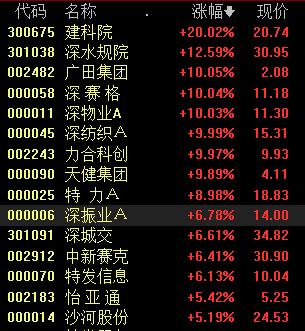
Market Overview - The A-share market opened lower with the Shanghai Composite Index down 0.25%, the Shenzhen Component down 0.29%, and the ChiNext Index down 0.28% [3][4] - The Hong Kong market also opened lower, with the Hang Seng Index down 0.25% and the Hang Seng Tech Index down 0.68% [5][6] Sector Performance - Sectors such as nuclear fusion, ultra-high voltage, and storage chips experienced significant declines, while sectors like CPO, wind power, and superhard materials also saw a general pullback [4] - In contrast, the real estate and oil & gas sectors remained active [4] Notable Stocks - Shenzhen's state-owned enterprise reform concept stocks opened high, with several stocks hitting the daily limit, including: - JianKaoYuan (建科院) up 20.02% to 20.74 - ShenWaterRegulation (深水规境) up 12.59% to 30.95 - GuangTianGroup (广田集团) up 10.05% to 2.08 - ShenSaiGe (深赛格) up 10.04% to 11.18 - ShenWu/A (深物业A) up 10.03% to 11.30 [2] Government Initiatives - The Shenzhen government issued the "Shenzhen Action Plan for Promoting High-Quality Development of Mergers and Acquisitions (2025-2027)," which is expected to positively impact related sectors [1]
贵金属价格大幅波动
Tebon Securities· 2025-10-22 11:24
Report Industry Investment Rating The document does not provide the report industry investment rating. Core Viewpoints of the Report - On October 22, 2025, the A-share market showed a shrinking and volatile trend, the bond market maintained a relatively strong trend, and the commodity market witnessed significant fluctuations in precious metal prices [2][3][7][8]. - It is recommended to maintain a balanced allocation strategy. With the upcoming conclusion of the Fourth Plenary Session of the 20th Central Committee, the focus of the "15th Five-Year Plan" policies may become the focus of the new market mainline. The technology sector and new sub - fields such as "deep - earth economy" may receive new catalysts, and the large - consumption sector is worthy of further attention [4][6]. - In the short term, for stocks, it is advisable to maintain a balanced allocation; for bonds, pay attention to policy signals; for commodities, the sharp adjustment of precious metal prices may bring new long - term layout opportunities [14]. Summary by Related Catalogs Market行情Analysis Stock Market - The A - share market was volatile and shrinking. The Shanghai Composite Index closed at 3913.76 points, down 0.07%; the Shenzhen Component Index fell 0.62% to 12996.61 points; the ChiNext Index dropped 0.79% to 3059.32 points; the STAR 50 closed at 1405.41 points, down 0.06%. The total trading volume was 1.69 trillion yuan, a 10.7% decrease from the previous day [3]. - The energy and banking sectors led the gains, while the precious metal sector tumbled. The energy equipment index rose 2.44%, the oil and gas index increased 1.37%, and the banking index rose 0.93%. The precious metal index dropped 2.49% [6]. - Due to the shift of funds from high - valuation technology stocks to low - valuation value stocks, it is recommended to maintain a balanced allocation. If the trading volume continues to decline, beware of the risk of insufficient market liquidity support [6]. Bond Market - The bond market maintained a relatively strong trend. The 30 - year main contract of treasury bond futures led the gains, and the short - end contracts were relatively weak. The central bank increased net investment, and the market sentiment was driven by the expectation of loose monetary policy and institutional duration - extension behavior [12]. - As the end of the month approaches, attention should be paid to macro - events such as the policy tone of the Fourth Plenary Session, the progress of Sino - US trade negotiations, and the impact of changes in capital fluctuations and policy expectations on subsequent trends [12]. Commodity Market - The domestic commodity futures market showed a sharply differentiated pattern. The energy and chemical sectors led the gains, while the precious metal sector was heavily hit. Crude - oil related varieties such as asphalt (2.95%), crude oil (2.52%), and low - sulfur fuel oil (2.32%) had significant increases, while Shanghai gold and Shanghai silver fell 3.92% and 3.86% respectively [11][12]. - The sharp decline in precious metal prices may be due to the expectation of the end of the Russia - Ukraine war and the market's concern that the CPI data to be released on October 24 may exceed expectations and weaken the Fed's rate - cut efforts [12]. Transaction Hotspot Tracking Recent Popular Varieties Combing - Precious metals: The central bank's continuous purchases and the Fed's expected rate cuts are the core logics. Follow - up concerns include the Fed's rate - cut situation and geopolitical risks [16]. - Dividend stocks: Market style switching is the core logic. Pay attention to the third - quarter report performance and corporate dividend situations [16]. - Artificial intelligence: The accelerating capital expenditure of global technology giants is the core logic. Focus on the capital expenditure and orders of US and domestic technology leaders [16]. - Nuclear fusion: The industrialization acceleration of the mid - upstream links is the core logic. Track project progress and industry bidding situations [16]. - Domestic chips: Technological breakthroughs and large domestic substitution space are the core logics. Watch for lithography machine technology breakthroughs and the progress of self - developed chips by Baidu, Alibaba, etc. [16]. - Robots: The accelerating industrialization trend is the core logic. Follow the order release rhythm of Tesla and the technological progress of domestic enterprises [16]. - Big consumption: RMB appreciation and market style switching are the core logics. Pay attention to the economic recovery situation and further stimulus policies [16]. - Securities firms: Active trading and deposit transfer are the core logics. Focus on the A - share market trading volume and possible changes in trading systems [16]. Recent Core Idea Summary - For equities, due to the lack of significant release of trading volume, it is recommended to maintain a balanced allocation in the short term. In the long - term, technology may still be dominant [14]. - For the bond market, the central bank's net investment and loose capital support the bond market. Pay attention to policy signals from the Financial Street Forum and the Fed's interest - rate meeting at the end of the month [14]. - For commodities, the sharp adjustment of precious metal prices may bring new long - term layout opportunities, and the prices of precious metals may reach new highs during the Fed's rate - cut cycle [14].