生成式AI

Search documents
智能眼镜将颠覆手机?虽销售火爆,但仍待突破技术瓶颈
Zhong Guo Jing Ji Wang· 2025-10-24 03:02
Core Insights - EssilorLuxottica, the manufacturer of Ray-Ban glasses, has seen its stock price rise by 14%, reaching an all-time high, with a market capitalization increase of nearly $20 billion [1] - The recent launch of a new generation of AI glasses in collaboration with Meta has led to record sales for EssilorLuxottica in Q3, prompting the company to accelerate its smart glasses production capacity [1] - The success of Ray-Ban glasses has reignited interest in the smart glasses market, with several tech companies re-entering the space [1] Industry Trends - The global smart glasses market is projected to see a shipment volume of 2.56 million units by Q2 2025, representing a year-on-year growth of 55% [1] - Barclays analysts predict that smart glasses could become the most disruptive innovation since smartphones, with global sales expected to reach 60 million units by 2035 [1] - Despite the growth potential, smart glasses are still not considered a "consumer-grade application" due to criticisms regarding their practicality, facing challenges in balancing performance, weight, and battery life [1]
金融时报:奥特曼豪赌AI离不开硬件 OpenAI应该做手机
Feng Huang Wang· 2025-10-24 02:56
Core Insights - The success of generative AI is still reliant on popular hardware, and OpenAI should collaborate with former Apple design chief Jony Ive to develop a smartphone [1][2] - The initial wave of AI hardware has largely failed due to being based on hype rather than actual functionality, as exemplified by Humane's AI Pin [1] - For generative AI to reach its full potential, it must be integrated into everyday devices like smartphones, which have proven to be user-friendly and deeply embedded in daily life [1] Group 1 - The first generation of AI hardware has failed primarily because these products were built on hype rather than practical use [1] - The AI Pin, a wearable device, promised to replace smartphones but failed to integrate well with essential functions like email and required users to learn cumbersome new gestures [1] - The smartphone's enduring presence is attributed to its intuitive interface and ease of use, making it a staple in people's lives [1] Group 2 - OpenAI's acquisition of Jony Ive's hardware startup for $6.4 billion represents a significant investment in the AI hardware sector and a chance to define how this technology integrates into human life [2] - To succeed, Ive and OpenAI must focus on the smartphone market rather than just smart speakers or AI accessories, which are currently their research priorities [2] - There is a noted lack of software talent in Ive's team, which is crucial for the long-term success of any hardware, as user needs must be met with simplicity and quality [2] - Building an AI smartphone outside of the Apple ecosystem will require reliance on Google's infrastructure, as Android is the only commercially viable open-source mobile operating system [2]


谷歌AI芯片获大单:Anthropic将使用100万个TPU训练大模型
Feng Huang Wang· 2025-10-23 23:06
Core Insights - Anthropic's Claude model will utilize up to 1 million Google AI chips for training, valued at several billion dollars, aiming to enhance performance in the rapidly evolving AI sector [1] - Google, as an investor in Anthropic, will also provide additional cloud computing services, highlighting the significant demand for computing power in training, deployment, and ongoing inference of generative AI products [1] Company Developments - The transaction coincides with Google's expansion of the availability of its proprietary Tensor Processing Units (TPUs), which were previously used mainly for internal purposes [1] - Google is currently renting out TPUs through its cloud services, indicating a strategic move to monetize its AI hardware capabilities [1] Technology and Efficiency - Anthropic selected TPUs due to their high cost-effectiveness and superior efficiency, supported by the company's prior experience in training and deploying models using these processors [1]

Coursera,(COUR) - 2025 Q3 - Earnings Call Transcript
2025-10-23 22:02
Financial Data and Key Metrics Changes - Coursera reported revenue of $194 million for Q3 2025, reflecting a 10% year-over-year increase [5][24] - Free cash flow reached $27 million, up 59% from the previous year [5][26] - The company raised its full-year revenue guidance to a range of $750 to $754 million, representing 8% to 9% growth from the prior year [6][22] Business Line Data and Key Metrics Changes - Consumer segment revenue was $130 million, up 13% year-over-year, driven by 7.7 million new registered learners [27][29] - Enterprise segment revenue was $64 million, up 6% year-over-year, with a 10% increase in the total number of paid enterprise customers [30][31] - Consumer segment gross profit was $80 million, with a gross margin of 61%, while enterprise segment gross profit was $45 million, maintaining a gross margin of 70% [29][31] Market Data and Key Metrics Changes - The total number of registered learners reached 191 million, indicating strong growth in user engagement [27] - The demand for generative AI courses has surged, with 14 enrollments per minute, up from eight enrollments per minute last year [11][12] Company Strategy and Development Direction - The company is focusing on product-led innovation and operational discipline to enhance customer experiences and drive long-term growth [5][6] - Coursera is expanding its catalog, which has grown by 44% to over 12,000 courses, and is enhancing its offerings in AI skills [10][11] - The introduction of SkillsTrax aims to address skill gaps and improve training impact for organizations [17][56] Management's Comments on Operating Environment and Future Outlook - Management expressed confidence in the consumer business, citing strong top-of-funnel metrics and the success of Coursera Plus [42][43] - The enterprise environment remains muted, with no significant changes expected in corporate spending trends [54][82] - The company anticipates Q4 revenue in the range of $189 to $193 million, reflecting seasonal trends [21][82] Other Important Information - The appointment of Anthony Salcido as the new General Manager of the enterprise segment is expected to drive future growth initiatives [7][56] - Coursera's partnership with OpenAI to embed its platform in ChatGPT is seen as a significant opportunity for user engagement [36][37] Q&A Session Summary Question: Insights on OpenAI embedded app and its impact - Management is excited about the partnership with OpenAI, viewing it as a top-of-funnel opportunity to attract new learners [34][35] Question: Sales and marketing investment priorities - The company continues to see effective returns on sales and marketing investments, particularly in driving subscriptions [38][39] Question: Q4 revenue outlook and consumer growth durability - Management raised full-year revenue guidance, citing strong consumer growth and visibility from Coursera Plus [41][42] Question: Balancing free cash flow growth with content investments - The company is pleased with content investments, which have expanded the course catalog and improved gross margins [44][45] Question: Factors driving consumer acceleration and international pricing - Improved marketing strategies and localized pricing adjustments have contributed to consumer growth [48][50] Question: Trends in enterprise segment and corporate spending - Mixed trends were observed across different enterprise verticals, with Coursera for Campus performing better than Coursera for Government [53][54] Question: Future of AI certifications and partnerships - Management sees opportunities for AI certifications in collaboration with partners like OpenAI and Anthropic [68][71] Question: Shifts in search behavior and investment in AI search - The integration with OpenAI is expected to enhance user experience and improve course discovery through AI-driven search [72][76]

腾讯研究院AI速递 20251024
腾讯研究院· 2025-10-23 16:01
Group 1: Google Skills AI Learning Platform - Google launched the AI learning platform Google Skills, integrating content from Google Cloud, DeepMind, and Google for Education, offering over 3000 courses covering large language model technology and ethics [1] - The platform employs gamification incentives such as streak tracking, skill badges, and leaderboards, with 26 million users having learned skills on Google's dispersed platforms over the past year, now centralized in one location [1] - Google Skills connects to recruitment channels, with over 150 employers in the recruitment alliance, allowing users who complete relevant certifications to bypass initial screening and directly enter interviews, creating a learning-proof-employment loop [1] Group 2: Sora Project Updates - The Sora2 upgrade will introduce a "role cameo" feature, allowing users to project real objects or generated characters into the virtual world, creating unique character IPs for interaction [2] - Social experience will be optimized, supporting specific community group sharing while reducing excessive content moderation [2] - Application optimizations include improved smoothness, video editing features, and multi-segment stitching, with the Android version set to launch soon and available for pre-registration on the Google Play Store [2] Group 3: Kuaishou's AI Programming Initiative - Kuaishou released an AI programming product matrix, introducing KAT-Coder model, CodeFlicker intelligent development tool, and Wanjing MaaS platform as a comprehensive solution [3] - KAT-Coder achieved a 73.4% solution rate on the SWE-bench Verified leaderboard, ranking among the top tier with GPT and Claude, while the open-source version KAT-Dev-72B-Exp reached 74.6%, with revenue growing fourfold in eight months [3] - CodeFlicker is utilized by 80% of Kuaishou's internal engineers, featuring DeepWiki functionality that automatically generates code repository documentation and supports enterprise-level customization for "coding as annotation" data flywheel [3] Group 4: DreamOmni2 by HKUST - The HKUST team led by Jia Ya introduced the DreamOmni2 multimodal image editing model, gaining 1.6K stars on GitHub in two weeks, capable of processing multiple reference images and understanding abstract concepts like style, lighting, and brushstrokes [4] - Based on the FLUX Kontext model, DreamOmni2 significantly outperforms existing open-source models on traditional tasks, with abstract concept processing comparable to Google's Nano Banana, supporting style transfer, action imitation, and multi-image editing [4] - The innovative three-phase data construction paradigm and indexing coding technology enable the generation from a single object to a complete 3D scene, now open-sourced and available on Huggingface for demonstration [4] Group 5: ByteDance's Seed3D 1.0 - ByteDance launched the 3D generation model Seed3D 1.0, based on the Diffusion Transformer architecture, capable of generating high-precision 3D models from a single image, including detailed geometry, realistic textures, and PBR materials [5][6] - The texture material generation capability matches SOTA levels, with the 1.5 billion parameter Seed3D 1.0 accurately reproducing fine features [5] Group 6: Meta's AI Department Layoffs - Meta conducted large-scale layoffs in its AI department, affecting approximately 600 positions, including prominent AI figure Tian Yuan Dong and his team, with the FAIR lab being heavily impacted [7] - The FAIR lab, led by Yang Likun, faced significant setbacks, with reports suggesting he may resign from his chief scientist position, while the newly established TBD superintelligence lab remains unaffected and continues hiring [7] - A memo from Meta's chief AI officer indicated that the company views its previous structure as overly bureaucratic, shifting focus from open foundational research to a superintelligence competition, recently securing $27 billion in data center financing [7] Group 7: Kohler's Smart Toilet - Kohler introduced the Dekoda smart toilet, priced from $599, featuring an AI camera that analyzes waste to assess gut health, hydration status, and blood detection [8] - Usage requires a subscription to the Kohler Health app, costing between $26 to $70 per person annually, utilizing an AI model trained on over one million data points based on the Bristol stool scale for analysis [8] - The product faces privacy concerns, high costs, and usage limitations, only supporting white toilets with specific edge thickness requirements, and the analysis results are relatively simple, categorizing as normal, hard, or loose stools [8] Group 8: Google's Quantum Computing Breakthrough - Google announced the successful execution of a verifiable quantum echo algorithm on the Willow chip, solving atomic interaction problems 13,000 times faster than the Frontier supercomputer, completing in hours what would take 3.2 years [9] - This marks the first successful run of a verifiable algorithm on real hardware by a quantum computer, with results that can be replicated on other quantum computers of similar capability, confirming accuracy [9] - The algorithm can study various system structures from molecules to black holes, paving the way for applications in drug development and materials science [9] Group 9: Vercel's Kimi K2 AI Model - Vercel's CEO revealed that the internal AI model Kimi K2 operates five times faster than GPT-5 and Sonnet 4.5, completing tasks in 2 minutes compared to 8-10 minutes for its competitors [10] - Kimi K2 boasts an accuracy rate exceeding 60%, surpassing GPT-5 (below 40%) by 50% and showing significant advantages over Sonnet 4.5 (below 50%) [10] - Several Silicon Valley companies, including Cline, Cursor, and Perplexity, have integrated the K2 model, with "SPAC King" Chamath disclosing that his company has shifted substantial work demands to K2 due to its strong performance and lower costs [10] Group 10: a16z Insights on Video Models - a16z partners noted that video models are entering a product era, with Sora 2 focusing on storytelling suitable for memes, while Veo 3 specializes in physical simulation and audio-video synchronization for professional creation, indicating a trend towards specialization [11] - There exists a significant gap between model capabilities and product requirements, necessitating manual efforts from creators to ensure character consistency, frame continuity, and camera control, which should be addressed at the product level [11] - The future is expected to see the emergence of specialized models for specific scenarios, products that help users select models to optimize effects, and integrated creative suites for voice and music, similar to the evolution seen in LLMs after a slowdown in model advancements [11]

小扎新AI,凉得彻底?
美股研究社· 2025-10-23 11:28
Core Viewpoint - Meta has launched a new feature called Vibes, an AI video stream integrated into the Meta AI application, allowing users to browse AI-generated short videos and remix them easily, indicating a significant shift in short video creation and sharing [3][4][10]. Group 1: Introduction of Vibes - Vibes is positioned as an "AI video stream," serving as a content entry point that combines media and creation, enabling users to generate videos from ideas or remix existing ones [9][10]. - The feature aims to create a new content cycle by connecting browsing, creation, and sharing seamlessly [10][15]. Group 2: Meta's Strategic Ambitions - Meta seeks to reclaim control in the AI video era, as short videos have become a competitive battleground among social platforms, with TikTok and YouTube leading the charge [16][17]. - AI is a core driver in Meta's strategy, with a vision for user-generated content to dominate social feeds [18][19]. Group 3: Technical Foundations and User Experience - Meta's AI research teams have developed models like MovieGen, which can generate realistic video segments and modify existing videos, providing the necessary technical support for Vibes [21][24]. - Vibes is designed as a closed-loop experience of "browse, remix, and share," lowering the creation barrier for ordinary users and integrating deeply with Meta's existing platforms [24][25][29]. Group 4: Implications for Content Creation - The ease of creating videos through Vibes may blur the lines between original and derivative works, raising questions about copyright and ownership as remixing becomes commonplace [27][38]. - The phenomenon of AI-generated content is already observable on other platforms, with concerns about content homogenization and misinformation arising [31][37]. Group 5: Future Directions - Vibes is part of a broader strategy that includes integrating AI with hardware like smart glasses, potentially transforming how users create and share content in real-time [40][42]. - The introduction of Vibes marks a significant step towards making AI video generation a part of everyday social interactions, while also presenting challenges in content governance and authenticity [46][53][55].


对话思迈特CEO姚诗成:存量时代 BI 不只拼产品,客户真正要的是这两种核心价值
Sou Hu Cai Jing· 2025-10-23 10:37
Core Insights - The rise of AI has created significant opportunities across various industries, with many clients shifting their focus and budgets towards AI solutions rather than traditional BI [2][5] - Despite the initial excitement, there is a pressing question regarding the actual monetization of these opportunities, as many clients express skepticism about the effectiveness of data in decision-making [2][4] Company Performance - The company has successfully implemented over a hundred projects, primarily from new clients, and has led the IDC technology assessment for ChatBI vendors [3] - The introduction of the Smartbi AIChat product has become a significant growth driver for the company, showcasing the successful integration of AI into BI [3][12] Industry Challenges - A deeper industry challenge has emerged, where clients are not just looking for products but are questioning the ability of data to genuinely assist in decision-making [4][7] - The shift in client priorities from innovation to cost reduction and compliance has led to a more cautious approach towards digital transformation investments [5][6] Technological and Strategic Shifts - The company has undergone a systematic transformation since 2019, focusing on redefining its strategic direction and enhancing its product offerings [4][10] - The emphasis on productization and a digital-first approach is seen as essential for understanding and meeting client needs effectively [10][20] Client Engagement and Value Proposition - The company recognizes that true value in BI lies not just in technology but in providing differentiated services tailored to various client levels [7][19] - By focusing on practical training and continuous updates, the company aims to empower clients to effectively utilize AI tools in their operations [19][20] Market Positioning - The company has transitioned from being a product supplier to a value partner, emphasizing the importance of service and capability over mere technology [17][20] - The ability to adapt to the changing landscape and client needs positions the company favorably in the current market, where understanding and addressing core client challenges is crucial [20]

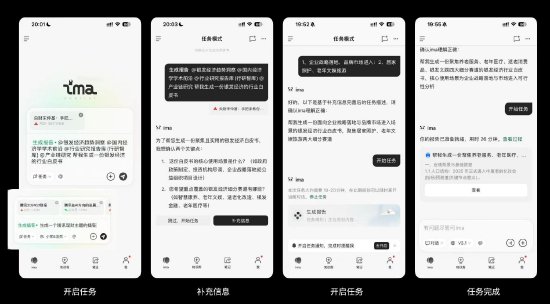
腾讯ima公布2.0版本:开启任务模式内测,可通过agent能力生成报告和播客
Xin Lang Ke Ji· 2025-10-23 10:23
Core Insights - Tencent's IMA Open Day introduced the IMA 2.0 version, set to launch internal testing on October 24, featuring a "task mode" based on agent capabilities and a knowledge base function called "AI Highlights" [1][2] Group 1: IMA 2.0 Features - The upgraded IMA will act as a "collaborative partner" capable of understanding objectives, executing tasks, and producing results [1] - The "task mode" supports generating reports and podcasts, allowing users to initiate tasks using natural language and attach various types of documents [1][2] - In podcast generation, users can select the number of speakers and voice tones, catering to deep information processing and creative needs in learning or work scenarios [1][2] Group 2: Task Execution and Knowledge Base - Upon activating "task mode," IMA autonomously breaks down and plans task steps using LLM, leveraging web data and knowledge base resources to fulfill user commands [2] - The new AI Highlights feature generates structured summaries and allows for multi-theme dialogues or tasks within the same knowledge base, enhancing collaboration [2] - User engagement metrics, such as "likes," help assess the authority and activity level of the knowledge base [2] Group 3: Market Impact and Growth - Over the past year, the IMA knowledge base has accumulated 200 million files, with monthly active users increasing by over 80 times since January [3] - IMA has been applied across more than 20 industries, including technology, finance, education, healthcare, law, and government, demonstrating its practical value and adaptability [2][3] - The product aims to serve as an "information management assistant," helping users not only store information but also effectively utilize it [3]

搜索入口保卫战:夸克对话助手上线,“搜索+对话”融合能否抵抗AI应用冲击?
Mei Ri Jing Ji Xin Wen· 2025-10-23 09:32
Core Insights - Alibaba's Quark has launched a dialogue assistant, marking the first project under its "Plan C" initiative, amidst a global shift in search technology led by major tech companies [1][2] - The integration of dialogue capabilities into Quark aims to enhance user experience by allowing seamless transitions between AI search and conversational interactions, addressing the challenge of switching between different tools [2][4] - The competitive landscape in the search industry is intensifying, with traditional search engines facing significant threats from AI applications that alter user information retrieval methods [4][6] Summary by Sections Quark's Dialogue Assistant Launch - Quark's dialogue assistant is part of its "Plan C," which is speculated to focus on AI capabilities [1][3] - The assistant combines search and dialogue functions to provide users with both direct AI search results and in-depth conversational experiences [2] Technological Advancements - Quark's dialogue assistant utilizes Alibaba's Qwen model, which reportedly outperforms GPT-5 and Claude Opus 4, ranking among the top three globally [2] - A joint research team has been established to ensure the professional quality of generated content, focusing on search reasoning and credible generation [2] Competitive Landscape - The rise of generative AI is reshaping how users access information, moving from traditional keyword searches to natural language queries and direct answers [4] - Quark has achieved the top position in the latest AI application rankings in China, while it ranks ninth globally, indicating strong competition with other AI applications [4][5] - Major tech companies are rethinking their search strategies, with Baidu and others adapting to the new AI-driven landscape [5][6]

李海辉:构建AI时代国家算力本位货币治理体系|金融与科技
清华金融评论· 2025-10-23 09:17
Core Viewpoint - The article discusses the exploration of a smart basic income (SBI) system based on national computing power, which aims to address the challenges posed by the integration of AI and traditional economic structures, responding to the national strategy of integrating the real economy with the digital economy [4][6][10]. Group 1: Concept of Smart Basic Income (SBI) - The SBI system transforms computing power into a material basis for social distribution, breaking away from traditional labor value theories and establishing a new paradigm of "computing power value sharing" [4][6]. - Unlike universal basic income (UBI) that relies on tax redistribution, the SBI system utilizes the national ownership and measurable characteristics of computing power resources to achieve "shared production materials for all" [9][10]. Group 2: New Monetary Framework - The SBI system shifts the monetary creation logic from "debt-credit" to "value-distribution," fundamentally changing the nature of currency from a debt certificate to a non-debt value distribution certificate [6][10]. - The currency issued under the SBI system, termed SBI Token, represents collective capital returns for citizens, ensuring that economic growth benefits everyone rather than just capital or technology owners [10][11]. Group 3: Computing Power as a New Value Anchor - In the intelligent era, computing power (GAICP) is identified as the core production material, akin to "digital gold," essential for economic production and the foundation for value creation [7][8]. - The expected scale of China's computing power economy is projected to exceed 4.5 trillion yuan by 2025, with a compound annual growth rate of over 25% [9]. Group 4: Technological Infrastructure and Mechanisms - The SBI system's architecture relies on a national computing power blockchain, creating a distributed infrastructure that ensures data integrity and real-time monitoring of computing power utilization [14][16]. - The operational process of the SBI system involves a closed loop of monitoring, calculating, distributing, and recycling, ensuring efficient and transparent distribution of resources [18][19]. Group 5: Societal Impact and Future Prospects - The implementation of the SBI system is expected to create a fair and stable economic environment, providing unconditional basic income to all citizens and reducing the complexity and costs of existing social security systems [26][27]. - By ensuring that every individual can share in the economic benefits of computing power, the SBI system aims to foster innovation and creativity, allowing people to pursue education, arts, and community service [28][40].