即时零售

Search documents
阿里美团京东财报齐了,外卖大战谁胜一筹?Q3最惨烈
Sou Hu Cai Jing· 2025-08-30 01:28
Core Insights - The article discusses the financial performance of Alibaba, Meituan, and JD.com, focusing on their competition in the food delivery sector and the impact of their investments on profitability and market share [1][2]. Alibaba - Alibaba's revenue for the quarter ending June 30, 2025, was RMB 247.65 billion (approximately USD 34.57 billion), representing a 2% year-on-year increase [4][5]. - The adjusted EBITDA decreased by 11% to RMB 45.74 billion (USD 6.38 billion), primarily due to investments in "Taobao Flash Sale" and user acquisition [4][5][6]. - Net profit fell to RMB 33.51 billion, a decline of 18% year-on-year, while adjusted EBITA dropped 14% to RMB 38.84 billion (USD 5.42 billion) [5][6]. - The "Taobao Flash Sale" service launched in April 2025 contributed to a 12% increase in instant retail revenue, reaching RMB 14.78 billion (USD 2.06 billion) [8][10]. - Sales and marketing expenses surged by RMB 204 billion, accounting for 21.5% of revenue, up from 13.4% in the previous year [9][13]. - Free cash flow decreased significantly, resulting in a net outflow of RMB 188.15 billion (USD 26.26 billion) [13][14]. Meituan - Meituan reported a revenue of RMB 91.84 billion for the second quarter, an 11.7% year-on-year increase, but experienced a dramatic decline in operating profit and net profit [16][18]. - The core local commerce segment generated RMB 65.35 billion, a 7.7% increase, but operating profit dropped 75.6% to RMB 3.72 billion [17][18]. - Sales and marketing expenses rose by 51.8% to RMB 225 billion, driven by increased competition in the food delivery market [19][21]. - Meituan's app reached over 500 million monthly active users, with peak daily orders for instant retail hitting 1.5 billion [20][21]. - Cash and cash equivalents totaled RMB 1,711 billion, sufficient to cover approximately 7.6 quarters of marketing expenses [22]. JD.com - JD.com achieved a revenue of RMB 356.7 billion, a 22.4% year-on-year increase, but net profit fell by 49% due to rising costs in the food delivery sector [23][24]. - New business revenue surged by 198.8% to RMB 138.52 billion, but incurred significant losses of RMB 147.77 billion due to high operating costs [23][24]. - Marketing expenses increased by 127.6% to RMB 270 billion, primarily for promoting new business initiatives [24][25]. - JD.com reported a peak daily order volume of 25 million for its food delivery service, expanding its market presence [26][27]. - The company held cash and cash equivalents totaling RMB 2,234 billion, enough to sustain operations for approximately 8 quarters at current marketing spending levels [27][28]. Competitive Analysis - In terms of net profit decline, Alibaba experienced the least drop, while Meituan faced the most significant decline [29][30]. - Meituan's delivery revenue exceeded that of its competitors, indicating a strong market position despite financial challenges [30]. - The article suggests that Alibaba is aggressively investing in its instant retail strategy, while Meituan is focusing on defensive measures and exploring new revenue streams [31][32][33]. - JD.com is positioned to leverage its unique business model and high-value product offerings to differentiate itself in the competitive landscape [35][36].




“迷失”阿里,从头再来
Hu Xiu· 2025-08-30 01:21
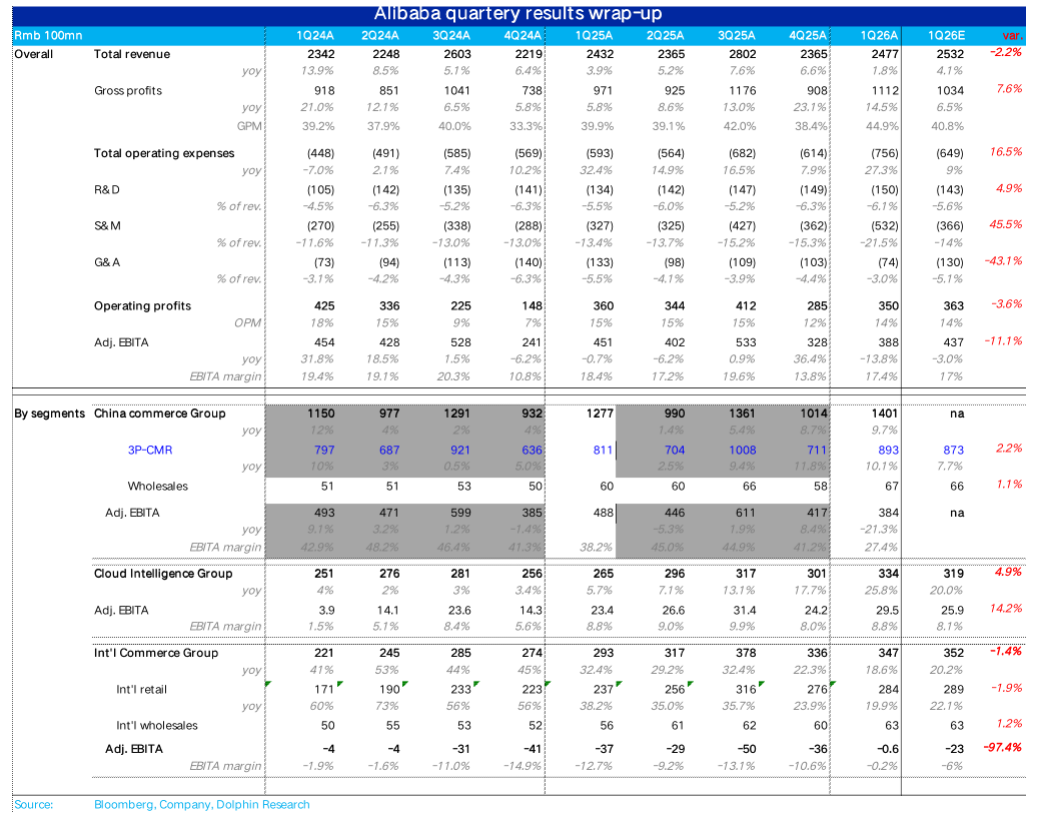
Core Insights - Alibaba's latest quarterly performance shows a significant loss due to the competitive food delivery market, but it remains better than its peers JD and Meituan [1][31] - The company's Cloud Intelligence Group and international e-commerce segments have shown promising growth and profitability improvements [2][9] Financial Performance - CMR (Core Metrics Revenue) grew by 10.1% year-on-year to RMB 89.3 billion, indicating solid performance in core e-commerce despite a slight deceleration [3][4] - The adjusted EBITA for the new China e-commerce group was RMB 38.4 billion, down approximately RMB 10.4 billion year-on-year, primarily due to losses from food delivery investments [7][53] - Total revenue for the quarter was approximately RMB 247.7 billion, a year-on-year increase of 1.8%, slightly below market expectations [17][71] Segment Analysis - Alibaba Cloud's revenue growth accelerated to nearly 26% year-on-year, with a profit of RMB 2.95 billion, reflecting strong demand driven by AI [9][11][57] - The international e-commerce segment reported a revenue growth of 18.6% year-on-year, with losses reduced to RMB 0.06 billion, indicating a shift towards more refined operations [13][64] Cost and Expenses - Marketing expenses surged to RMB 52.7 billion, an increase of RMB 20.8 billion year-on-year, largely due to competitive pressures in the food delivery sector [22][76] - The company's cash capital expenditures reached RMB 38.6 billion, indicating a strong commitment to future growth, particularly in AI and cloud services [12][60] Strategic Outlook - The integration of food delivery and travel services into the new China e-commerce group is expected to enhance operational efficiency and revenue generation [44][45] - Despite the current challenges in the food delivery market, Alibaba's strong financial position allows for continued investment in growth areas like AI and cloud computing [41][32]
怒涨13%!王者归来!创23年3月以来最佳单日表现!阿里巴巴Q2电话会全文:AI芯片B计划曝光!替代英伟达?
美股IPO· 2025-08-30 00:25
Core Viewpoint - Alibaba's stock rose by 13%, marking its best single-day performance since March 2023, while the Chinese concept index increased by 6% in August, continuing a four-month upward trend [1] Group 1: Business Performance - In Q2, Alibaba reported a Non-GAAP net profit decline of 18% year-on-year, but core businesses showed resilience, with cloud revenue growing by 26% and the newly launched Taobao Flash Sale driving user growth [3][4] - The Taobao Flash Sale, launched just four months ago, has surpassed 300 million monthly active users, a 200% increase since April, and daily average orders reached 120 million in July [4][5] - The company plans to integrate over one million offline brand stores into the Taobao Flash Sale, potentially generating an additional RMB 1 trillion in sales over the next three years [5] Group 2: Investment and Future Strategy - Alibaba has invested over RMB 100 billion in AI infrastructure and product development over the past four quarters, with plans to continue investing RMB 380 billion in AI capital expenditures over the next three years [5][13] - The company is preparing backup plans for global AI chip supply and policy changes by diversifying its supply chain through partnerships [5][13] - Alibaba aims to create a comprehensive consumption platform to meet the needs of one billion consumers, targeting a potential market size of RMB 30 trillion [14][21] Group 3: Cloud Business and AI Integration - The cloud business revenue grew by 26%, driven by increased demand for AI-related products, which now contribute over 20% of external commercial revenue [9][10] - AI-related revenue has maintained triple-digit growth for eight consecutive quarters, indicating strong market demand [9][10] - Alibaba's cloud infrastructure is positioned as a key player in the AI era, with ongoing investments to enhance its capabilities and market share [30][32] Group 4: E-commerce and User Engagement - The integration of Taobao and Tmall, along with the expansion of instant retail, has significantly boosted user engagement, with Taobao's monthly active users increasing by 25% [12][14] - The company has launched a new loyalty program that connects various platforms, enhancing user experience across its ecosystem [19] - The e-commerce segment achieved a revenue of RMB 1,401 billion, a 10% year-on-year increase, driven by improved customer management and promotional strategies [17][18]

股价大涨13%,阿里电话会:AI芯片供给有B计划,未来三年闪购和即时零售有望带来1万亿元新成交
华尔街见闻· 2025-08-29 23:37
Core Viewpoint - Alibaba's latest financial report indicates a 18% year-on-year decline in Non-GAAP net profit, but its core business shows strong resilience, particularly in cloud services and the rapid growth of Taobao Flash Sales [1][2]. Financial Performance - In Q2, Alibaba's total revenue reached 247.7 billion RMB, with a 10% year-on-year increase in customer management revenue from its Chinese e-commerce business [14][17]. - The adjusted EBITDA decreased by 14%, primarily due to strategic investments in expanding the instant retail business [15]. - Free cash flow showed a net outflow of 18.8 billion RMB, attributed to accelerated AI expansion and increased capital expenditures [16]. Business Highlights - Cloud business revenue grew by 26% year-on-year to 33.4 billion RMB, driven by AI-related services, which now contribute over 20% of external commercial revenue [2][7]. - Taobao Flash Sales, launched four months ago, has achieved over 300 million monthly active users, a 200% increase since April, with daily average orders reaching 120 million in July [1][24]. - The company plans to integrate over one million offline brand stores into its instant retail platform, potentially generating an additional 1 trillion RMB in transaction volume over the next three years [2][29]. Strategic Investments - Alibaba has committed to investing 380 billion RMB in AI capital expenditures over the next three years, with over 100 billion RMB already spent on AI infrastructure and product development [2][11]. - The company is focusing on building a comprehensive consumption platform that leverages AI and cloud technology to enhance user experience and operational efficiency [10][20]. Market Positioning - Alibaba aims to capture the growing demand for instant retail and AI services, positioning itself as a key player in the evolving e-commerce landscape [13][50]. - The integration of various business units, including Taobao and Tmall, is expected to enhance consumer experience and drive long-term growth [10][20]. Future Outlook - The company anticipates that the combination of AI and cloud services will create significant opportunities in the next decade, with a focus on enhancing its competitive edge in the market [12][13]. - Alibaba's strategic investments in both AI and consumer markets are expected to yield substantial returns, balancing short-term and long-term growth objectives [50].

阿里淘宝闪购业绩飙升,高盛预估其将占据45%市场份额
Sou Hu Cai Jing· 2025-08-29 22:39
Core Insights - Alibaba Group reported strong financial results for the quarter ending June 2025, driven by the rapid growth of its Taobao Flash Sales business, with customer management revenue reaching 89.252 billion RMB, a 10% year-over-year increase, surpassing market analysts' expectations [1] - CEO Wu Yongming highlighted the effectiveness of the company's investment in instant retail, which has led to significant consumer engagement and record highs in monthly active users and daily order volume [1] - The Taobao Flash Sales platform achieved a remarkable 25% year-over-year growth in monthly active users during the first three weeks of August, with daily order volume exceeding 10 million for three consecutive days [1] Financial Performance - Alibaba's total revenue for the quarter reached 140.072 billion RMB, reflecting a 10% year-over-year growth while maintaining healthy profit levels [2] - The company's rational investment in flash sales is effectively reshaping the market landscape and becoming a key driver of sustained growth in its e-commerce business [2] Market Position - According to Goldman Sachs, Taobao Flash Sales is expected to capture a 45% share of the takeaway market, further solidifying its competitive position [1] - Data from QuestMobile indicated that Taobao's daily active users (DAU) grew by 17% year-over-year in July, widening the gap with other e-commerce platforms [2] Brand Engagement - In July, 395 non-food brands on Taobao Flash Sales achieved monthly transaction volumes exceeding 1 million, with 66 brands surpassing 10 million, indicating the platform's potential as a new growth area for brands [3] - The integration of e-commerce platforms with flash sales is opening new channels for products and services while reducing operational costs, creating a positive feedback loop [3] User Experience and Membership Growth - Alibaba is actively optimizing user experience and operational efficiency while integrating supply chains and member benefits across its ecosystem, resulting in a double-digit year-over-year growth in 88VIP membership, reaching 53 million [5] - The launch of a new membership system on August 6 has integrated benefits across various services, enhancing the overall consumer experience [5]
半年净赚423亿元,阿里业绩暴涨,公司高管:不会单独看外卖盈利情况!吴泳铭:过去一年在AI上投了1000亿元
Mei Ri Jing Ji Xin Wen· 2025-08-29 16:56
Core Insights - Alibaba Group reported its first-quarter financial results for fiscal year 2026, showing a revenue of RMB 247.65 billion, a year-on-year increase of 2%. Excluding disposed businesses, the revenue growth would be 10%. Net profit surged by 76% to RMB 42.38 billion [1] - The "instant retail" business of Alibaba's China e-commerce group generated RMB 14.78 billion in revenue, up 12% from RMB 13.20 billion in the same period last year, primarily driven by increased order volume from "Taobao Flash Purchase" [1] - Alibaba's adjusted EBITA decreased by 14% to RMB 38.84 billion, attributed to investments in Taobao Flash Purchase and user experience, partially offset by double-digit revenue growth in the e-commerce group [1] Financial Performance - Revenue for the first quarter of fiscal year 2026 was RMB 247.65 billion, with a 2% year-on-year growth. Adjusted for disposed businesses, the growth rate would be 10% [1] - Net profit reached RMB 42.38 billion, reflecting a significant increase of 76% year-on-year [1] - The adjusted EBITA for the quarter was RMB 38.84 billion, down 14% compared to the previous year [1] Business Strategy - Alibaba's CEO emphasized the importance of AI and cloud technology as key strategic opportunities for the company, with a capital expenditure of RMB 38.6 billion in AI and cloud for the quarter [3] - The company aims to create a comprehensive consumption platform that meets the needs of 1 billion consumers, focusing on integrating instant retail and e-commerce [4] - Alibaba plans to maintain a startup mentality over the next three years, continuously investing in core businesses to enhance competitive advantages [4] Market Competition - Alibaba's executives acknowledged the competitive landscape in the instant retail sector, noting that they are working to improve efficiency and increase the proportion of high-value orders [5] - The company expects Taobao Flash Purchase to generate an additional RMB 1 trillion in transactions over the next three years [5] - Competitors like Meituan are also facing challenges, with their core local business segment experiencing a 75.6% decline in operating profit year-on-year due to intense competition [6]
3亿人都在抢的淘宝闪购,如何用30分钟撬动万亿消费市场?
Sou Hu Cai Jing· 2025-08-29 16:27
Core Insights - Alibaba's latest financial report indicates a significant shift towards "instant retail," with 300 million users opting for delivery services in August, leading to a record of 120 million daily orders on Taobao Flash Purchase [1][3] - The rapid growth of the flash purchase business is characterized by a threefold increase in weekly average daily orders to 80 million over four months, alongside a rise in active delivery personnel to 2 million [3][4] Group 1: Growth Metrics - The flash purchase service has seen a 300% increase in monthly active users, reflecting a substantial change in e-commerce dynamics [1][3] - The daily order peak of 120 million is supported by a delivery capacity of 2 million riders, indicating a robust real-time transaction network [3][4] Group 2: Consumer Behavior - The consumer base for flash purchases is predominantly young, with over 60% of users aged 18-35, highlighting a trend towards "scene-triggered consumption" [4][5] - The combination of "limited-time discounts" and "fast delivery" has amplified impulsive buying behaviors among younger consumers [4][5] Group 3: Operational Efficiency - Flash purchase users exhibit a weekly purchase frequency of 3.5 times, significantly higher than the 30% repurchase rate typical of traditional e-commerce [5][6] - The integration of AI in product selection has led to a threefold increase in revenue, optimizing inventory turnover through dynamic demand forecasting [5][6] Group 4: Market Potential - Alibaba aims to generate an additional 1 trillion yuan in transactions through flash purchases and instant retail over the next three years, relying on a three-pillar model: delivery capacity, consumer habits, and AI-driven efficiency [6][7] - The shift towards instant delivery is expected to redefine retail competition, focusing on spatial and temporal efficiency rather than product variety [6][7]
阿里巴巴-SW财报电话会:未来几个季度阿里云业务增速会持续向上
Zhi Tong Cai Jing· 2025-08-29 15:28
日前,阿里巴巴-SW(09988)公布2026财年Q1财报。阿里巴巴在随后的财报电话会中表示,关于增速预 期看,现在看到客户、阿里云客户在使用ai产品,在他们企业内部开发ai产品,看到明确趋势,从趋势 看需求旺盛,企业因为ai模型能力强进而开发新应用,同时,传统功能被ai替代,看到趋势发展下,客 户需求旺盛,看到训练与推理需求增长,近几个季度,推理需求增长之外,看到训练有新的行业观察, 除了行业行业基础大模型迭代模型,也看很多新机会,例如车厂、教育企业、多媒体应用公司,他们专 有数据训练专属模型,对ai使用量有推进。结合推理需求,未来几个季度,阿里云业务增速会持续向 上。 关于ai的资本开支,3年投资3800亿元,由于供应链波动,每个季度会有波动,根据全球芯片变化,公 司也会外部合作储备,备用计划,面对不同行业变化,会按照预期的情况去完成。 Q&A Q:关于即时零售,闪购投资加大,在中国即时零售增长机会有什么愿景?投资计划如何?是否 带来价值?有什么协同效应?如何考虑投资对GMVCMR影响如何? A:闪购业务上线4M,在用户、商单超预期,外卖到家超过行业,日均订单峰值1.2亿单,买家3亿元, 商品供给,大量新 ...
暴涨12%!阿里发生了什么?二季度电话会全文:AI芯片供给有B计划,重申3800亿Capex,闪购和即时三年零售带来1万亿元
美股IPO· 2025-08-29 15:15
Core Insights - The company has achieved significant growth in its instant retail business, with monthly active users of Taobao Flash Purchase exceeding 300 million, a 200% increase compared to before April [3][4] - The cloud business has shown resilience, with revenue growth of 26% year-on-year, driven by strong demand for AI-related products [3][6] - The company plans to invest 380 billion RMB in AI infrastructure over the next three years, with a focus on diversifying supply chains to mitigate risks [4][11] Group 1: Instant Retail Business - Taobao Flash Purchase has reached a daily average order volume of 120 million in July, maintaining around 80 million in August [3][24] - The number of active riders for the flash purchase service has tripled to 2 million since April, indicating significant operational expansion [3][4] - The company anticipates over 1 trillion RMB in new transaction volume from integrating more than one million offline brand stores into the instant retail platform over the next three years [4][28] Group 2: Cloud Business - The cloud segment's revenue reached 333.98 billion RMB, with AI-related revenue contributing over 20% to external commercial income [4][18] - The company has invested over 100 billion RMB in AI infrastructure and product development over the past four quarters, with plans for continued investment [11][35] - The cloud business is expected to maintain strong growth momentum, driven by increasing demand for AI applications and services [32][34] Group 3: Financial Performance - The company's Non-GAAP net profit decreased by 18% year-on-year, but core business revenues remained strong [3][15] - The adjusted EBITDA margin for the cloud segment stabilized at 8.8%, reflecting operational efficiency improvements [18] - Free cash flow showed a net outflow of 18.8 billion RMB, primarily due to accelerated investments in AI and infrastructure [15][19] Group 4: Strategic Initiatives - The company is integrating various business units, including Taobao and Tmall, to create a comprehensive consumer platform that enhances user experience [10][19] - A new loyalty program has been launched to connect different business units, improving customer engagement across platforms [16][19] - The company is focusing on enhancing operational efficiency and profitability while expanding its instant retail and cloud services [14][19]

阿里二季度即时零售收入增长12%,蒋凡首谈淘宝闪购战略
Nan Fang Du Shi Bao· 2025-08-29 15:10
Core Insights - Alibaba's investment in instant retail has shown rapid results since May, with monthly active buyers reaching 300 million in August, leading to a 25% increase in monthly active buyers on the Taobao app [1][4] - The company's Q1 FY2026 revenue was 247.65 billion RMB, a 10% year-over-year increase, with net profit rising 76% to 42.38 billion RMB, exceeding market expectations [2][4] - The stock price surged over 10% to $131.67 following the earnings report [1] Financial Performance - Alibaba's revenue from its China e-commerce group was 1,400.72 billion RMB, a 10% increase year-over-year, while adjusted EBITA decreased by 21% to 383.89 billion RMB due to investments in user experience and technology [4][5] - The international digital commerce group's revenue grew by 19% to 34.74 billion RMB, with adjusted EBITA losses narrowing significantly [5] - Sales and marketing expenses rose to 531.78 billion RMB, accounting for 32.5% of revenue, up from 13.4% the previous year, driven by investments in user acquisition [5] Business Segments - Instant retail revenue reached 14.78 billion RMB, a 12% increase, attributed to the growth in orders from Taobao Flash Sales [4][5] - The cloud computing segment saw a 26% increase in revenue to 333.98 billion RMB, marking the highest growth rate in three years, driven by AI-related services [9] - The company plans to invest 380 billion RMB in cloud and AI infrastructure over three years, with 38.6 billion RMB already allocated in the second quarter [9] Strategic Developments - The integration of Ele.me and Fliggy into the China e-commerce group aims to transform Alibaba into a comprehensive consumer platform [4] - The Taobao Flash Sales initiative has exceeded initial user growth targets, with daily orders peaking at 12 million and monthly active users reaching 300 million [7][8] - The company is focusing on enhancing operational efficiency in its instant retail segment, with plans to optimize order structures and logistics costs [8]