
避险资产

Search documents
金价大涨!今年以来涨幅已接近40%
Sou Hu Cai Jing· 2025-09-13 09:22
Group 1: Gold Price Surge - Gold prices reached a record high of $3,674.27 per ounce, surpassing the previous peak of $850 per ounce (adjusted for inflation) [1] - The price of gold has increased approximately 5% this month and nearly 40% year-to-date, highlighting its status as a safe-haven asset amid macroeconomic uncertainties [1] - Factors such as rising unemployment claims and persistent high core CPI contributed to the recent surge in gold prices, with analysts suggesting a constructive outlook for gold in the coming months [1] Group 2: Economic Indicators and Market Sentiment - Recent economic data indicates a cooling U.S. economy, with the August CPI rising 2.9%, the largest increase in seven months, and a decline in the PPI [2] - Non-farm payrolls added only 22,000 jobs in August, with the unemployment rate rising to 4.3%, raising concerns about stagflation [2] - Market expectations for a 25 basis point rate cut by the Federal Reserve have increased, with traders fully pricing in this possibility [2] Group 3: Factors Driving Gold Prices - U.S. tax cuts and tariffs, along with challenges to the independence of the Federal Reserve, have diminished the attractiveness of the dollar and U.S. Treasuries, leading to increased investment in gold [3] - Historical perspectives on gold as a hedge against inflation and currency devaluation are being reinforced by current economic conditions and geopolitical uncertainties [3] - Goldman Sachs projects gold prices could reach $3,700 by the end of 2025 and potentially $4,000 by mid-2026, with scenarios suggesting prices could even hit $4,500 to $5,000 if there is a significant outflow from dollar assets [3] Group 4: Central Bank Trends and Future Outlook - Central banks are diversifying their foreign reserves, with gold's share in reserves rising since the Russia-Ukraine conflict, making it the second-largest reserve asset globally [4] - The future trajectory of gold prices will depend on Federal Reserve policy and global risk events, with historical trends indicating that rate-cutting periods enhance gold's appeal [4] - The ongoing gold market rally is supported by a broad investor base and policy uncertainties, positioning gold as both an inflation hedge and a beneficiary of global asset reallocation [4]
突发!金价,彻底爆了!
Sou Hu Cai Jing· 2025-09-13 07:53
Group 1 - Gold prices reached a historic high of $3674.27 per ounce, surpassing the previous peak of $850 per ounce (adjusted for inflation) from January 1980, with a cumulative increase of approximately 5% in September and nearly 40% year-to-date [1] - The rise in gold prices is attributed to macroeconomic uncertainties, with significant factors including a surge in initial jobless claims to 263,000, the highest in three years, and a core CPI increase of 0.3% [1] - Analysts suggest that despite some short-term buyer fatigue, the outlook for gold remains constructive with limited room for significant pullbacks in the coming months [1] Group 2 - Recent economic data indicates a cooling U.S. economy, with the August CPI rising by 2.9%, the largest increase in seven months, and non-farm payrolls adding only 22,000 jobs, leading to a rise in the unemployment rate to 4.3% [2] - The market is increasingly concerned about stagflation, with traders fully pricing in a 25 basis point rate cut by the Federal Reserve in the upcoming meeting [2] - The combination of a weakening labor market and persistent inflation signals has heightened expectations for a gradual resumption of rate cuts by the Federal Reserve [2] Group 3 - Factors such as tax cuts and tariffs from the Trump administration, along with challenges to the independence of the Federal Reserve, have diminished the attractiveness of the U.S. dollar and Treasury bonds, driving funds into gold [3] - Gold is viewed as a unique hedge against inflation and currency devaluation, with historical precedence reinforcing its role as a safe haven during economic uncertainty [3] - Analysts note that the current volatility in gold prices is lower compared to the sharp spikes seen in 1980, attributed to increased market liquidity and the accessibility of gold through ETFs [3] Group 4 - Central banks are diversifying their foreign reserves, with gold's share in reserves rising since the Russia-Ukraine conflict, making it the second-largest reserve asset globally, surpassing the euro [4] - The future trajectory of gold prices will depend on the Federal Reserve's policy direction and global risk events, with historical trends indicating that rate-cutting periods enhance gold's appeal [4] - The ongoing relationship dynamics between the Trump administration and the Federal Reserve are considered a significant variable influencing gold prices [4]
【UNFX 课堂】金价突破历史真实高点这意味着什么
Sou Hu Cai Jing· 2025-09-12 10:30
Core Insights - The international gold price has surged, breaking through a key resistance level of XXXX USD per ounce, and after adjusting for inflation, it has surpassed the historical high of approximately 850 USD per ounce set in January 1980, which is equivalent to about 2600 USD today, marking a new bull market for gold after half a century [1][3][12] Inflation Adjustment - The nominal price of gold is often viewed by ordinary investors, while professional investors focus on the real price adjusted for inflation [1] - The purchasing power of 850 USD in 1980 is significantly higher than today due to inflation [2] Drivers of Current Gold Price Surge - Three macroeconomic forces are driving the current gold price to a "real new high": - Global de-dollarization and central bank gold purchases, with countries like China, Poland, and Singapore increasing their gold reserves to diversify foreign exchange risks, providing solid support for gold prices [4] - Expectations of Federal Reserve interest rate cuts and declining real interest rates, which lower the opportunity cost of holding gold, potentially weakening the dollar and driving gold prices higher [4] - Geopolitical risks and heightened risk aversion, as ongoing international conflicts and global economic uncertainties enhance gold's traditional safe-haven appeal [4] Implications for Investors - The confirmation of a long-term upward trend in gold prices is significant, but it does not guarantee a continuous rise, as market fluctuations and corrections are normal [5] - The market is undergoing a re-evaluation of gold's value, indicating an enhanced strategic position for gold in global asset allocation [6] Opportunities and Risks - From a long-term perspective, the current situation may represent a new starting point rather than an endpoint for gold prices [7] - Any asset reaching a new high may experience short-term technical corrections, necessitating caution when considering high entry points [8] Investment Strategies - Long-term investors are advised to consider gold as part of their asset allocation (recommended allocation of 5%-10%) for risk hedging and value preservation, employing a strategy of gradual accumulation rather than chasing high prices [9] - Short-term traders should focus on key technical support and resistance levels, setting strict stop-loss orders, and remain vigilant for potential corrections after positive news [10]
黄金远未到天花板?高盛、瑞银双双上调金价预测!
Jin Shi Shu Ju· 2025-09-12 08:33
Group 1 - Goldman Sachs has raised its long-term gold price forecast for 2029 from $2850/oz to $3300/oz, maintaining a positive outlook on gold prices with potential risks pushing prices to $4500-$5000/oz [1] - The revision by Goldman Sachs comes after a sustained increase in gold prices and gold stocks, with Newmont rated as neutral but showing positive prospects in production, free cash flow, and capital management [2] - Goldman Sachs emphasizes that margin expansion is a key driver for the strong performance of mining stocks, expecting the current gold stock cycle to continue, outperforming commodities throughout 2025 [3] Group 2 - UBS has also raised its gold price forecasts, increasing the 2025 year-end prediction by $300 to $3800/oz and the mid-2026 forecast by $200 to $3900/oz, citing expected Fed easing policies and geopolitical risks affecting the dollar [4] - UBS revised its estimate for gold ETF holdings, predicting they will exceed 3900 tons by the end of 2025, close to the record of 3915 tons set in October 2020, maintaining a bullish view on gold [4] - UBS expects central bank gold purchases to remain strong at around 900-950 tons this year, slightly below last year's record levels, while highlighting the key risk of unexpected Fed rate hikes due to inflation [4]


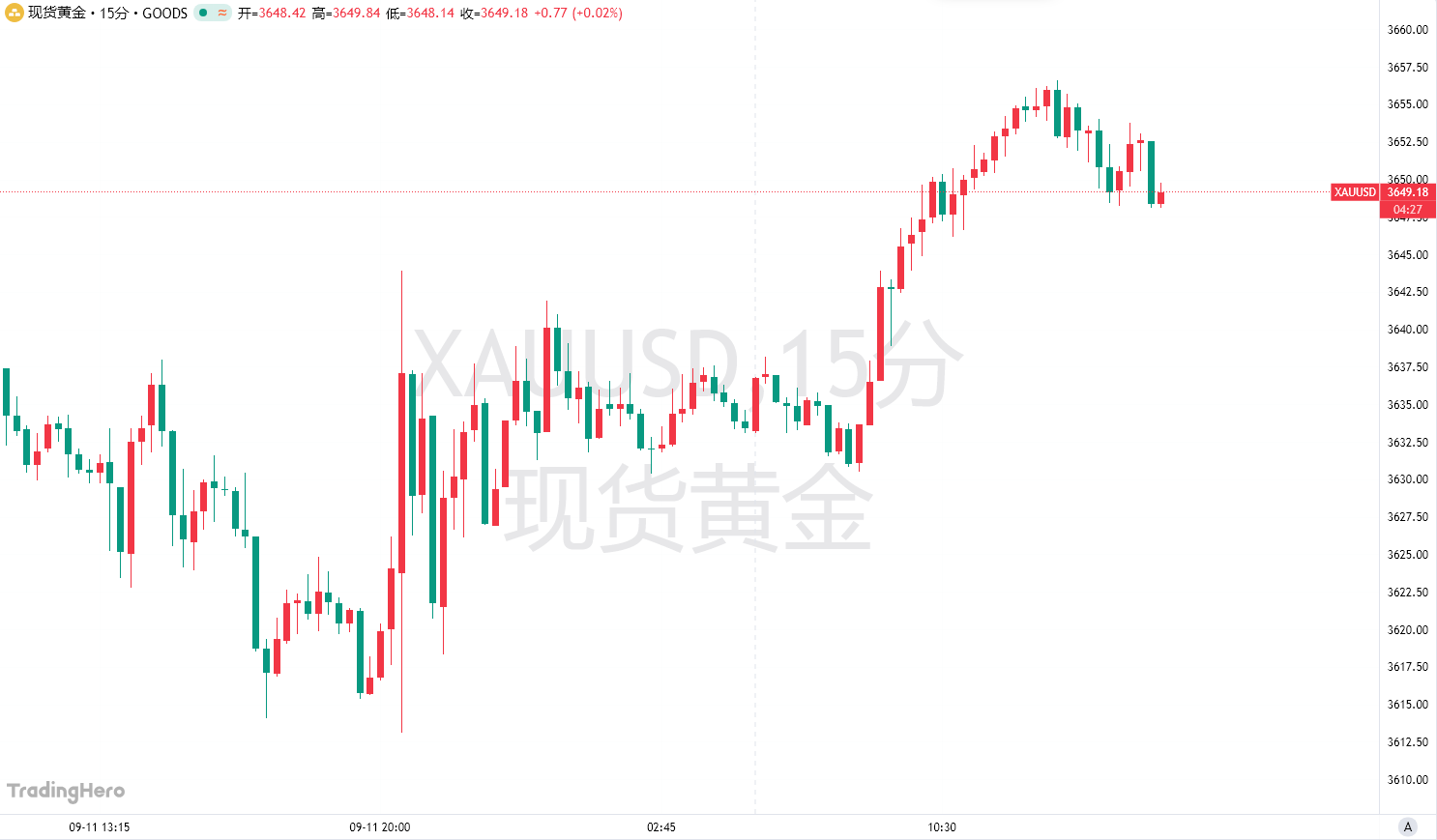
跑赢通胀!金价,彻底爆了!
Sou Hu Cai Jing· 2025-09-12 08:03
多重因素推升金价 特朗普政府的减税与关税政策,加之对美联储独立性的挑战,削弱了美元与美债的吸引力,推动资金加 速流入黄金。马拉松资源顾问公司投资组合经理罗伯特·马林(Robert Mullin)表示:"黄金在数百甚至 上千年的历史中,一直扮演着对冲通胀和货币贬值的独特角色。" 世界银行前首席经济学家卡门·莱因哈特(Carmen Reinhart)也认为,黄金上涨不仅反映通胀担忧,还 折射出全球经济与地缘政治的不确定性。"黄金在上世纪七八十年代已被视为有效的对冲工具,如今这 种作用再次被强化。" 9月12日,现货黄金一度升至3674.27美元/盎司,创下新的历史纪录,并首次突破1980年1月21日创下的 850美元/盎司峰值(按通胀调整约为3590美元)。本月以来金价累计上涨约5%,今年以来涨幅已接近 40%。市场普遍认为,这一突破再次凸显黄金在持续的宏观不确定性中作为避险资产的地位。 在美国经济数据公布前,金价曾一度下跌多达0.6%。随着数据出炉,价格迅速扭转跌势并刷新高位。 独立金属交易员黄泰(Tai Wong)评论称:"上周初请失业金人数大幅攀升至26.3万,创三年来新高, 而核心CPI环比增幅仍维持在0 ...
多重因素助推,黄金价格创历史新高
Huan Qiu Wang· 2025-09-12 03:21
在美国经济数据公布前,金价曾一度下跌多达0.6%。随着数据出炉,价格迅速扭转跌势并刷新高位。独立金属交易员黄泰评论称:"上周初请失业金人数大 幅攀升至26.3万,创三年来新高,而核心CPI环比增幅仍维持在0.3%的高位,这些因素共同'拯救'了黄金。"他补充道,尽管短期走势显示部分买家出现疲 态,但未来几个月黄金前景依然具有建设性,大幅回调的空间有限。 【环球网消费综合报道】9月12日,现货黄金一度升至3674.27美元/盎司,创下新的历史纪录,并首次突破1980年1月21日创下的850美元/盎司峰值(按通胀 调整约为3590美元)。本月以来金价累计上涨约5%,今年以来涨幅已接近40%。市场普遍认为,这一突破再次凸显黄金在持续的宏观不确定性中作为避险 资产的地位。 市场分析人士表示,本轮金价上涨的波动性明显降低。部分原因在于市场流动性增强,以及ETF等产品使更多投资者能够便捷配置黄金。伦敦金库中黄金储 备的总价值上月首次突破1万亿美元,凸显机构需求。高盛在最新报告中称,央行持续购金、私人投资者加仓以及美元资产信任削弱,共同推动金价进入新 阶段。该行预计,到2025年底金价或升至3700美元,2026年中有望突破 ...
突破1980年通胀调整峰值,现货黄金再创历史新高
Di Yi Cai Jing· 2025-09-12 01:21
Group 1 - Gold prices reached a historic high of $3,674.27 per ounce, surpassing the inflation-adjusted peak of $850 per ounce from January 1980, with a cumulative increase of approximately 5% in September and nearly 40% year-to-date [1] - The rise in gold prices is attributed to macroeconomic uncertainties, with significant factors including a surge in initial jobless claims to 263,000, the highest in three years, and a core CPI increase of 0.3% [1] - Analysts suggest that despite some short-term buyer fatigue, the outlook for gold remains constructive with limited room for significant pullbacks in the coming months [1] Group 2 - Recent economic data indicates a cooling U.S. economy, with the August CPI rising by 2.9%, the largest increase in seven months, and non-farm payrolls adding only 22,000 jobs, leading to a rise in the unemployment rate to 4.3% [2] - The market is increasingly concerned about stagflation, with traders fully pricing in a 25 basis point rate cut by the Federal Reserve in the near future [2] - The combination of a weakening labor market and persistent inflation signals a shift in monetary policy expectations, with a gradual resumption of rate cuts anticipated [2] Group 3 - Factors such as tax cuts and tariffs from the Trump administration, along with challenges to the independence of the Federal Reserve, have diminished the attractiveness of the U.S. dollar and Treasury bonds, driving investment into gold [3] - Gold is viewed as a unique hedge against inflation and currency devaluation, with historical precedence reinforcing its role as a safe haven during economic uncertainty [3] - The volatility of gold prices has decreased compared to the sharp spikes seen in 1980, attributed to enhanced market liquidity and the accessibility of gold through ETFs [3] Group 4 - Central banks are diversifying their foreign reserves, with gold's share in reserves increasing since the Russia-Ukraine conflict, now surpassing the euro to become the second-largest reserve asset globally [4] - The future trajectory of gold prices will depend on the Federal Reserve's policy direction and global risk events, with historical trends indicating that rate cuts typically enhance gold's appeal [4] - The ongoing gold market rally is supported by a broad investor base and policy uncertainties, positioning gold as both an inflation hedge and a beneficiary of global asset reallocation [4]
金价突破1980年通胀调整峰值
Di Yi Cai Jing Zi Xun· 2025-09-12 00:32
Core Insights - Gold prices reached a historic high of $3,674.27 per ounce, surpassing the previous peak of $850 per ounce (adjusted for inflation) from January 1980, with a year-to-date increase of nearly 40% [2] - The recent surge in gold prices is attributed to macroeconomic uncertainties and a shift in investor sentiment towards gold as a safe-haven asset [2][4] - Economic indicators suggest a cooling U.S. economy, with rising unemployment and inflation concerns, leading to expectations of potential interest rate cuts by the Federal Reserve [3][5] Economic Indicators - The U.S. Consumer Price Index (CPI) rose by 2.9% year-on-year in August, marking the largest increase in seven months, while the Producer Price Index (PPI) unexpectedly declined [3] - Non-farm payrolls added only 22,000 jobs in August, with the unemployment rate rising to 4.3%, indicating a weakening labor market [3] - The Federal Reserve is expected to initiate a gradual rate-cutting cycle after pausing monetary easing earlier this year [3] Factors Driving Gold Prices - The Trump administration's tax and tariff policies have diminished the attractiveness of the U.S. dollar and Treasury bonds, leading to increased investment in gold [4] - Historical perspectives highlight gold's role as a hedge against inflation and currency devaluation, a sentiment echoed by economists [4] - Enhanced market liquidity and the availability of gold through ETFs have contributed to reduced volatility in gold prices compared to past surges [4] Central Bank Trends - Central banks have been diversifying their foreign reserves, with gold's share in reserves increasing since the Russia-Ukraine conflict, now surpassing the euro [5] - The ongoing demand from central banks and private investors, coupled with a decline in trust in dollar assets, is expected to support gold prices in the long term [5] - Historical trends indicate that periods of interest rate cuts typically enhance gold's appeal as an investment [5]
降息预期叠加地区动荡!黄金股票ETF基金(159322)备受关注
Xin Lang Cai Jing· 2025-09-11 05:42
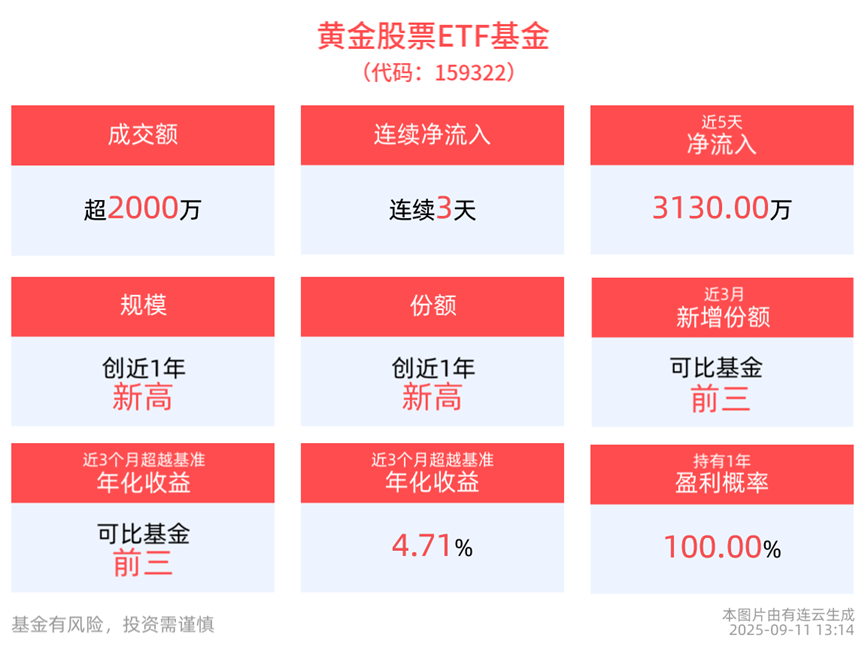
Group 1: Market Overview - The Federal Reserve is expected to shift towards a loose monetary policy, enhancing the appeal of gold as a safe-haven asset amid increasing macroeconomic uncertainties [1] - Gold prices are anticipated to rise further due to strengthened expectations of interest rate cuts by the Federal Reserve, alongside heightened global trade policy uncertainties and regional political turmoil [1] Group 2: Gold Sector Performance - The gold sector is expected to maintain a bullish trend in the first half of 2025, with both cyclical and trend forces resonating [1] - Longjiang Securities notes that gold prices have reached new highs amid deepening trade conflicts and recession expectations in the U.S., with most companies in the industry entering a phase of volume expansion, leading to enhanced profit elasticity [1] Group 3: ETF Fund Performance - As of September 10, 2025, the gold stock ETF fund has seen a net value increase of 52.09% over the past six months, ranking 55 out of 3589 in the index stock fund category [3] - The gold stock ETF fund has achieved a maximum monthly return of 16.59% since its inception, with a historical one-year profit probability of 100% [5] Group 4: Fund Liquidity and Inflows - The gold stock ETF fund has experienced active trading, with a turnover rate of 17.47% and a total transaction volume of 20.08 million yuan [2] - The fund has seen continuous net inflows over the past three days, with a peak single-day net inflow of 33.81 million yuan, totaling 42.81 million yuan in net inflows [2] Group 5: Fund Metrics - The gold stock ETF fund's latest scale reached 116 million yuan, marking a one-year high, with the latest share count at 76.41 million, also a one-year high [2] - The fund's Sharpe ratio for the past year is 1.91, ranking it in the top 2 out of 6 comparable funds, indicating higher returns for the same level of risk [6]



时报观察 | 多国财政困局推涨金价 全球资产定价面临重构
Zheng Quan Shi Bao· 2025-09-10 19:16
Group 1 - The core viewpoint of the articles highlights the significant rise in international gold prices, which have increased nearly 40% this year, driven by factors such as ongoing central bank purchases, complex global situations, and heightened demand for safe-haven assets [1][2] - The recent surge in gold prices since late August is linked to market speculation regarding a potential interest rate cut by the Federal Reserve in September, alongside rising long-term bond yields in multiple countries due to concerns over fiscal sustainability [1][2] - France's 10-year bond yield has risen to a high level within the Eurozone, surpassing that of Greece and Spain, reflecting investor worries about the country's fiscal sustainability amid challenges in reducing budget deficits [1][2] Group 2 - The upward pressure on long-term bond yields is not isolated to France and the UK; similar trends are observed in the US, Japan, and Germany, indicating a broader concern among investors regarding government debt risks [2] - The trend of selling government bonds to invest in gold is emerging, suggesting a shift in investor behavior as they seek to diversify risk amid fiscal sustainability concerns [2] - The ongoing bull market for gold, which has lasted nearly three years, is supported by traditional factors such as central bank purchases and geopolitical uncertainties, while the recent trend of bond selling adds a new dynamic to gold's price increase [2]