央行独立性

Search documents
突发特讯!美媒通告全球:美联邦检察官已对美联储主席鲍威尔展开调查,引爆国际舆论
Sou Hu Cai Jing· 2026-01-12 06:26
Group 1 - The core issue revolves around a criminal investigation initiated against Federal Reserve Chairman Jerome Powell, linked to a $2.5 billion renovation project, which is seen as part of a broader political conflict between the White House and the Federal Reserve [1][3]. - The investigation was approved shortly after former President Trump publicly criticized Powell for causing significant financial losses, indicating a shift in their relationship from one of nomination to confrontation [3][5]. - The renovation project, initially budgeted at $1.9 billion, escalated to $2.5 billion, which Powell defended as necessary due to aging infrastructure, but the real concern for the White House was the Fed's independence in monetary policy decisions [3][5]. Group 2 - The legal battle has significant implications for the independence of the Federal Reserve, as the investigation could set a precedent for presidential interference in monetary policy [5][7]. - Market reactions to the investigation were immediate, with the dollar index dropping by 1.2% and gold prices soaring to a historical high of $2070 per ounce, reflecting investor anxiety over the Fed's autonomy [5][7]. - Powell's response to the investigation framed it as a test of the rule of law, emphasizing the importance of maintaining the Fed's independence from political pressures, and referencing historical instances of political interference in monetary policy [7][8].

为何成美国大选筹码?特朗普最想解雇的人,鲍威尔成了眼中钉?
Sou Hu Cai Jing· 2026-01-08 03:19
Core Viewpoint - The article discusses the political conflict between the U.S. administration and the independence of the Federal Reserve, highlighted by Trump's intention to sue Fed Chairman Powell over budget overruns in the Fed's headquarters renovation project, which escalated from $1.9 billion to $2.5 billion [1][10]. Group 1: Federal Reserve Renovation Project - The budget overrun of $600 million was primarily due to asbestos removal and soil contamination issues, which are common in the renovation of historical buildings [1]. - Powell's justification for the budget increase is based on the necessity to replace hazardous materials and update critical systems, which is a reasonable explanation from an objective standpoint [3]. Group 2: Political Implications - Trump's shift from criticizing the Fed's interest rate policies to focusing on the renovation budget is seen as a strategic move to resonate with public sentiment against government waste [5]. - The lawsuit threat appears to be more of a political statement rather than a genuine legal pursuit, as the Federal Reserve enjoys significant judicial immunity and the standard for proving gross negligence is high [7]. Group 3: Global Context and Trends - The article notes that many central banks worldwide are facing increasing political pressure, with examples from Turkey and Argentina where government interference has led to economic instability [9]. - The independence of central banks, including the Federal Reserve, is crucial for global economic stability, and the current political climate in the U.S. poses challenges to this independence [10][13].
特朗普再掀风波,威胁起诉美联储主席鲍威尔
Sou Hu Cai Jing· 2025-12-30 05:37
Group 1 - Trump has intensified his conflict with the Federal Reserve, considering a lawsuit against Chairman Powell for "serious misconduct" related to the budget overruns of the Fed's headquarters renovation project, which escalated from an initial budget of $1.9 billion to $2.5 billion due to issues like asbestos handling and soil contamination [2] - The underlying conflict between Trump and Powell centers on monetary policy, with Trump criticizing Powell for being slow to lower interest rates and even threatening to fire him [2] - The selection process for the next Fed Chair is underway, with Powell set to leave in May next year, and Trump is actively interviewing candidates, expected to announce a new nominee in January [2] Group 2 - Market participants suggest that the new Fed Chair could be chosen from former Fed Governor Kevin Walsh, a critic of the Fed, or Kevin Hassett, the Director of the National Economic Council, who supports Trump's economic agenda and is likely to favor a more accommodative monetary policy [2] - Bank of America CEO Brian Moynihan emphasized the importance of maintaining the Fed's independence, warning that a lack of independence could lead to market repercussions [3] - Moynihan expressed concerns about lowering interest rates too much, arguing that returning mortgage rates to 3% could hinder economic growth and merely offset recession impacts, contradicting Trump's view that lower rates would stimulate the economy [3]

今年全球最“神奇”的资产?30年期美国国债!
Xin Lang Cai Jing· 2025-12-24 00:57
Core Viewpoint - The 30-year U.S. Treasury bond has shown remarkable resilience in 2025, maintaining its value despite significant market turbulence and not experiencing any price increase throughout the year [1][3]. Group 1: Market Performance - The price of the 30-year U.S. Treasury bond has remained nearly flat compared to the beginning of the year, despite expectations of rising long-term bond yields due to various economic factors [3][6]. - The yield curve for U.S. Treasury bonds has steepened, with the 2-year/30-year spread reaching its steepest in four years, primarily driven by short-term rate changes [4]. - In contrast to other international bonds, U.S. long-term bonds have performed relatively well, even as the dollar depreciated by nearly 10% [4]. Group 2: Demand and Auction Results - Strong demand from institutional investors such as pension funds, mutual funds, and insurance companies has supported the 30-year Treasury bond, as these entities seek to match long-term liabilities with long-term assets [8][9]. - The U.S. Treasury successfully conducted 12 auctions of 30-year bonds this year, raising a total of $276 billion, with an average bid-to-cover ratio of 2.37, consistent with historical averages [9]. Group 3: Future Challenges - Despite the strong performance of long-term U.S. bonds this year, they are expected to face significant challenges in the coming year, including rising risk premiums, inflation risks, and increased debt supply [10]. - Concerns regarding the independence of the Federal Reserve and doubts about the productivity prospects of artificial intelligence may further complicate the outlook for 30-year bonds [10].

年度惊喜资产?30年期美债2025年韧性十足,明年或迎更严酷大考
智通财经网· 2025-12-23 14:00
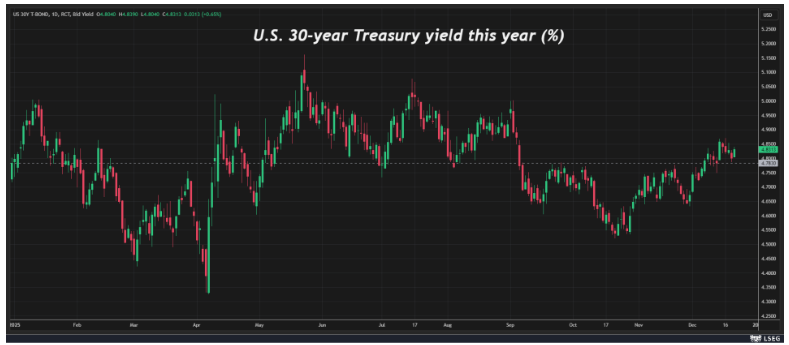
Core Viewpoint - The 30-year U.S. Treasury bond is expected to close the year at a level nearly unchanged from the beginning of the year, despite facing significant challenges over the past 12 months [1]. Group 1: Market Performance - The yield on the 30-year U.S. Treasury bond currently stands at approximately 4.8%, nearly returning to the level at the start of the year [3]. - The yield curve has steepened, with the 2-year/30-year curve reaching its steepest point in four years, primarily driven by short-term interest rate movements [4]. Group 2: Investor Demand - A yield of 5% is attractive to many investors, particularly pension funds, mutual funds, and insurance companies, which require long-term assets to match their long-term liabilities [4]. - Domestic institutional investors subscribed to about 70-75% of the bonds sold, with foreign investors increasing their purchases in the second half of the year [6]. Group 3: Auction Performance - The U.S. Treasury conducted 12 auctions of 30-year bonds this year, selling a total of $276 billion, with an average bid-to-cover ratio of 2.37, close to the average of 2.38 from the past 50 auctions [6]. - In these auctions, the Treasury only paid lower yields than the pre-auction market level three times, while six times it paid higher yields, indicating investor demand for a premium [6]. Group 4: Future Challenges - Despite the resilience shown by long-term U.S. bonds this year, they face significant challenges in the coming year, including rising risk premiums, inflation risks, and concerns over debt supply [6].
Ultima Markets:特朗普的下一任美联储主席:降息承诺下的经济现实与独立性挑战
Sou Hu Cai Jing· 2025-12-18 07:04
Core Viewpoint - President Trump's intention to appoint a new Federal Reserve chair who supports significant interest rate cuts raises concerns about the independence of the central bank and the balance of power in monetary policy [1][3]. Group 1: Interest Rate Policy - Trump emphasizes the need for a Fed chair who believes in "substantial" rate cuts to alleviate mortgage burdens for American homeowners [1]. - Current candidates for the Fed chair, including Kevin Hassett, Kevin Warsh, and Christopher Waller, are believed to support lowering rates from the current 3.5%-3.75% range, but none have committed to extreme low rates as suggested by Trump [1][2]. - Despite adjustments in the Fed's policy rates over the past year, mortgage rates have remained stable between 6.3%-6.4% since Labor Day, indicating the complexity of monetary policy transmission [2]. Group 2: Central Bank Independence - Trump's public statements challenge the long-standing tradition of respecting the Fed's independence, suggesting he should have a say in interest rate decisions [3]. - The pressure on the Fed reflects a broader global challenge to central bank independence, especially during economic slowdowns when political figures seek quick monetary relief [3]. - The independence of the Fed is crucial for ensuring that monetary policy serves long-term economic interests rather than short-term political pressures [4]. Group 3: Economic Context - The U.S. economy is at a delicate juncture, with inflation still above target and a resilient labor market, necessitating a careful balance in the Fed's decision-making [3]. - Trump's desire for significant rate cuts, if disconnected from economic fundamentals, could undermine his goal of reducing mortgage rates and potentially lead to future inflation risks [3][4]. - The outcome of the Fed chair selection process will not only influence interest rate trends but also reflect the resilience of key institutions amid increasing political pressures [4].
美联储理事沃勒:希望进一步降息,但无需操之过急
Xin Lang Cai Jing· 2025-12-17 15:38
Core Viewpoint - Federal Reserve Governor Waller supports further interest rate cuts to bring rates back to neutral levels, indicating that decision-makers do not need to rush into cuts [1][3]. Group 1: Interest Rate Policy - Waller stated that the current monetary policy interest rate is up to 100 basis points above the neutral rate, which is the level where the Fed neither suppresses growth nor raises inflation [1][3]. - He emphasized that due to persistently high inflation, there is no need to hasten the rate cuts, suggesting a gradual approach to lowering the policy rate towards neutral [1][3]. Group 2: Federal Reserve Leadership - Waller is considered a strong candidate for the next Federal Reserve Chair and is expected to interview with President Donald Trump [1][3]. - He expressed his commitment to defending the independence of the Federal Reserve against any political pressure from the White House, citing his 20 years of research on the importance of central bank independence [2][4].
美联储理事沃勒:有空间进一步下调利率 但不需要急于采取行动
智通财经网· 2025-12-17 14:37
智通财经APP获悉,美联储理事沃勒表示,随着通胀持续放缓,美联储有空间进一步下调利率,使货币 政策回归"中性"立场,但当前并不需要急于采取行动。 这是沃勒在美联储上周连续第三次降息后的首次公开表态。该次利率决议出现了自2019年以来首次三名 官员投反对票的情况,且反对意见来自政策立场的不同阵营,凸显出联邦公开市场委员会(FOMC)内部 的分歧正在加深。与此同时,政策声明措辞也出现细微调整,暗示官员们对下一次降息时点的不确定性 有所上升。 值得注意的是,沃勒目前被视为下一任美联储主席的潜在人选之一,预计将于周三晚些时候与美国总统 特朗普进行面谈。被问及此事时,沃勒打趣称"自己也是这么听说的"。 在谈及政治因素时,沃勒强调将坚决捍卫美联储的独立性,抵御来自白宫的任何政治压力。"毫无疑 问,我愿意这样做。我花了20年时间研究和捍卫央行独立性及其重要性,在这方面我留下了大量研究和 记录。" 沃勒周三在接受采访时勾勒出一条通胀在2026年前持续降温的情景,并指出,当前货币政策立场仍明显 偏紧。他估算称,联邦基金利率水平仍较中性利率高出最多约100个基点。 "由于通胀仍然偏高,我们可以慢慢来,没有必要着急降到位,"沃勒表 ...
美联储主席大热门沃勒主张温和降息步伐,承诺将向特朗普强调独立性!
Jin Shi Shu Ju· 2025-12-17 14:25
Core Viewpoint - The current job market is described as "very weak," indicating that there is room for further interest rate cuts by the Federal Reserve, according to Waller, a candidate for the next Fed chair [1][2] Group 1: Employment Market - Waller emphasizes that job growth is "not optimistic," suggesting that the Fed should continue to lower interest rates to return to neutral levels [1] - He notes that the current interest rates are 50 to 100 basis points above neutral, advocating for a moderate pace of rate cuts rather than aggressive actions [1] - Despite the weak job market, Waller reassures that there is no "cliff-like drop" in employment [1] Group 2: Inflation Outlook - Waller acknowledges that inflation rates are still above target levels but expects a decline in the coming months [1] - He expresses confidence in stable inflation expectations and dismisses concerns about a potential resurgence in price pressures [1] - Waller believes inflation will decrease over time [1] Group 3: Future Economic Outlook - Waller anticipates an economic improvement by 2026, hoping that this will positively impact the job market [1] - He acknowledges uncertainty regarding the impact of artificial intelligence on future employment [1] Group 4: Federal Reserve Independence - Waller asserts the importance of Federal Reserve independence and plans to emphasize this during his meeting with President Trump [2] - He has become a strong advocate for interest rate cuts within the Fed, having voted against maintaining rates in July [2] - Waller's appointment by Trump and his subsequent confirmation have positioned him as a significant voice in the current Fed discussions [2]
无论美联储掌门之争结局如何,贝森特才是实权拥有者?
Jin Shi Shu Ju· 2025-12-15 09:41
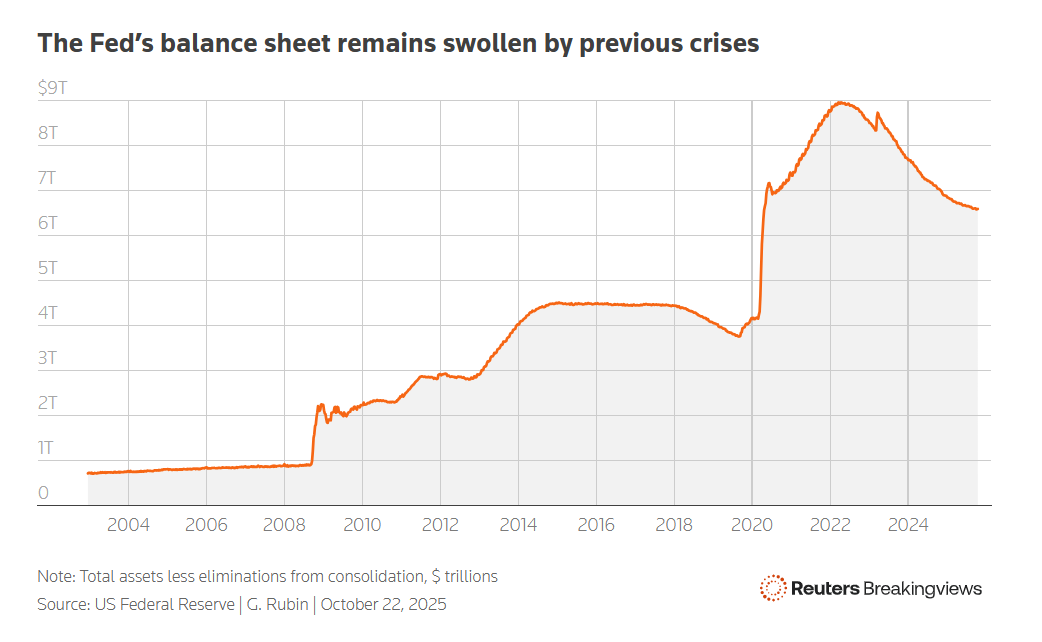
Core Viewpoint - The independence of the Federal Reserve is increasingly under threat as political influences grow, particularly with the upcoming retirement of Chairman Jerome Powell and the potential for President Trump to reshape the leadership and policies of the Fed [2][10]. Group 1: Federal Reserve Leadership and Political Influence - The impending retirement of Jerome Powell presents an opportunity for President Trump to alter the leadership of the Federal Reserve, which has faced criticism since Powell's appointment in 2018 [2]. - Scott Bessent, a key figure in the selection process, is expected to exert significant influence over the choice of Powell's successor, with speculation that Kevin Hassett is the leading candidate [2][3]. - Trump has publicly criticized Powell for not lowering interest rates quickly enough, indicating a desire for a more compliant Fed leadership [2][9]. Group 2: Criticism of Federal Reserve's Role - Bessent argues that the Federal Reserve has strayed from its original role, particularly during the financial crisis and the COVID-19 pandemic, where it expanded its influence without sufficient democratic oversight [3][7]. - The Fed's balance sheet has ballooned to $6.6 trillion, reflecting its expanded role in the economy, which has disproportionately benefited asset owners [3][6]. - Critics, including Bessent, suggest that the Fed has overestimated the effectiveness of fiscal stimulus while underestimating the impact of tax cuts and deregulation on economic growth [7]. Group 3: Regulatory and Structural Changes - The Fed's responsibilities have broadened post-2008 financial crisis, extending into areas like financial regulation and social issues, which some argue is beyond its mandate [7][8]. - There are calls to revisit the 1951 Federal Reserve-Treasury Agreement, which allowed the Fed to control its balance sheet independently, marking a significant step towards its independence [7][8]. - The Trump administration aims to align the Fed's regulatory agenda with White House priorities, including a push for lower interest rates and a shift in debt management responsibilities to the Treasury [8]. Group 4: Future Implications for the Federal Reserve - The potential loss of independence for the Federal Reserve could lead to a concentration of power in the government during future economic crises, undermining the Fed's ability to manage inflation and maintain credit health [10]. - Trust and recognition from the public are essential for the Fed to effectively control inflation and ensure financial stability, which may be compromised under the current political climate [10].