
房地产高质量发展

Search documents
多省市定调 未来五年房地产发展路线图浮出
2 1 Shi Ji Jing Ji Bao Dao· 2025-12-10 23:40
Core Viewpoint - The recent release of the 15th Five-Year Plan proposals by various provinces highlights the focus on real estate development, emphasizing risk mitigation, consumption promotion, urban renewal, and high-quality development during this transitional phase of the economy [1][4][11]. Group 1: Risk Mitigation and Consumption Promotion - The proposals stress the importance of preventing and resolving risks in the real estate sector, identifying it as a systemic risk alongside local government debt and small financial institutions [4]. - Shandong Province has proposed a mechanism for normalizing "white list" financing in real estate, indicating a policy shift towards improving financing structures [5]. - Several provinces, including Guangdong and Hubei, have included measures to promote housing consumption, reflecting its significance in driving overall consumption [6][7]. Group 2: Urban Renewal Initiatives - Urban renewal has been identified as a key strategy, with multiple provinces advocating for "in-depth urban renewal" and emphasizing the need for sustainable development models [9][10]. - Beijing's proposal includes comprehensive urban renewal strategies, focusing on the integration of resources and systematic updates to old neighborhoods [9]. - The emphasis on urban renewal reflects a shift from rapid expansion to enhancing existing urban areas, aligning with national urbanization goals [8][10]. Group 3: High-Quality Development - The concept of "high-quality development" is a recurring theme, with provinces like Shanxi and Shandong detailing specific institutional arrangements to support this goal [11][13]. - The establishment of foundational systems for real estate, such as safety inspections and quality management, is seen as essential for achieving high-quality outcomes [12][13]. - Differentiated policies based on local conditions are being proposed, indicating a tailored approach to real estate development across different regions [14][15].


多省市定调未来5年房地产发展路线
21世纪经济报道· 2025-12-10 14:43
编辑丨张伟贤 近期,多个省市陆续发布关于国民经济和社会发展的第十五个五年规划建议(以下简称"'十五五'规划建议"),对"十五五"时期的经 济社会发展提出目标和要求,并做出工作部署。 记者丨张敏 在多个省市的"十五五"规划建议中,提出"统筹推进"房地产风险有序化解,并将房地产与地方政府债务、中小金融机构的风险,并 列为需严格防范的系统性风险。 值得注意的是, 山东省还提出,健全房地产"白名单"融资常态化机制, 体现出从融资端推进相关制度建设的政策思路。 房地产处于新旧动能转换关键阶段,又事关金融稳定与民生福祉,对这项工作的安排,备受各方关注。 21世纪经济报道记者梳理多个地方的"十五五"规划建议发现,对房地产相关工作的部署,主要体现在化解风险、促进消费、发力城 市更新、推动高质量发展等方面。其中,不少地方的提法颇有亮点。 广东省、重庆市、厦门市均在"十五五"规划建议中提出,实现更高水平住有所居, 体现出在住有所居的基础上,对供应制度、居住 品质和管理体系的更高要求。 贵州省强调,探索推进"四房联动",即"以旧换新促进二手房与商品房联动,以需定购促进保障房与商品房联动,以购代建促进安置 房与商品房联动"。贵州还因 ...

多省市定调!未来五年房地产发展路线图浮出
2 1 Shi Ji Jing Ji Bao Dao· 2025-12-10 12:07
近期,多个省市陆续发布关于国民经济和社会发展的第十五个五年规划建议(以下简称"'十五五'规划 建议"),对"十五五"时期的经济社会发展提出目标和要求,并做出工作部署。 房地产处于新旧动能转换关键阶段,又事关金融稳定与民生福祉,对这项工作的安排,备受各方关注。 21世纪经济报道记者梳理多个省份的"十五五"规划建议发现,对房地产相关工作的部署,主要体现在化 解风险、促进消费、发力城市更新、推动高质量发展等方面。其中,不少省份的提法颇有亮点。 广东省、重庆市、厦门市均在"十五五"规划建议中提出,实现更高水平住有所居,体现出在住有所居的 基础上,对供应制度、居住品质和管理体系的更高要求。 贵州省强调,探索推进"四房联动",即"以旧换新促进二手房与商品房联动,以需定购促进保障房与商 品房联动,以购代建促进安置房与商品房联动"。贵州还因地制宜地提出,"大力发展旅居地产"。 作为城市内涵式发展的重要内容,不少省市对城市更新也有创新性提法。 梳理这些内容,对于理解未来五年房地产发展模式和路径,有着重要意义。 防风险与促消费并重 在楼市处于新旧发展动能转换的关键阶段,防范化解风险仍是房地产政策的重要底线。 在多个省市的"十五五 ...
房地产行业周报(25/11/29-25/12/5):发改委支持REITs底层资产扩围,成交继续边际走弱-20251210
Hua Yuan Zheng Quan· 2025-12-10 07:15
证券研究报告 房地产 行业定期报告 hyzqdatemark 2025 年 12 月 10 日 证券分析师 邓力 SAC:S1350525070006 dengli@jzsec.com 陈颖 SAC:S1350525110002 chenying02@huayuanstock.com 联系人 唐志玮 tangzhiwei@huayuanstock.com 发改委支持 REITs 底层资产扩围,成交继续边际走弱 投资评级: 看好(维持) ——房地产行业周报(25/11/29-25/12/5) 投资要点: 请务必仔细阅读正文之后的评级说明和重要声明 板块行情:本周上证指数上升 0.4%、深证成指上升 1.3%、创业板指上升 1.9%、沪深 300 上升 1.3%、房地产(申万)下跌 2.2%。个股方面,涨跌幅 前五的分别为:中国武夷(+10.2%)、华联控股(+7.4%)、华夏幸福(+7.1%)、 宁波富达(+5.7%)、财信发展(+5.6%),涨跌幅后五的分别为:三湘印象 (-12.9%)、ST 中迪(-11.5%)、沙河股份(-8.7%)、深振业 A(-8.4%)、新华 联(-8.3%)。 板块表现: 数据跟 ...




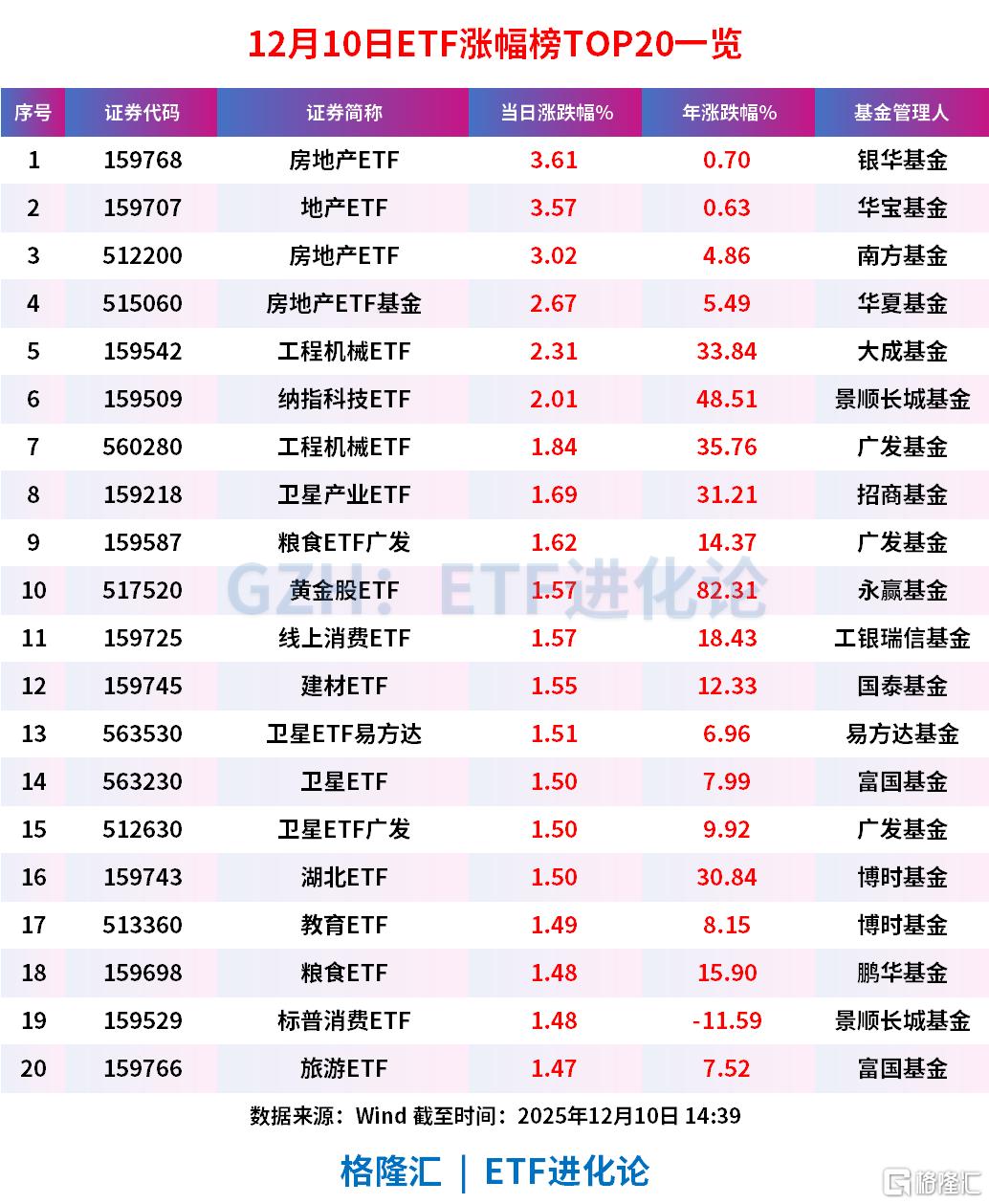
午后房地产板块拉升,万科涨停,房地产ETF、地产ETF、房地产ETF涨3%
Ge Long Hui A P P· 2025-12-10 06:57
Group 1 - Vanke A experienced a significant surge, hitting the daily limit with a closing order amount exceeding 2.7 billion [1] - Hong Kong real estate stocks also saw gains, with Vanke Enterprises rising over 17%, and other companies like R&F Properties and Sunac China increasing by over 12% [1] - Real estate ETFs showed positive performance, with increases of 3.61%, 3.57%, 3.02%, and 2.67% respectively [1] Group 2 - Vanke's first bond extension meeting is crucial for its financial relief, with three proposals discussed, including two new ones that may help reach a consensus [5] - The real estate market has faced deep adjustments this year, with second-hand housing prices declining across 70 cities in October, and overall sales and investment continuing to drop [5] - The industry is currently in a "bottoming" phase, with increasing losses reported in Q3 compared to Q2, indicating ongoing challenges [5] Group 3 - The long-term investment logic in the real estate sector has fundamentally changed, focusing on "high-quality development" as per the 20th Central Committee's fourth plenary session [6] - Current policies aim to stabilize the market and establish a new development model, emphasizing urban renewal and affordable housing [6] - The previous high-leverage model has ended, and companies are encouraged to adopt a balanced approach between development and operations, particularly in light-asset service sectors [6] Group 4 - The largest real estate ETF in A-shares is the Southern Real Estate ETF, with a latest scale of 5.122 billion [7] - Other ETFs include the Financial Real Estate ETF and Real Estate ETF Fund, with scales of 0.675 billion and 0.579 billion respectively [7] - The net inflow for the Southern Real Estate ETF is 0.674 billion, while the Financial Real Estate ETF has seen a net outflow of 0.569 billion [8]
四川“十五五”规划建议:推动“川居好房”建设,提升房屋品质和物业服务质量
Cai Jing Wang· 2025-12-10 03:41
其中提到,实现更高水平住有所居,加快构建房地产发展新模式,优化保障性住房供给,大力推动"川 居好房"建设,提升房屋品质和物业服务质量,加强房屋全生命周期安全管理,推动房地产高质量发 展。 有效防范化解房地产、地方政府债务、中小金融机构等重点领域风险。 推动房地产高质量发展。 12月10日,四川省发布《中共四川省委关于制定四川省国民经济和社会发展第十五个五年规划的建 议》。 ...
青海“十五五”规划建议:加大保障性住房建设和供给力度,更好满足城镇工薪群体和各类困难家庭基本住房需求
Cai Jing Wang· 2025-12-10 03:41
Core Viewpoint - The Qinghai Provincial Committee emphasizes the need for high-quality development in the real estate sector, focusing on a new development model and enhancing housing supply systems to meet diverse residential needs [2]. Group 1: Real Estate Development - The proposal includes accelerating the construction of a new model for real estate development, improving the foundational systems for commodity housing development, financing, and sales [2]. - There is a commitment to a "guarantee + market" housing supply system, promoting both rental and purchase options while increasing the construction and supply of affordable housing [2]. Group 2: Housing Supply and Quality - The initiative aims to better meet the basic housing needs of urban wage earners and various struggling families by providing diverse and upgraded housing options [2]. - The plan includes the creation of unique housing products, such as "summer resort houses," that reflect the characteristics of Qinghai [2]. - There is a focus on building safe, comfortable, green, and smart housing, along with implementing quality improvement projects for housing and property services [2].
新基础设施REITs项目行业范围清单发布;保险公司相关业务风险因子调整|每周金融评论(2025.12.1-2025.12.7)
清华金融评论· 2025-12-08 13:01
Group 1: Infrastructure REITs - The National Development and Reform Commission has released the "2025 Industry Scope List for Infrastructure REITs," expanding the range of projects eligible for REITs to include sports venues, commercial complexes, four-star hotels and above, and urban renewal projects [6][7]. - The expansion of the REITs issuance scope is expected to facilitate project applications, enhance efficiency, and stimulate market activity, particularly in urban renewal and consumption sectors [7]. Group 2: Insurance Industry - Five Chinese insurance companies made it to the 2025 Global Top 50 Property Insurance Companies list, with China Life Insurance being the only one in the top ten [8]. - The rankings of China Life, China Ping An, and China Reinsurance have declined compared to last year, prompting a need for these companies to rethink their international strategies [8]. Group 3: Urbanization and Real Estate - Premier Li Qiang emphasized the importance of new urbanization as a vehicle for expanding domestic demand and promoting industrial upgrades, highlighting the need for urban renewal actions [9]. - The focus on addressing housing issues for the large population of rural migrants is expected to create opportunities for real estate development in the coming years [9]. Group 4: Securities Industry - The Chairman of the China Securities Regulatory Commission indicated a policy shift towards enhancing capital efficiency for quality securities firms by loosening capital space and leverage restrictions [10][11]. - This policy aims to transition the industry from scale competition to value competition, addressing the low return on equity (ROE) issue [10][11]. Group 5: Insurance Risk Factor Adjustment - The National Financial Regulatory Administration has adjusted risk factors for insurance companies, reducing capital requirements for certain stock investments, which is expected to enhance capital utilization efficiency [12]. - The adjustment allows for a potential influx of capital into the market, estimated to bring in hundreds of billions [12]. Group 6: IPO Market - Moore Threads' IPO on the STAR Market achieved a market capitalization exceeding 300 billion yuan, marking the largest IPO on the STAR Market this year [13]. - This listing signifies a milestone in domestic GPU technology and reflects the capital market's support for high-tech industries [13]. Group 7: Central Bank Operations - The People's Bank of China conducted a 10 billion yuan reverse repurchase operation to maintain liquidity in the banking system, indicating a consistent approach to liquidity management [14]. - This operation is part of a broader strategy to stabilize liquidity expectations and interest rates, supporting economic stability [14].
房地产政策调控与市场趋势演变:现状分析与未来展望
Dong Fang Jin Cheng· 2025-12-08 08:55
Investment Rating - The report does not explicitly state an investment rating for the real estate industry Core Insights - The real estate market in China has shown strong sensitivity to policy adjustments since the housing reform in 1998, with three significant downturns and recoveries closely linked to policy interventions [2][4] - Recent policy relaxations, such as the "three arrows" policy and the "442" policy, have only resulted in temporary rebounds, indicating a weakening sensitivity of the market to policy changes [2][12] - The current downturn is characterized by a significant decline in both housing prices and sales, with the investment amount in October reaching the lowest level since 2013 [2][20] Summary by Sections 1. Interaction Between Real Estate Adjustments and Policy Regulation - Policy regulation has been the core driver of changes in the real estate market, with each downturn and recovery phase closely tied to policy adjustments [5] - The first adjustment occurred during the global financial crisis in 2008, where a significant stimulus plan led to a rapid recovery in sales [5][6] - The second adjustment in 2011-2012 saw a shift to a more relaxed monetary policy, which helped the market recover after a period of decline [6][7] - The third adjustment in 2014-2015 involved strict regulations to curb speculation, followed by a shift to "de-stocking" policies that eventually led to market recovery [7][8] 2. Current Downturn and Market Sensitivity - The current downturn has seen a significant reduction in the market's sensitivity to policy changes, with the impact of recent policies being less effective than in previous cycles [9][12] - Factors contributing to this include a slower-than-expected policy implementation, a systemic reduction in residents' willingness to leverage, and rising actual mortgage rates [13][14] 3. Market Performance in 2025 - The real estate market has continued to face downward pressure, with a notable decline in second-hand housing prices and overall sales volume [15][20] - From January to October 2025, the cumulative sales area and sales amount of commercial housing have decreased by 6.8% and 9.6% respectively, reaching levels comparable to 2010 [20] - Investment in real estate has also contracted significantly, with October's investment amount marking a new low since 2013 [25][29] 4. Future Policy Space and Directions - Future policies are expected to focus on stabilizing the market through both short-term stimulus and long-term structural adjustments [35][38] - The report highlights the need for a balanced approach that includes lowering mortgage rates and improving income distribution to enhance residents' purchasing power [64][68] - The establishment of a more mature regulatory framework for the real estate market, including measures to prevent risks associated with unfinished projects and to promote rental markets, is also emphasized [68][69]
再提稳楼市:房价不再是唯一答案
Sou Hu Cai Jing· 2025-12-08 06:49
12月3日,国务院进行第十七次专题学习,总理李强在会上强调,要深入实施城市更新行动,把城市更新和消除安全隐患、稳楼市等工作结合起 来,扎实推进好房子建设和房地产高质量发展。 可以说,在新的房地产发展语境之下,房价已经逐渐退化为结果性指标。非唯一目标。 不同城市、群体之间的居住需求差异还在不断放大,价格上涨没涨,已不再是市场的真实面貌! 从过往经验来看,近几年围绕房地产的所有举措几乎都围绕一个核心,那就是先托底,再重构。 根据国家统计局的数据显示,截止10月,全国商品房销售面积及销售金额仍在小幅回落,整体修复节奏偏缓。 也正是在这样的现实背景之下,稳楼市的意义反而愈发凸显。 在今年内中央遴选了20个城市更新示范城市,在财政层面累计投入超过200亿,重点用于老旧小区,城中村基础建设等方向。 当然这也并不是要让房地产重回高歌猛进的老路,而是在历经多年的下探和挤压之后,通过更系统有序的方式为市场寻找一套可持续的运行逻 辑。 与过去相比,本轮的稳楼市路径也将发生改变,在两三年前,更多体现在政策松绑以及需求刺激上。 例如限购松动,首付下降,利率下调,补贴支持等手段更为直接。 但这些工具逐步用尽后,边际效应开始显现,单纯从 ...
