人工智能(AI)

Search documents
英伟达独强难支,AI股何去何从?
Jin Shi Shu Ju· 2025-11-24 03:26
Core Insights - The initial positive reaction to Nvidia's earnings report did not alleviate investor concerns about the AI stock bubble, leading to significant market volatility [1] - The market is currently divided into two camps: skeptics who warn of bubble risks and optimists who see potential for long-term growth [2] Group 1: Skeptics' Concerns - Skeptics are worried that the market valuations are reaching unreasonable levels as investors chase a few AI-related stocks [3] - There are concerns about the sustainability of the massive capital investments made by companies to remain competitive, especially as they begin to incur debt [3] - The cyclical nature of these financing arrangements could pose systemic risks, where the weakness of one company could drag down the entire AI-related sector [3] Group 2: Optimists' Perspective - Optimists view the recent pullback in AI stocks as a healthy correction, indicating that greater growth is on the horizon [4] - Major tech companies like Microsoft, Amazon, Meta Platforms, and Alphabet are expected to continue investing heavily in AI, with a projected 34% increase in capital expenditures to $440 billion over the next 12 months [4] - There is a belief that the AI investment cycle is just beginning, supported by strong industry demand and a favorable regulatory environment [4] Group 3: Nvidia's Role and Market Reactions - Nvidia's performance was anticipated due to prior disclosures from its major clients, which account for over 40% of its sales [5] - Despite Nvidia's strong earnings, other semiconductor stocks have faced significant declines, with the chip-related stock index dropping 11% in November, marking the worst monthly performance since 2022 [5] - Concerns about the sustainability of AI spending have led to sharp declines in stocks of companies like AMD and ARM, with losses exceeding 20% [5] Group 4: Investment Return Concerns - Investors are increasingly questioning the return on investment (ROI) for AI-related expenditures, which is critical for future growth and profitability [6] - The need for clarity on ROI is seen as essential for reviving interest in AI investments, with expectations that it may take one or two more quarters to see relevant evidence [6] - Nvidia's earnings report may have temporarily alleviated immediate concerns about AI investment sustainability, but doubts about large spending companies remain [6] Group 5: Market Volatility and Consensus - The divergence in investor perspectives contributes to ongoing volatility in the AI market, with macroeconomic uncertainties and differing views on the AI revolution's development stage [8] - The collapse of the cryptocurrency market is also seen as a factor contributing to the observed volatility [8]

越秀证券每日晨报-20251124
越秀证券· 2025-11-24 02:21
Market Performance - The Hang Seng Index closed at 25,220, down 2.38% for the day and up 25.72% year-to-date [1] - The Hang Seng Tech Index fell 3.21% to 5,395, with a year-to-date increase of 20.76% [1] - The CSI 300 Index decreased by 2.44% to 4,453, with a year-to-date rise of 13.18% [1] - The Shanghai Composite Index closed at 3,834, down 2.45%, marking a year-to-date increase of 14.41% [1] - The Shenzhen Component Index dropped 3.41% to 12,538, with a year-to-date increase of 20.39% [1] Currency and Commodity Overview - The Renminbi Index stood at 97.830, up 0.52% over the past month and 1.35% over six months [2] - Brent crude oil price was $62.720 per barrel, up 2.62% month-on-month but down 1.29% over six months [2] - Gold price was $4,059.66 per ounce, down 1.68% month-on-month but up 22.36% over six months [2] - Bitcoin price fell to $83,560, marking a 7.02% decline, the lowest in over seven months [23] Hong Kong Stock Market Review - The Hong Kong stock market experienced significant declines, with the Hang Seng Index hitting a two-and-a-half-month low and recording its largest single-day drop in over seven months [5] - Major tech stocks like Alibaba and Baidu fell nearly 5%, while Meituan and JD.com dropped close to 3% [5] - The property sector saw significant declines, with Link REIT dropping about 7.5%, marking a near seven-month low [5] A-Share Market Review - The A-share market saw major indices drop between 2.5% to 4%, with the Shanghai Composite Index falling below 3,900 points [6] - The Shenzhen Component Index and ChiNext Index also reached approximately two-and-a-half-month lows [6] US Stock Market Overview - The US stock market indices closed up nearly 1%, with the Dow Jones rising 1.1% to 46,245 [7] - The Nasdaq Index increased by 0.9% to 22,273, while the S&P 500 rose by nearly 1% to 6,602 [7] - Major tech stocks showed mixed results, with Alphabet rising over 3% while Nvidia and Microsoft fell [7] European Market Overview - European stock markets showed mixed results, with the DAX Index down 0.8% and the CAC Index up slightly [8] - Over the week, German stocks fell nearly 3.3%, while French stocks declined close to 2.3% [8] Economic Indicators - The Central City Leading Index (CCL) in Hong Kong rose 0.54% week-on-week, reaching a near one-and-a-half-year high, with a year-to-date increase of 3.52% [11] - In mainland China, electricity consumption in October reached 857.2 billion kWh, a year-on-year growth of 10.4% [20] - Japan's exports to the US have declined for seven consecutive months, with a 3.1% year-on-year drop in October [19]
财信证券宏观策略周报(11.24-11.28):短期保持谨慎,静待市场企稳
Sou Hu Cai Jing· 2025-11-24 00:41
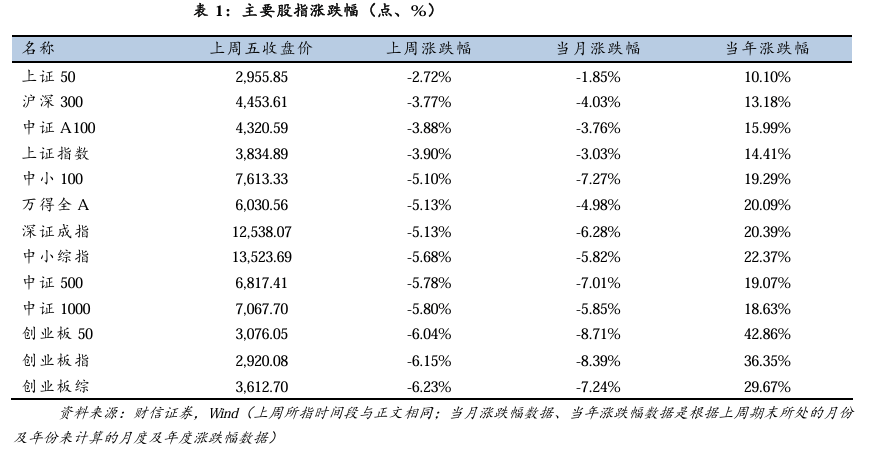
来源:市场资讯 (来源:财信证券研究) 大势研判。上周在海外市场调整影响下,万得全A指数阶段性向下调整,跌破震荡调整区间,短期仍需合理控制仓位,静待指数企 稳信号出现。一是从资金面来看,11月底之前机构倾向于守住全年收益,加仓意愿不强,但12月中旬开始,机构资金将逐步开始布 局2026年方向,存在"抢跑"的预期;二是中央经济工作会议通常在12月中旬召开,将为明年经济工作指明方向,预计在中央经济工 作会议前后,政策预期利好将支撑市场;三是从技术形态来看,2015年以来,上证指数曾屡次挑战3700点未果,本次有效突破3700 点以后,上证指数3700点附近将从"强压力位"转为"强支撑位",后续指数调整空间可能有限。我们对中长期市场走势仍然保有信 心,A股这一轮"牛市"并未结束,我们预计12月中旬前后,市场将迎来再次做多的机会窗口期。 投资建议。短期建议适当控制仓位水平,以防守方向为主,适当关注:(1)高股息的大盘蓝筹。例如银行、保险、公用事业、交通 运输等。(2)新消费方向。例如健康、文旅、体育、美容护理、IP经济、宠物经济、文化娱乐等。(3)"反内卷"方向。例如钢 铁、煤炭、建材等。(4)AI应用方向。例如传媒 ...

这八个岗位,未来两年会消失?
吴晓波频道· 2025-11-24 00:20
为何是730天?根据专家的预测,AI在代码生成、测试与部署领域的速度曲线,正以3.4倍的季度增速逼近人类开发极限。这意味着,仅两年 后,人工岗位数量或将迎来首次负增长拐点。 立即点击 ▲ 观看视频 如果我告诉你,24个月后,你所在的岗位很可能就被AI取代,你的第一反应会是什么? 这并非危言耸听。在不久前的硅谷论坛上,几位AI专家达成了一个共识——未来730天(即两年内),8类岗位或将被AI取代。 ◎ 第三,你能否在变化中保留一个安静的自己。 那是哪8类岗位会优先被取代呢?几位专家的观点是,初级开发、销售助理、客服支持、内容编辑、招聘筛选、项目协调、报表制作及基础数据 分析这8个类别。这些岗位具备共同特征:可结构化、可流程化、可预测与可衡量。 此外,几位专家在论坛中还提出几个颇具启发的观点。 ◎ 其一 ,人 类认知进化和AI进化存在"错位"。AI的决策判断往往快速、清晰且结构化,而人类判断多偏模糊、情绪化,依靠经验积累,二者 形成"不对称竞争"。AI的诞生,恰似闯入人类生态系统的外来物种,无天敌制约,人类大脑对AI也没有任何的免疫系统。今天,我们或许将自 身所有认知漏洞和盘托出,交付给这一黑盒系统。 ◎ 其 二 ...

专访巴黎政治大学校长:我不太喜欢“精英”这个词,它可能会加剧社会分裂
Xin Lang Cai Jing· 2025-11-23 23:38
Core Viewpoint - The president of Sciences Po, Luis Vassy, emphasizes the importance of "excellence" over "elite," advocating for a commitment to doing one's best to reduce social divisions [1][9]. Group 1: Background of Sciences Po - Founded in 1872, Sciences Po is known as a breeding ground for French political elites, having produced numerous national leaders, including President Emmanuel Macron [3]. - Vassy, a graduate of Sciences Po, previously served as a diplomat and chief of staff for two French foreign ministers, highlighting the importance of international communication in both diplomacy and education [4]. Group 2: Impact of AI on Education - Vassy acknowledges the challenges posed by AI but does not view it as a crisis, noting that the first affected areas are primarily technical fields like programming [7]. - He believes that social sciences and humanities have a unique opportunity to thrive, as human contributions in strategic judgment and critical thinking surpass technical knowledge [7][8]. Group 3: Responsibility of Students - Vassy stresses that students at Sciences Po, which admits only the top 2% of high school graduates in France, have a responsibility to society, as their actions will influence future leaders [8][9]. - He emphasizes the need for students to maintain their ambition and effort, ensuring they can contribute meaningfully even without technological tools [8]. Group 4: European Strategic Autonomy - Vassy discusses the importance of understanding Europe and its operations, especially in light of current geopolitical tensions, and plans to introduce a mandatory course on Europe for all students [10][11]. - He believes that the concept of "strategic autonomy" for Europe is gaining traction, with a growing commitment to independence and the ability to defend its interests [11]. Group 5: Academic Freedom - Vassy advocates for academic and intellectual freedom, arguing that a competitive society relies on well-functioning universities and the ability to conduct research freely [12].

博道基金杨梦: “双均衡”配置 获取稳定超额收益
Zhong Guo Zheng Quan Bao· 2025-11-23 21:49
Core Insights - The article highlights the significant growth and development of the quantitative investment sector in China, particularly focusing on the achievements of Bodao Fund's quantitative product, which has delivered a cumulative return of over 144% since its inception in August 2018, with an annualized return exceeding 13% [1] - Bodao Fund's quantitative management scale has reached approximately 27 billion yuan, placing it among the top three in the industry, reflecting the rapid expansion of the public quantitative product market, which has surpassed 400 billion yuan as of Q3 2025 [1] - The firm emphasizes a balanced approach in its investment strategy, integrating traditional multi-factor models with AI-driven frameworks to ensure sustainable excess returns across different market cycles [5][6] Group 1: AI Integration and Development - Bodao Fund began exploring AI in quantitative investment as early as 2017, evolving its approach to include AI price-volume factors by 2019, which contributed to strong performance in 2020 and 2021 [2] - In Q1 2023, the quantitative team upgraded its AI framework to an "AI full-process investment framework," allowing for end-to-end learning and prediction from raw data [2] - The team has conducted thousands of trials on AI models, resulting in several sub-strategy models ready for real-world application, showcasing a commitment to continuous evolution and practical implementation [3] Group 2: Team Structure and Collaboration - The quantitative team at Bodao Fund operates under a "collaborative research and investment integration" model, ensuring that each member specializes in a specific research area, which enhances the uniqueness and competitiveness of their strategies [3][4] - The team consists of eight internally trained members, focusing solely on research while systematizing the processes of portfolio generation, trade execution, and attribution analysis to maintain high discipline and consistency in investment [3] Group 3: Balanced Investment Strategy - Bodao Fund adopts a "double balance" strategy, combining traditional multi-factor models and AI frameworks, each contributing 50% to the investment process, which allows for complementary information extraction [6] - The strategy also includes a balanced factor weighting approach, ensuring that stock return predictions are derived equally from fundamental analysis and valuation/technical factors, which helps stabilize performance across varying market conditions [6][7] Group 4: Product Offerings and Market Positioning - Bodao Fund has developed a clear and structured "index+" product matrix to cater to diverse investor needs, including standard index enhancement, flexible index enhancement, Smart Beta enhancement, and quantitative fixed income series [8][9] - Each product is designed with specific investment scenarios in mind, addressing common investor challenges such as the difficulty of selecting funds, thereby providing systematic solutions to outperform average active fund performance [9][10] Group 5: Long-term Vision and Market Adaptation - The firm maintains a long-term vision focused on sustainable excess returns, recognizing that the financial market is primarily driven by human participation and historical patterns cannot be perfectly applied to the future [5][10] - Bodao Fund's commitment to a balanced strategy and continuous adaptation to market changes positions it favorably for long-term success, aiming to provide investors with stable returns and a better holding experience [7][10]
视频丨跟着课本去旅行 苏州园林“一秒入画” 处处诗意处处寻
Yang Shi Xin Wen Ke Hu Duan· 2025-11-23 14:29
Core Viewpoint - The article highlights the beauty and artistic design of Suzhou gardens, emphasizing their unique "picture-like" quality that captivates visitors, especially students experiencing them firsthand during their autumn break [2][4][12]. Group 1: Artistic Design and Experience - Suzhou gardens are characterized by their scenic artistry, with elements like windows and pavilions serving as "viewing frames" that capture different beautiful scenes [4]. - Students express that visiting the gardens provides a deeper understanding of their layout and beauty compared to reading about them in textbooks [6][8]. - The design of the gardens encourages a gradual reveal of the best views, enhancing the experience of exploration rather than presenting everything at once [10]. Group 2: Technological Integration and Visitor Engagement - The experience of visiting Suzhou gardens is evolving with the integration of high-precision digital collection, VR, and AI technologies, creating a more immersive and interactive environment [16]. - From January to October of this year, visitor numbers have increased by approximately 10% compared to the same period last year, indicating a growing interest in these cultural sites [18].

量化择时和拥挤度预警周报(20251121):市场下周或将维持震荡-20251123
GUOTAI HAITONG SECURITIES· 2025-11-23 12:47
- The SAR indicator shows that the Wind All A Index broke below the reversal point on November 17, indicating a bearish signal for the market[3][10][13] - The moving average strength index, calculated using Wind secondary industry indices, scored 80, placing it at the 25.9% percentile since 2023, suggesting further downside potential in the market[3][10][13] - The sentiment model, constructed using factors related to limit-up and limit-down board data, scored 0 out of 5, indicating weak market sentiment. Both the trend model and weighted model signals are negative[3][10][13] Sentiment Model Construction - **Name**: Sentiment Model - **Construction Idea**: The model uses limit-up and limit-down board data to measure market sentiment strength[10][13] - **Detailed Process**: Factors such as net limit-up ratio, next-day return after limit-down, limit-up board ratio, limit-down board ratio, and high-frequency board trading returns are calculated to derive the sentiment score[13] - **Evaluation**: The sentiment model indicates weak market sentiment, with a score of 0 out of 5[10][13] Sentiment Model Backtest Results - **Sentiment Model**: Sentiment score = 0[13] Factor Crowding Observations - **Name**: Factor Crowding Metrics - **Construction Idea**: Factor crowding is measured to predict potential factor failure due to excessive capital tracking or investing in specific factors[14] - **Detailed Process**: Metrics such as valuation spread, pairwise correlation, long-term return reversal, and factor volatility are used to calculate crowding levels for common factors like small-cap, low valuation, high profitability, and high growth[14][15] - **Evaluation**: Low valuation factor shows the highest negative crowding score (-0.69), indicating potential instability, while small-cap factor has a positive crowding score (0.39), suggesting moderate stability[15][17] Factor Crowding Backtest Results - **Small-cap Factor**: Crowding score = 0.39[15][17] - **Low Valuation Factor**: Crowding score = -0.69[15][17] - **High Profitability Factor**: Crowding score = -0.02[15][17] - **High Growth Factor**: Crowding score = 0.05[15][17]
原来,这才是印度IT产业的成色与底色
虎嗅APP· 2025-11-23 10:01
Core Insights - The Indian IT industry is facing significant challenges due to the impact of artificial intelligence (AI) and geopolitical tensions, highlighted by Tata Consultancy Services (TCS) announcing a major layoff plan of 12,000 positions by March 2026, which is about 2% of its workforce [2][14] - The rise of AI technologies, such as ChatGPT and Claude, threatens the traditional low-cost labor advantage that India has relied on for decades, leading to potential structural unemployment in the IT sector [14][15] - India's IT sector, while historically successful, has been criticized for lacking innovation and primarily serving as a low-cost service provider rather than a leader in technological advancements [8][12] Historical Context - India's IT industry has evolved over the past 30 years, transitioning from a service-oriented economy to a global leader in IT services, particularly after the Y2K crisis in the late 1990s [4][5] - The sector has experienced a compound annual growth rate of 14% in service exports from 1993 to 2022, making India the second-largest IT service exporter globally, with a 15% market share [5][6] Current Challenges - The Indian IT industry's reliance on low-cost labor has created a "resource curse," where the focus on human capital over innovation has left it vulnerable to AI advancements [6][12] - Despite a large pool of IT talent, India has not produced globally recognized software products or brands, limiting its role in the innovation landscape [8][9] - The lack of investment in research and development (R&D) is evident, with India's R&D spending at only 0.65% of GDP, compared to 2.68% in China and 3.3% in the U.S. [10][11] Impact of AI and Geopolitical Factors - The rapid advancement of AI is eroding the cost advantage that Indian IT firms have enjoyed, as AI tools can perform many tasks previously handled by human labor at a lower cost [14][16] - U.S. protectionist policies, including tariffs on Indian goods and proposed taxes on outsourcing, pose additional risks to the Indian IT sector, which heavily relies on the U.S. market for revenue [15][17] Future Strategies - In response to these challenges, the Indian government and industry leaders are initiating measures to pivot towards AI and innovation, including a national AI plan and increased investment in R&D [19][20] - Major IT firms are recognizing the need to transition from low-cost outsourcing to more value-added services, with companies like Infosys and Wipro planning to enhance their AI capabilities and employee training [20][21] - The establishment of Global Capability Centers (GCCs) by multinational companies in India may provide opportunities for skill enhancement and knowledge transfer, potentially helping to overcome the current low-end service lock-in [20]




苏姿丰:不担心AI泡沫,2030年市场规模将达1万亿美元
Sou Hu Cai Jing· 2025-11-23 07:15
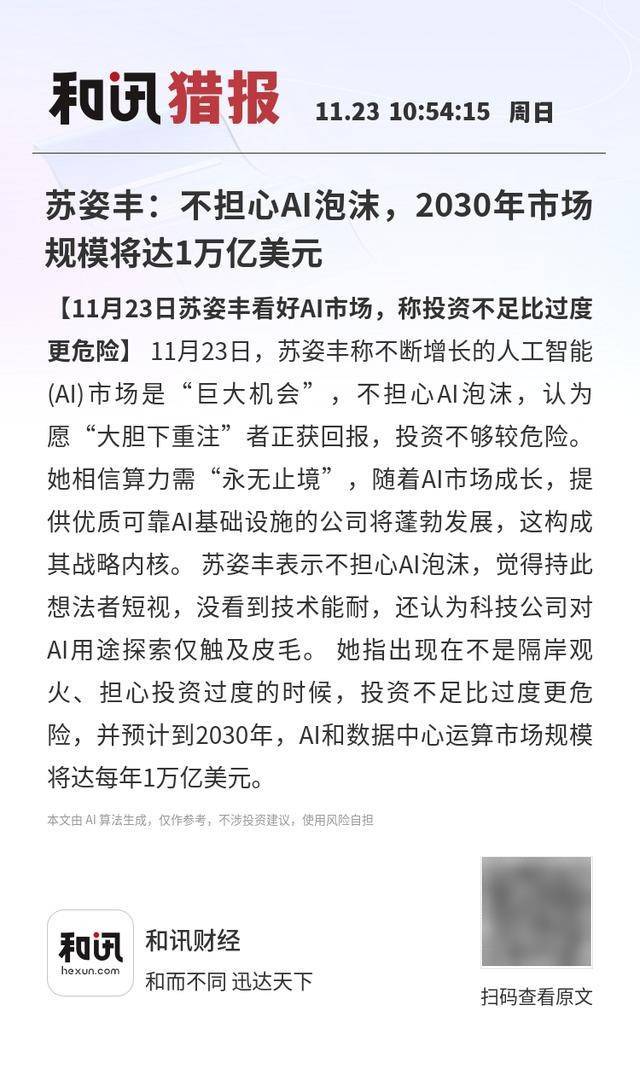
【11月23日苏姿丰看好AI市场,称投资不足比过度更危险】11月23日,苏姿丰称不断增长的人工智能 (AI)市场是"巨大机会",不担心AI泡沫,认为愿"大胆下重注"者正获回报,投资不够较危险。 她相信算 力需"永无止境",随着AI市场成长,提供优质可靠AI基础设施的公司将蓬勃发展,这构成其战略内核。 苏姿丰表示不担心AI泡沫,觉得持此想法者短视,没看到技术能耐,还认为科技公司对AI用途探索仅 触及皮毛。 她指出现在不是隔岸观火、担心投资过度的时候,投资不足比过度更危险,并预计到2030 年,AI和数据中心运算市场规模将达每年1万亿美元。 本文由 AI 算法生成,仅作参考,不涉投资建议,使用风险自担 扫码查看原文 FOG hexun.com 和讯财经 和而不同 迅达天下 ...