生成式AI

Search documents
对冲基金大佬Griffin:生成式AI很难发现Alpha,对冲基金难借此跑赢市场
Hua Er Jie Jian Wen· 2025-10-16 08:46
Group 1 - Ken Griffin stated that generative AI has not yet helped hedge funds achieve excess returns and has not made a substantial impact on the industry [1] - Griffin emphasized that while generative AI has clear value in enhancing productivity, it has not replaced meaningful research work at Citadel [1] - Citadel, founded by Griffin in 1990, currently manages assets totaling $69 billion and has become a major player in the industry [1] Group 2 - Griffin expressed skepticism about the transformative potential of generative AI, suggesting its impact will be limited and disproportionately affect different industries [2] - He previously referred to AI as a limited tool in investment analysis and downplayed its potential to replace human jobs in the short term [2] - During the meeting, Griffin highlighted the limitations of generative AI in identifying investment opportunities, particularly for hedge funds like Citadel that rely on deep research and trading strategies [2] - Despite reservations about AI's role in investment, Griffin acknowledged that the technology is driving increased tech investments by U.S. companies and elevating the status of Chief Technology Officers [2] - He noted that the AI wave has enabled companies to achieve business advancements that should have been completed over the past 25 years, indicating that generative AI's value lies more in operational efficiency than in strategic advantages in financial markets [2]
指数再度进入到横盘震荡!指数红了却亏钱,还有哪些投资机会?
Sou Hu Cai Jing· 2025-10-16 08:23
Group 1 - Current liquidity remains a key characteristic of the short-term stock market, with market risk appetite driving market rhythm. The upcoming interest rate cuts by the Federal Reserve may lead to a slight slowdown in capital inflows, while foreign capital may gradually shift towards inflows due to the potential for interest rate cuts, appreciation of the RMB, and stabilization of domestic PPI [1] - The top five sectors with net inflows include: large financials, banks, liquor, coal, and insurance. The top five concept sectors with net inflows are: DRAM, servers, smart glasses/MR headsets, optical co-packaging CPO, and optical communication. The top ten individual stocks with net inflows are: Sunshine Power, ZTE, Kweichow Moutai, Changan Automobile, Shannon Semiconductor, Zhongji Xuchuang, Cambrian, Longi Green Energy, Invec, and Tuwei Information [1] Group 2 - The global smartphone shipment volume is expected to reach 1.24 billion units in 2025, with a year-on-year growth of 1%, which is higher than the previously set 0.6% [3] - The average selling price of global smartphones is projected to increase by 5% year-on-year in 2025, with the total market value expected to grow by 6% year-on-year [3] - Key areas of focus for manufacturers include ultra-thin body design, generative AI technology, foldable screens, and advanced camera systems, aimed at attracting consumers through differentiated competition and enhancing product value [3] Group 3 - Gold prices have reached historical highs this year, with silver prices also rising, as London spot silver prices surpassed $42 per ounce, marking a 14-year high with a cumulative increase of over 40% this year [5] - The main silver futures contract price on the Shanghai Futures Exchange has exceeded 10,000 yuan per kilogram, reaching a nearly 13-year high with a cumulative increase of over 30% this year [5] - The demand for investment silver bars has significantly increased alongside rising silver prices, while orders for semi-finished jewelry products have decreased [5] Group 4 - The short-term trend of the market is weak, with no significant inflow of incremental capital and a weak market profit effect [7] - The Shanghai Composite Index reached a new high with reduced trading volume, breaking the 4000-point mark in just one day, but the significant rise does not guarantee profits for investors [11] - The market direction has become unclear, with cautious participation from funds, and a focus on value-oriented non-bank sectors is recommended in a "slow bull" market [11]


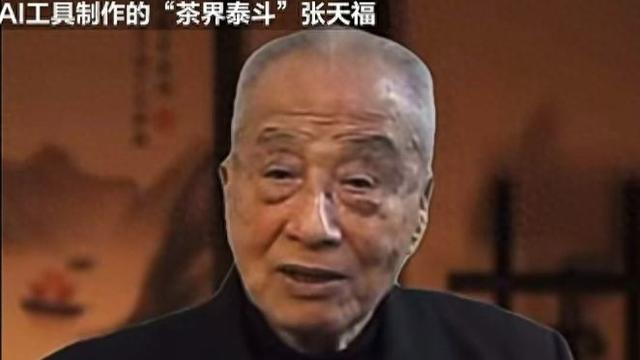
“复活”茶界泰斗代言、伪造主持人卖货:AI不可逾越哪些红线?
Xin Lang Cai Jing· 2025-10-16 07:23
Core Viewpoint - The use of AI technology to "revive" deceased individuals for commercial endorsements raises ethical concerns and legal issues, particularly when done without the consent of the deceased's family [4][5][6]. Group 1: Ethical and Legal Implications - The recent controversy surrounding the AI-generated video of the late tea master Zhang Tianfu endorsing a tea company highlights the potential for misuse of AI in marketing, which can violate the deceased's image and reputation rights as protected by laws such as the Civil Code [4]. - The family of Zhang Tianfu has expressed intentions to pursue legal action to protect their rights, indicating the seriousness of unauthorized use of a deceased person's likeness for commercial gain [4]. - The trend of using AI to create content featuring deceased individuals has become more common, with instances of other historical figures being digitally resurrected for various media, raising questions about respect for the deceased and the impact on their families [4]. Group 2: Consumer Protection and Market Trust - The misuse of generative AI in advertising can mislead consumers, as seen in a case where a company falsely claimed its product could treat multiple diseases and used a fabricated image of a well-known host to promote it [5]. - This manipulation exploits consumer trust in authoritative figures and media, significantly reducing vigilance among consumers and undermining the integrity of the market [5]. - The low barrier to creating AI-generated videos poses a risk, as even minimal audio or video material can be used for deep synthesis, complicating the enforcement of data security and ethical standards [5]. Group 3: Technological Development and Governance - While AI is intended to serve humanity, its development must remain within legal and ethical boundaries to prevent it from becoming a tool for exploiting the deceased or misleading the public [6]. - Effective governance of AI technology is essential to ensure it contributes positively to society and maintains public trust [6].
香港金管局公布生成式AI沙盒名单,蚂蚁数科、富邦香港、中银香港等机构入选
Jing Ji Guan Cha Wang· 2025-10-16 06:39
Core Insights - The Hong Kong Monetary Authority (HKMA) and Hong Kong Cyberport Management Company Limited announced the second phase of the generative AI sandbox participant list, featuring 20 banks and 14 technology partners with 27 use cases [1] Group 1: Participants and Use Cases - Notable participants include Ant Bank, Bank of China Hong Kong, and Fubon Bank Hong Kong, highlighting a diverse range of financial institutions involved in the initiative [1] - Ant Group's Ant Technology is a key technology provider, contributing innovative solutions such as AI agent services and AI security products [1] Group 2: Objectives and Benefits - The initiative aims to enhance banking operational efficiency, improve user experience, and strengthen financial risk management capabilities [1]

香港金管局公布生成式AI沙盒名单,蚂蚁数科入选技术合作伙伴
Xin Lang Ke Ji· 2025-10-16 06:05
Group 1 - The Hong Kong Monetary Authority (HKMA) and Hong Kong Cyberport Management Company announced the second phase of the generative AI sandbox, featuring 20 banks and 14 technology partners with 27 use cases, including Ant Group as a key technology provider [1] - The second phase of the sandbox focuses on enhancing AI governance, employing "AI against AI" strategies for automated governance monitoring of AI-generated content, improving system accuracy and consistency [1] - Fubon Bank (Hong Kong) will collaborate with Alibaba Cloud, Ant Group, and Weitou Zhikong to explore an AI assistant for a personalized, secure, and interactive mobile banking experience, enhancing financial service accessibility and promoting financial inclusion [1] Group 2 - Ant Group's ZOLOZ will provide AI risk control solutions for Hong Kong financial institutions, utilizing AI facial recognition and document verification to defend against deepfake attacks and batch account opening fraud, achieving a 99.9% accuracy rate in identification [2] - The AI risk control solutions will offer lightweight integration and continuous evolution for digital banks, effectively improving risk control efficiency and reducing labor costs [2]
苏姿丰出手,Oracle下单5万颗AMD芯片,英伟达王座撼动
3 6 Ke· 2025-10-16 00:39
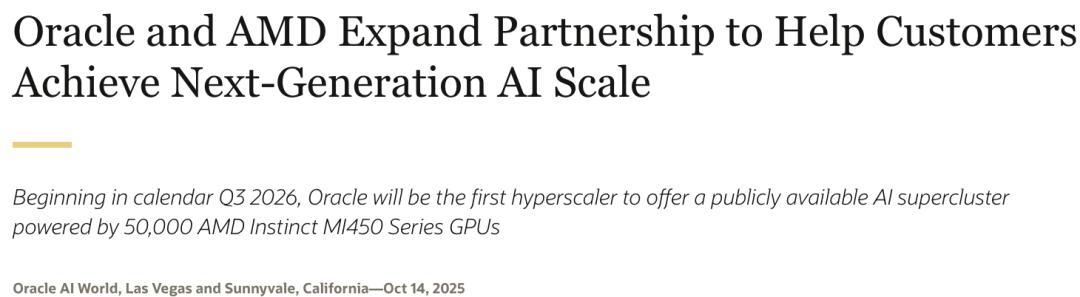
Core Insights - Oracle announced the deployment of 50,000 AMD Instinct™ MI450 GPUs in its OCI starting Q3 2026, with plans for further expansion in 2027 and beyond [1][9] - The collaboration aims to provide AMD Instinct GPU platform's computing power directly to OCI customers [2] - AMD's CEO Lisa Su highlighted the strong market response to the partnership, with AMD's stock experiencing an increase of approximately 0.8% to 3% following the announcement [4] Group 1: Technical Specifications and Innovations - The MI450 GPUs are designed for advanced large models, generative AI, and high-performance computing tasks, featuring significant upgrades in memory and bandwidth [7] - Each MI450 GPU is equipped with 432GB HBM4 memory and 20TB/s bandwidth, allowing for training models 50% larger than the previous generation under the same memory conditions [7] - The new liquid cooling architecture "Helios" enhances performance density, cost, and energy efficiency while optimizing inter-rack communication speed [7] - The architecture includes the next-generation AMD EPYC "Venice" CPU, which improves scheduling and data processing, and supports confidential computing and built-in security [7] Group 2: Strategic Implications and Market Position - The expanded collaboration between AMD and Oracle is seen as a significant move in the ongoing AI computing power race, especially following Oracle's previous deployment of AMD Instinct MI300X GPUs [9][10] - The partnership is viewed as a critical breakthrough for AMD in the competitive AI chip market, particularly against Nvidia, which currently holds a 92% market share in the data center GPU sector [17] - The collaboration with OpenAI, which involves deploying approximately 6 gigawatts of computing power through AMD GPUs, further solidifies AMD's strategic alliances in the AI ecosystem [15][20] - The formation of a new AI ecosystem linking chips, cloud platforms, and model applications is emerging, intensifying competition for computing power dominance [20]


哔哩哔哩-W(9626.HK):社区生态稳健 商业化成熟向前
Ge Long Hui· 2025-10-15 20:58
Core Viewpoint - Huatai Securities initiates coverage on Bilibili's Hong Kong stock with a "Buy" rating and a target price of HKD 316.5, corresponding to a 25E PS of 4.1x, highlighting the company's unique position as a mid-video community platform with a solid ecosystem and robust user retention [1][2]. Group 1: Community and User Engagement - Bilibili has evolved from a niche ACG community to a comprehensive video ecosystem over 15 years, establishing a competitive moat through its unique community atmosphere and closed-loop ecosystem [1]. - The platform primarily attracts a young demographic, with over 80% of users under 35 years old, showcasing high user retention rates, including over 80% for formal members and more than 84% for users with over ten years on the platform [1]. Group 2: Advertising Business - The advertising segment has transitioned from an exploratory phase to systematic and scalable growth, with an expected overall revenue growth of 27.7% in 2024, driven by a 40% increase in performance advertising [1]. - The completion of the advertising infrastructure and the integration of AI technology have significantly enhanced advertising efficiency, with a projected 10% year-on-year increase in eCPM for the first half of 2025 [1]. Group 3: Gaming Business - The gaming segment has shown a strong recovery, with revenues reaching CNY 5.6 billion in 2024, a 40% year-on-year increase, largely due to the successful launch of the new game "Three Kingdoms: Strategy Determination" [2]. - The strategy focuses on long-term operation and youth-oriented game categories, with both self-developed and exclusive agency games contributing to revenue growth [2]. Group 4: Market Perspective and Valuation - The market tends to focus on valuation and growth certainty, but the company’s community advantages and high active user growth remain underappreciated [2]. - Revenue projections for 2025-2027 are CNY 30.03 billion, CNY 32.72 billion, and CNY 35.09 billion, with adjusted net profits expected to be CNY 2.31 billion, CNY 3.18 billion, and CNY 3.99 billion respectively [2].

Anthropic上线高性价比小模型Haiku 4.5,编程比肩Sonnet 4,今年营收有望90亿、力争明年翻近两倍
Hua Er Jie Jian Wen· 2025-10-15 20:27
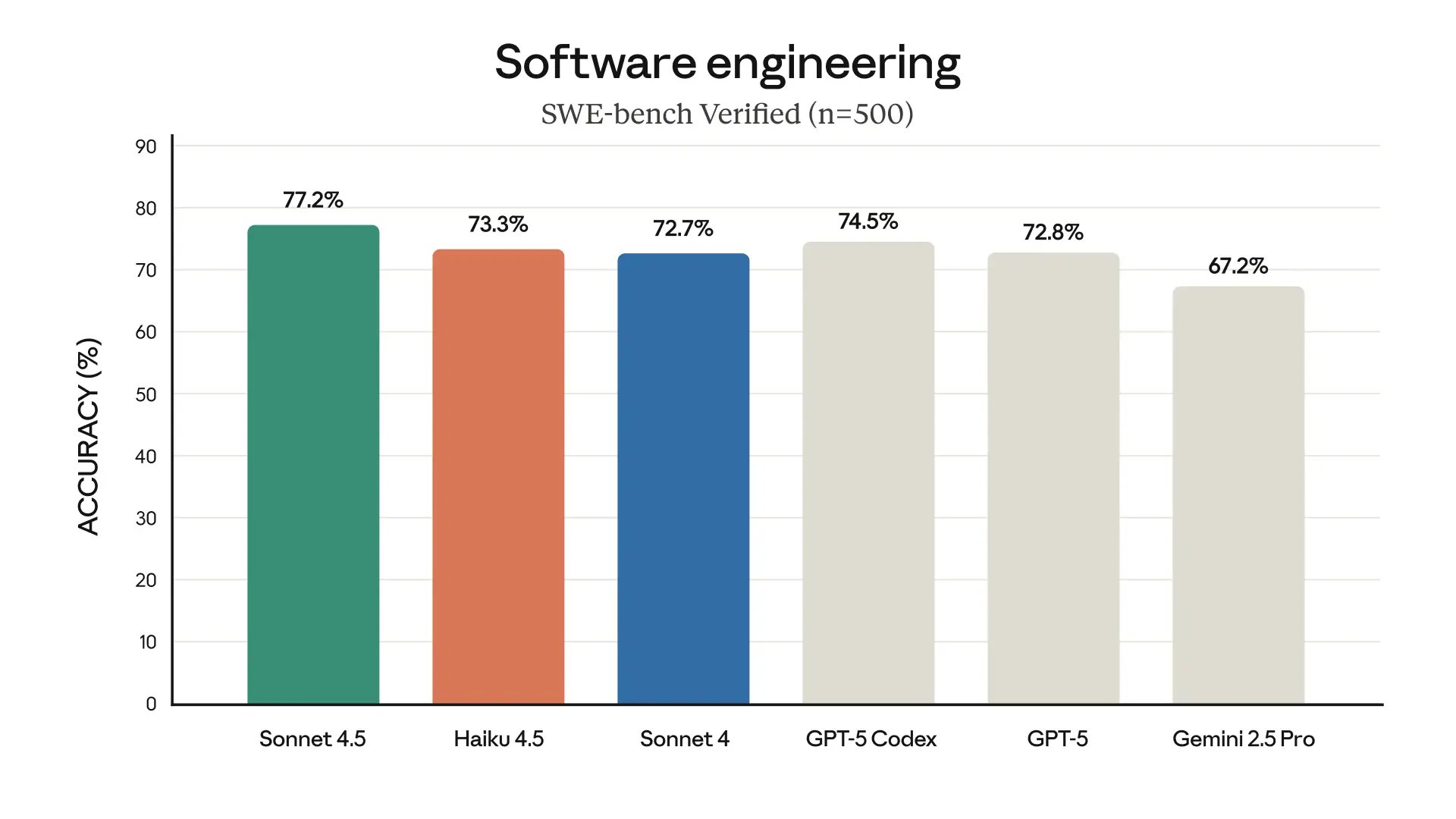
Core Insights - Anthropic has launched a new version of its smallest model, Claude Haiku 4.5, which performs comparably to the recently released mid-sized model Sonnet 4.5 but at one-third the cost and over twice the speed [1][4]. Group 1: Model Performance and Cost Advantages - Claude Haiku 4.5 demonstrates superior performance in several benchmark tests, scoring 73% in SWE-Bench and 41% in Terminal-Bench, comparable to Sonnet 4 and OpenAI's GPT-5 [5][6]. - The pricing for Haiku 4.5 is approximately one-third that of Sonnet models, with API costs set at $1 per million input tokens and $5 per million output tokens [7]. Group 2: Revenue Growth and Market Position - Anthropic is experiencing rapid growth, with an estimated valuation of $183 billion and over 300,000 enterprise customers contributing approximately 80% of its revenue [4][10]. - The company aims for an annual revenue target of $9 billion by the end of this year, with more aggressive goals set for next year, potentially exceeding $20 billion [4][10]. Group 3: Collaborative Applications and Use Cases - Haiku 4.5 and Sonnet 4.5 can work in tandem, with Haiku handling sub-tasks and Sonnet managing complex planning, making it particularly useful for enterprises engaged in long-term projects [8]. - The new model is expected to enhance software development tools, addressing critical factors such as speed and efficiency in processing [8]. Group 4: Competitive Landscape and Future Developments - The release of Haiku 4.5 follows closely on the heels of Sonnet 4.5, highlighting the fast-paced nature of competition in the AI industry [9]. - Anthropic is actively developing another model, potentially an update to Opus, expected to be released by the end of this year or early next year [9].
腾讯研究院AI速递 20251016
腾讯研究院· 2025-10-15 17:47
Group 1: New Product Releases - New Kai launched a 90GHz ultra-high-speed real-time oscilloscope, ranking second globally with a sampling rate of 200GSa/s and a storage depth of 4Gpts, enhancing domestic oscilloscope performance by 500% [1] - Apple released the M5 chip featuring a 10-core CPU and GPU, with AI performance 3.5 times that of the M4 version, and a memory bandwidth of 153GB/s, marking a nearly 30% improvement [2] - Google’s Gemini 3.0 Pro demonstrated the ability to replicate operating systems like macOS and Windows in just 2 minutes using a few prompts, showcasing advanced capabilities in generating complete HTML versions [3] Group 2: AI and Machine Learning Developments - Alibaba's Qwen3-VL model series, available in 4B and 8B versions, surpassed competitors in various benchmark tests, achieving state-of-the-art results in both text and vision tasks [4] - iFlytek upgraded its simultaneous translation model, achieving a user experience score of 4.6 out of 5, with a professional vocabulary expanded to over 100,000 terms [5][6] - OPPO introduced ColorOS 16, featuring advanced AI capabilities and a unique chip-level dynamic tracking technology, enhancing performance stability under high temperatures [7] Group 3: Research and Theoretical Insights - Hong Kong University of Science and Technology and NVIDIA proposed the NewtonBench benchmark to evaluate scientific discoveries, revealing that GPT-5 had a low accuracy of 29.9% in difficult scenarios [8] - Anthropic co-founder Jack Clark expressed a dual sentiment of optimism and fear regarding AI's evolution, noting that larger and more complex AI systems exhibit signs of self-awareness [9] - Philippe Aghion discussed the economic implications of AI, suggesting that even with full automation, economic growth rates will still be constrained by physical laws and the limitations of less efficient sectors [12]




重塑工作:生成式AI时代的变革管理
麦肯锡· 2025-10-15 06:37
Core Viewpoint - The article emphasizes that successful implementation of generative AI in organizations relies more on effective change management than on the technology itself. It highlights the importance of aligning AI with the organizational culture and capabilities to create value [2]. Group 1: Establishing a "North Star" Goal - Organizations should focus on outcomes rather than viewing generative AI merely as a tool. AI should be seen as a capability that enables seamless collaboration between humans and AI [3]. - A "North Star" goal must be clear and ambitious, guiding how generative AI can create value and competitive advantage while considering its impact on the talent lifecycle [3][4]. Group 2: Building Trust through Data and Governance - Establishing trust in generative AI within organizations is crucial for its widespread adoption. Companies that invest in trust-building activities are more likely to see significant revenue growth [5][8]. - Leaders must prioritize data accessibility and governance as key components of change management, ensuring that AI outputs are reliable and trustworthy [8][9]. Group 3: Redesigning Workflows and Teams - Generative AI should be integrated into workflows rather than treated as a standalone tool. This requires a collaborative approach between business and technical teams to redefine work processes [10]. - The transformation can occur in three stages, from using AI for discrete tasks to fully autonomous AI clusters operating as minimal viable organizations [11][12]. Group 4: Restructuring Organizational Architecture - Different departments may require different structural adjustments, with some evolving into minimal viable organizations while others maintain enhanced human teams [15][16]. - Organizations must invest in AI operations and monitoring systems to ensure the efficient functioning of these new structures [16]. Group 5: Empowering Employees as Change Agents - Employee participation is vital for the success of generative AI integration. Higher employee involvement correlates with better transformation outcomes [17]. - Companies should encourage employees to become advocates for AI, fostering a culture of learning and adaptation [18][19].