
数字经济

Search documents
齐心集团涨2.21%,成交额6919.94万元,主力资金净流出939.32万元
Xin Lang Cai Jing· 2026-01-05 02:10
Core Viewpoint - Qixin Group's stock price has shown a modest increase of 2.21% year-to-date, with fluctuations in recent trading days indicating mixed performance in the market [2]. Group 1: Stock Performance - As of January 5, Qixin Group's stock price reached 7.85 CNY per share, with a trading volume of 69.19 million CNY and a turnover rate of 1.25%, resulting in a total market capitalization of 5.662 billion CNY [1]. - The stock has increased by 2.21% since the beginning of the year, with a 0.64% rise over the last five trading days, a 1.26% decline over the last 20 days, and a significant 23.80% increase over the last 60 days [2]. Group 2: Company Overview - Qixin Group, established on January 12, 2000, and listed on October 21, 2009, is located in Shenzhen, Guangdong Province, and specializes in the research, production, and sales of office supplies, including document management products and office equipment [2]. - The company's revenue composition is primarily from office supplies (99.18%), with minor contributions from other segments (0.46%) and enterprise-level SaaS software and services (0.36%) [2]. - Qixin Group is classified under the light industry manufacturing sector, specifically in cultural products, and is associated with concepts such as artificial intelligence, cloud computing, digital economy, Tencent concepts, and online office solutions [2]. Group 3: Financial Performance - For the period from January to September 2025, Qixin Group reported a revenue of 7.729 billion CNY, reflecting a year-on-year decrease of 7.94%, while the net profit attributable to shareholders was 140 million CNY, down 11.45% year-on-year [2]. - The company has distributed a total of 614 million CNY in dividends since its A-share listing, with 159 million CNY distributed over the past three years [3]. Group 4: Shareholder Information - As of September 30, 2025, Qixin Group had 36,500 shareholders, a decrease of 9.03% from the previous period, with an average of 19,650 circulating shares per shareholder, which is an increase of 9.93% [2]. - Notably, Hong Kong Central Clearing Limited has exited the list of the top ten circulating shareholders [3].

制造业PMI时隔8个月重返扩张区间
Jin Rong Shi Bao· 2026-01-05 01:27
Core Viewpoint - The overall economic sentiment in China is improving as indicated by the rise in the Purchasing Managers' Index (PMI) across manufacturing and non-manufacturing sectors, suggesting a recovery in market demand and production activities [1][2][4]. Manufacturing Sector - In December 2025, the manufacturing PMI rose to 50.1%, an increase of 0.9 percentage points from the previous month, marking the first time it entered the expansion zone since April 2025 [1][2]. - The production index and new orders index were reported at 51.7% and 50.8%, respectively, with significant increases of 1.7 and 1.6 percentage points, indicating a strong recovery in market demand [2]. - The new export orders index increased by 1.4 percentage points to 49.0%, reflecting a positive shift in external trade conditions [2]. - The PMI for large enterprises reached 50.8%, up 1.5 percentage points, while medium-sized enterprises saw a rise to 49.8%. Small enterprises, however, experienced a decline to 48.6% [3]. Non-Manufacturing Sector - The non-manufacturing business activity index rose to 50.2%, an increase of 0.7 percentage points from the previous month, indicating improved sentiment in the service sector [4]. - The service sector PMI was reported at 49.7%, showing a slight recovery of 0.2 percentage points, with certain industries like telecommunications and financial services experiencing rapid growth [4]. Construction Sector - The construction PMI surged to 52.8%, a significant increase of 3.2 percentage points, returning to the expansion zone for the first time in five months, driven by new policy financial tools and favorable weather conditions [5]. - The business activity expectation index for the construction sector was reported at 57.4%, indicating optimism among construction enterprises regarding future developments [5]. Overall Economic Outlook - The comprehensive PMI output index reached 50.7%, indicating an overall expansion in production and business activities compared to the previous month [5]. - Analysts expect that the supportive measures for economic growth will continue to bolster the manufacturing sector, although consumer demand remains weak and requires further improvement [5].


【渭南】要素保障“强支撑”
Shan Xi Ri Bao· 2026-01-05 00:28
2025年12月19日,在位于白水高新技术产业开发区的陕西万德恒发科技装备制造有限公司的智慧化 加工车间里,技术人员专注地调试着焊接机器人。 针对重点项目资金需求,渭南市坚持早谋划、快行动,积极搭建高效"政银企"对接桥梁,推动金融 活水精准滴灌建设一线。2025年以来,渭南市累计向省级金融机构推荐有融资需求的省市重点项目28 个,融资需求达107亿元。 除了破解资金难题,渭南市深化"放管服"改革,推行项目审批"一站式"服务,并实施市级领导包联 重大项目的制度,全方位为项目保驾护航。 在狠抓当下项目建设的同时,渭南市积极为"十五五"发展储能蓄势:一方面,紧盯产业发展前沿, 围绕数字经济、低空经济等方向谋划培育新质生产力项目;另一方面,着力推动现有产业链的协同与升 这些机械手臂即将开启24小时不间断作业,这意味着这个占地39亩的精品结构件制造基地,已进入 投产前的最后冲刺阶段。该项目负责人薛青春介绍,2025年3月开工建设以来,项目高效推进,基础设 施已全部完工,近期即可实现小批量试产。 该项目的快速推进,是渭南市以智能化、高端化推动传统产业升级的一个生动缩影。 2025年以来,渭南市将高质量项目作为发展的硬支撑 ...
发掘“借景”的智慧(人民论坛)
Ren Min Ri Bao· 2026-01-05 00:18
Core Viewpoint - The article emphasizes the concept of "borrowing scenery" in Chinese garden design as a metaphor for local development, highlighting the importance of understanding one's own strengths and external opportunities to achieve high-quality growth [1][2]. Group 1: Borrowing Scenery in Development - "Borrowing scenery" is not arbitrary but requires deep insight into one's characteristics and the external environment, allowing for a harmonious integration of different elements [2]. - Guizhou's success in attracting Apple's iCloud data center is attributed to its natural resources and energy advantages, positioning itself as a leader in digital economy development [2]. - The article suggests that instead of waiting for opportunities, regions should actively pursue them by aligning their strengths with national needs and market opportunities [2]. Group 2: Regional Coordination and Integration - Successful regional development requires organic integration and communication among different areas to create a unified force [3]. - The Yangtze River Delta exemplifies efficient collaboration in the electric vehicle industry, with each province contributing specific components, leading to Anhui becoming China's largest producer of new energy vehicles [3]. - The article highlights that finding a unique position and leveraging local advantages can lead to successful resource integration and regional development [3]. Group 3: Creating New Opportunities - The higher realm of "borrowing scenery" is "creating scenery," where regions can innovate and develop new industries through collaboration and resource sharing [4]. - Xinjiang's development, supported by targeted aid policies, showcases how borrowing resources can lead to significant advancements in various sectors, transforming it from a remote area to a hub of opportunity [4]. - Continuous collaboration can generate new advantages and expand opportunities, fostering the emergence of new industries and business models [4].
山东省地矿局鲁南院:科技创新能力稳步提升,科技兴院根基不断夯实
Zhong Guo Fa Zhan Wang· 2026-01-04 22:59
Core Viewpoint - The Shandong Provincial Geological Bureau's Lunan Institute has made significant advancements in scientific and technological innovation during the 14th Five-Year Plan period, establishing a comprehensive innovation system that integrates platforms, teams, and results to support high-quality development [1]. Group 1: Research Platform Development - Lunan Institute has established nine provincial and ministerial-level research platforms, including the Shandong Provincial Key Laboratory for Geothermal Clean Energy, marking its entry into the provincial "1313" laboratory system [2]. - The institute has strengthened collaborations with prestigious research institutions and universities, integrating various research resources and attracting high-level expert teams [2]. - Over the past five years, the institute has cultivated more than 60 high-level talents, including leaders in scientific innovation and award-winning experts, enhancing its innovation capabilities [2]. Group 2: Innovation Team Strength - The institute has developed specialized innovation teams focusing on key business chains, achieving breakthroughs in geological exploration and resource utilization [3]. - Significant discoveries include a new medium-sized rare earth deposit and advancements in geothermal energy applications, showcasing the institute's innovative approaches [3]. - The institute's geothermal energy development model has been recognized with awards for energy conservation and technology excellence [3]. Group 3: Technological Achievements - Lunan Institute has actively pursued technological innovation, participating in 21 major research projects and focusing on the integration of production and research [5]. - The institute's achievements include 223 awards, 146 patents, and numerous publications, reflecting its commitment to advancing geological science and technology [6]. - The development of a digital economy framework has led to the creation of various information technology projects, enhancing urban modernization and high-quality development [6]. Group 4: Infrastructure and Employee Welfare - The institute has established advanced geological laboratories and the largest geological data center in the province, enhancing its research and operational capabilities [7]. - The new geological technology innovation center provides a comfortable and efficient working environment for employees, promoting a culture of innovation and dedication [7]. - The institute is committed to contributing to the national geological mission and improving the quality of life for its employees through sustainable development practices [7].
产业平台驱动制造之都迈向智造强市——台州赶海
Jing Ji Ri Bao· 2026-01-04 22:12
Core Viewpoint - Taizhou is transforming from a manufacturing hub to an intelligent manufacturing stronghold, leveraging its unique industrial platforms and vibrant business environment to attract investment and foster innovation [1][2]. Group 1: Industrial Development - Taizhou's coastline stretches 700.5 kilometers, making it a significant area for marine-based economic activities, with a strong focus on private enterprises [1]. - The city has developed two trillion-yuan industrial clusters and 32 hundred-billion-yuan county-level industrial clusters, with nearly 90,000 manufacturing companies [1]. - The "14th Five-Year Plan" emphasizes the importance of industrial platforms for attracting investment and developing new productive forces [1]. Group 2: Government Initiatives - The local government is committed to implementing the Private Economy Promotion Law and enhancing collaboration between government and market forces [2]. - Initiatives like "Ten Thousand Cadres Assist Ten Thousand Enterprises" and "Government-Enterprise Face-to-Face Talks" are designed to support industrial chain collaboration and innovation [2]. Group 3: Technological Advancements - The establishment of a computing power center in Huangyan aims to support the digital economy by providing essential infrastructure for businesses [3][4]. - The center has attracted over 40 companies in fields such as semiconductor and artificial intelligence, generating revenues exceeding 2.4 billion yuan and tax contributions of over 110 million yuan [4]. Group 4: Robotics Industry - Yuhuan is transitioning to a robotics industry, leveraging its strong foundation in precision manufacturing to enhance local automotive parts production [5][6]. - The South Bay Intelligent Valley Robotics Industrial Park exemplifies the "inch of land, inch of gold" concept, maximizing land use for high-growth industries [6]. Group 5: Digital Economy - The establishment of the Luchin Park has attracted several enterprises in chip design and intelligent operations, with a focus on digital economy [8]. - The park's support for startups includes a matrix of funds to address financial challenges and a rapid establishment process for new businesses [7][8]. Group 6: Long-term Partnerships - Valeo has been operating in Taizhou for 30 years, adapting to market changes and benefiting from local government support [11][12]. - The company has transitioned from relying on imports to local production, marking a significant milestone in its operational history [12]. Group 7: Innovation and Collaboration - Companies like Jack Technology are utilizing AI and other technologies to drive smart and green transformations in production lines, enhancing local industrial clusters [13]. - The local government has established a rapid response mechanism for intellectual property protection, aiding companies in safeguarding their innovations [13]. Group 8: Overall Economic Impact - From January to October 2025, Taizhou has launched 276 projects with over 100 million yuan in investment, with 89.9% of these projects being facilitated through industrial platforms [10].
2026在变局中重塑增长极
Xin Lang Cai Jing· 2026-01-04 22:09
重塑增长极,开放合作是必由之路,制度型开放是关键抓手。经济全球化潮流不可阻挡,中国始终是经 济全球化的坚定维护者和推动者,不断以制度型开放破解全球贸易投资难题。从海南自贸港全岛封关运 作实施"零关税、低税率、简税制"政策,到22个自贸试验区持续推进规则创新、累计贡献全国约1/5的 外商投资和进出口总额;从不断缩减外资准入负面清单、实现制造业领域全面开放,到持续优化市场 化、法治化、国际化营商环境,一系列务实开放举措让中国市场更具吸引力。进博会、服贸会等平台意 向成交额再创新高,2025年中欧班列开行量突破2万列,中国与共建"一带一路"国家贸易额稳步增 长……这些成果不仅丰富了中国重塑增长极的资源与路径,更让全球共享中国发展机遇。 (来源:经济参考报) 应当看到,重塑增长极是一项系统工程,需要正视挑战、精准施策。外部环境变化影响加深,国内供强 需弱矛盾突出,重点领域风险隐患较多……我国经济发展中的老问题、新挑战仍然不少。当前既要破解 国内部分行业产能过剩与高品质消费供给不足并存、新旧动能转换不畅等问题,通过优化供给结构、扩 大服务消费、化解重点领域风险,夯实发展基本盘;也要应对全球人工智能、高端芯片等前沿领域技 ...
竞逐新赛道,都有啥新招?
Xin Lang Cai Jing· 2026-01-04 22:08
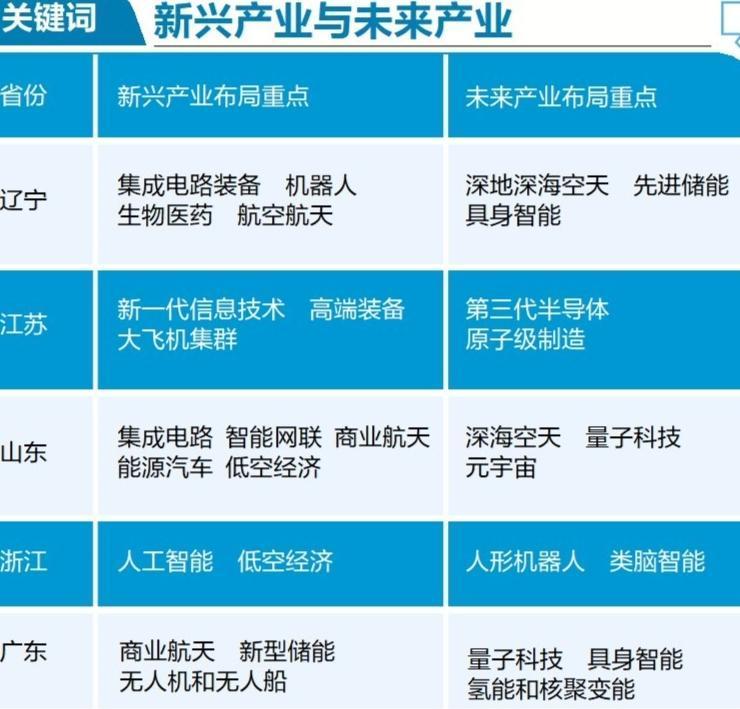
Group 1: Emerging and Future Industries - Various provinces are focusing on emerging and future industries, with specific emphasis on sectors like integrated circuits, robotics, and advanced energy storage [1][6] - Jiangsu aims to deepen integration into the Yangtze River Delta's aircraft manufacturing cluster and emphasizes atomic-level manufacturing [6] - Provinces like Shandong and Guangdong are prioritizing sectors such as quantum technology and hydrogen energy, indicating a trend towards high-tech and sustainable industries [1][7] Group 2: Digital Development - Provinces are actively developing digital infrastructure, with Liaoning focusing on data annotation industries and integrating AI into traditional industries [2][9] - Beijing aims to become a global benchmark city for digital economy, emphasizing core technologies like high-end chips and software [2][9] - Guangdong is enhancing its data trading platforms to foster industrial clusters, showcasing a strong market-driven approach [2][9] Group 3: Marine Economy - Coastal provinces are shifting their focus to marine economies, with Guangdong and Shandong aiming to create comprehensive marine industry ecosystems [8][19] - Liaoning and Jiangsu are leveraging their industrial bases to upgrade traditional marine industries towards high-end and green solutions [8][19] - The emphasis on marine economic development reflects a strategic pivot towards utilizing ocean resources for economic growth [8][19] Group 4: Consumption and Economic Growth - Guangdong is promoting the establishment of international consumption centers, aiming to enhance service industry standards and consumer environments [10][11] - Provinces like Beijing and Jiangsu are emphasizing high-energy consumption innovations, focusing on cultural and tourism integration to stimulate local economies [11][15] - The strategies aim to release local market potential and enhance consumer confidence through improved infrastructure and services [11][15] Group 5: Strategic Technology and Talent Development - Provinces are prioritizing the establishment of national laboratories and major scientific facilities to strengthen strategic technological capabilities [12][14] - There is a focus on integrating education, technology, and talent development to foster innovation and address regional needs [13][14] - Collaborative efforts across provinces aim to enhance the overall effectiveness and resilience of the national innovation system [12][14]
科技+文旅绘就融合发展新图景
Xin Lang Cai Jing· 2026-01-04 21:06
Core Insights - The integration of technology into cultural tourism in Tangshan is transforming visitor experiences from passive observation to active immersion, enhancing cultural value and driving industry upgrades [1][2][4] Group 1: Technological Empowerment in Cultural Tourism - Technology is redefining traditional cultural tourism experiences, allowing for immersive environments that engage visitors beyond mere observation [2][4] - Tangshan's attractions, such as the "Tangshan Light" Ferris wheel and the Cao Fei Dian Doma Amusement Park, exemplify the successful fusion of modern technology with historical themes, drawing significant visitor numbers [2][3] Group 2: Revitalization of Industrial Heritage - The use of technology in industrial heritage sites is enabling a dynamic preservation of history, allowing visitors to engage with the past in meaningful ways [3][4] - Projects like the Kailuan National Mine Park and the Qixin Cement Factory Museum utilize immersive experiences to convey the historical significance of industrial sites, enhancing cultural tourism [3][4] Group 3: Industry Upgrades and Economic Growth - The deep integration of technology in cultural tourism is shifting the industry from resource-dependent models to innovation-driven approaches, fostering economic growth [4][5] - Tangshan's diverse cultural tourism product system, supported by technological advancements, is enhancing brand competitiveness and driving collaborative development across the industry [4][5] Group 4: Future Directions - The ongoing integration of technology and culture in tourism requires a focus on cultural depth alongside technological advancements to avoid superficial implementations [5] - Continued investment in technologies such as 5G, artificial intelligence, and digital twins is essential for the sustainable development of the cultural tourism sector [5]
中韩经贸合作在变局中拓展共赢新空间
Xin Lang Cai Jing· 2026-01-04 20:04
对此,姜昊求认为,竞争绝不意味着合作空间压缩或互补性减弱,韩中经济关系呈现竞争与合作并存局 面,两国可通过各自技术优势形成互补。两国企业可通过促竞争、提效率、谋利益,惠及全球消费者, 实现"正和博弈"。"尤其在未来的新兴产业,双方合作大于竞争。" 他表示,人工智能、新能源产业等是引领新一轮产业革命的核心领域。在这些产业发展过程中,韩中两 国企业若能加强战略沟通,充分发挥各自产业优势,扬长补短,双方将有机会共同建立起以"水平合 作、人工智能"为基础的东亚新生产网络。 目前,中韩两国多家企业正通过资本与技术整合等途径,在多个新兴产业领域开展深度协作。韩国三星 SDI作为主要从事电池、电池材料及新材料研发和生产的企业,其偏光片业务在技术研发等方面具有核 心竞争力。中国昊盛科技集团控股的恒美光电去年9月正式完成对三星SDI偏光片业务的并购交割,进 一步深化了中韩企业在光电显示产业的合作。 在姜昊求看来,韩中经济正迎来新的机遇期。人工智能、数字经济、服务贸易、绿色转型、第三方市场 合作等领域,均为韩中两国高度重视的发展方向,双方应加强沟通,共同探讨合作方案,拓展新的合作 空间。 姜昊求表示,韩中经济合作应在两国政府的推 ...