
降息

Search documents
四季度还有戏!机构预测央行或单独下调5年期LPR 房贷利率有望再降?
Sou Hu Cai Jing· 2025-09-28 08:40
Core Viewpoint - The anticipated interest rate cuts in China have not materialized, with the Loan Prime Rate (LPR) remaining stable for four consecutive months, while the Federal Reserve has initiated a new easing cycle with a 25 basis point cut [1][2][5] Group 1: Monetary Policy Context - The People's Bank of China (PBOC) has maintained the 1-year and 5-year LPR at 3.0% and 3.5% respectively, reflecting a cautious approach amid various economic pressures [1][5] - The Fed's recent rate cut to a range of 4.00%-4.25% marks the beginning of a new easing cycle, with expectations of further cuts in the fourth quarter [1][2] Group 2: Economic Conditions - Domestic economic conditions, including weak inflation and pressures in the real estate market, have led to expectations for a follow-up rate cut in China to stabilize the RMB and stimulate economic recovery [2][5] - The banking sector is facing significant pressure on net interest margins, which have dropped to approximately 1.45%, limiting the scope for further rate reductions [5] Group 3: Real Estate Market Challenges - The stability of the real estate market is under threat, with 69 out of 70 major cities reporting a decline in second-hand housing prices, particularly in first-tier cities [6][9] - The core issues in the real estate market extend beyond financing costs, highlighting structural problems in supply and demand [7][9] Group 4: Policy Recommendations - To address the real estate market's challenges, a combination of fiscal policy and structural adjustments is recommended, including optimizing market supply and enhancing demand through employment and income stability [9][11] - The government is encouraged to pause new land auctions and repurchase undeveloped land to alleviate supply pressures, aligning with recent policy directions [9][11] Group 5: Future Outlook - The potential for new monetary policy actions, including further rate cuts, is anticipated as the Fed's easing opens up more operational space for the PBOC [9][11] - The overall expectation is that with the gradual release of policy effects and ongoing economic recovery, the real estate market may stabilize over time [11]


估值担忧持续搅动市场,美股9月如何收官?
Di Yi Cai Jing· 2025-09-28 03:04
Group 1: Market Overview - The U.S. stock market ended a previous streak of weekly gains, with a focus on the Federal Reserve's future policy direction and Chairman Powell's warnings on valuations [1] - The S&P 500 index has risen 2.8% in September, outperforming historical averages, and has a year-to-date increase of 13% [6] - Investor sentiment improved following NVIDIA's announcement of a $100 billion investment in OpenAI, leading to a net inflow of $12.06 billion into U.S. equity funds in the week ending September 24 [7] Group 2: Economic Data - Recent economic data indicates resilience, with initial jobless claims significantly lower than expected, suggesting a stable labor market despite Fed concerns [3] - The Personal Consumption Expenditures (PCE) index showed a slight increase in inflation, with the year-over-year rate rising from 2.6% to 2.7%, marking the highest level since March [3] - The U.S. GDP growth rate for Q2 was reported at 3.8%, the strongest performance since Q3 2023, indicating a significant rebound from a 0.5% contraction in Q1 [3] Group 3: Federal Reserve Insights - Fed officials expressed differing views on inflation and labor market conditions, with Powell indicating a need to balance persistent inflation risks against a cooling job market [4][5] - The upcoming employment report is highly anticipated, with expectations of a net increase of 85,000 jobs, which could influence the Fed's decision to maintain current policies [5] Group 4: Sector Performance - The communication services sector experienced the largest decline, down 2.7%, influenced by significant drops in stocks like Meta Platforms and Alphabet [6] - The energy sector led gains with a 4.7% increase, followed by utilities and real estate sectors, while technology and industrial sectors saw slight increases [6]

特朗普让美国豆农崩溃,下周加关税,美联储大消息,10月再降息
Sou Hu Cai Jing· 2025-09-27 21:02
Group 1: Agricultural Impact - U.S. soybean production reached a historical high in 2025, but prices have plummeted by 40% compared to 2022, leading to significant distress among farmers [1] - The trade war has caused U.S. soybean market share in China to drop from 40% in 2016 to 20% in 2024, with farmers expressing frustration over the government's handling of the situation [2] - The number of farm bankruptcies increased by 55% in 2024, indicating a severe crisis in the agricultural sector [2] Group 2: Economic Consequences - The Trump administration's tariffs were expected to generate over $300 billion in revenue, but actual revenue was only $100 billion by July 2025, highlighting a significant shortfall [3] - Tariffs have led to a drastic reduction in U.S. soybean exports to China, from 22 million tons in 2024 to just 3 million tons, resulting in a complete loss of related tariff revenue [3] - The U.S. economy is facing a potential slowdown, with a 65% probability of recession as consumer prices for everyday goods have risen by 30% due to tariffs [5] Group 3: Federal Reserve Actions - The Federal Reserve lowered interest rates by 25 basis points to 4.00-4.25% in response to rising unemployment and low job growth, with expectations of further cuts [4] - Despite potential cumulative rate cuts of 75 basis points, the structural issues caused by tariffs may negate the positive effects of lower interest rates on consumer spending [4] Group 4: Business Challenges - Companies are facing a dilemma as tariffs increase production costs while incentivizing domestic manufacturing, creating a challenging environment for supply chains [6] - Retailers and importers are struggling with reduced product lines and legal challenges against the government due to the financial strain caused by tariffs [3]
美国第二季度GDP增速终值上调至3.8%,增速创近两年来最快
Sou Hu Cai Jing· 2025-09-27 08:47
Core Insights - The U.S. economy has unexpectedly shown strong growth in Q2, with GDP increasing by 3.8% year-on-year, surpassing economists' expectations of 3.3% [1][4] Economic Growth Factors - The growth is attributed to increased consumer spending and a significant decline in imports, while investment and exports have decreased [4] - Personal consumption expenditure, which accounts for about 70% of the U.S. economy, grew by 2.5% in Q2 [4] - Non-residential fixed investment rose by 7.3%, while residential fixed investment fell by 5.1% [4] - Government consumption and investment decreased by 0.1%, and exports declined by 1.8%, with imports dropping sharply by 29.3% [4] Contribution to Economic Growth - Personal consumption expenditure contributed 1.68 percentage points to the economic growth for the quarter [4] - Net exports contributed 4.83 percentage points, while government consumption and investment had a negligible negative impact of 0.01 percentage points [4] - Private inventory investment negatively impacted growth by 3.44 percentage points [4] Economic Imbalance - The current economic situation reflects a "strong consumption, weak investment" and "warm domestic demand, cold external demand" imbalance, which poses risks for sustained economic recovery [4] Employment Market and Federal Reserve Actions - Despite the strong economic growth, the U.S. job market has shown signs of weakness, with new job creation falling short of expectations [8] - In response, the Federal Reserve recently lowered the benchmark interest rate for the first time since December, bringing it to a range of 4.0% to 4.25% [8] - The Fed aims to find a compromise solution amid rising inflation and risks in the job market [10]

白宫,紧急“撤回”!美联储,新计划!
Sou Hu Cai Jing· 2025-09-27 08:00
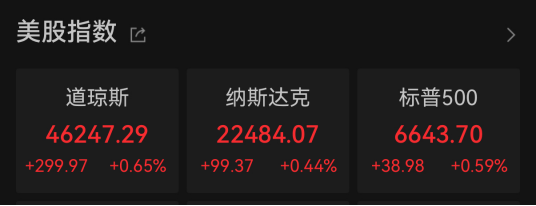
Market Performance - On September 26, the three major U.S. stock indices rebounded, with the Dow Jones rising by 0.65%, the Nasdaq increasing by 0.44%, and the S&P 500 gaining 0.59% [1][2] - The Dow closed at 46,247.29, the Nasdaq at 22,484.07, and the S&P 500 at 6,643.70 [2] Sector Performance - Major technology stocks mostly rose, with the "Seven Giants" index of U.S. tech stocks up by 0.46%. Notable individual stock movements included Tesla and Intel rising over 4%, while Oracle fell over 2% [2] - Chinese concept stocks mostly declined, with the Nasdaq Golden Dragon China Index down 1.56%. Significant declines were seen in stocks like Kingsoft Cloud (down over 10%) and NIO (down nearly 6%) [2] Economic Indicators - The U.S. core PCE price index for August rose by 2.9% year-on-year, aligning with market expectations and indicating a stabilization of inflation [3] - The likelihood of a Federal Reserve rate cut in October is estimated at 89.8%, with a 65.1% chance for December [3] Federal Reserve Insights - Federal Reserve Governor Bowman emphasized the fragility of the U.S. labor market and called for a firm approach to rate cuts, suggesting that the Fed should consider selling mortgage-backed securities [3][4] - There is increasing uncertainty within the Federal Reserve regarding the path of interest rates, with some officials advocating for continued rate cuts to mitigate employment risks [3] Trade Policy Developments - The U.S. administration announced that new tariffs on pharmaceuticals will not apply to countries with which the U.S. has trade agreements, including the EU and Japan [5] - President Trump announced new tariffs on various imports, including a 50% tariff on kitchen cabinets and a 100% tariff on patented and branded drugs starting October 1 [5][6] Price Impact - The furniture prices in the U.S. rose by 4.7% year-on-year as a result of tariff policies [6]
美国8月PCE物价数据未出现明显反弹
Sou Hu Cai Jing· 2025-09-27 04:48
Core Insights - The core PCE price index for the U.S. in August remained steady at an annual rate of 2.9%, with a monthly rate also unchanged at 0.2% [2] - The overall PCE price index annual rate increased slightly from 2.6% to 2.7%, while the monthly rate rose from 0.2% to 0.3% [2] - The latest PCE and core PCE data indicate that the risk of inflation rebound in the U.S. economy is not as severe as previously feared, suggesting that the primary concern is the risk of economic downturn rather than inflation [2] Economic Outlook - The Federal Reserve is expected to focus more on the employment market rather than inflation when making monetary policy decisions based on the recent economic data [2] - Future interest rate cuts by the Federal Reserve are anticipated, although the extent and pace of these cuts will be cautious [2] - Despite showing resilience, the U.S. economy exhibits signs of fatigue in the manufacturing and employment sectors, leading to ongoing concerns about the economic outlook [2]
申万宏观·周度研究成果(9.20-9.26)
申万宏源宏观· 2025-09-27 04:05
Core Viewpoint - The article emphasizes the importance of macroeconomic research and its continuous evolution, highlighting the team's commitment to providing valuable independent research outcomes for 2025 and beyond [8][10]. Group 1: Macro Investment - The article outlines ten essential readings for macro investment, tracking major asset performances and macro trends since the beginning of the year, including changes in gold, RMB/USD exchange rates, and bond yields [8]. Group 2: Domestic Economy - Six key judgments regarding the domestic economy have been made, addressing areas such as tariff impacts, policy framework shifts, and new economic drivers, which differ from mainstream market expectations [8]. Group 3: 2025 Outlook - The year 2025 is positioned as a pivotal year for the research team, focusing on restructuring research frameworks and systematically presenting research findings, adhering to the principle of providing actionable insights [8]. Group 4: Classic Review - A review of Trump's "big cycle" and the re-evaluation of the dollar exchange rate is presented, discussing global trade imbalances and the U.S. twin deficits, along with potential solutions to these issues [10]. Group 5: Excess Savings - The article discusses the phenomenon of excess savings surpassing 10 trillion, questioning who is contributing to this increase and exploring potential release paths compared to international experiences [12]. Group 6: Interest Rate Trends - The article analyzes the implications of a potential interest rate cut by the Federal Reserve, examining historical patterns of long-term U.S. Treasury yields and the associated market dynamics [16]. Group 7: High-Frequency Tracking - Following the Federal Reserve's September meeting, global stock indices have generally continued to rise, indicating a positive market response to the anticipated interest rate cuts [18].

10月降息稳了?美联储,大消息!
Zheng Quan Shi Bao· 2025-09-27 00:20
Group 1 - The core point of the article is that the U.S. August PCE inflation data met expectations, boosting rate cut expectations and leading to a collective rise in U.S. stock markets [1][3] - As of September 26, 2023, the three major U.S. stock indices closed higher, with the Dow Jones Industrial Average up 0.65% at 46,247.29 points, the S&P 500 up 0.59% at 6,643.7 points, and the Nasdaq up 0.44% at 22,484.07 points [1][2] - The August PCE price index rose 0.3% month-on-month, while the core PCE, excluding food and energy, rose 0.2% month-on-month, indicating stable inflationary pressures [3] Group 2 - European stock indices also closed higher, with the German DAX up 0.87% at 23,739.47 points, the French CAC40 up 0.97% at 7,870.68 points, and the UK FTSE 100 up 0.77% at 9,284.83 points [2] - The market is strongly betting on the Federal Reserve cutting rates again in October, with an 87.7% probability, while the likelihood of a third consecutive cut in December is around 65% [3] - Concerns about a potential U.S. government shutdown are growing, which could disrupt the release of key economic data and add uncertainty to the market [4]

美联储鲍曼:就业市场明显更脆弱,应果断降息,青睐最小资产负债表
Sou Hu Cai Jing· 2025-09-27 00:05
Group 1 - The core viewpoint emphasizes the need for the Federal Reserve to take decisive action in response to signs of weakness in the labor market and to consider interest rate cuts to support employment goals [1][2][4] - Recent data indicates a notable deterioration in the labor market, prompting the Federal Reserve to reassess its approach to monetary policy and potentially lower the benchmark interest rate [2][3] - Bowman advocates for a smaller balance sheet for the Federal Reserve, suggesting that it should primarily consist of Treasury securities to minimize its impact on credit allocation in the economy [5][6] Group 2 - The proposal includes actively selling mortgage-backed securities (MBS) to ensure a timely return to a pure Treasury investment portfolio, rather than relying solely on MBS maturities [5][6] - Recommendations for the Standing Repo Facility (SRF) include setting the minimum bid rate above the upper limit of the federal funds rate target range to reinforce its role as a backup tool [5][6] - Bowman suggests restoring the Enhanced Supplementary Leverage Ratio (eSLR) as a backup tool rather than a binding constraint to improve the intermediation function in the Treasury market [6]
10月降息稳了?美国PCE符合预期 市场静待非农表现
Di Yi Cai Jing· 2025-09-26 23:43
美国经济分析局(BEA)数据显示,8月PCE环比增长0.3%,较7月加快0.1个百分点;从同比来看,PCE 上涨2.7%,高于7月的2.6%。 当地时间周五,美国公布了8月个人消费支出(PCE)价格指数。作为美联储最关注的物价指标之一, 数据显示关税压力正在继续缓慢推高物价,不过消费者支出和个人收入月率稳健增长给经济提供了重要 动力。市场继续维持今年两次降息的定价,并将目光转向下周五的非农就业报告。 物价走高但压力可控 尽管目前尚未出现全面的通胀上升,但部分受关税影响的商品价格已大幅上涨。企业通过消化关税生效 前囤积的库存,避免了通胀失控。然而,不少经济学家认为这种情况不会无限期持续,预计企业终将在 某个时点将关税成本更大范围地转嫁给消费者。今年第二季度,企业库存已出现下降。 与此同时,美国政府仍在推动更多关税政策,本周特朗普宣布对品牌药品征收100%的关税,对重型卡 车征收25%的关税。 剔除波动较大的食品和能源价格后,8月核心PCE价格指数环比增长0.2%,同比增长2.9%,均与7月持 平。 分类别看,服务价格上涨 0.3%,主要反映在机票、酒店住宿、金融服务与保险、住房及公用事业等领 域,推动了PCE通 ...