
低空经济

Search documents
2025智能网联新能源汽车十大年度事件 | 精进2025——汽车行业10个十大年度盘点(七)
Jing Ji Guan Cha Wang· 2026-01-13 10:48
Core Insights - The automotive industry in China has made significant progress in 2025, driven by a series of proactive policies that have boosted consumption and improved the competitive environment [2] - The "2025 Progress Report" by Automotive Vertical Media highlights ten key annual reviews in the automotive sector, marking the sixth consecutive year of such reporting [2] Group 1: Key Events in Smart Connected New Energy Vehicles - The issuance of the first L3 special license plate in China marks the beginning of commercialized L3-level autonomous driving, with the first vehicle, Deep Blue SL03, officially licensed for road use [4][5] - The world's first flying car production line has been established in Guangzhou, with the first "land aircraft" successfully produced, indicating a significant step towards commercial production in the low-altitude economy [7][8] - Solid-state battery production is accelerating, with multiple companies announcing timelines for mass production, including CATL and Toyota, which are expected to enhance battery performance and safety [8][9] Group 2: AI Integration and Industry Transformation - Generative AI and large model technologies have been deeply integrated into the automotive industry, enhancing manufacturing efficiency and product competitiveness across the entire supply chain [10][12] - The adoption of AI technologies is reshaping the automotive industry's research and development logic, manufacturing models, and service ecosystems, driving the sector towards a higher quality of intelligent transformation [12] Group 3: Global Market Expansion and Competitiveness - Chinese automotive solutions have gained global recognition, with partnerships established with major international brands like BMW and collaborations with various multinational automakers, indicating a shift towards "China solutions" in the global market [13][14] - BYD has become the world's largest manufacturer of pure electric vehicles, surpassing Tesla in sales, reflecting the competitive strength of Chinese brands in the global electric vehicle market [19][20] Group 4: Safety Standards and Regulations - The introduction of new mandatory national standards for electric vehicle batteries emphasizes safety, requiring batteries to not catch fire or explode under thermal runaway conditions, effective from July 2026 [17][18] - The implementation of dynamic monitoring safety standards for new energy vehicles marks a transition to proactive safety management, enhancing consumer protection and industry accountability [21][22] Group 5: Charging Technology Advancements - The competition in ultra-fast charging technology has reached the "megawatt" level, with several companies launching solutions that enable rapid charging capabilities, significantly improving user experience in electric vehicles [15][16] - The advancements in charging technology are expected to reshape the competitive landscape of the electric vehicle market, facilitating broader adoption and integration of electric vehicles into everyday use [16] Group 6: IPO Trends in Autonomous Driving - The surge of IPOs among autonomous driving companies signifies a shift from capital cultivation to market validation, with major players like Pony.ai and Hesai Technology entering the public market [23][24] - The rise of end-to-end autonomous driving solutions is expected to accelerate the mass production of high-level autonomous vehicles, enhancing the industry's growth trajectory [24]




小鹏汇天或已秘密递交香港上市申请,传由摩根大通、摩根士丹利负责
机器人圈· 2026-01-13 09:41
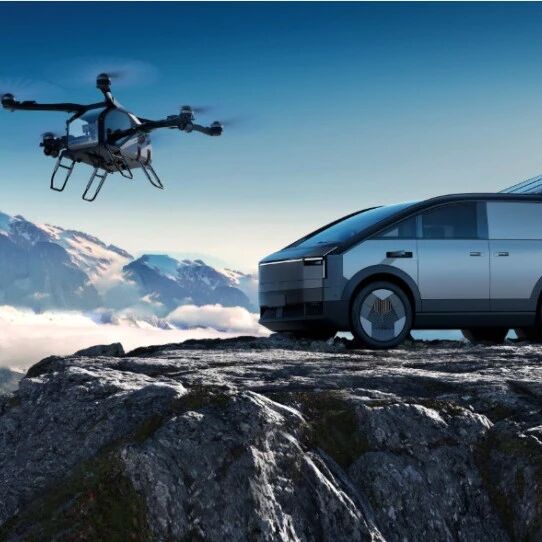
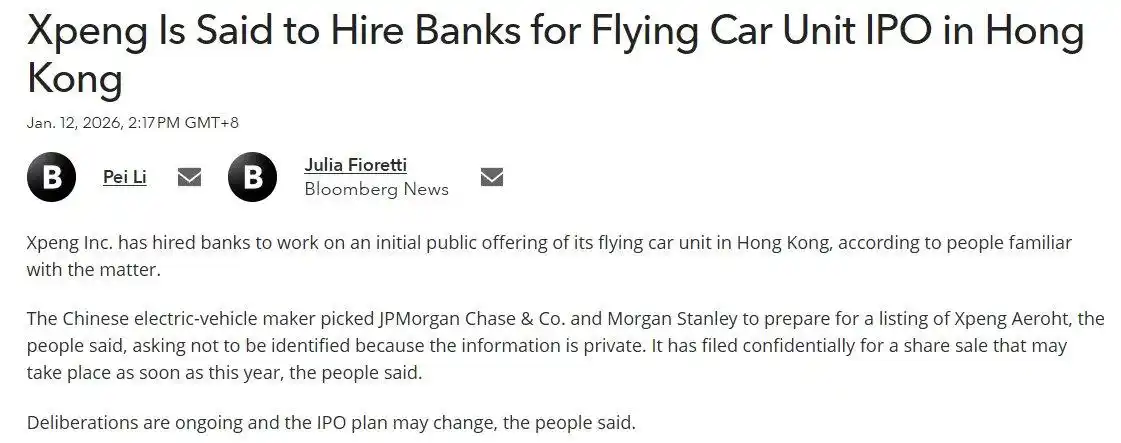
Core Viewpoint - Xiaopeng Motors is preparing for an IPO of its flying car division in Hong Kong, having engaged JPMorgan and Morgan Stanley for the process, with a potential completion as early as this year [2]. Group 1: IPO Plans and Timeline - Xiaopeng Motors has secretly submitted its IPO application for its flying car division, with plans to complete the process potentially within this year [2]. - The founder of Xiaopeng Huitian, Zhao Deli, previously indicated that an IPO plan is in place, with timing to be determined [5]. - Xiaopeng Motors aims to transition from technology exploration to practical application by 2026, including the launch of its flying cars [5]. Group 2: Product Features and Capabilities - The Huitian A868 flying car is designed for a range of over 500 kilometers, making it suitable for intercity routes rather than just short urban travel [8]. - The flying car has a cruising speed exceeding 360 kilometers per hour, significantly reducing travel time compared to ground transportation [8]. - Xiaopeng Huitian has received 7,000 orders for its land carrier flying vehicle, aiming to set a world record for annual sales of manned flying vehicles [9]. Group 3: Company Background and Market Position - Xiaopeng Huitian is recognized as Asia's largest flying car company, focusing on creating low-altitude products and aiming to revolutionize personal flight and air commuting [10]. - If the IPO is successful, Xiaopeng Huitian will become the second listed manned flying vehicle company in China [11]. - The company has completed several funding rounds, including over $500 million in Series A funding, marking the largest single financing in Asia's low-altitude manned flying vehicle sector as of 2021 [11]. Group 4: Recent Developments and Production Capacity - The production facility for the flying car began trial production on November 3, 2025, marking the establishment of the world's first production line for flying cars [14]. - The factory has an area of approximately 120,000 square meters, with an initial annual production capacity of 5,000 units, scalable to 10,000 units [14]. - The flying car features a unique design that allows it to operate both as a vehicle and an aircraft, with a price point of under 2 million yuan [16].

最高补助1000万元,一地支持仪器仪表等企业
仪器信息网· 2026-01-13 09:07
Core Viewpoint - Shanghai has released a three-year action plan to support the transformation and upgrading of advanced manufacturing, aiming to add 100 enterprises with an annual output value exceeding 1 billion yuan by 2028, totaling over 600, and to drive the addition of 500 new large-scale industrial enterprises in the supply chain, while significantly increasing the proportion of R&D expenses in revenue [2][3][7]. Group 1: Main Goals - By 2028, the plan aims to add 100 manufacturing enterprises with an annual output value exceeding 1 billion yuan, totaling over 600, and to drive the addition of 500 new large-scale industrial enterprises in the supply chain [7]. Group 2: Implementation Actions - **Optimizing Traditional Advantage Industries**: The plan encourages petrochemical companies to reduce oil dependency and develop new functional materials, while supporting steel and non-ferrous metal companies to strengthen specialty steel and expand lightweight alloys [8]. - **Accelerating Leading Industry Strategies**: Support for integrated circuit companies to focus on equipment, advanced processes, and materials, aiming to cultivate internationally competitive leading enterprises [8]. - **Promoting Key and Emerging Industries**: The plan emphasizes the development of new-generation electronic information, smart connected vehicles, high-end equipment, and green low-carbon industries [9]. Group 3: Innovation and Technology - **Releasing Innovation Vitality**: The plan supports enterprises to increase basic research investment, providing financial subsidies based on the amount of R&D expenditure [9]. - **Accelerating Core Technology Breakthroughs**: Focus on supporting enterprises in laser manufacturing, quantum technology, and new functional materials to conduct foundational research [10]. Group 4: Quality and Efficiency Enhancement - **Promoting Technological Transformation**: Support for enterprises to upgrade production, R&D, and design processes, with financial support for fixed asset investment loans [10]. - **Deepening Digital Transformation**: The plan includes initiatives for AI integration in manufacturing, aiming for large enterprises to achieve full digital application coverage by 2027 [10]. Group 5: Resource and Support Actions - **Strengthening Talent Development**: The plan supports enterprises in attracting high-level talent, providing priority recommendations for national and local talent cultivation programs [11]. - **Enhancing Financial Support**: Focus on promoting low-interest, high-amount, and long-term loan products for manufacturing enterprises, with interest subsidies for key component and raw material loans [12]. - **Expanding Logistics Support**: The plan aims to build industrial logistics and warehousing facilities to integrate logistics with manufacturing [12].

A股三大指数下挫 军工股大回调 AI应用尾盘跳水 贵金属多股创新高,黄金白银下跌
2 1 Shi Ji Jing Ji Bao Dao· 2026-01-13 08:33
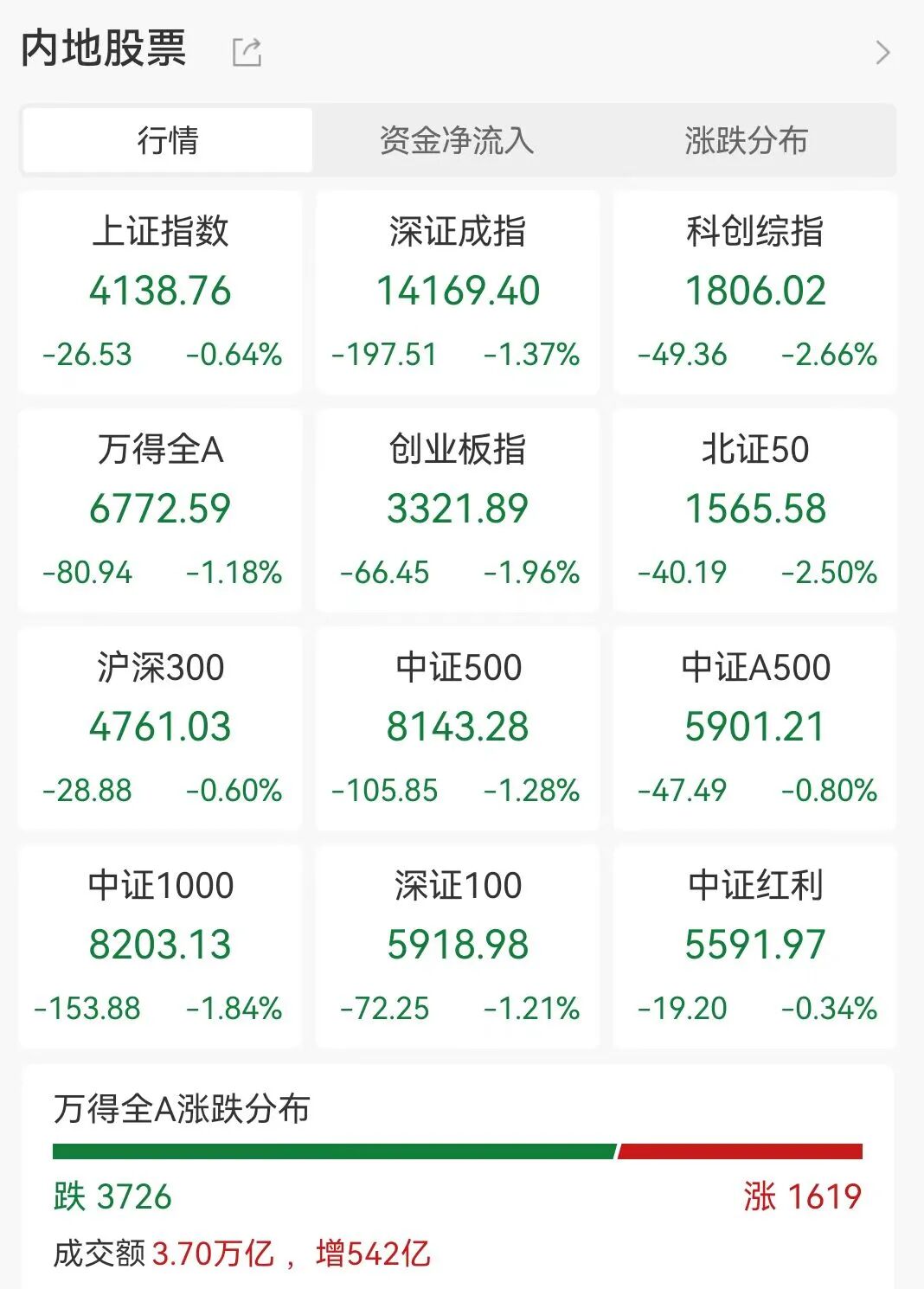
Market Overview - The A-share market experienced a collective pullback on January 13, with the Shanghai Composite Index ending a 17-day winning streak, closing down by 0.64% [1] - The Shenzhen Component Index fell by 1.37%, and the ChiNext Index decreased by 1.96%, with a total trading volume of 3.7 trillion yuan, setting a new historical record [1][2] Sector Performance - Multiple sectors faced significant declines, particularly in commercial aerospace and satellite internet, with nearly 100 stocks dropping over 8% [4] - The large aircraft and military sectors also saw declines, with stocks like Zhongtian Rocket and Leike Defense hitting the daily limit down [4] - The controlled nuclear fusion sector experienced a downturn, with Wangzi New Materials hitting the daily limit down [4] - The communication equipment sector fell, with stocks like Changjiang Communication hitting the daily limit down [4] Stock Movements - Over 1,600 stocks rose, with more than 70 stocks hitting the daily limit up [4] - The commercial aerospace concept stocks suffered heavy losses, with over 60 stocks hitting the daily limit down or dropping more than 10% [4] - Specific stocks such as Aerospace Electronics and Beidou Star Communication saw significant declines, with many military stocks also hitting the daily limit down [6] Investment Insights - The market sentiment has shifted from hesitation to active allocation, driven by a consensus on the current market rally [10] - Investors are advised to avoid speculative risks in popular sectors, particularly in commercial aerospace, and to focus on policy and industry resonance themes such as technological innovation and high-end manufacturing [11] - Key investment areas include sectors with performance support, such as overseas computing power, storage, consumer electronics, and wind energy storage, which still have room for low-cost allocation [10][11]
商业航天板块深度回调,航空ETF基金(159257)跌8%,资金逆势净流入超2600万元,连续6日“吸金”1.4亿元!力鸿一号飞行器首飞成功
Sou Hu Cai Jing· 2026-01-13 07:39
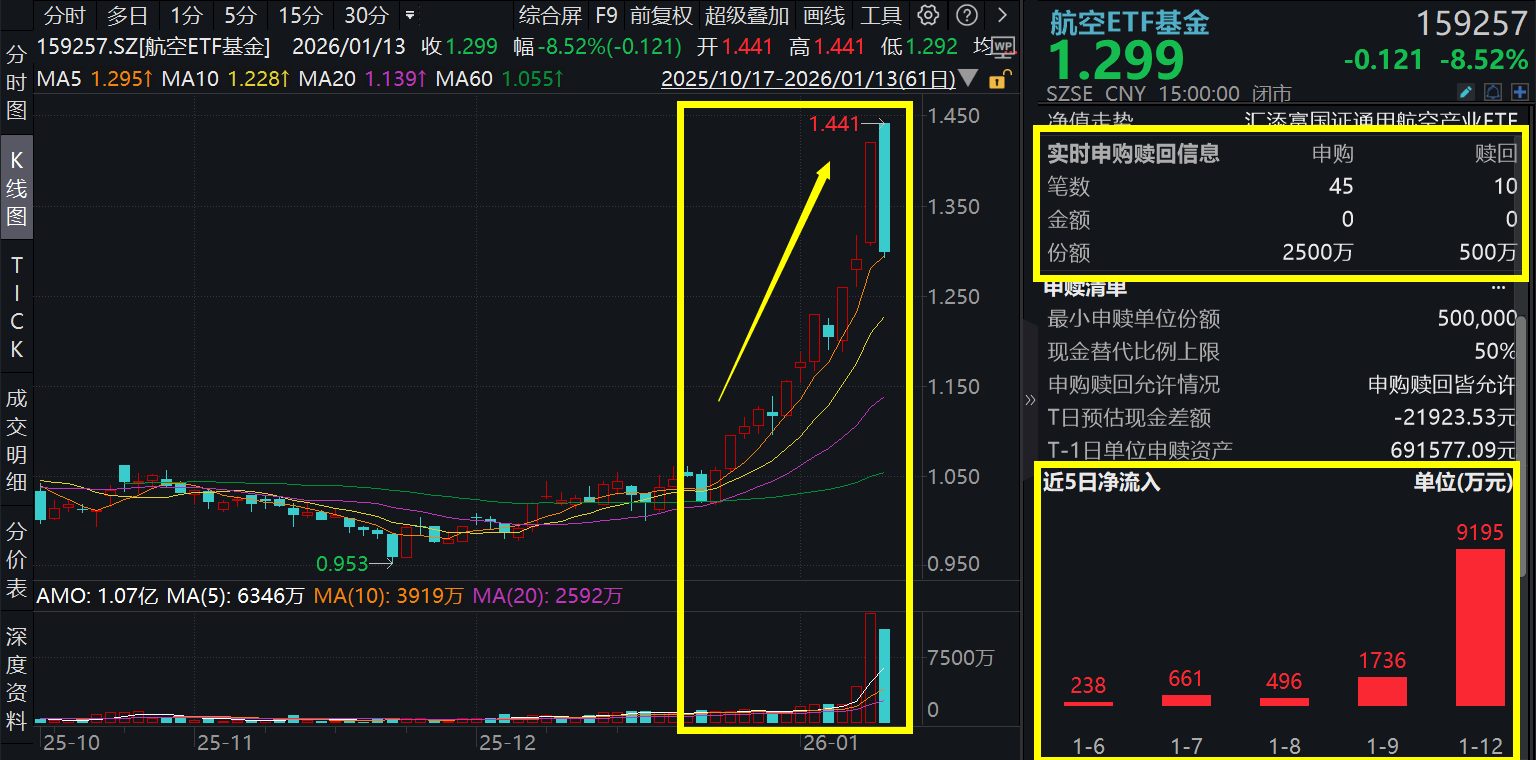
Core Viewpoint - The commercial aerospace sector is experiencing a significant pullback, with the Aviation ETF (159257) down by 8.52% as of 15:00 on January 13, despite a net inflow of over 26 million yuan, marking a six-day streak of strong capital inflow exceeding 140 million yuan [1][3]. Group 1: Market Performance - The majority of the component stocks in the Aviation ETF (159257) have retreated, with notable declines in Aerospace Electronics and Aerospace Rainbow, while Tianyin Electromechanical rose over 12% and China Satellite increased by over 4% [3][4]. - The Aviation ETF (159257) has a significant focus on the defense and military industry, which constitutes 61.6% of its index weight, alongside other sectors like computers and automotive [7][10]. Group 2: Industry Developments - The successful suborbital flight test of the Lihong-1 spacecraft by China Aerospace, which is designed for microgravity scientific experiments, marks a significant advancement in commercial aerospace capabilities [5]. - China has recently applied for over 200,000 satellite frequency resources, significantly exceeding its previous applications and those of SpaceX, which could potentially increase the market space for the entire industry chain fivefold [5][6]. Group 3: Future Projections - The ongoing U.S.-China space race is expected to accelerate, with projections indicating that China's annual satellite launch capacity could exceed 10,000 units in the future [6]. - The commercial aerospace theme is entering a "heating up" phase, supported by improved top-level design and new policy backing, which enhances market confidence in long-term development [6][7]. Group 4: Investment Opportunities - The Aviation ETF (159257) is well-positioned to benefit from the low-altitude economy and military sectors, with a significant portion of its components being low-altitude economy concept stocks [9][10]. - The ETF's focus on commercial aerospace, which accounts for 30% of its holdings, positions it to capitalize on the trillion-dollar market opportunities in the satellite industry [10].
皖通科技:业务暂不涉及商业航天和低空经济领域,暂无拓展计划
Sou Hu Cai Jing· 2026-01-13 07:39
有投资者在互动平台向皖通科技提问:"请问公司业务是否涉及商业航天和低空经济领域?未来是否有 单独或联合拓展相关领域的计划?" 针对上述提问,皖通科技回应称:"您好,公司业务暂不涉及上述领域,且暂无相关计划拓展上述领 域。感谢您的关注!" 声明:市场有风险,投资需谨慎。本文为AI基于第三方数据生成,仅供参考,不构成个人投资建议。 来源:市场资讯 ...

消息称小鹏聘投行筹备小鹏汇天香港IPO
Guan Cha Zhe Wang· 2026-01-13 06:52
Company Overview - Xiaopeng Motors' ecological enterprise, Xiaopeng Huitian, has submitted a confidential IPO application to the Hong Kong Stock Exchange, with JPMorgan and Morgan Stanley appointed as underwriters, aiming for a potential listing by the end of the year [1] - Xiaopeng Huitian focuses on product development and mass production delivery, with no additional IPO-related information currently available [3] - The company, originally founded in Dongguan in 2013, became officially established after Xiaopeng Motors' investment in 2020 [3] Funding and Financial Milestones - In October 2021, Xiaopeng Huitian completed a Series A funding round, raising over $500 million, marking the largest single financing in Asia's low-altitude manned aircraft sector at that time [3] - In August 2024, the company secured $150 million in Series B1 funding from three state-owned enterprises in Guangzhou [3] - On July 15, 2025, Xiaopeng Huitian completed a $250 million Series B funding round [3] Product Development and Market Strategy - Xiaopeng Huitian aims to achieve mass production of flying cars by 2026, as emphasized by the chairman of Xiaopeng Motors during a recent product launch event [3] - The company's split-type flying car, referred to as the "land aircraft carrier," is set for its first public flight in 2024 and will debut overseas in 2025, with approximately 5,000 orders already received [3] - Plans for international market expansion are set for 2027 [3] Industry Insights - Industry experts emphasize that safety must be prioritized in the development of the low-altitude economy, with many companies aiming to increase aircraft production capacity to enhance economic viability [4] - The aviation sector's logic dictates that safety and standards should be discussed before market and order considerations [4]
纵横股份战略投资空天智能产业基金
Zheng Quan Shi Bao Wang· 2026-01-13 06:45
Group 1 - The core viewpoint of the article is that Zongheng Co., Ltd. has recently invested in an industrial fund focusing on cutting-edge sectors such as low-altitude economy, artificial intelligence, commercial aerospace, and satellite internet applications [1] Group 2 - The investment was made in the Qiongcheng Kaisheng Aerospace Intelligent Venture Capital Partnership [1] - The industrial fund aims to capitalize on emerging trends and technologies within its targeted sectors [1]

航空航天ETF天弘(159241)探底回升!标的指数早盘一度跌近8%,盘中回升跌幅收窄至3%
Sou Hu Cai Jing· 2026-01-13 06:15
1月13日,三大指数集体走弱,商业航天板块早盘盘中回升,国证航天航空行业指数(CN5082.SZ)早盘一度跌近8%,盘中回升跌幅收窄至3%,现 跌约5%,该指数成分股中,洪都航空上涨超7%,中国卫星上涨近3%,航亚科技上涨0.25%,内蒙一机上涨0.05%,国博电子下跌1.49%。 航空航天ETF天弘(159241)紧密跟踪国证航天航空行业指数,该指数覆盖航空装备、航天装备、军工电子等细分领域,涉及卫星互联网、大 飞机、低空经济等前沿科技方向。跟踪指数行业布局在申万一级行业分类中,国防军工权重占比高达98.66%。 招商证券表示,我国商业航天景气度显著抬升,产业规模迅速扩张。据中投顾问,2025年,我国商业航天产业规模预计达2.8万亿元,年均复合 增长率超26%,较2020年增长180%。其中,上游卫星制造与火箭发射环节价值占比约10%,中游地面设备制造占比约45%,下游卫星应用服务 占比约45%。 相关ETF方面,航空航天ETF天弘(159241)盘中探底回升,成交额为1.93亿元。资金流向方面,该ETF上个交易日(1月12日)净流入额为1.57亿 元,截至上个交易日,已连续2个交易日获资金净流入,累计净流 ...

四川国资等新设低空经济股权投资基金
Zheng Quan Shi Bao Wang· 2026-01-13 05:52
人民财讯1月13日电,企查查APP显示,近日,四川兴蜀启航低空经济股权投资基金合伙企业(有限合伙) 成立,出资额17亿元,经营范围包含:以私募基金从事股权投资、投资管理、资产管理等活动。企查查 股权穿透显示,该企业由四川省先进制造投资引导基金合伙企业(有限合伙)等共同出资。 ...