数字货币

Search documents
信创ETF(562570)备受资金青睐,连续11个交易日获资金净流入
Mei Ri Jing Ji Xin Wen· 2025-06-03 02:35
6月3日早盘,美容护理、传媒、有色金属等行业板块领涨A股,黄金珠宝、脑机接口、医美、数字货 币、跨境支付等概念指数盘中活跃。ETF方面,信创ETF(562570)一度涨超1%,持仓股中,北信源、 中望软件、山大地纬、华大九天、广联达等涨幅居前。云计算50ETF(516630)涨超0.5%,奇安信、科 大讯飞、广联达、神州信息、国投智能等持仓股领涨。 5月以来,资金布局信创板块的热情较高。数据显示,信创ETF(562570)已连续11个交易日获资金净 流入,期间净流入金额高达35187万元。值得一提的是,或博弈海光信息、中科曙光复牌后上涨预期, 上周资金抢筹该ETF的力度更是直线上升。据悉,信创ETF(562570)上周获资金净流入34077万元, 净流率高达81.2%。 相关ETF: 1、信创ETF(562570):近日海光信息、中科曙光宣布战略重组,中证信创指数(931247)与该事件 相关度较高。截至5月30日,海光信息、中科曙光分别是该指数第1大、第8大权重股,合计权重超 10%。信创ETF(562570)为跟踪该指数规模最大的ETF。 2、云计算50ETF(516630):标的指数为云计算指数(930 ...


港股概念追踪|《稳定币条例》正式成为法例 RWA生态主体有望快速壮大(附概念股)
智通财经网· 2025-06-03 00:58
Group 1 - Hong Kong's "Stablecoin Regulation" is the world's first specialized legislation for fiat-backed stablecoins, filling a regulatory gap and promoting compliance in the stablecoin sector [1] - The Hong Kong Legislative Council passed the draft regulation on May 21, with licensed stablecoin issuers expected to emerge by the end of this year [1] - The Hong Kong Monetary Authority has released the first batch of stablecoin issuer sandbox participants, including Round Coin Innovation Technology [1] Group 2 - Citic Securities reports that recent legislative progress in Hong Kong and the U.S. on stablecoins enhances market liquidity and supports the issuance of Real World Assets (RWA) by mainland enterprises in Hong Kong [2] - The stablecoin legislation is expected to indirectly boost the development of digital currency payment and settlement interfaces in Hong Kong's financial sector, benefiting financial IT companies experienced in cross-border settlements [2] - With the ongoing development of RWA, various stakeholders in the RWA ecosystem, including issuers, custodial banks, and investors, are anticipated to grow rapidly, presenting investment opportunities in RWA asset operations and cross-border payments [2] Group 3 - ZhongAn Online (06060) holds a 43.43% stake in ZhongAn Bank, the first digital bank in Hong Kong to provide reserve banking services for stablecoin issuers, and has a 8.7% stake in Round Coin Innovation Technology, a sandbox participant [3] - LianLian Digital (02598) indirectly owns 100% of LianLian Pay Global Limited and collaborates with Round Coin Technology on stablecoin applications in cross-border payments [3] - PCCW (00008) announced a partnership with Standard Chartered Bank and Animoca Brands to explore stablecoin issuance, aiming to leverage their combined expertise and technology [3]


中信证券:稳定币有望激发RWA交易活跃度 助推金融行业数字货币相关支付、结算接口建设
智通财经网· 2025-06-03 00:39
2025年5月19日,美国参议院通过了《指导与建立美国稳定币国家创新法案》的程序性投票;2025年5月 21日,香港立法会正式三读通过《稳定币条例草案》。据香港立法会官网,香港金融管理专员(HKMA) 将负责稳定币监管与发牌,设立香港本地实体公司持牌人须具备2500万港元缴足股本;稳定币须100% 以储备资产支撑,其市值应始终不低于流通面值。RWA(Real-World Assets)即通过区块链技术将现实中 的资产数字化并上链。稳定币对RWA中的赋能包括: 1)为RWA代币交易提供币值稳定的工具:稳定币作为数字货币能够用于RWA资产交易,币值又和法定 货币1:1挂钩,有效降低购买RWA代币时支付币值变化的风险。 2)增加流动性:稳定币能帮助RWA代币更容易买卖,投资者可以用稳定币快速买进或卖出RWA代币, 激发RWA市场活跃度。 智通财经APP获悉,中信证券发布研报称,近期中国香港、美国均不同程度推进稳定币相关法案立法进 程,稳定币能够为RWA代币资产提供币值稳健的交易方式,增强市场流动性,有助于促进大陆企业在 港RWA发行项目进一步落地;同时,稳定币法案有望间接助推香港金融行业数字货币相关支付、结算 接口 ...

港股午后回升,恒指跌幅收窄至1%,比亚迪股份、快手跌3%,泡泡玛特涨超4%
news flash· 2025-06-02 08:14
香港恒生指数收跌0.57%,恒生科技指数收跌0.70%。新世界发展跌超6%,四只永续债延迟派息;数字 货币概念股大涨,众安在线涨超9%。 ...

数字货币概念港股继续活跃 众安在线急升11%
news flash· 2025-06-02 06:51
Group 1 - The core viewpoint of the article highlights the active performance of digital currency stocks in the Hong Kong market, particularly after the implementation of the Stablecoin Regulation by the Hong Kong government [1] - Notable stock performances include Lianlian Digital rising by 59%, Okex Cloud Chain increasing by 39%, Yika gaining 35%, and ZhongAn Online up by 11% [1] - The Stablecoin Regulation, published in the Hong Kong government gazette on May 30, signifies a step towards enhancing the regulatory framework for digital assets in Hong Kong [1]
假期重点速递 | 今年消费品以旧换新销售额突破1万亿元;A股科技题材爆发,6月反弹能否持续?
Mei Ri Jing Ji Xin Wen· 2025-06-02 05:16
Group 1: Consumer Goods and Market Trends - The sales volume of consumer goods through the old-for-new program has exceeded 1 trillion yuan as of June 1, indicating a strong recovery in consumption [1] - As of May 31, the old-for-new program has driven a total sales volume of 1.1 trillion yuan across five major categories, with approximately 175 million subsidies issued to consumers [1] - The automotive sector has seen 4.12 million subsidy applications, while 49.86 million consumers purchased 77.62 million units of 12 major categories of home appliances [1] Group 2: Stock Market Analysis - The A-share market is experiencing rapid shifts in hotspots, with technology sectors leading the gains, although uncertainties remain due to ongoing overseas tariff issues [2] - The average price-to-earnings ratios for the Shanghai Composite Index and the ChiNext Index are at 13.69 times and 35.8 times, respectively, indicating a suitable environment for medium to long-term investments [3] - The market is expected to continue a pattern of oscillation and rotation of hotspots, with a focus on technology and consumer sectors [4] Group 3: Stablecoin Industry Developments - Circle, the issuer of the USDC stablecoin, plans to go public on the NYSE, aiming to raise up to $624 million with a total valuation of $6.7 billion [5] - The global stablecoin market is projected to reach nearly $240 billion by April 2025, with USDT and USDC dominating the market with a combined share of nearly 90% [5] - Stablecoins are increasingly being utilized in various payment and transaction scenarios, with a total transfer volume expected to reach $27.6 trillion in 2024, surpassing traditional payment giants [6] Group 4: Industrial Software and Investment Opportunities - The inclusion of industrial software in the "two new" policy is expected to stimulate investment and development in the sector, with a projected market size of 333.2 billion yuan by 2024 [8][9] - The government aims to update approximately 200,000 sets of industrial software and 80,000 sets of operating systems by 2027, focusing on key industries such as petrochemicals and aerospace [8] - Companies like Saiyi Information and Dingjie Zhizhi are recommended for investment due to their involvement in the industrial software sector [9] Group 5: Solid-State Battery Market Insights - Solid-state batteries are anticipated to play a crucial role in the global energy market, with expected shipments reaching 614.1 GWh by 2030 [10][11] - The market for solid-state batteries is driven by demand from electric vehicles, low-altitude economy, and robotics, with significant advantages over traditional lithium-ion batteries [10] - Investment opportunities in the solid-state battery sector include companies such as Sanxiang New Materials and Shanghai Xiba [12]
摩根大通的杰米·戴蒙呼吁美国囤积子弹,用稀土代替比特币
Sou Hu Cai Jing· 2025-05-31 00:02
周五,戴蒙在加利福尼亚州西米谷(Simi Valley)的里根国家经济论坛(Reagan National Economic Forum)上参加了在里根总统图书馆(Reagan Presidential Library)举行的炉边谈话,就经济以及世界"构造板块如何以战争、代理恐怖分子和核武器的潜在扩散"的形式在地缘政治中发生转移进行了全面的讨论。 戴蒙在演讲中强调,他并不认为中国是美国的头号对手,而是将注意力集中在可能导致美国成为世界领导者的"内部敌人"上。 "我没有那么担心中国,"戴蒙说。"中国是一个潜在的对手。他们做得很好,也有很多问题。但我真正担心的是我们自己。我们能否将自己的行动、自己的 价值观、自己的能力、自己的管理结合起来? 戴蒙称美国最大的威胁是"内部敌人" 加利福尼亚州西米谷 —摩根大通首席执行官杰米·戴蒙(Jamie Dimon)周五在加利福尼亚州举行的首届里根国家经济论坛上表示,美国应该囤积枪支、弹药 和无人机,而不是比特币。 "我们不应该囤积比特币,"戴蒙在小组讨论中被问及产业政策如何与国家安全政策交织在一起时说。"我们应该储备枪支、子弹、坦克、飞机、无人机,你 知道的,稀土。我们知道我 ...


单周上涨超10%,数字货币概念股接力走高
3 6 Ke· 2025-05-30 12:48
在政策热潮推动下,数字货币概念股接力走高。 Wind(万得)数据显示,截至5月30日,A股数字货币指数单周上涨10.89%。5月30日单日,A股数字货 币指数更是触及2022.84的高点。 从个股来看,5月30日,拉卡拉收报24.56元/股,较上日收盘上涨3.4%。雄帝科技收报25.00元/股,较上 日收盘上涨13.22%。实际上,就在5月29日,拉卡拉、雄帝科技、四方精创等数字货币概念股均涨停。 数字货币概念股在港股市场同样火爆。不过,在连涨多日后,不少资金获利了结,一些数字货币概念股 在5月30日回调。 截至5月30日,在港股市场上,连连数字、众安在线单周上涨幅度达34%和55%。但就当日单日来看, 连连数字收报10.02港元/股,较上日收盘跌5%。众安在线收报19.26港元/股,较上日收盘跌8.5%。 对于未来何种企业和股票将持续上涨,于佳宁认为,其一,将是具备合规路径预期、基础设施能力与金 融嵌入场景的企业,尤其是能够在"监管框架—金融服务—实际落地"三者之间建立技术与制度桥梁的参 与者;其二,是拥有可通证化资产池与链上原生发行能力的现实世界资产(RWA)技术平台型公司。 这类公司可以将稳定币从纯金融 ...
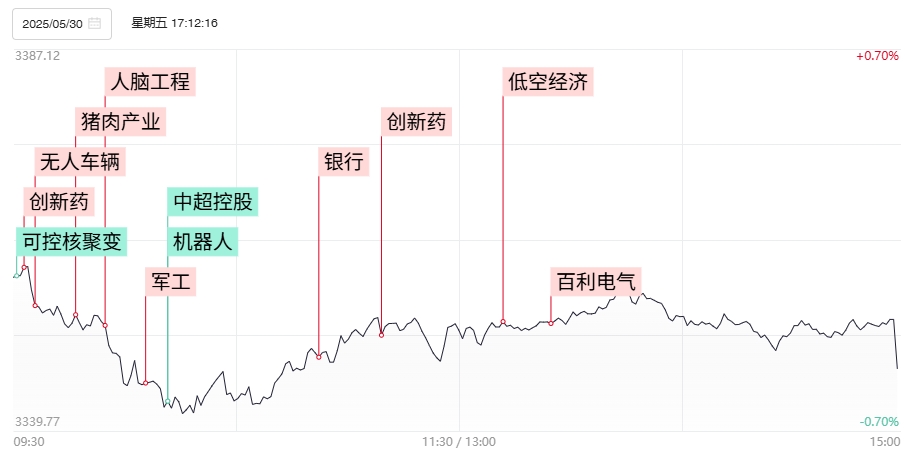
【焦点复盘】创指跌近1%收周线3连阴,银行板块再获逆势抱团,热门股遭批量“核按钮”
Xin Lang Cai Jing· 2025-05-30 09:40
Market Overview - A total of 42 stocks hit the daily limit up, while 21 stocks faced limit down, resulting in a sealing rate of 67% [1] - The market experienced fluctuations throughout the day, with the ChiNext index leading the decline. The Shanghai Composite Index rose over 2% for the month, while the total trading volume in the Shanghai and Shenzhen markets was 1.14 trillion yuan, a decrease of 46.2 billion yuan from the previous trading day [1][8] - The Shanghai Composite Index fell by 0.47%, the Shenzhen Component Index by 0.85%, and the ChiNext Index by 0.96% [1] Sector Performance - The pork, innovative drugs, banking, and CRO sectors saw significant gains, while the gold, glyphosate, controllable nuclear fusion, humanoid robots, environmental equipment, and consumer electronics sectors experienced declines [1] - The innovative drug sector received positive momentum from the National Medical Products Administration's approval of 11 new drugs, boosting stocks like Wisdom Medicine and others to limit up [4][8] Stock Analysis - The advancement rate for consecutive limit-up stocks dropped to 17.39%, with notable declines in high-profile stocks such as Shangwei and Rongfa Nuclear Power, which both hit limit down [3] - Stocks like Huason Pharmaceutical and Debang Co. achieved four consecutive limit-ups, while Baoli Electric and Palm Co. maintained strong performance with multiple limit-ups [3][9] - The low-altitude logistics sector gained attention with the launch of regular low-altitude logistics test flights in Zhengzhou, leading to a rally in related stocks like Beijiao Road Bridge Information [5] Digital Currency and Stablecoins - The Hong Kong Legislative Council passed the Stablecoin Regulation Framework, expected to allow institutions to apply for compliance as stablecoin issuers by the end of 2024 [6][12] - The digital currency sector saw fluctuations, but stocks like Yuyin Co. and others managed to achieve consecutive limit-ups, indicating renewed interest in the sector [6][13] Pork Industry - Major pork companies received directives to pause the expansion of breeding sows and control the weight of market pigs, leading to a surge in pork-related stocks like Juxing Agriculture and Xiangjia Co. [7][21] - The tightening supply expectations contributed to the rise in pork stocks, despite the overall market sentiment being weak [7] Future Outlook - The market showed signs of weakness with a significant drop in the number of limit-up stocks and an increase in limit-down stocks, indicating potential continued downward pressure on high-profile stocks [8] - Technical indicators suggest that the Shanghai Composite Index may face direction choices in the short term, with the potential for further downward testing if it cannot recover key support levels [8]
由创新高个股看市场投资热点
量化藏经阁· 2025-05-30 09:16
报 告 摘 要 乘势而起:市场新高趋势追踪 触及新高的个股、行业和板块可被视为市场的风向标。越来越多的研究表明动量、趋势跟踪策略的有效性。本报告旨在定期跟踪市场中创新高的个股及其 分布,以追踪市场趋势、把握市场热点。 截至2025年5月30日,上证指数、深证成指、沪深300、中证500、中证1000、中证2000、创业板指、科创50指数250日新高距离分别为4.08%、 12.65%、9.77%、10.42%、8.85%、6.39%、21.84%、13.29%。中信一级行业指数中银行、电力及公用事业、医药、家电、农林牧渔行业指数距离 250日新高较近,煤炭、石油石化、房地产、消费者服务、电子行业指数距离250日新高较远。概念指数中,数字货币、银行精选、制药、创新药、万得微 盘股日频等权、银行等概念指数距离250日新高较近。 见微知著:利用创新高个股进行市场监测 截至2025年5月30日,共697只股票在过去20个交易日间创出250日新高。其中创新高个股数量最多的是基础化工、机械、医药行业,创新高个股数量占 比最高的是银行、汽车、纺织服装行业。按照板块分布来看,本周制造、周期板块创新高股票数量最多;按照指数分布 ...