光伏反内卷

Search documents
光伏ETF涨幅领先,机构建议关注行业底部反转丨ETF基金日报
2 1 Shi Ji Jing Ji Bao Dao· 2025-11-04 03:01
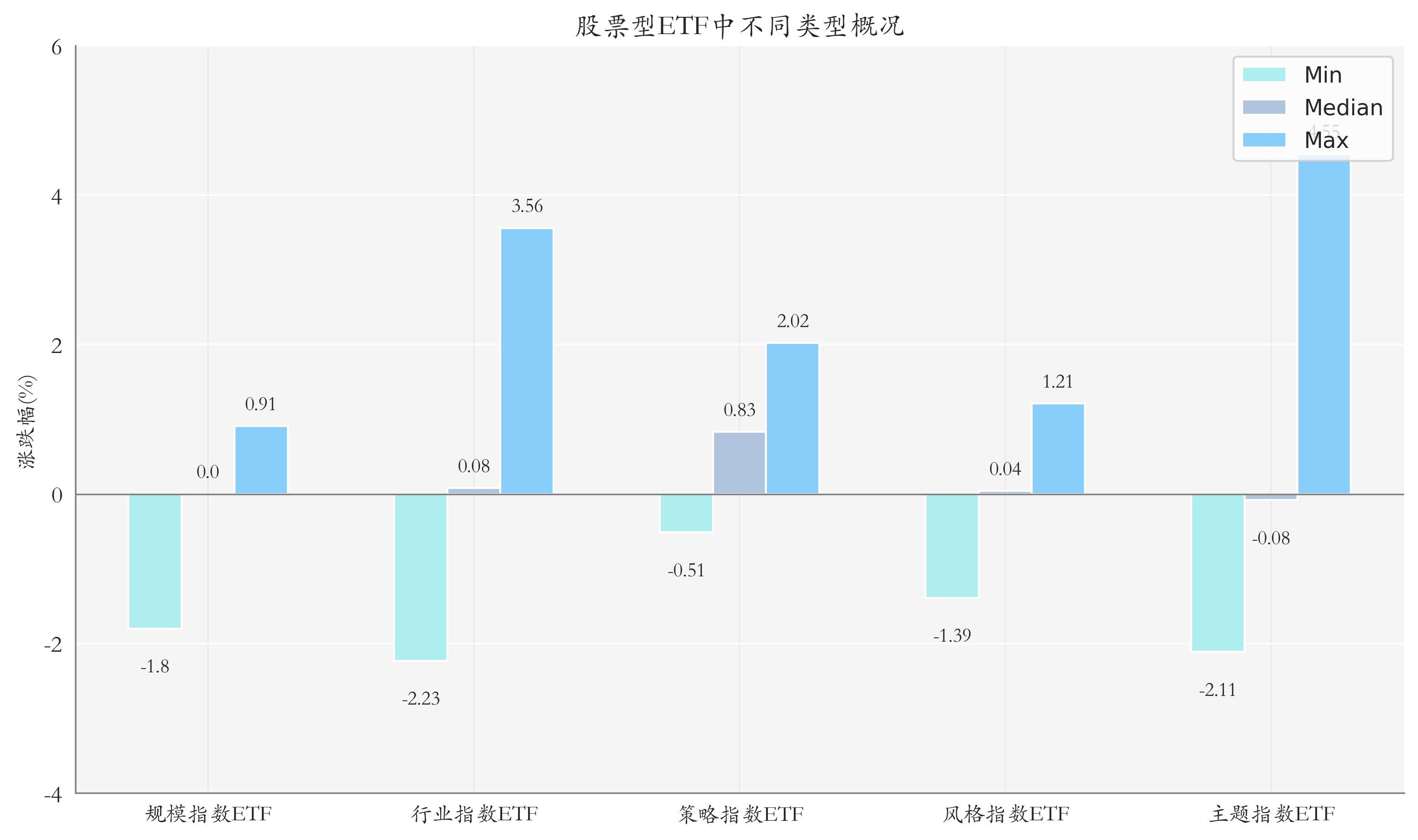
Market Overview - The Shanghai Composite Index rose by 0.55% to close at 3976.52 points, with a daily high of 3977.31 points [1] - The Shenzhen Component Index increased by 0.19% to close at 13404.06 points, reaching a high of 13404.06 points [1] - The ChiNext Index saw a rise of 0.29%, closing at 3196.87 points, with a peak of 3199.4 points [1] ETF Market Performance - The median return for stock ETFs was 0.0% yesterday. The highest returns were from the Penghua CSI 800 Free Cash Flow ETF at 0.91%, and the Huatai-PB CSI A500 ETF at 9.14% [2] - The top-performing stock ETFs included the GF CSI Photovoltaic Leading 30 ETF with a return of 4.55%, followed by the Yinhua CSI Film and Television Theme ETF at 4.38% [5] - The worst-performing ETFs were the Huaan SSE Sci-Tech Innovation Board New Generation Information Technology ETF at -2.23% and the Huaxia CSI Hong Kong Gold Industry ETF at -2.11% [6] ETF Fund Flows - The top three ETFs by fund inflow were the Guotai CSI All-Share Securities Company ETF with an inflow of 1.098 billion, the Huatai-PB CSI A500 ETF with 914 million, and the Huabao CSI Bank ETF with 678 million [8] - The ETFs with the highest outflows included the Huatai-PB CSI 300 ETF with an outflow of 656 million and the Southern CSI 500 ETF with 523 million [9] ETF Margin Trading Overview - The highest margin buying amounts were for the Huaxia SSE Sci-Tech Innovation Board 50 ETF at 632 million, followed by the Guotai CSI All-Share Securities Company ETF at 506 million [11] - The top ETFs for margin selling included the Southern CSI 1000 ETF with 119 million and the Southern CSI 500 ETF with 40.61 million [13] Institutional Insights - According to Open Source Securities, the photovoltaic industry is seeing positive effects from the "anti-involution" trend, with upstream segments expected to significantly reduce losses in Q3. Focus areas include supply chain measures and future demand for photovoltaic installations [13] - Xiangcai Securities anticipates that the prices of photovoltaic products and corporate profits will stabilize and recover, supported by continued growth in new photovoltaic installations and increasing overseas market demand [15]

隆基绿能(601012):BC出货放量驱动盈利改善
HTSC· 2025-11-03 09:18
Investment Rating - The investment rating for the company is "Buy" with a target price of RMB 24.41 [7]. Core Views - The company's revenue for the first nine months of 2025 was RMB 50.915 billion, a year-on-year decrease of 13.10%, while the net profit attributable to the parent company was a loss of RMB 3.403 billion, improving by RMB 3.101 billion year-on-year [1]. - The company is expected to benefit from the recovery of silicon prices and the increase in BC technology shipments, which are anticipated to drive profitability improvements [1][2]. - The company maintains a strong position in the silicon wafer market and is expected to generate excess profits from BC components [1]. Summary by Sections Silicon Wafer Business - In the first nine months of 2025, the company achieved external sales of 38.15 GW of silicon wafers, with 13.4 GW sold in the third quarter, remaining stable quarter-on-quarter [2]. - The price of N-type G12R silicon wafers increased by 36% from the end of June to the end of September 2025, contributing to improved profitability in the silicon wafer segment [2]. Battery Components - The company sold 63.43 GW of battery components in the first nine months of 2025, with 21.58 GW sold in the third quarter, showing a slight decline due to high base effects from the previous quarter [3]. - The BC components achieved external sales of 14.48 GW in the first nine months, with 5.8 GW in the third quarter, reflecting a significant increase quarter-on-quarter [3]. - The HIBC product line has a price premium of 50%-100% in the European distributed market, which helps mitigate cost pressures from upstream price increases [3]. Cash Flow and Financial Position - The company has improved its operating cash flow, with a net inflow of RMB 2.303 billion in the third quarter of 2025, representing a year-on-year increase of 217.86% [4]. - As of the end of the third quarter, the company had cash reserves of RMB 51.366 billion and a debt-to-asset ratio of 62.43%, indicating strong financial resilience [4]. Profit Forecast and Valuation - The company’s net profit forecasts for 2025-2027 are adjusted to -RMB 5.106 billion, RMB 6.234 billion, and RMB 7.074 billion, respectively [5][13]. - The target price of RMB 24.41 is based on a 29.76x PE ratio for 2026, reflecting an increase in comparable company valuations [5][15].

多晶硅及工业硅、光伏产业链市场分析
2025-11-03 02:35
Summary of the Conference Call on the Polysilicon and Industrial Silicon Market Industry Overview - The conference call focused on the polysilicon and industrial silicon markets, particularly within the photovoltaic (PV) industry chain [1][2]. Key Points and Arguments Market Dynamics - From July to September, the polysilicon market experienced price increases and inventory accumulation, with downstream companies optimistic about the PV market. However, by late September to October, a turning point in inventory occurred, leading to increased spot market inventory, peaking at nearly 270,000 tons, which weakened the price increase momentum [1][10]. - The average production cost for polysilicon companies is approximately 52,500 RMB per ton, with electricity prices in the Southwest region rising to 0.45 RMB per kWh during the dry season [1][8]. - The expected global demand for polysilicon in 2026 is projected to be around 1.27 million tons, with a significant focus on balancing domestic and international demand due to declining domestic installation needs [11][13]. Export Market - By 2025, exports of PV products are expected to account for 70%-75% of total production, primarily targeting India, which is heavily investing in PV infrastructure [11]. - The anticipated increase in India's installed capacity by approximately 5 GW in 2026 could generate a demand for about 100,000 tons of polysilicon, although domestic demand in China is expected to decline [11][12]. Production and Pricing Outlook - Polysilicon production is expected to see a slight decrease in November and December, with industrial silicon production potentially dropping by around 100,000 tons due to the dry season affecting production in Yunnan and Sichuan [21][22]. - The price range for industrial silicon is projected to be between 8,700 and 9,200 RMB per ton, influenced by rising electricity costs during the dry season [22]. Inventory and Supply Chain Issues - The polysilicon market has seen a significant increase in inventory, with the highest levels nearing 270,000 tons. If downstream companies continue to reduce purchases, upstream pressure will increase [10][24]. - The establishment of a storage platform for polysilicon is rumored to involve the acquisition of 500,000 tons of capacity at around 60,000 RMB per ton, although this has not been officially confirmed [5]. Future Scenarios - Several scenarios for the future of polysilicon pricing were discussed, including potential price increases if a storage platform is established and demand remains stable. Conversely, if demand weakens and the platform does not materialize, prices may face downward pressure [19][24]. Additional Important Insights - The overall sentiment in the market is cautious, with downstream companies adopting conservative strategies due to economic uncertainties. This has led to a trend of price competition among suppliers [8][15]. - The relationship between polysilicon and industrial silicon demand is significant, with polysilicon accounting for 35% of industrial silicon demand. As long as polysilicon remains profitable, it is unlikely that industrial silicon prices will significantly impact production levels [23]. This summary encapsulates the critical insights from the conference call, highlighting the current state and future expectations of the polysilicon and industrial silicon markets within the photovoltaic industry.
中信建投:看好储能全球共振大趋势不变 对应材料、电池、集成均存投资机会
Zhi Tong Cai Jing· 2025-11-02 23:53
Group 1: Energy Storage - The energy storage market is recovering, and the global trend remains positive, driven by the economic turning point in domestic energy storage and strong investment due to renewable energy marketization and capacity pricing [1][2] - The cumulative penetration rate of energy storage in China is still below 10%, with an expected increase in new installations to 300 GWh next year [2] - The largest overseas opportunity comes from data centers, which are generating significant storage demand, with leading companies already securing large orders [2] - Energy storage is projected to drive lithium battery demand growth exceeding 30% next year, presenting investment opportunities across materials, batteries, and integration [1][2] Group 2: Lithium Batteries - Energy storage represents the most elastic segment under non-linear growth, as the industry is currently experiencing supply shortages and profitability at the bottom [2] - Demand for lithium materials is expected to grow by over 25% in 2026, leading to price increases in materials, despite current market skepticism regarding demand and pricing [2] - The focus is on the upcoming peak production season, where supply-demand imbalances in materials and energy storage batteries are expected to drive prices higher [2] Group 3: Photovoltaics - The cost of silicon materials is expected to support prices strongly, with anticipated production cuts leading to rising average industry costs [3] - Key observations for the photovoltaic sector include the pricing situation in the component segment and the progress of silicon material capacity consolidation, with positive changes expected in November [3] - The sector's top recommendation is BC batteries, which could lead to a recovery in profitability for leading photovoltaic companies if progress in reducing internal competition is achieved [3] Group 4: Power Equipment - Recent developments include NVIDIA's release of an 800V HVDC white paper, indicating trends in the HVDC/SST industry, and increased interest in supporting equipment [3] - High-voltage equipment tenders are expected to revive, particularly in the Guangdong-Hong Kong-Macao Greater Bay Area, with a notable increase in domestic transformer exports [3] - The power equipment sector remains a high-certainty area with ample orders on hand, and attention is drawn to high-voltage tenders and IDC supporting opportunities [3] Group 5: Hydrogen Energy - Hydrogen energy is positioned as a forward-looking industry in the 14th Five-Year Plan, with significant potential for growth over the next decade [3] - The focus is on identifying which downstream hydrogen energy applications will develop commercial models first, serving as key investment signals for the sector [3] Group 6: Robotics - Elon Musk anticipates the release of the Optimus V3 mass production prototype in early 2026, with plans to establish a production line for 1 million units by the end of 2026 [4] - The focus is on leading companies in the supply chain and the expected significant growth in shipments from domestic players [4]

横店东磁(002056):Q3利润同比高增,磁材和锂电稳步发展
Changjiang Securities· 2025-11-02 11:41
Investment Rating - The investment rating for the company is "Buy" and is maintained [8][7]. Core Insights - In the first three quarters of 2025, the company achieved a revenue of 17.562 billion yuan, representing a year-on-year growth of 29.31%. The net profit attributable to the parent company was 1.452 billion yuan, up 56.8% year-on-year. In Q3 2025, the revenue reached 5.626 billion yuan, with a year-on-year increase of 40.14%, and the net profit was 432 million yuan, growing by 50.42% year-on-year [2][5]. - The company is expected to achieve a net profit of 1.85 billion yuan in 2025, corresponding to a PE ratio of 19.4 times [7]. Financial Performance - The company reported a significant increase in operating cash flow, with a net cash flow from operating activities of approximately 2.99 billion yuan in the first three quarters, a year-on-year increase of 147.3% [13]. - The Q3 expense ratio was 7.6%, which is an increase of 5.3 percentage points compared to the previous quarter, primarily due to fluctuations in financial expenses and an increase in R&D expenses, although the absolute amount of expenses remained at a reasonable level [13]. Business Segments - The magnetic materials business continues to gain market share in the home appliance and automotive sectors, with significant growth in shipments for electric vehicle onboard chargers, charging modules, thermal management systems, AI server power supply units, and chip inductors, enhancing profitability [13]. - In the photovoltaic sector, despite a projected decline in battery component shipments in Q3, the company is expected to maintain good unit profitability through proactive supply chain management [13]. - The lithium battery business focuses on small power applications across multiple fields, achieving further improvements in gross margin due to high capacity utilization and leading product technology [13].

行业聚焦反内卷,光伏部分企业Q3业绩已出现显著改善信号
2025-11-01 12:41
Summary of Conference Call on Photovoltaic Industry's Anti-Competition Measures Industry Overview - The conference focused on the photovoltaic (PV) industry, particularly discussing the recent anti-competition measures and market dynamics within the sector [1][2]. Key Points and Arguments 1. **Market Recovery and Policy Support**: The market has shown a positive recovery, driven by recent policy announcements aimed at eliminating barriers to a unified national market and addressing excessive competition [1][2]. 2. **Formation of Industry Alliances**: 17 leading companies in the silicon material sector are forming a coalition to stabilize prices and reduce production capacity, with expectations to complete this by the end of the year [2][3]. 3. **Price Recovery Indicators**: The third quarter has shown signs of improvement in the PV supply chain, particularly due to the recovery in prices of silicon materials, which is expected to continue as production cuts are anticipated in November [3][4]. 4. **Impact of Policy Changes**: The introduction of stricter regulations against below-cost pricing has led to a significant increase in silicon prices, from around 30,000 to over 50,000 [6][15]. 5. **Performance of Key Companies**: Major companies like Xiexin and Tongwei reported significant improvements in their financial performance in Q3, indicating a recovery in the industry [8][18]. 6. **Investment Recommendations**: Analysts recommend focusing on companies with strong cyclical attributes in the silicon material and PV glass sectors, including Tongwei, Daqo, and Xiexin [9][23]. 7. **Technological Advancements**: The industry continues to see technological progress, which is expected to create a competitive edge for companies that can innovate and maintain high margins [9][20]. 8. **Long-term Market Dynamics**: The anticipated supply-side reforms in the silicon sector are expected to lead to a more balanced supply-demand situation, which will benefit downstream companies and prevent a return to cutthroat competition [19][21]. Additional Important Insights - **Regulatory Environment**: The government's commitment to creating a unified market and addressing local protectionism is crucial for the long-term health of the PV industry [7][22]. - **Market Sentiment**: The recent media coverage and government announcements have sparked renewed investor interest and optimism regarding the anti-competition measures [2][4]. - **Financial Health of the Sector**: Many companies are showing signs of financial recovery, with improved profit margins and reduced losses compared to previous quarters [8][22]. This summary encapsulates the key discussions and insights from the conference call regarding the photovoltaic industry's current state and future outlook, emphasizing the importance of policy support and industry collaboration in fostering a healthier market environment.






赛伍技术
2025-11-01 12:41
Summary of the Conference Call for Saiwu Technology Q3 2025 Company Overview - **Company**: Saiwu Technology - **Quarter**: Q3 2025 - **Revenue**: 687 million (up 4.8% year-on-year) [1][2] - **Net Profit**: Loss of 44.89 million [2] Key Points Financial Performance - **Revenue Growth**: Q3 revenue shows a slight increase compared to the previous year, indicating a stabilization after a decline from 2024 [1] - **Net Loss**: The company reported a net loss of 44.89 million, although this represents a 44% improvement year-on-year [2] - **Backplane Business**: The backplane segment has seen a significant decline in demand, contributing to the overall losses [2][3] - **Film Business**: The solar film segment is stabilizing, with a slight recovery in prices, but still operating at a loss [3][5] Business Segments - **Non-Photovoltaic Growth**: The non-photovoltaic segments, particularly new energy vehicle materials, have shown substantial growth, with a 50% increase in revenue year-on-year [3][4] - **New Energy Vehicle Materials**: Revenue from this segment reached approximately 180 million in Q3, making it the second-largest segment after solar film [3][4] - **3C Electronics and Semiconductors**: These segments are also growing rapidly, although they currently do not match the revenue of the new energy vehicle materials [4] Production and Capacity - **Production Capacity**: The company is operating at approximately 70% capacity utilization for solar film production, with expectations for further improvements [15][16] - **Vietnam Facility**: The Vietnam facility is running at full capacity, producing around 15 million square meters of solar film monthly [60] Strategic Adjustments - **Backplane Strategy**: The company plans to retain some production capacity for specialized backplanes while transitioning some equipment to non-photovoltaic products [8][9] - **Cost Reduction Initiatives**: Efforts are underway to reduce costs in the Vietnam facility, particularly concerning logistics and packaging [60] Future Outlook - **Profitability Goals**: The company aims to achieve breakeven by Q4 2025, with hopes of turning profitable in the near future [60] - **Market Trends**: The solar film market is expected to stabilize, but significant recovery in profitability is not anticipated in the short term [66] - **New Product Development**: The company is focusing on expanding its product offerings in new energy materials and enhancing its market presence in the semiconductor sector [54][56] Industry Context - **Market Conditions**: The overall photovoltaic market is experiencing challenges, with a slow recovery in pricing and demand for backplane products [62][63] - **Emerging Technologies**: The company is exploring opportunities in solid-state battery materials and other innovative products, indicating a proactive approach to market changes [71][72] Additional Insights - **R&D Focus**: The company has a dedicated R&D team focusing on new energy materials, 3C electronics, and semiconductor materials, with plans to expand this team [54][56] - **Competitive Landscape**: The company is positioned as a leader in certain segments, particularly in new energy vehicle materials, but faces competition in the semiconductor space [56][58] This summary encapsulates the key points discussed during the conference call, highlighting the financial performance, strategic direction, and market context for Saiwu Technology.

上游报喜下游“失血”,光伏主链企业三季度业绩分化
第一财经· 2025-10-31 11:06
Core Viewpoint - The photovoltaic industry chain is experiencing a divergence, with upstream companies reporting improved profits while downstream components continue to face losses [3][6]. Upstream Performance - Leading upstream companies such as Tongwei Co., GCL-Poly Energy, and Daqo New Energy have shown improved quarterly profits in Q3 2025, with Daqo New Energy achieving a net profit of 73.48 million yuan for the first time since Q2 2024 [3][4]. - Tongwei Co. holds the highest global market share in high-purity silicon, reporting a reduced net loss of 315 million yuan in Q3, down from 2.363 billion yuan in Q2, marking an over 80% reduction in losses [3][4]. - GCL-Poly Energy reported an increase in the average selling price of granular silicon to 42.12 yuan/kg in Q3, up from 35.71 yuan/kg in Q1 and 32.93 yuan/kg in Q2 [3]. Market Trends - The improvement in upstream performance reflects a market recovery trend and the initial effects of the photovoltaic "anti-involution" strategy, with a reported reduction of approximately 12,000 tons in domestic polysilicon inventory in the first three quarters of the year [4][5]. - Polysilicon prices have strengthened due to reduced supply, with average prices for N-type and granular silicon rising to 53,200 yuan/ton and 50,500 yuan/ton by the end of September, representing increases of 55% and 51% respectively since June [5]. Downstream Challenges - Downstream component manufacturers are struggling with rising costs and weakened terminal demand, failing to achieve profitability in Q3 2025 [6][7]. - Major companies in the component sector, including JinkoSolar, LONGi Green Energy, Trina Solar, and JA Solar, reported significant net losses in Q3, with losses ranging from 8.34 billion yuan to 12.83 billion yuan [6][7]. - Cumulatively, these companies have incurred losses exceeding 30 billion yuan in the first three quarters, with Trina Solar leading with a loss of 4.201 billion yuan [6][7]. Future Outlook - The industry outlook for Q4 remains cautious, with expectations of demand decline and some companies reporting lower-than-expected orders [7]. - LONGi Green Energy's chairman expressed confidence in achieving breakeven in Q4 by increasing the revenue share of BC products and scenario-based products [7].




财报解读|上游报喜下游“失血”,光伏主链企业三季度业绩分化
Di Yi Cai Jing· 2025-10-31 10:10
Core Insights - The photovoltaic industry is experiencing a divergence where upstream companies are showing signs of recovery while downstream components continue to struggle with losses [2][4][5] Upstream Performance - Leading upstream companies such as Tongwei Co., Ltd. (600438.SH), GCL-Poly Energy Holdings Limited (03800.HK), and Daqo New Energy Corp. (688303.SH) reported improved quarterly profits in Q3 2025, with Daqo achieving a net profit of 73.48 million yuan for the first time since Q2 2024 [2][3] - Tongwei holds the highest global market share in high-purity crystalline silicon, reporting a reduced net loss of 315 million yuan in Q3, down from 2.363 billion yuan in Q2, indicating a more than 80% reduction in losses [2][3] - GCL-Poly's average selling price for granular silicon products increased to 42.12 yuan/kg in Q3, up from 35.71 yuan/kg in Q1 and 32.93 yuan/kg in Q2, reflecting a positive price trend [2] Market Dynamics - The supply-side self-discipline and production cuts have led to a reduction of approximately 12,000 tons in domestic polysilicon inventory in the first three quarters of the year, contributing to a stronger market price [3] - Polysilicon prices have significantly increased, with N-type raw materials and granular silicon averaging 53,200 yuan/ton and 50,500 yuan/ton respectively by the end of September, marking increases of 55% and 51% since June [3] Downstream Challenges - The downstream component sector is facing challenges due to rising costs and weakened end-user demand, with major companies like JinkoSolar, LONGi Green Energy, Trina Solar, and JA Solar all reporting losses in Q3 [4][5] - The total shipment volume of the top ten global component suppliers is projected to be around 247.9 GW in the first half of 2025, with the top four companies accounting for nearly 60% of this total [4] - The net losses for these leading companies in Q3 were significant, with Trina Solar reporting a loss of 1.283 billion yuan, followed by JinkoSolar, JA Solar, and LONGi Green Energy with losses of 1.012 billion yuan, 973 million yuan, and 834 million yuan respectively [4] Future Outlook - The industry outlook for Q4 remains cautious, with expectations of declining demand and some companies reporting lower-than-expected orders [6] - The focus is shifting towards the signing of orders and production arrangements for Q1 of the following year as demand is anticipated to weaken further towards the end of the year [6]
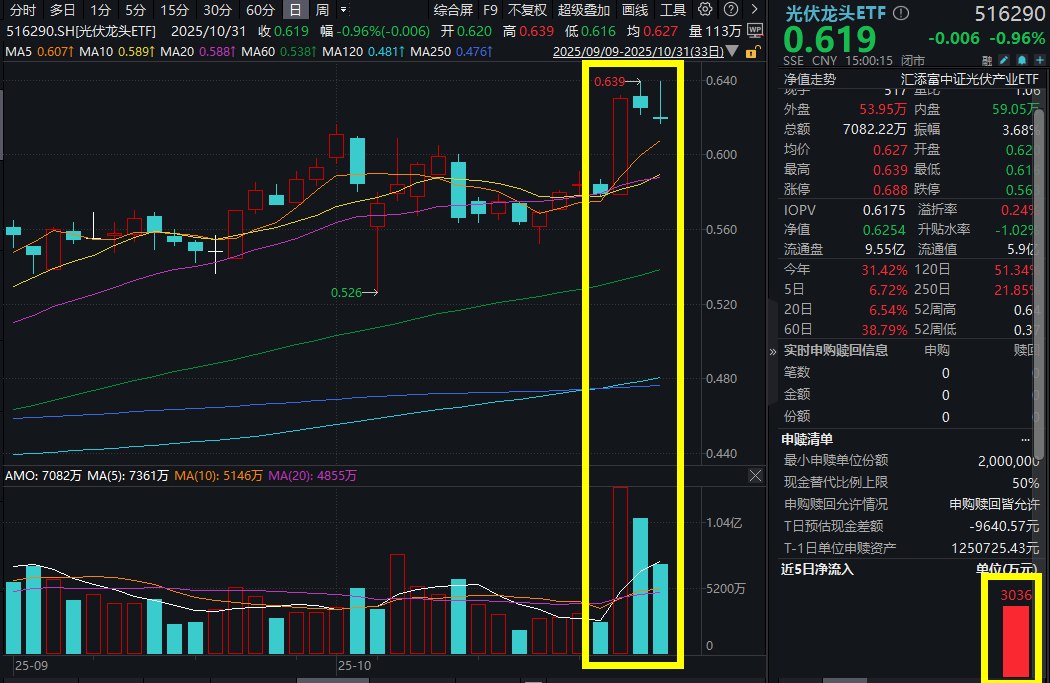
光伏冲高回落,同类费率最低档的光伏龙头ETF(516290)跌近1%,一度涨近2%,弘元绿能涨停,三季度营收净利双增!反内卷下,光伏困境反转?
Sou Hu Cai Jing· 2025-10-31 09:59
Core Viewpoint - The A-share market showed significant divergence on October 31, with small-cap and high-growth sectors like the North Securities 50 and CSI 2000 rising, while the photovoltaic sector experienced a pullback despite a substantial inflow of funds into the leading photovoltaic ETF (516290) [1][3] Group 1: Market Performance - The photovoltaic leading ETF (516290) saw a decline of 0.96% with a total trading volume of 71 million yuan on October 31, despite attracting over 30 million yuan in inflows the previous day [1] - The component stocks of the photovoltaic leading ETF exhibited mixed performance, with Hongyuan Green Energy rising by 10.00% and Trina Solar increasing by 4.25%, while TBEA and Sungrow Power fell by over 5% and 2%, respectively [3] Group 2: Company Announcements - Trina Solar announced a sales contract for over 1 GWh of energy storage products with European clients, indicating a growing demand for photovoltaic-related technologies [5] - Hongyuan Green Energy reported a third-quarter revenue of 2.456 billion yuan, a year-on-year increase of 85.50%, and a net profit of 532 million yuan, marking a turnaround from losses [5] Group 3: Industry Insights - Zhongyuan Securities noted signs of recovery in the photovoltaic sector's third-quarter performance, driven by rising polysilicon prices and previous production cuts improving supply-demand dynamics [6] - Nomura Orient International expressed optimism about investment opportunities arising from the photovoltaic sector's recovery, highlighting a significant narrowing of losses for Tongwei Co. in the third quarter [7] - The photovoltaic sector is expected to undergo fundamental recovery, with potential improvements in competition and industry standards, creating opportunities for valuation recovery [6][7]