新基建

Search documents
冰火两重天!创业板大涨2.23%,这个板块指数却罕见涨停10.01%,发生了什么?
Sou Hu Cai Jing· 2025-12-22 07:40
Core Insights - The A-share market showed strong performance today, driven by structural opportunities, particularly in the Hainan sector, which significantly boosted market sentiment [1] - The total trading volume reached 18,619 billion yuan, an increase of 1,360 billion yuan from the previous day, indicating active market participation [1] Market Performance - The Shanghai Composite Index rose by 0.69% to close at 3,917.36 points, while the Shenzhen Component Index increased by 1.47% to 13,332.73 points, with a trading volume exceeding 10,000 billion yuan [1] - The ChiNext Index surged by 2.23% to 3,191.98 points, and the STAR 50 Index gained 2.04% to close at 1,335.25 points, reflecting a strong performance in technology stocks [1] Key Sectors - The Hainan Free Trade Port concept saw a significant surge, with the Hainan Provincial State-owned Assets Index soaring by 10.01% and the Hainan Free Trade Port Index rising by 9.28%, with trading volumes of 65.63 billion yuan and 281.63 billion yuan respectively [2] - The technology growth sector, particularly in telecommunications and electronics, also performed well, with the telecommunications sector rising by 4.28% and the electronics sector by 2.62%, supported by policy initiatives and technological advancements [2] Technological Advancements - The optical communication index increased by 5.34%, with a trading volume of 1,164.39 billion yuan, driven by government support for new infrastructure and breakthroughs in technology, such as new optical computing chips and improved GPU architectures [2][3] - The semiconductor equipment index rose by 5.35%, with a trading volume of 205.14 billion yuan, reflecting a recovery in the global chip supply chain and accelerated domestic substitution processes [3] Investment Recommendations - Investors are advised to avoid chasing short-term hot sectors, particularly those that have surged significantly, such as Hainan stocks, and to look for opportunities after potential corrections [5] - Focus on sectors with strong underlying logic, particularly technology growth stocks that have clear policy and technological support [5] - Maintain a diversified investment approach and manage positions according to individual risk tolerance to avoid emotional decision-making [5]

国际复材:2025年,玻纤市场环境较2024年有所回暖,热塑与风电领域需求恢复明显加快
Zheng Quan Ri Bao Zhi Sheng· 2025-12-19 10:43
证券日报网12月19日讯 国际复材在12月16日-18日回答调研者提问时表示,2025年,玻纤市场环境较 2024年有所回暖,热塑与风电领域需求恢复明显加快。然而,受相关行业持续调整、行业内竞争态势尚 未根本扭转等因素影响,市场需求结构仍呈现分化态势,终端降价压力逐步向产业链上游传导。叠加海 外政治经济环境不确定性加剧,公司对行业整体发展保持谨慎乐观态度。未来,公司将以"产品创新、 卓越运营、纤材协同"的发展思路,继续深化全球运营,让中国智造的优秀材料服务全球市场。同时, 公司会进一步推进高模、高强、超细、低介电等创新产品在"双碳""数智化""航空航天""新基建"等领域 的持续落地,拓宽玻纤应用场景、塑造行业"成长性"。 (编辑 任世碧) ...
多重因素共振 铜价结构性牛市可期
Qi Huo Ri Bao· 2025-12-19 00:09
全球铜矿供应正面临系统性压力。2025年,智利El Teniente矿难、印尼Grasberg泥石流及刚果(金) Kamoa-Kakula矿震等事件接连发生,导致全球铜矿产量同比下滑约4.7%,预计全年供应缺口将扩大至 15万~30万吨。与此同时,矿山品位持续下降(1990年以来平均品位降幅已达30%)与新增项目投产普 遍延迟(未来五年年均增速预计不足2%)进一步加剧中长期供应压力,引发全球市场对铜矿供应的担 忧,并显著推升其风险溢价水平。 2025年四季度以来,全球铜价持续刷新历史高位。12月上旬,沪铜主力合约突破9.45万元/吨,LME铜 价触及1.19万美元/吨,年内累计涨幅均超过30%。笔者认为,本轮铜价上涨并非由单一供需矛盾驱 动,而是供应瓶颈、金融属性释放与政策扰动等多重因素共振的结果。尽管国际铜研究组织数据显示, 2025年全球精炼铜市场预计小幅过剩17.8万吨,但区域性库存失衡叠加长期结构性缺口预期,共同推动 铜价脱离即期基本面约束,凸显出铜作为战略资源,在能源转型与地缘格局演变过程中正在经历价值重 估。 矿山中断与冶炼困局交织 从需求结构来看,铜市传统消费领域如建筑、家电等行业表现疲软,但新 ...
巨力索具(002342) - 巨力索具投资者关系管理信息
2025-12-18 13:14
Company Overview - Giant Lifting Equipment Co., Ltd. has a history of 40 years since its establishment in 1985, with headquarters located in Baoding, Hebei Province [3] - The company occupies over 1,700 acres and has two main production bases in Baoding and Mengzhou, with plans for a third base in Tianjin [3] - It specializes in the R&D, design, manufacturing, and sales of lifting equipment, offering over ten product series and thousands of specifications [3] Product Composition - The company's products are divided into two main categories: - Metal lifting products (mainly steel plates, round steel, and wire rods) - Soft lifting products (mainly industrial fiber wires such as polyester, nylon, aramid, and polypropylene) [4] - Revenue breakdown by product type: - Engineering and metal lifting products: ~50% - Synthetic fiber lifting belts: ~20% - Wire ropes and related products: ~26% [4] - Overall gross margin is maintained at around 20%, above the industry average [4] Industry Trends and Demand - Company revenue has shown double-digit growth since 2018, with the exception of declines in 2021 and 2024 [5] - Current market demand is increasing, particularly in emerging sectors such as renewable energy and infrastructure projects [5] - Traditional sectors like metallurgy and construction are experiencing slower growth, but the existing market remains substantial [5] Technological and Standardization Efforts - The company has authored 16 national, industry, and local standards and participated in 49 others, totaling 65 standards [4] - It holds over 370 patents, including 66 invention patents, and has established several R&D platforms [4] Project Developments - The Henan subsidiary has invested in two projects, with the first phase reaching full production in 2024 and the second phase entering trial production by the end of the year [4] Interaction Insights - The company provides products for commercial aerospace applications, ensuring support from assembly to pre-launch processes [7] - The deep-sea economy is supported by government policies aimed at promoting high-quality marine economic development [8] - The company has established a wholly-owned subsidiary in Tianjin to enhance its capabilities in the deep-sea economy [8] International Strategy - The company has received factory recognition from eight classification societies and established a stable sales network in over 100 countries [9] - Recent projects include significant sports venues in Saudi Arabia and Serbia, with expectations for increased overseas revenue due to the Belt and Road Initiative [9] - Currently, there are no plans for overseas factory expansions [10]

海南适度超前建设基础设施 持续提高基础设施网络化智能化水平
Hai Nan Ri Bao· 2025-12-18 03:56
Core Viewpoint - Hainan is advancing its infrastructure development to enhance connectivity and support the construction of a free trade port, aiming to improve its global reach and trade capabilities [4][13]. Infrastructure Development - Hainan's airport network is set to handle over 50 million passengers this year, marking a historic record [4]. - The province's trade import and export volume is projected to increase from 93.33 billion yuan in 2020 to 277.89 billion yuan by 2024, with annual growth rates of 31.3% for goods trade and 32.3% for service trade [4]. - The total length of highways in Hainan has reached 42,000 kilometers, with a density of 124.2 kilometers per 100 square kilometers [6]. Transportation Network - The completion of the Hainan Ring Road and the Hainan Island Highway has significantly improved travel times, reducing a journey that previously took four hours to just half an hour [5]. - Hainan has established a "Five Ring" transportation network, integrating highways, high-speed rail, and national roads [6]. - The province's civil aviation capacity is expected to reach 68 million passengers annually after the completion of airport expansion projects [7]. Maritime and Air Connectivity - Hainan has opened 75 container shipping routes, including 36 international routes, enhancing its global shipping network [8]. - The number of international passenger routes is expected to exceed 90, connecting to 42 cities across 21 countries and regions [8]. Digital and Smart Infrastructure - Hainan is implementing smart infrastructure projects, including a digital port management system and a dedicated internet data channel for the free trade port [12]. - The province has established "gigabit cities" in Haikou, Sanya, and Danzhou, with advanced optical networks and smart grid systems [10]. Future Development Plans - Hainan's "14th Five-Year Plan" emphasizes proactive infrastructure development to enhance connectivity and support the free trade port's operations [13]. - The province aims to integrate new technologies such as AI, blockchain, and 5G into its infrastructure to foster high-quality development [12].


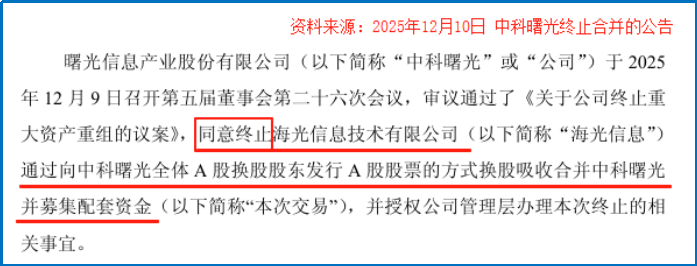
刚刚,5000亿科技巨头,终止重组!
Xin Lang Cai Jing· 2025-12-17 14:19
Core Viewpoint - The planned merger between Haiguang Information and Zhongke Shuguang, aimed at creating a comprehensive "chip-server-computing service" giant, has been halted due to significant changes in market conditions and the complexity of the transaction [4][21]. Group 1: Company Background - Haiguang Information, established in 2014, has Zhongke Shuguang as its largest shareholder, holding 27.96% of its shares as of September 30 [2][18]. - Haiguang focuses on CPU and DCU chip design, while Zhongke Shuguang specializes in server manufacturing and cloud computing services, with over 2 million cloud platform users [3][19]. Group 2: Business Synergy - The merger was expected to allow Haiguang's chips to be deeply integrated with Zhongke Shuguang's server systems, reducing adaptation costs and accelerating product iteration [20]. - The combination was seen as a strong partnership in the context of increasing demand for AI computing and domestic alternatives [20]. Group 3: Reasons for Termination - The termination was attributed to the large scale of the transaction, the number of parties involved, and significant market changes since the merger was proposed, making the conditions for restructuring no longer viable [4][21]. - Both companies have committed to a "cooling-off period" of at least one month before planning any major asset restructuring [6][22]. Group 4: Financial Health and Strategic Focus - Zhongke Shuguang reported a healthy cash flow, with a cumulative net inflow of 6.834 billion from 2021 to 2024, indicating strong profitability and self-sufficiency [10][25]. - The termination of the merger allows both companies to focus on their core competencies without the distraction of integration challenges, with Haiguang needing to concentrate on chip development and Zhongke Shuguang on system integration [12][27]. Group 5: Market Opportunities - The current "new infrastructure" wave in China, with a total investment of 5.75 trillion planned for key projects by mid-2025, presents significant opportunities for Zhongke Shuguang as a major supplier of computing equipment [28][29]. - The reduction in sales expense ratio from 5.88% in 2024 to 5.51% in the first three quarters of 2025 indicates improved market expansion conditions for Zhongke Shuguang [13][31]. Group 6: Future Collaboration - Despite the merger's termination, both companies will continue to deepen their collaboration in system product applications, focusing on high-end computing and AI platforms [15][32]. - This approach allows them to maintain flexibility in technology paths and market responses while avoiding potential management redundancies from a merger [32].


「善友探索流第四期」|她以“天地一体”战略,卡位万亿赛道
混沌学园· 2025-12-17 11:57
Core Viewpoint - The article emphasizes the transformative potential of the commercial space industry in China, highlighting the strategic positioning of Xingyi Lianxin and its founder Peng Yuanyuan in the critical area of integrated digital processing payloads for satellites, which are essential for data processing and control [1][2] Industry Insights - The Chinese government is injecting new policy momentum into the commercial space sector by establishing special development funds, aiming to shift the industry from single satellite launches to large-scale, systematic operations [1] - The commercial space industry is at a pivotal moment, with national support and a clear direction towards integrated operations, aligning with the strategic initiatives of companies like Xingyi Lianxin [17] Company Development - Peng Yuanyuan founded Xingyi Lianxin in 2021, focusing on a more concentrated and core segment of the satellite industry, moving from initial educational efforts in satellite manufacturing to addressing the more complex challenges of satellite payloads [10][9] - The shift in focus to satellite payloads is based on a strategic judgment that the satellite platform market is becoming increasingly competitive and commoditized, while the true value lies in the payload technology, which requires advanced communication technology and aerospace engineering expertise [12][13] Strategic Positioning - The company recognizes a significant talent and knowledge gap between the communication and aerospace industries, which presents a unique opportunity for startups to integrate resources and create distinct value [14] - The "5G in space" strategy proposed by Peng aims to leverage China's established advantages in ground communication technologies and adapt them for space applications, capitalizing on the country's rapid advancements in the telecommunications sector [13] Future Outlook - The upcoming dialogue featuring Peng Yuanyuan will provide deeper insights into the entrepreneurial journey within the commercial space sector and the broader implications for China's space industry [18][19]

研判2025!中国冗余电源系统行业产业链、市场规模及发展趋势分析:AI算力爆发与新基建加速共驱,定制化高压直流/液冷方案崛起[图]
Chan Ye Xin Xi Wang· 2025-12-17 01:41
Core Insights - The Chinese redundant power system industry is experiencing strong demand driven by AI computing power and "new infrastructure," with a projected market size of approximately 30.8 billion yuan in 2024, reflecting a year-on-year growth of 8.83% [1][8] - The growth is attributed to the rigid demand for high reliability in power supply for key infrastructures such as data centers, communication networks, and industrial internet, as well as the direct pull from high-power density loads like AI servers [1][8] - The focus of competition in the industry has shifted from traditional general-purpose products to customized and intelligent solutions such as high-voltage direct current (HVDC) and liquid-cooled power supplies [1][8] Industry Overview - Redundant power systems (RPS) are designed to achieve load balancing, automatic fault switching, and continuous power supply through parallel or backup designs of multiple power modules, ensuring seamless operation even during main power failures [2] - The systems typically utilize chip-controlled modules for load distribution and health monitoring, supporting hot-swappable functionality to allow for module replacement without service interruption [2] Industry Value Chain - The upstream of the redundant power system industry includes raw materials and components such as MOSFETs, IGBTs, diodes, chips, sensors, and various protective devices [4] - The midstream involves the production and manufacturing of redundant power systems, while the downstream applications span data centers, industrial automation, communication, transportation, medical, and aerospace sectors [4] Market Size - The market size of the Chinese redundant power system industry is expected to reach approximately 30.8 billion yuan in 2024, with an 8.83% year-on-year growth, driven by the demand for high reliability in power supply for critical infrastructures [1][8] - The industry is witnessing a transition towards customized and intelligent solutions that cater to high-efficiency computing clusters [1][8] Key Companies Performance - The industry has a high concentration of market players, with companies like Eurotech deeply integrated with major clients such as Inspur and Alibaba, and their 800V HVDC solution passing tests by Meta [8] - Megmeet has entered the Nvidia supply chain and co-developed an immersion liquid-cooled power supply, supporting a power density of 300kW per cabinet [8] - Zhongheng Electric provides deep service in the HVDC market for internet giants like Tencent and Alibaba [8] Industry Development Trends 1. **Technological Evolution**: The industry is evolving towards AI-driven intelligent redundancy, enhancing energy efficiency and smart development, with power conversion efficiency exceeding 96% and modular designs supporting high power density [11] 2. **Rising Market Demand**: The demand for redundant power modules is increasing significantly, particularly in data centers, driven by projects like "East Data West Computing" and the growth of 5G and industrial automation [12] 3. **Policy and Industry Synergy**: National goals for carbon neutrality and the "14th Five-Year Plan" are pushing the industry towards greener and more autonomous upgrades, with an increasing penetration of domestic power management chips [13]




机构预计楼市下行趋势将在2026年见底
2 1 Shi Ji Jing Ji Bao Dao· 2025-12-16 14:51
Group 1: Economic Outlook - The chief economist of Bank of America Securities for Greater China, Qiao Hong, forecasts China's GDP growth rate to reach 4.7% in 2026, with expectations for more counter-cyclical policies to support economic growth close to target levels [1] - The structure of economic growth in China is expected to change by 2026, with increased importance of domestic demand and a relative weakening of export-driven growth compared to 2025 [1] - The People's Bank of China is anticipated to implement two 10 basis point interest rate cuts in 2026, aiming for a moderately accommodative monetary policy to stimulate domestic demand [1] Group 2: Investment and Infrastructure - Despite the government's deployment of fiscal tools, including a 4% fiscal deficit and record local government special bonds of 4.4 trillion yuan, infrastructure investment faces challenges due to local government liquidity constraints [1] - Infrastructure investment is expected to rebound in the first quarter of 2026, driven by seasonal spending and incremental policy implementation, with a long-term shift in focus from traditional transportation networks to new infrastructure such as energy, 5G, data centers, and public service facilities [1] Group 3: Export and Consumption - China's export performance has exceeded expectations this year, maintaining positive growth for most of the past 20 months, supported by a global recovery in electronic products and strong exports to regions outside the U.S. [2] - The retail sales growth of consumer goods in China has been around 4% since 2025, primarily driven by government subsidy programs for major items like automobiles and home appliances, although growth has slowed recently due to high base effects from the previous year [2] - The government is expected to continue a subsidy program of approximately 300 billion yuan in 2026, potentially expanding the scope to include more small items, with measures to boost service consumption likely to be introduced in the second half of 2026 [2] Group 4: Real Estate Market - The downward trend in the mainland real estate market is expected to bottom out in 2026, with first-tier city housing prices likely to recover first, followed by a gradual transmission of recovery to second and third-tier city markets [2]
机构预计楼市下行趋势将在2026年见底
21世纪经济报道· 2025-12-16 14:40
Group 1 - The core viewpoint of the article is that China's GDP growth rate is expected to reach 4.7% in 2026, with a shift in the economic growth structure towards increased domestic demand and a reduced role of exports compared to 2025 [1][2] - The People's Bank of China is anticipated to implement two rate cuts of 10 basis points each in 2026 to support domestic demand, likely occurring in the first and second quarters [1] - Infrastructure investment is expected to rebound in the first quarter of 2026, despite previous constraints due to local government liquidity issues, with a long-term focus shifting from traditional transportation to new infrastructure such as energy, 5G, and data centers [1] Group 2 - China's export performance has exceeded expectations this year, primarily driven by a global recovery in electronic products and strong export growth to regions outside the U.S. [2] - The retail sales growth rate of social consumer goods in China has been around 4% since 2025, supported by government subsidy programs for major items, although recent months have seen a slowdown due to high base effects from the previous year [2] - The real estate market is expected to bottom out in 2026, with first-tier cities likely to see a recovery in housing prices first, which will gradually extend to second and third-tier cities [2]