金融开放

Search documents
浙商证券廖博解读八项重磅金融举措:不仅应对短期挑战,更是长期战略部署
Zhong Guo Jing Ying Bao· 2025-06-24 05:52
Core Insights - The People's Bank of China announced eight significant financial measures aimed at stabilizing the financial market and enhancing the long-term reform of the financial system and international competitiveness [1][8] - The measures are designed to strengthen the financial defenses against potential external shocks while promoting financial openness through institutional innovation [1][4] Financial Market Development - Establishing an interbank market trading report library will improve transaction and investment efficiency for financial institutions and enhance regulatory precision [1][5] - The internationalization of the digital yuan is expected to advance significantly, with its advantages in speed and security facilitating cross-border payments [2][4] Digital Currency and Credit System - The development of the digital yuan is anticipated to reshape the cross-border payment system and open new pathways for its internationalization, particularly in supply chain finance and cross-border e-commerce [2][3] - The establishment of personal credit institutions aims to address information asymmetry in the rapidly growing consumer finance market, potentially boosting domestic consumption [2][3] Offshore Financial Services - The Shanghai Lingang New Area's offshore trade finance service reform and the development of free trade offshore bonds are expected to enhance the international influence of the renminbi [3][4] - The free trade offshore bonds, also known as "pearl bonds," are designed to maintain financial security and stability while increasing the attractiveness of renminbi-denominated bonds in international markets [3][4] Structural Monetary Policy Tools - Innovative structural monetary policy tools are focused on supporting foreign trade, technological innovation, and green finance, addressing financing challenges faced by enterprises [4][5] - Cross-border trade refinancing initiatives are set to improve the efficiency of cross-border settlements and provide new financing channels for both large and small enterprises [4][5] Foreign Exchange Market Enhancements - The promotion of renminbi foreign exchange futures trading will fill a significant gap in the foreign exchange market, providing more tools for managing exchange rate risks [5][6] - This initiative is expected to enhance the international competitiveness of China's financial market and support the stability and liquidity of the foreign exchange market [5][6] Investment Opportunities - The eight financial measures are expected to boost market confidence and create various investment opportunities, particularly in sectors like technology innovation and green industries [6][7] - The bond market is projected to see a decline in the ten-year government bond yield, enhancing the attractiveness of bond investments [6][7] Strategic Outlook - The combination of these policies represents a strategic deployment towards becoming a financial powerhouse, providing robust financial support for stable economic growth [8] - Investors and enterprises are encouraged to adopt a broader perspective to seize opportunities arising from these policy changes [8]

新家办周报(6.17-6.23)| 全球逾四成家办加速数字化转型AI应用率达12%;2029年中国将新增超500万名百万富翁
Sou Hu Cai Jing· 2025-06-24 01:10
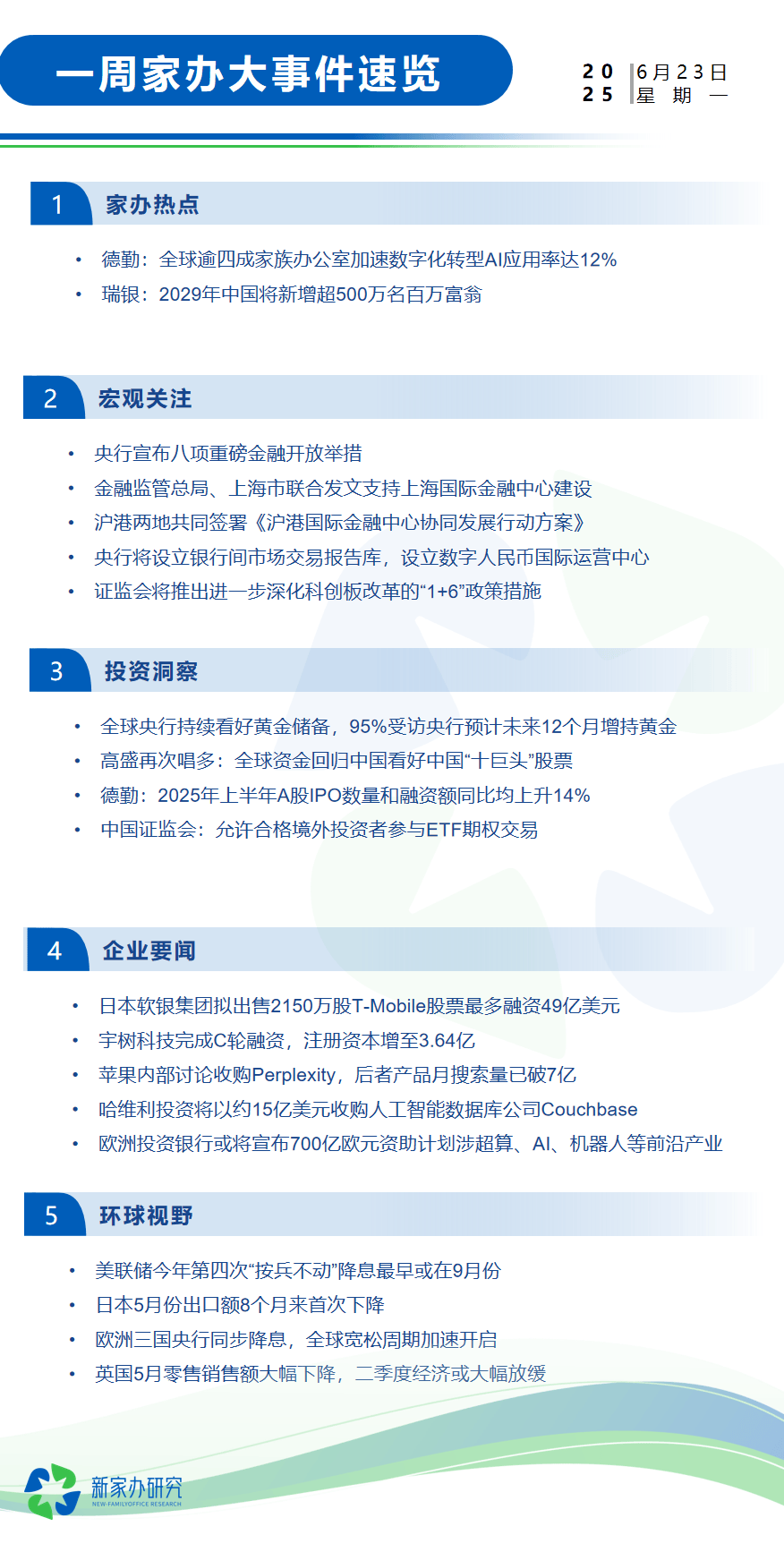
Family Offices - Over 43% of global family offices are accelerating digital transformation, with 12% applying AI for automation and risk management [5][9] - 55% of family offices utilize data analytics to identify trends and improve decision-making [5][9] Wealth Growth in China - UBS forecasts that China will add over 5 million millionaires by 2029, driven by continuous economic growth [5][10] - Daily increase of over 380 millionaires in China is expected in 2024 [5][10] Financial Policy and Regulation - The People's Bank of China announced eight major financial opening measures, including the establishment of a trading report database and a digital RMB international operation center [5][10][12] - The China Securities Regulatory Commission will introduce "1+6" policy measures to deepen the reform of the Sci-Tech Innovation Board [5][12] Market Trends - 95% of surveyed central banks expect to increase gold reserves in the next 12 months, marking a 17 percentage point increase from last year [5][12] - Goldman Sachs is optimistic about the return of global funds to China, highlighting ten major Chinese companies with a total market value of $1.6 trillion [5][13] IPO Activity - Deloitte predicts a 14% year-on-year increase in the number of IPOs and financing amounts in the A-share market for the first half of 2025 [5][13] Investment and Acquisitions - SoftBank plans to sell 21.5 million shares of T-Mobile, potentially raising $4.9 billion [5][14] - Haveli Investments is set to acquire Couchbase for approximately $1.5 billion [5][16] International Financial Cooperation - Shanghai and Hong Kong signed a collaborative development action plan for their international financial centers, focusing on infrastructure connectivity and financial product services [5][11]

以开放促合作 陆家嘴论坛释放金融开放强信号
Zhong Guo Qing Nian Bao· 2025-06-24 00:42
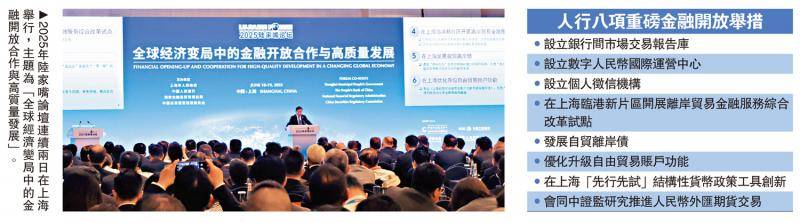
Group 1 - The core message of the news is the strong commitment of China to financial openness and reform, highlighted by multiple financial policies announced at the Lujiazui Forum [1][2] - Financial regulatory authorities emphasize that foreign investment has significantly improved corporate governance and operational management in Chinese banks, with 80% of national banks introducing foreign strategic investors [1][2] - The total investment of Oaktree Capital in Greater China has surpassed 47 billion RMB since entering the market in the 1990s, showcasing the benefits of China's financial openness [1][2] Group 2 - Eight new financial opening measures were announced, including offshore trade finance services and support for foreign institutions in various financial sectors, indicating China's determination for financial reform [2][5] - The importance of the Chinese market is underscored by foreign financial executives, noting that three-quarters of multinational companies investing in China have partnerships with local firms [2][3] - The introduction of new rules for futures and derivatives is seen as a milestone for China's position as a leading global financial center [3][4] Group 3 - The establishment of the Shanghai-London Stock Connect in 2019 has facilitated mutual market access, enhancing the internationalization of China's capital markets [4][5] - The total assets of foreign banks and insurance institutions in China exceed 7 trillion RMB, with foreign insurance companies' market share increasing from 4% in 2013 to 9% currently [5][6] - The Chinese financial market is expected to expand significantly, driven by rising consumer demand and opportunities in technology and green finance [5][6] Group 4 - The Lujiazui Forum serves as a significant indicator of China's financial reform and global financial governance, promoting a cooperative and open economic environment [6][7] - The People's Bank of China plans to enhance the foreign exchange management system to facilitate cross-border investment and support the internationalization of the RMB [7][8] - As of May 31, the cumulative approved quota for Qualified Domestic Institutional Investors (QDII) reached approximately 167.79 billion USD, with 189 institutions granted investment quotas [8]

经济学家宋清辉:设数字人民币国际运营中心意义重大
Sou Hu Cai Jing· 2025-06-23 22:35
Group 1 - The core viewpoint is that multiple national policies have been introduced to support the high-quality development of Shanghai's financial industry, which will have a profound impact on the higher-level development of Shanghai as an international financial center [1][8] - Shanghai will become more competitive in attracting international financial institutions and multinational companies due to a favorable business and financial service environment, leading to an increase in the establishment of branches or expansion of operations by international financial institutions [1][8] Group 2 - The People's Bank of China announced eight significant financial opening measures, including the establishment of a digital RMB international operation center to promote the internationalization of digital RMB and the development of financial market business [4][5] - Other measures include the establishment of a personal credit agency, comprehensive reform pilot for offshore trade finance services in the Lingang New Area, and the development of offshore bonds to enhance financing channels for enterprises involved in the Belt and Road Initiative [4][5] - The measures also involve innovative structural monetary policy tools in Shanghai, such as blockchain credit certificate refinancing and cross-border trade refinancing, as well as promoting RMB foreign exchange futures trading to improve the foreign exchange market product series [5]

光晖控股携手IFRA国际金融论坛在青岛共话金融变革新路径
Sou Hu Cai Jing· 2025-06-23 04:32
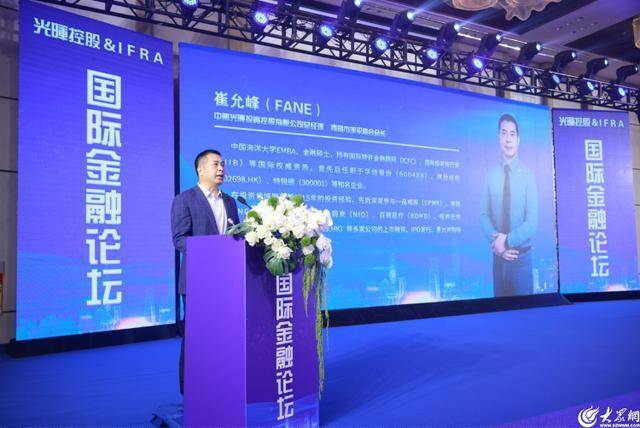
Core Viewpoint - The forum highlighted the importance of overseas listings for Chinese companies as a means to access capital and showcase the resilience and innovation of the Chinese economy in a challenging global market [1][5]. Group 1: Forum Overview - The "Financial Transformation, Exploring New Paths" international financial forum was held in Qingdao, attracting over 200 representatives from policy institutions, multinational banks, industrial capital, and academia [1]. - The forum focused on the reform paths under the backdrop of deep adjustments in the global financial system, discussing financial openness, cross-border collaboration, and industrial upgrading [1]. Group 2: Expert Insights - Experts discussed the current state of the U.S. and domestic capital markets, emphasizing that "listed companies are designed," advocating for sustainable enterprise development [3]. - The IMF predicts that global economic growth may fall below 3% by 2025, while China is expected to maintain a growth rate above 5%, providing stability to the world economy [5]. Group 3: Strategic Initiatives - Liu Tao, Chairman of Guanghui Holdings, called for enhanced regulatory recognition, technological empowerment in risk control, and sustainable development to support cross-border financing [7][8]. - Guanghui Holdings, in collaboration with IFRA, aims to create a comprehensive service system for companies, covering strategic planning, compliance management, and investor relations [8]. Group 4: Partnerships and Collaborations - Guanghui Holdings signed strategic cooperation agreements with various asset management companies and granted operational licenses to 19 entities, marking a significant step in supporting domestic SMEs in overseas listings [10].
金融行业周报:陆家嘴金融论坛聚焦开放与科技,证券公司分类评价修订-20250623
Ping An Securities· 2025-06-23 03:31
Investment Rating - The industry investment rating is "Outperform the Market," indicating an expected performance that exceeds the CSI 300 Index by more than 5% over the next six months [56]. Core Insights - The Lujiazui Financial Forum focused on financial openness and technology, with key policies aimed at enhancing the international financial center in Shanghai and promoting the internationalization of the RMB [2][19]. - The China Securities Regulatory Commission (CSRC) has released a draft for public consultation on the revised "Securities Company Classification Evaluation Regulations," emphasizing the enhancement of securities firms' functional capabilities and the promotion of differentiated development for small and medium-sized institutions [2][20]. Summary by Sections Key Focus - The Lujiazui Financial Forum opened on June 18, 2025, with discussions led by prominent financial leaders, focusing on global economic changes and financial cooperation [10]. - Eight financial policies were announced to be implemented in Shanghai, including the establishment of a digital RMB international operation center and the development of offshore trade financial services [10][19]. Industry News - The CSRC is seeking public opinion on the revised "Securities Company Classification Evaluation Regulations," which aim to enhance the functional roles of securities firms and improve their professional capabilities [20]. - The Financial Regulatory Bureau has approved the establishment of insurance asset management companies by AIA and Aegon in Shanghai, marking a significant step in the opening of the insurance asset management market [31]. Industry Data - The banking, securities, insurance, and fintech indices changed by +2.63%, -1.73%, +0.27%, and +0.88% respectively this week, with the CSI 300 Index down by 0.45% [39]. - The average daily trading volume of stock funds was 15.26 trillion yuan, a decrease of 10% from the previous week [48]. - The ten-year government bond yield decreased by 0.24 basis points, with the yield standing at 1.640% [51].
2025年陆家嘴论坛政策解读:全球变局下的金融:促改革、扩开放、重科创
Haitong Securities International· 2025-06-23 03:28
Financial System - The international monetary system is evolving towards a structure with a few dominant sovereign currencies competing and balancing each other[5] - The global cross-border payment system is developing towards greater efficiency, security, inclusiveness, and diversity[5] - International financial organizations need to enhance the representation and voice of emerging markets and developing countries[5] Financial Opening - China has significant potential for high-level financial opening, focusing on expanding consumption demand and financial services[13] - The technology finance sector is a vast blue ocean, with initiatives for equity investment in financial asset investment companies and loans for technology enterprise mergers[13] - Green finance is gaining momentum, with foreign institutions introducing ESG rating systems and climate risk management tools into China[13] Capital Market - The capital market aims to promote the integration of technological innovation and industrial innovation, with a focus on deepening reforms through a "1+6" policy framework[15] - The introduction of a growth layer on the Sci-Tech Innovation Board and the restart of the fifth listing standard for unprofitable companies are key measures[15] - There is a push to strengthen the linkage between equity and debt to support technological innovation[15] Foreign Exchange Management - A comprehensive and innovative foreign exchange management system will be established, focusing on convenience, openness, safety, and intelligence[19] - Ten facilitation policies will be implemented in the free trade pilot zones, including optimizing new international trade settlement methods[19] Risk Warning - External factors may cause disturbances in the financial system[22]
上海跨境金融再跃升 更好服务企业“走出去” 访上海金融与发展实验室首席专家、主任曾刚
Jin Rong Shi Bao· 2025-06-23 03:09
Core Viewpoint - The "Action Plan" aims to enhance the competitiveness and influence of Shanghai as an international financial center, reflecting China's commitment to financial reform and opening up [2][4]. Group 1: Competitiveness and Influence of Shanghai International Financial Center - The financial market system in Shanghai is increasingly complete, with a total cross-border RMB payment amount expected to reach 29.8 trillion yuan in 2024, a 30% year-on-year increase, accounting for 47% of the national total [3]. - The internationalization level of Shanghai's financial institutions is rising, with 1,782 financial institutions, one-third of which are foreign [3]. - Shanghai is leading in financial technology innovation, enhancing the application of fintech to empower the real economy [3]. - The ability to serve the real economy has significantly improved, with Shanghai becoming a key funding allocation center supporting various national initiatives [3]. Group 2: Pain Points in Cross-Border Financial Services - Companies face three main pain points in cross-border financial services: inefficient cross-border fund turnover, inadequate foreign exchange risk management tools, and limited cross-border financing channels [4][5]. Group 3: Optimization Measures in the Action Plan - The Action Plan includes 18 innovative measures across five areas, such as optimizing foreign exchange business management and enhancing the global fund management system for enterprises [6]. - It expands the range of participants in the foreign exchange market and enriches hedging tools to improve the functionality of the RMB cross-border payment system [6]. - The plan supports banks in increasing cross-border trade credit issuance, thereby reducing the cost of RMB trade financing for enterprises [6]. Group 4: Highlights of the Action Plan - A notable innovation is the pilot program in Shanghai to support RMB cross-border trade financing through the rediscount window, which will lower financing costs for enterprises [7]. - The optimization of the full-function fund pool in the Shanghai Free Trade Zone allows for automated cross-border payment processing, enhancing global fund management efficiency [7]. - These measures reflect a focus on enhancing the convenience of cross-border financial services and demonstrate China's commitment to financial openness and institutional innovation [8]. Group 5: Regulatory and Safety Measures - The regulatory framework should be categorized and layered, simplifying approval processes for high-credit-rated enterprises while maintaining strict oversight on high-risk activities [9]. - A unified data collection and sharing platform for cross-border financial business can enhance regulatory efficiency and identify abnormal fund flows [9]. - The introduction of regulatory technology and international regulatory cooperation will help balance financial openness with risk prevention [9].

金融开放再进一步丨系列新政推动金融开放 上海国际金融中心建设提速
Sou Hu Cai Jing· 2025-06-23 01:31
■张炜 在近日举行的2025陆家嘴论坛上,中国人民银行、国家金融监管总局、中国证监会及国家外汇管理局发布了多项金融开放举措。相关专家在接受中国经济 时报采访时表示,一系列新举措的推出将增强金融服务实体经济能力,构建高水平对外开放机制,同时推动上海国际金融中心建设不断实现新突破。 增强金融服务实体经济能力 论坛期间,央行宣布将在上海实施八项金融开放举措,包括设立数字人民币国际运营中心、在上海临港新片区开展离岸贸易金融服务综合改革试点、在上 海"先行先试"结构性货币政策工具创新等。 "一系列金融开放举措将助力中国金融体系全方位提升市场活力与竞争力、优化金融结构与产品、助力人民币国际化进程、增强金融服务实体经济能力以 及提升金融风险管理水平。"上海交通大学安泰经济与管理学院、中国发展研究院副研究员钟辉勇对中国经济时报说,这些举措再次表明中国坚定不移推 进高水平对外开放的决心,将进一步推动中国金融市场在规则、标准、制度等方面与国际先进水平接轨,更好地发挥市场在资源配置中的决定性作用,引 导国内外资本的高效流动和配置,更好提升中国金融市场的国际影响力。 南开大学金融发展研究院院长田利辉在接受中国经济时报采访时表示,陆家 ...
时报访谈丨吴昀华:千方百计激活民企 重启发展引擎
Sou Hu Cai Jing· 2025-06-23 01:30
——访上海前滩新兴产业研究院秘书长、首席研究员吴昀华 图片来源/新华社 ■中国经济时报记者 刘慧 民营经济已成为推进中国式现代化的生力军,促进其持续、健康、高质量发展是国家长期坚持的重大方针政策。多部门在破除市场壁垒、拓展发展空间等 方面出台了一系列政策举措,如《市场准入负面清单(2025年版)》发布,今年将在能源、交通运输等重点领域推出总投资规模约3万亿元的优质项目, 支持民营企业参与国家重大战略和重大工程。 日前,上海前滩新兴产业研究院秘书长、首席研究员吴昀华在接受中国经济时报记者专访时表示,我国民营企业数量已突破5700万家(占企业总数的 91.96%),民企在战略性新兴产业、高技术产业、数字经济核心产业等领域表现活跃。应全面激发全社会内生动力,尤其是激发民企的创新活力,让民 资民企能深度参与重大产业项目,畅通国民经济循环。投喂场景、开源市场,就是千方百计、想方设法激活民企,重启发展最好的引擎。 民营经济在高技术产业领域表现活跃 中国经济时报:我国民营经济发展的现状怎样?在科技创新领域取得了哪些成果? 吴昀华:据官方统计,截至2024年12月31日,我国民营企业数量已突破5700万家(占企业总数的91. ...