军工

Search documents
2块钱的稀土股不是垃圾:有矿有订单,机构悄悄买了近3亿股
Sou Hu Cai Jing· 2025-10-06 23:03
Core Viewpoint - Rare earth stocks are considered undervalued, with potential for significant returns, likened to the next "Zhengzhou Coal Electricity" opportunity [1] Industry Overview - Rare earth elements are essential for industries such as renewable energy, robotics, and military applications, often referred to as "industrial vitamins" [3] - China holds 70% of the world's rare earth reserves, but has historically faced criticism for low-price exports [3] - Recent developments include Myanmar's complete halt of rare earth mining, tightening global supply chains [3] - China's tightening of export quotas has led to a surge in rare earth prices, with dysprosium oxide prices tripling compared to two years ago [3] Key Data - China's rare earth reserves account for 38% of global totals, with Northern Rare Earth holding significant resources at the Baiyun Obo mine, targeting a production capacity of 150,000 tons of high-performance magnetic materials by 2025 [4] - China Rare Earth has consolidated 80% of ion mines in Ganzhou, reporting a net profit of 72.61 million in Q1 2025, successfully turning around its financial performance [5] Company Highlights - **Northern Rare Earth (600111)**: The largest supplier of light rare earths globally, with a net profit increase of 727% year-on-year in Q1 2025 [6] - **China Rare Earth (000831)**: Recognized as a hidden champion in medium and heavy rare earths, with leading separation technology and strong military orders [8] - **Jinli Permanent Magnet (300748)**: Utilizes advanced technology to reduce neodymium usage by 60%, with a projected net profit increase of 120% in 2025 [10] Market Dynamics - Foreign investment is increasing, with Inlohua seeing significant foreign purchases, indicating confidence in the demand for magnetic materials in electric vehicles [12] - Speculative trading has surged, with Huahong Technology's stock price soaring 372% due to rare earth recycling and Tesla orders [13] - State-owned entities like China Rare Earth and Northern Rare Earth are receiving continued support from institutional investors, benefiting from policy advantages and resource monopolization [14] Price Volatility - Rare earth prices are highly influenced by policy and supply-demand dynamics, with historical examples of significant price fluctuations [15] - Potential technological advancements in non-rare earth permanent magnet materials could disrupt the current market landscape [16] International Competition - The U.S. is accelerating efforts to establish its own rare earth supply chain, with MP Materials receiving $400 million in funding from the White House, indicating increasing long-term competition [17]



多家公募发布四季度策略,看好四大核心赛道机会
天天基金网· 2025-10-04 05:58
牛市来了还没上车?上天天基金APP搜索777注册即可领500元券包,优选基金10元起投!限 量发放!先到先得! 在股票市场进入四季度之际,多家公募发布2025年四季度策略,看好赚钱效应持续演绎。 基于居民存款搬家以及海外增量资金的持续涌入,基金经理对四季度A股和港股市场行情给予乐观判断, 预期市场延续震荡抬升格局,行情有望在政策呵护中逐级上移。A股和港股的科技股、新消费、互联网、 创新药等四大方向是布局的核心。 鹏华基金表示,随着大盘指数突破十年新高,当前A股整体定价回归到合理状态。结构上看,股债再平衡 是推动近期ERP修复的主因,而市场对于成长定价依旧维持极度乐观。活跃资金加仓、机构由债入股是近 期主要的增量,存款搬家还在起步阶段,但后市具备较大潜力。 "对比历史,科技行情整体还未到过热阶段,科技行情有产业基本面变化的支撑。"鹏华基金强调,四季度 需关注科技板块内部局部拥挤度过高的问题,从平衡组合收益与波动的角度,在交易层面可以关注涨幅相 对滞后且基本面有积极变化的方向。 长城久恒灵活基金经理储雯玉认为,A股市场的这轮亮眼表现主要源于政策托底、科技突破、资金驱动三 重因素。 一是政策面积极发力,构建市场稳定 ...

四季度,公募看好四大赛道
证券时报· 2025-10-03 13:54
Core Viewpoint - The article emphasizes a positive outlook for the A-share and Hong Kong stock markets in the fourth quarter of 2025, driven by the continuous influx of overseas capital and the relocation of resident deposits, with a focus on sectors such as technology, new consumption, the internet, and innovative pharmaceuticals [1][4]. Group 1: Market Dynamics - Fund managers are optimistic about the market's performance, expecting a sustained upward trend supported by policy measures [1][3]. - The overall pricing of A-shares has returned to a reasonable state, with a significant increase in active capital allocation and a shift from bonds to stocks by institutions [3][5]. - The market is experiencing a recovery in risk appetite, with increased trading activity and a notable shift in sentiment among retail investors [4][5]. Group 2: Policy and Economic Factors - The article highlights three main factors contributing to the A-share market's performance: supportive policies, technological breakthroughs, and capital inflows [4]. - Coordinated efforts between proactive fiscal policies and moderately loose monetary policies are stabilizing the economy and market sentiment [4]. - The ongoing recovery of the economy, coupled with improvements in the industrial sector, is expected to enhance the pricing power of equity assets [5]. Group 3: Sector Focus - Fund companies are particularly bullish on four key sectors: technology stocks, new consumption, the internet, and innovative pharmaceuticals [6][7]. - The technology sector is seen as having strong growth potential, with a focus on industries experiencing positive changes in fundamentals [7][9]. - In the Hong Kong market, new consumption and technology stocks are viewed as having significant investment value, supported by improving liquidity and a recovering earnings cycle [8]. Group 4: Investment Strategies - Investment strategies emphasize prioritizing sectors with strong certainty and ongoing verification of industry prosperity, particularly in technology and innovative pharmaceuticals [7][9]. - The article suggests that the current investment environment favors sectors that are experiencing technological advancements and increased demand, such as AI and robotics [9].

长城基金汪立:市场有望长期向好,科技成长风格或持续占优
Xin Lang Ji Jin· 2025-09-29 08:00
Core Viewpoint - The A-share market has entered a strong upward trend after over three years of adjustment, with major indices experiencing significant gains since September 24, 2024, driven by various factors including policy support, technological breakthroughs, and increased market participation [1][2]. Group 1: Market Performance - The North Stock 50 Index has risen by 158.01%, while the Sci-Tech 50 Index and the ChiNext Index have both more than doubled, increasing by 118.85% and 103.50% respectively since September 24, 2024 [1]. - The average daily trading volume in the market has surged from less than 500 billion yuan to over 2 trillion yuan [1]. Group 2: Key Drivers of Market Surge - Policy support has played a crucial role, with the central bank implementing structural monetary policies and the securities regulator encouraging long-term capital inflow and share buybacks [2]. - Rapid breakthroughs in technology sectors such as AI, robotics, semiconductors, and innovative pharmaceuticals have contributed to increased global competitiveness and market optimism [2]. - There has been a notable recovery in market risk appetite, with investor sentiment turning positive and active trading resuming since late September 2023 [2][3]. Group 3: Changes in Market Structure - The price-to-earnings (PE) ratio of the Shanghai Composite Index has increased from around 12 times to 16.4 times, indicating a significant valuation recovery [4]. - The market has shifted from a state of low trading volume to maintaining daily trading volumes above 2 trillion yuan, reflecting improved liquidity [4]. - The investor structure has evolved, with a shift from ETF and insurance-driven investments to a more diverse mix including institutional funds, enhancing focus on sectors with growth potential [4]. Group 4: Future Policy Expectations - The Chinese economy has shown unexpected resilience, with GDP growth of 5.2% in Q2, setting a solid foundation for achieving the annual growth target [5]. - Anticipated policy measures in Q4 are expected to stabilize growth, including initiatives to optimize the business environment and enhance consumer spending [5]. Group 5: Market Outlook - The "924 market" is viewed as a key turning point, with expectations for continued market improvement driven by technological advancements and supportive policies [6]. - The technology growth style is expected to outperform in the future, supported by both industry expansion and policy backing [6].
资金缘何持续流入化工板块?
Shang Hai Zheng Quan Bao· 2025-09-28 15:12
Core Viewpoint - The continuous inflow of funds into the chemical sector is driven by multiple factors, indicating a shift towards high-quality development and innovation in the industry [2][3][4] Group 1: Policy and Market Dynamics - The "anti-involution" policy is being actively promoted, with initiatives aimed at updating and eliminating outdated facilities in the petrochemical sector, reflecting a transition towards quality and technological innovation [2] - The capital expenditure in the chemical industry is nearing its peak, with companies focusing on optimizing existing capacities rather than expanding investments, leading to a significant decline in capital expenditure growth [3] Group 2: Market Position and Valuation - The global chemical sales are projected to reach €5.2 trillion in 2023, with China accounting for €2.2 trillion, representing a 43% market share, which has increased by 9 percentage points since 2013 [3] - The valuation of the chemical sector remains at historically low levels, with the basic chemical index's price-to-book ratio (PB) at 2.10, placing it in the 43rd percentile over the past decade, compared to 2.87 for the non-ferrous metals index [3] Group 3: Growth Opportunities - The chemical industry is evolving beyond traditional cyclical characteristics, with significant growth potential in areas such as new energy materials, electronic chemicals, and specialty materials, which are closely linked to emerging industries like AI and new energy vehicles [4]
9·24一周年!从北证50到“易中天”,这些基金一年狂赚200%!
私募排排网· 2025-09-28 03:04
Core Viewpoint - The article discusses the significant performance of various sectors in the A-share market since the "policy combination punch" ignited the market on September 24, 2024, highlighting the structural bull market and the impressive returns of specific funds and sectors [3][4][10]. Group 1: Market Performance - The North Exchange 50 Index has surged over 150% since the September 24 market initiation, becoming a focal point for investors due to its high volatility and small-cap stocks [3][4]. - The top 10 funds related to the North Exchange 50 Index have all achieved returns exceeding 130%, with two funds surpassing 170% [4][5]. Group 2: Semiconductor Sector - The global semiconductor sales reached $53.1 billion in August 2024, marking a 20.6% year-on-year increase, while China's semiconductor sales hit $16.6 billion, up 27.5% [6]. - Funds focusing on the semiconductor sector have shown remarkable performance, with the top fund, 嘉实绿色主题股票A, achieving a return of 151.92% since September 24 [6][7]. Group 3: Robotics Sector - The humanoid robot sector is gaining traction, with the 中航趋势领航混合C fund achieving a return of 188.30% since September 24, driven by heightened market interest [8][9]. - The humanoid robot industry is expected to enter mass production by 2025, indicating significant growth potential [8]. Group 4: Innovative Pharmaceuticals - The innovative pharmaceutical sector is experiencing a revival after three years of adjustment, with the 中银医疗保健混合A fund returning 110.40% since September 24 [10]. - The internationalization of China's innovative pharmaceutical industry is accelerating, with a surge in cooperative development agreements with multinational pharmaceutical companies [10]. Group 5: Military Industry - The military sector is gaining attention, with the 中航军民融合精选A fund returning 97.40% since September 24, supported by favorable policies and technological advancements [14][15]. - Historical trends suggest that military stocks often rise in anticipation of major military parades, indicating potential for future growth [14].

【午报】三大指数缩量整理全线收跌,风电板块逆势爆发,AI概念股陷入调整
Xin Lang Cai Jing· 2025-09-26 04:21
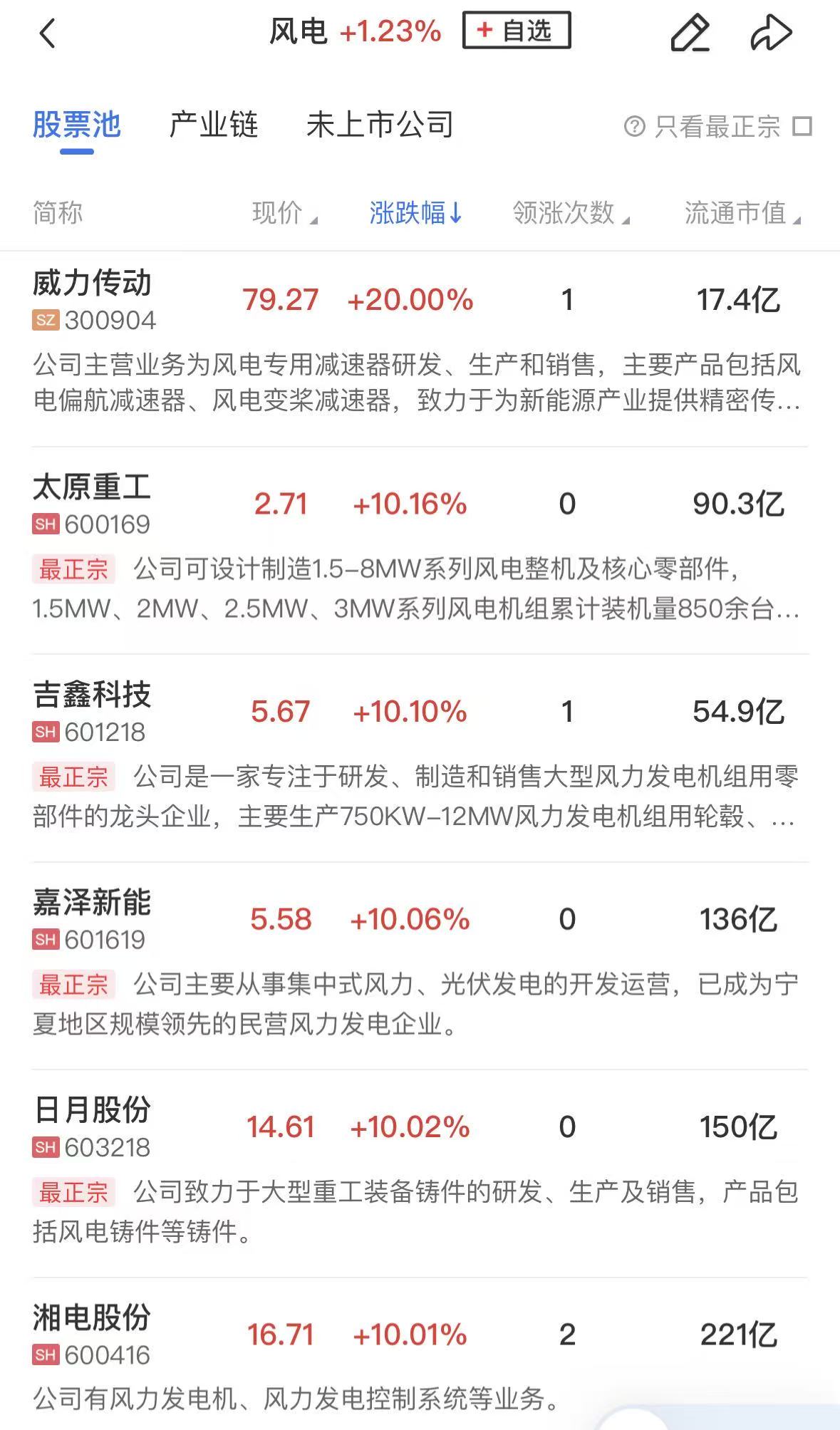
Market Overview - The market experienced fluctuations with the ChiNext Index dropping over 1% and a total trading volume of 1.37 trillion yuan, a decrease of 173.3 billion yuan from the previous trading day [1] - Over 2,500 stocks declined, while the wind power sector showed strength with multiple stocks hitting the daily limit [1][3] - The Shanghai Composite Index fell by 0.18%, the Shenzhen Component Index by 0.79%, and the ChiNext Index by 1.17% [1] Wind Power Sector - The wind power sector continued its strong performance, with stocks like Weili Transmission and Jixin Technology hitting the daily limit [1][3] - The National Energy Administration reported that as of August, the cumulative installed capacity for wind power reached 580 million kilowatts, a year-on-year increase of 22.1% [3] - Analysts expect domestic wind power installation demand to remain resilient, highlighting investment opportunities in key component suppliers and submarine cable companies [3] Semiconductor Industry - The semiconductor supply chain showed signs of recovery, with stocks like Saiwei Microelectronics hitting the daily limit and reaching historical highs [1][3] - Despite some activity, most semiconductor stocks still experienced slight declines overall [11] Automotive Sector - The automotive sector was active, with stocks like Shuguang and Sailyus hitting the daily limit [1][4] - Sailyus announced plans to issue up to 331 million overseas listed shares, which has been approved by the China Securities Regulatory Commission [4][22] - Some electric vehicle manufacturers are gradually improving profitability, with companies like Leap Motor and Xiaopeng Motors expected to reach breakeven by 2025 [7] Nonferrous Metals Sector - The nonferrous metals sector remained active, with stocks like Jingyi and Shengtun Mining showing significant gains [3][31] - The China Nonferrous Metals Industry Association expressed strong opposition to "involution" competition in the copper smelting industry [4][31] - The Grasberg mine in Indonesia, which accounts for about 3% of global copper supply, announced a force majeure due to a landslide, impacting global supply [4][31] Military Industry - The military sector rebounded, with stocks like Hangyu Technology and Hangya Technology showing notable gains [7][25] - Analysts predict a new upward cycle for the defense industry from 2025 to 2027, with 2025 marking a significant turning point [25]





长城基金汪立:“924行情”是关键转折点,市场有望长期向好
Xin Lang Ji Jin· 2025-09-26 04:01
Group 1 - The A-share market has experienced a significant upward trend since September 24 last year, with the Shanghai Composite Index rising approximately 39% and the ChiNext Index increasing about 102% as of September 19, 2025 [1][2] - Over 3,000 stocks in the market have seen gains exceeding 50%, with more than 1,400 stocks doubling in value [1] - The total market capitalization of A-shares has reached 104 trillion yuan [1] Group 2 - Three main factors have driven this sustained rally: supportive policies, rapid breakthroughs in the technology sector, and a notable increase in market risk appetite [2][3] - The People's Bank of China has implemented various structural monetary policy tools, while the China Securities Regulatory Commission has encouraged long-term capital inflows and optimized merger and acquisition mechanisms [1][2] - The technology sector has seen advancements in artificial intelligence, robotics, semiconductors, military industry, innovative pharmaceuticals, and new consumption, enhancing global competitiveness [2] Group 3 - The market's characteristics have changed significantly in terms of valuation, liquidity, and investor structure [3] - The price-to-earnings ratio of the Shanghai Composite Index has risen from around 12 times to 16.4 times, indicating a substantial valuation recovery [3] - The average trading volume has remained above 2 trillion yuan, reflecting active market sentiment [3] Group 4 - The investor structure has shifted, with insurance and retail investors becoming the main sources of capital inflow, leading to a diversified market style [3][4] - The upcoming "14th Five-Year Plan" and potential interest rate cuts by the Federal Reserve may provide more operational space for domestic macro policies, with expectations for a series of growth-stabilizing measures in the fourth quarter [3][4] - Key policy directions may include promoting a unified national market, enhancing the business environment, and implementing structural monetary policies to stimulate domestic demand [4]

0924A股日评:科技高低切,半导体受益-20250924
Changjiang Securities· 2025-09-24 14:11
Core Insights - The A-share market experienced a volatile rise, with all three major indices increasing, particularly the Sci-Tech 50 which rose over 3% [2][4] - The semiconductor industry chain has replaced AI hardware as the core focus of the market today, benefiting from advancements in chip self-sufficiency [4][7] Market Performance - The Shanghai Composite Index rose by 0.83%, the Shenzhen Component Index by 1.80%, and the ChiNext Index by 2.28%. The Sci-Tech 50 saw a significant increase of 3.49%, with a total market turnover of 2.35 trillion yuan and 4,457 stocks rising [2][7] - In terms of sector performance, the power and new energy equipment sector increased by 2.77%, electronics by 2.65%, and computers by 2.53%. Conversely, banking and coal sectors saw declines of 0.32% and 0.29% respectively [7] Industry Highlights - The semiconductor sector led the gains, with semiconductor silicon wafers up by 7.57%, semiconductor equipment by 6.26%, and wafer industry by 6.02% [7] - The market is driven by continuous catalysts in the technology sector, including the public unveiling of extreme ultraviolet (EUV) lithography machine parameters by Shanghai Micro Electronics [7] Future Outlook - The report maintains a bullish outlook on the Chinese stock market, expecting a bull market driven by ample liquidity and gradual recovery in fundamentals, drawing parallels to previous bull markets in 1999, 2014, and 2019 [7] - Short-term focus should be on sectors with improving revenue growth and gross margins, such as fiberglass, cement, and fine chemicals, while also considering technology growth areas like lithium batteries and military technology [7]
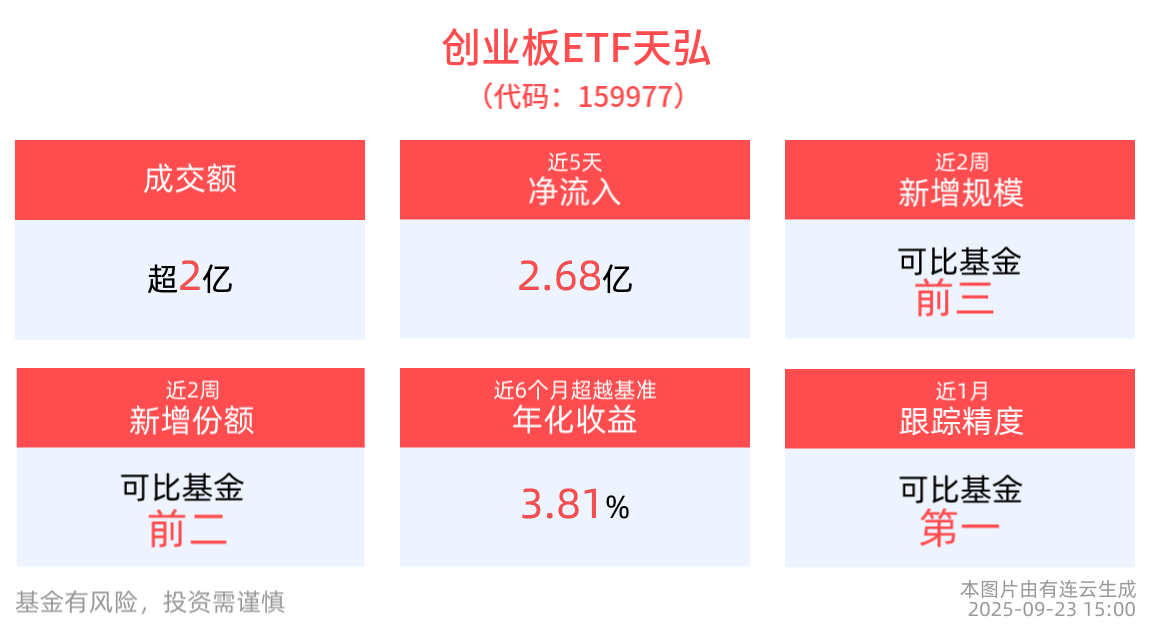
V型反转极限上演!“上涨先锋”创业板ETF天弘(159977)尾盘深“V”反弹翻红,强势冲击百亿规模
Sou Hu Cai Jing· 2025-09-23 07:27
Group 1 - The core viewpoint of the articles highlights the significant growth and performance of the ChiNext ETF Tianhong (159977), which saw a 0.37% increase in closing price and a notable inflow of funds amounting to 2.68 billion yuan over the last five trading days [3] - The ChiNext index is characterized as a leading indicator in the A-share market, with a high proportion of emerging industries and high-tech enterprises, making it an attractive investment opportunity for growth during the A-share recovery process [3] - As of September 22, the ChiNext ETF Tianhong (159977) experienced a scale increase of 8.83 billion yuan and a share increase of 30.30 billion shares over the past two weeks, indicating strong investor interest [3] Group 2 - According to the China Securities Regulatory Commission, over 90% of newly listed companies in recent years are technology enterprises or have high technological content, with the market capitalization of the technology sector now exceeding 25% of the total A-share market [4] - The number of technology companies among the top 50 by market capitalization has increased from 18 at the end of the 13th Five-Year Plan to 24 currently, reflecting a growing emphasis on technology within the market [4] Group 3 - CICC believes that the current market is supported by strong macroeconomic resilience, improving corporate profitability, attractive global valuations, and enhanced liquidity, establishing a long-term positive trend [5] - Since the second half of this year, the A-share market has exhibited diverse sector rotations, with growth sectors, particularly those related to AI and hard technology, leading the market's upward movement [5] - Institutional investors are actively entering the market, focusing on sectors benefiting from industrial trends, such as AI and innovative pharmaceuticals, with expectations that future capital allocation will favor industries with solid fundamentals and long-term advantages [5]