
技术迭代

Search documents
易方达基金郑希:站在科技浪潮之巅顺势而为
Shang Hai Zheng Quan Bao· 2025-05-18 18:07
"究竟是苹果开创了智能手机时代,还是智能手机时代选择了苹果,每个人心中都有自己的答案,而我 的答案倾向于后者。"易方达基金基金经理郑希的这番话,正是他以中观视角审视科技股投资逻辑的真 实写照。 当下,全球产业链格局面临挑战,郑希认为,如果新一轮颠覆性技术迭代得到实现,我们现在面对的很 多问题或许都会迎刃而解。 在科技浪潮中选择最受益的公司 也是基于这种底层认知,在郑希的投资体系中,很难对任何一家科技公司形成"信仰"。"科技股走势往 往难以预测,它们的爆发往往缘于突如其来的产业级突破,而非某个公司本身的必然成功。"他认为, 大多数科技企业实际上都是特定技术周期中的阶段性受益者。 因此,郑希在审视科技公司时,并不拘泥于传统定义下的"优秀"。"尽管有些公司运营稳健且盈利能力 出色,但如果其业绩表现与所处行业的发展变化关联度不高,这类公司也不是我投资的首选。"对行业 变化的敏感性,是郑希构建投资组合的重要考量因素。他理想的投资标的是,当产业由于新的技术迭代 处于上升周期时,企业能够站在风口之上,利润增长能与行业上行趋势同步甚至超预期。 郑希以苹果手机为例:"究竟是苹果开创了智能手机时代,还是智能手机产业选择了苹果?在 ...
大医集团港股闯关:高瓴临阵撤退、家族控股权集中与财务失血三重绞杀
Xin Lang Zheng Quan· 2025-05-16 06:13
Core Viewpoint - Deyi Group, a leader in the radiation therapy sector in China, is facing significant financial challenges despite its market position, as evidenced by ongoing losses and cash flow issues [1][2]. Financial Sustainability and Cash Flow Pressure - Deyi Group has been in a prolonged state of loss, with net losses of 69.78 million yuan in 2023 and 94.57 million yuan in 2024, totaling 777 million yuan [2]. - Although the gross profit margin is projected to rise to 52.7% in 2024, revenue growth is nearly stagnant, with only a 1.2% increase, primarily driven by high-margin TaiChi platform solutions, while low-margin digital business revenue plummeted by 82.7% [2]. - The company has reported negative operating cash flow for eight consecutive years, with cash reserves of only 126 million yuan at the end of 2024, sufficient for approximately 40 months of operation at the current burn rate, alongside a significant inventory turnover period of 894 days, indicating substantial inventory impairment risks [2]. Customer Concentration and Accounts Receivable Risk - Deyi Group's revenue is heavily reliant on its top five customers, accounting for 58.4% in 2023 and 53.4% in 2024, with the largest customer contributing up to 21.6% [3]. - Trade receivables increased from 159 million yuan in 2023 to 271 million yuan in 2024, representing 28% of current assets, with the average collection period extending from 172 days to 322 days, intensifying bad debt provision pressures [3]. - High customer concentration may weaken bargaining power, and the loss or delayed payments from major clients could directly impact cash flow and revenue stability [3]. Technology Commercialization and R&D Investment Imbalance - Despite holding a 75.8% market share in the gamma knife segment with core products CybeRay and TaiChiRT Pro, Deyi Group's overall market share in radiation therapy equipment is only 4.7%, significantly lower than leading competitors [4]. - The R&D investment as a percentage of revenue is as high as 43%, notably exceeding peers like Mindray Medical at 10%, yet the expansion of core product indications remains in clinical trial phases, leading to slow commercialization [4]. - The risk of technological obsolescence is pronounced, as competitors may introduce more cost-effective or innovative products, potentially squeezing Deyi Group's market space [4]. Shareholding Structure and Governance Risks - The Liu Haifeng family controls 52.99% of the voting rights through a multi-layered structure, with several family members in key management positions, raising concerns about centralized decision-making risks [5]. - Hillhouse Capital's sudden transfer of shares worth 50 million yuan before the IPO has sparked market concerns regarding institutional investor confidence [5]. - Historical related-party transactions, such as the acquisition of Prowess in the U.S., lacked sufficient disclosure, potentially indicating issues of interest transfer or compliance disputes [5]. Industry Competition and Policy Dependence - The domestic radiation therapy equipment market is dominated by imported brands, with Deyi Group facing competition from comprehensive giants like United Imaging, which is projected to exceed 10 billion yuan in revenue in 2024 [6]. - The regulatory environment for medical device approvals is stringent, with long and uncertain product registration cycles; for instance, the TaiChiB multi-mode radiation therapy system has not yet completed clinical trials, and failure to obtain approval could hinder market expansion [6]. - The rapid pace of technological iteration in the industry necessitates continuous innovation and adaptation to regulatory changes; failure to do so may result in the loss of first-mover advantages [6]. - Deyi Group previously withdrew its A-share listing application, and despite multiple financing rounds leading to a valuation of 5.1 billion yuan, its profitability remains unverified, compounded by institutional sell-offs raising doubts about long-term value and management capabilities [6].
大中尺寸渗透加速,国产替代方兴未艾
Huaan Securities· 2025-05-15 01:45
大中尺寸渗透加速,国产替代方兴未艾 华安证券研究所 分析师 王强峰 S0010522110002 电话:13621792701 邮箱:wangqf@hazq.com 分析师 刘天其 S0010524080003 电话:17321190296 邮箱:liutq@hazq.com 华安证券研究所 2025年5月15日 华安研究•拓展投资价值 证券研究报告 1 • 整体而言,中游面板制造厂商积极扩建高世代产线,叠层OLED等新技术商业化进程加快,下游应用多元化将加速上游材 料与设备国产化,提供需求增量。以发光材料为例,其市场规模持续扩大,据QYResearch预计,2023年全球OLED发光 层主体材料市场销售额达到了15.3亿美元,预计2030年将达到33.03亿美元,年复合增长率(CAGR)为11.6%(2024- 2030)。OLED终端材料是当前国产替代的重点难点,核心专利技术一度被海外公司垄断,据群智咨询测算,2023年 OLED有机材料(包括OLED终端材料和前端材料)整体国产材料市占率约为38%;前端材料占比较大为58%,终端材料 国产化率低,其中终端材料中通用层材料为17%左右,发光层材料不足6%, ...



健信超导IPO:“左手分红、右手募资” 研发费用率仅个位数
Xin Lang Zheng Quan· 2025-05-13 06:00
Core Viewpoint - Ningbo Jianxin Superconductor Technology Co., Ltd. (referred to as "Jianxin Superconductor") faces multiple potential risks in its pursuit of an IPO on the Sci-Tech Innovation Board, raising concerns about its "hard technology" credibility and listing motivations [1] Group 1: Supply Chain and Customer Dependency - Jianxin Superconductor is in a weak position within the industry chain, with high customer and supplier concentration. The top five customers contributed nearly 80% of revenue, with the largest customer, Fujifilm Group, accounting for over 40% [1] - The company relies significantly on its top five raw material suppliers, which account for about 60% of purchases, leading to weak bargaining power and a gross margin of only 19.56%-24.94%, less than half the industry average of approximately 45% [1] Group 2: Lack of Technological Moat - The company has insufficient R&D investment, with R&D expense ratios of only 5.66%, 5.42%, and 6.50% from 2022 to 2024, which is less than one-third of comparable peers (14%-18%) [2] - Jianxin Superconductor holds only 42 invention patents, while competitors like United Imaging Healthcare have 3,475 patents, indicating a significant technological gap [2] - The core technology is protected by only 42 patents and confidentiality agreements, posing a risk of losing competitive advantage if key personnel are poached or if there is a leak [2] Group 3: Inventory Backlog and Liquidity Risk - The company's inventory surged from 182 million to 319 million yuan, accounting for over 30% of current assets, with inventory turnover days exceeding 200 [3] - The rapid iteration of superconducting magnet technology raises the risk of existing inventory becoming obsolete, yet the company has only recognized a write-down of 7.18 million yuan for inventory depreciation [3] - Accounts receivable have consistently exceeded 20% of revenue, which could exacerbate liquidity issues if downstream customers face financial difficulties [3] Group 4: Dividend Payouts and Fundraising Contradictions - Despite claiming a need to raise 90 million yuan for liquidity, the company distributed 59.99 million yuan in dividends over the past three years, with the chairman personally receiving 24.91 million yuan [4] - This "left hand dividend, right hand fundraising" approach raises questions about the rationality of its capital operation logic, especially given the average working capital ratio of 58.13% of revenue [4] Group 5: Policy Dependence and International Competitive Pressure - The company relies on a 15% income tax incentive for high-tech enterprises, with tax benefits accounting for 18% of total profits in 2024, making it vulnerable to policy changes [5] - With over 90% dependence on imported liquid helium, fluctuations in the international supply chain could disrupt production [5] - Although the company holds a 4.2% global market share, it faces significant pressure from international giants like Siemens and GE, which could squeeze its market position [5] Conclusion - The risk profile of Jianxin Superconductor's IPO journey includes both visible operational crises and hidden long-term concerns related to technological iteration and industry transformation [6]
友达、群创等6家面板厂公布4月营收
WitsView睿智显示· 2025-05-09 09:47
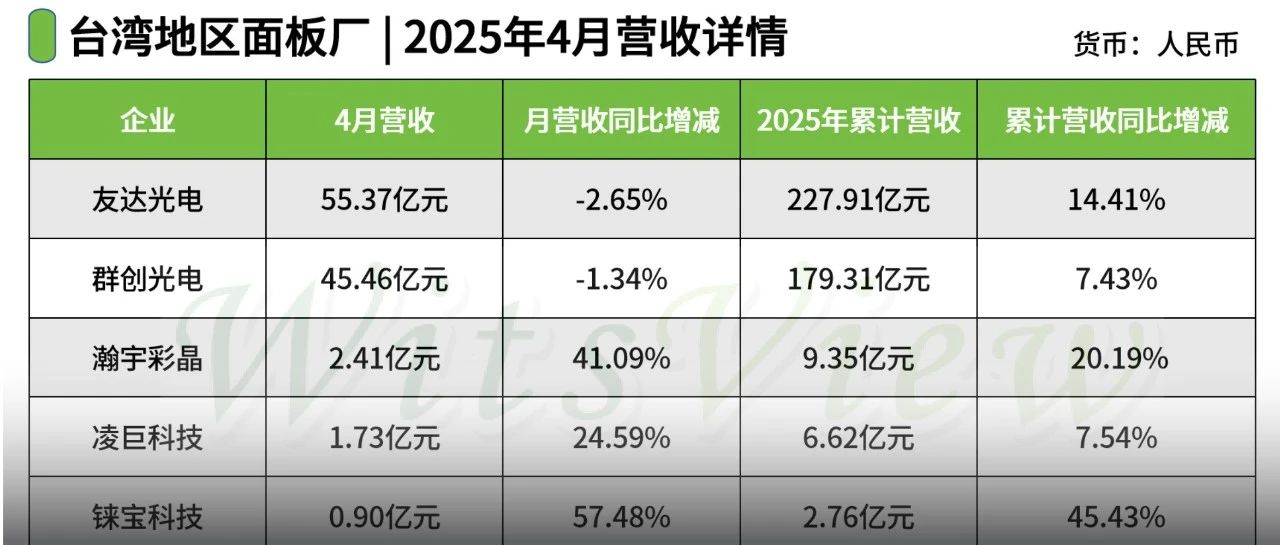
Core Viewpoint - In April 2025, Taiwan's panel manufacturers showed a mixed revenue performance, with leading companies like AUO and Innolux experiencing slight declines, while smaller firms like HannStar and Lianjia benefited from high-growth businesses. The industry is adapting to market fluctuations through diversification and technological advancements [15]. Group 1: AUO (友达光电) - AUO's revenue for April 2025 was NT$231.38 billion (approximately RMB 55.37 billion), a year-on-year decrease of 2.65% [1][2] - Cumulative revenue for 2025 reached NT$952.40 billion (approximately RMB 227.91 billion), reflecting a year-on-year increase of 14.41% [1][2] - AUO announced a joint venture with E Ink to establish a large electronic paper module production line, expected to commence production in Q4 2025 [2] Group 2: Innolux (群创光电) - Innolux's revenue for April 2025 was NT$189.97 billion (approximately RMB 45.46 billion), a year-on-year decrease of 1.34% [3][4] - Cumulative revenue for 2025 was NT$749.29 billion (approximately RMB 179.31 billion), showing a year-on-year increase of 7.43% [3][4] - Innolux showcased advanced technologies at Touch Taiwan 2025 and is progressing towards mass production of fan-out panel-level packaging (FOPLP) [5] Group 3: HannStar (瀚宇彩晶) - HannStar's revenue for April 2025 was NT$1.006 billion (approximately RMB 2.41 million), a year-on-year increase of 41.09% [6][7] - Cumulative revenue for 2025 reached NT$3.906 billion (approximately RMB 9.35 million), reflecting a year-on-year increase of 20.19% [6][7] - The company has improved yield rates in its eco-friendly display business and is increasing its revenue share from automotive applications [7] Group 4: Lianjia (凌巨科技) - Lianjia's revenue for April 2025 was NT$721 million (approximately RMB 1.73 million), a year-on-year increase of 24.59% [8][9] - Cumulative revenue for 2025 was NT$2.768 billion (approximately RMB 6.62 million), showing a year-on-year increase of 7.54% [8][9] - The company is optimistic about growth in its industrial control and consumer electronics segments, particularly due to increased demand for printers and instant cameras [9] Group 5: Raibo (铼宝科技) - Raibo's revenue for April 2025 was NT$375 million (approximately RMB 0.90 million), a year-on-year increase of 57.48% [10][11] - Cumulative revenue for 2025 reached NT$1.153 billion (approximately RMB 2.76 million), reflecting a year-on-year increase of 45.43% [10][11] - The growth is attributed to revenue recognition from battery cabinets after customer acceptance, and the company is expanding into the energy sector [11][12] Group 6: Hualing (华凌光电) - Hualing's revenue for April 2025 was NT$183 million (approximately RMB 0.44 million), a year-on-year decrease of 4.70% [13][14] - Cumulative revenue for 2025 reached NT$699 million (approximately RMB 1.68 million), showing a year-on-year increase of 5.85% [13][14] - The company is expanding its production capacity in Taiwan and is actively engaging with U.S. clients to shift orders to local production [14]

吉利汽车20250507
2025-05-07 15:20
Summary of Geely Automobile Conference Call Company Overview - **Company**: Geely Automobile - **Key Event**: Privatization of Zeekr and acquisition of Lynk & Co shares Core Points and Arguments - **Privatization of Zeekr**: Geely announced a non-binding offer to privatize Zeekr at $2.566 per share, representing a 13% premium based on the average price over the last 30 trading days. This move aims to enhance internal integration and reduce costs, especially given the low valuation of Zeekr in the US market [2][3] - **Acquisition of Lynk & Co**: Geely completed a 100% acquisition of both Zeekr and Lynk & Co, which is expected to improve operational efficiency and resource integration [2][4] - **Sales Performance**: During the May Day holiday, Geely's sales increased by approximately 10% year-on-year, driven by the popularity of the Galaxy series models, which have received positive customer feedback for their spaciousness and high configuration [2][5] - **Development Stages**: Geely has undergone five development stages, from establishment and listing to technological transformation, launching popular models, and now focusing on strategic integration and brand consolidation through the Taizhou Declaration [2][8] - **Vehicle Platforms**: Geely utilizes multiple vehicle platforms (BMA, CMA, SEA, GEA) to support diverse vehicle production, providing a flexible development foundation [2][10] - **Upcoming Technology Launch**: Geely plans to launch a super electric hybrid system by the end of Q3 2025, alongside the Zeekr 9X, which is expected to significantly enhance market performance [2][11] - **Valuation Analysis**: Despite shrinking profit margins in domestic fuel vehicles, Geely's overall market value has a potential upside of 50%, considering overseas profits, revenue from Galaxy and Zeekr, and investment returns [2][23] Additional Important Content - **Market Trends**: The overall market is expected to recover in the coming months, particularly in the new energy vehicle sector, supporting Geely's new vehicle cycle [2][7] - **Brand Integration**: The integration of brands like Geometry into Galaxy and the merger of Lynk & Co with Zeekr are part of Geely's strategy to optimize resource allocation and improve operational efficiency [2][12][16] - **Competitive Position**: Geely claims to possess comparable technology to BYD and emphasizes the importance of governance and technological iteration over individual model sales [2][17] - **Future Product Plans**: Geely plans to launch five new models this year, including the Starry 8 and Star越 7, to address gaps in fuel vehicle offerings [2][19] - **Lynk & Co's New Energy Strategy**: Lynk & Co has achieved over 60% penetration in the new energy sector and is set to release a hybrid version of a large sedan [2][21] - **Profitability Outlook**: In extreme scenarios, Geely's domestic fuel vehicle profits could drop to around 12 billion RMB, but overall market capitalization could reach 230 billion RMB, indicating significant upside potential [2][23]

国家战略下的材料突围:"十五五"新材料万亿级机遇与十大观点
材料汇· 2025-05-07 14:51
Core Viewpoints - The segmented fields show differentiated growth: semiconductor materials grow at 50%, new energy materials at 52%, and biomedical materials at 87%, while traditional structural materials maintain a stable growth of 8-10% [2] - Emerging fields are rapidly rising: AI servers with high-frequency materials grow at 60%, new energy vehicles with MLCC at 100%, foldable screens with UTG glass at 30%, and hydrogen energy with a 60% localization rate for proton exchange membranes [2] - The industrial chain is changing: semiconductor materials are developed in a bundled manner with "wafer factories + material factories," while new energy materials involve a three-in-one integration of car manufacturers, battery factories, and material suppliers [2] Market Analysis - The Chinese innovative materials market has formed a diversified tiered structure, reaching a total scale of 6 trillion yuan in 2024, with a forecast to exceed 10 trillion yuan in 2025. The segmented fields show differentiated growth: semiconductor materials (50% growth), new energy materials (52%), and biomedical materials (87%) constitute three major growth poles, while traditional structural materials grow steadily at 8-10% [10][11] - The application field is being restructured, with traditional applications (aerospace, automotive manufacturing) dropping from 65% in 2019 to 48% in 2023, while emerging fields like AI servers (CCL usage growth of 60%), new energy vehicles (MLCC demand growth of 100%), and foldable screens (UTG glass demand growth of 30%) are rapidly rising [10] Competitive Landscape and Industrial Chain Evolution - The industry concentration is accelerating, showing a dual-track pattern of "national teams leading + private specialization." China National Building Material Group, as a representative of "national materials," has achieved breakthroughs in carbon fiber and silicon nitride ceramics, with R&D investment exceeding 10 billion yuan in 2023 [12] - The collaborative model in the industrial chain is innovating significantly. In the semiconductor materials field, a "wafer factory + material factory" bundled development model has formed, while new energy materials show a three-in-one R&D model involving car manufacturers, battery factories, and material suppliers [12] Future Market Space - The innovative materials market in China is expected to reach 10 trillion yuan by 2025 and exceed 30 trillion yuan by 2030, maintaining a CAGR of 18%. The growth engines come from deepening domestic substitution, technological iteration dividends, and the expansion of emerging applications [19] - Key areas to focus on include high-end photoresists, aerospace engine materials, solid-state batteries, high-temperature superconducting materials, perovskite photovoltaic materials, high-frequency materials, MLCC, UTG glass, silicon-carbon anodes, AI + new materials, and biodegradable materials [10][19] Policy Environment and Institutional Innovation - The national strategic layout provides strong support, with the Ministry of Industry and Information Technology clarifying key development directions for frontier materials, and local governments increasing support, such as Guangdong Province establishing a 10 billion yuan new materials industry fund [15] - The policy combination has shown significant effects, with the first application insurance compensation mechanism covering 80% of key materials, reducing R&D risks for enterprises by 30% [15] Technological Innovation and Industry Upgrade - The materials genome engineering is revolutionizing the R&D model, significantly shortening the development cycle of new materials [16] - Breakthroughs in production processes are reshaping cost curves, with significant reductions in unit costs and improvements in yield rates for various materials [16] Investment Strategy Recommendations - Focus on three major tracks: high-end semiconductor materials, new energy materials, and biomedical materials. Risk control should pay attention to technological route risks and the competitive landscape of leading enterprises [25][26] - The certainty of domestic substitution is high, with significant opportunities in solid-state electrolytes and superconducting materials [26]





国家战略下的材料突围:2025-2030"十五五"新材料万亿级机遇解读
材料汇· 2025-05-05 14:59
Industry Background - The innovative materials sector is a cornerstone for China's manufacturing transformation, evolving from strategic support to a key pillar of national competitiveness. By 2024, the industry scale is projected to exceed 60 trillion yuan, maintaining a 20% annual growth rate, making it the fastest-growing new materials market globally [2] - The "14th Five-Year Plan" identifies innovative materials as a core area of strategic emerging industries, with the release of the "Guidance Directory for the First Batch of Key New Materials Application Demonstration (2024 Edition)" covering 299 new materials, providing clear guidance for industry development [2] - The industry is entering a quality upgrade phase, with the localization rate of semiconductor materials increasing from 15% in 2020 to 25% in 2024, while lithium iron phosphate cathode materials in the new energy sector have reached a 95% localization rate, supporting companies like CATL and BYD with over 60% global market share [2] Market Status Analysis - The Chinese innovative materials market has formed a diversified tiered structure, with an overall scale reaching 60 trillion yuan in 2024 and expected to surpass 100 trillion yuan by 2025. Key growth areas include semiconductor materials (50% growth), new energy materials (52%), and biomedical materials (87%), while traditional structural materials grow steadily at 8-10% [4] - The regional distribution shows the Yangtze River Delta (45% share in semiconductor materials), the Pearl River Delta (leading in new energy materials), and the Beijing-Tianjin-Hebei region (cluster advantage in biomedical materials) [4] Competitive Landscape and Industry Chain Evolution - The industry concentration is accelerating, characterized by a dual-track model of "national teams leading + specialized private enterprises." China National Building Material Group has made breakthroughs in carbon fiber and silicon nitride ceramics, with R&D investment exceeding 10 billion yuan in 2023 [7] - The semiconductor materials sector has developed a "wafer factory + material factory" collaborative development model, while new energy materials show a "vehicle manufacturers + battery factories + material suppliers" integrated R&D approach [7] Policy Environment and Institutional Innovation - National strategic layouts provide strong support, with the Ministry of Industry and Information Technology outlining key development directions for frontier materials, including superconductors and graphene [9] - The establishment of a standard system that aligns with international standards is accelerating, with China National Building Material Group participating in the formulation of 52 ISO international standards [9] Future Forecast Analysis - The Chinese innovative materials market is expected to experience structural growth, reaching 100 trillion yuan by 2025 and exceeding 300 trillion yuan by 2030, with a CAGR of 18%. Growth drivers include deepening domestic substitution, technological iteration benefits, and the expansion of emerging applications [14] - The future five years will focus on four major technological breakthroughs: extreme performance, intelligent upgrades, green manufacturing, and cross-border integration [15] Investment Strategy Recommendations - Key investment areas include semiconductor materials, new energy materials, and biomedical materials, with a focus on technological breakthroughs and capacity releases [20]


挺价、提质:磷酸铁锂厂商开启盈利突围
高工锂电· 2025-05-03 11:55
Core Viewpoint - The article discusses the current trends and future outlook of the lithium iron phosphate (LFP) market, highlighting the impact of upstream lithium carbonate prices and the evolving pricing strategies of LFP manufacturers [3][4][6]. Group 1: Market Trends - In Q1, the price of lithium iron phosphate saw a slight rebound due to unexpected market demand from downstream sectors, despite a rapid decline in lithium carbonate prices, which fell nearly 10% in April [3][4]. - The price impact on lithium iron phosphate was relatively minor, with a decrease of less than 5%, indicating that manufacturers are maintaining a strong pricing stance [3][4]. - The pricing mechanism for lithium iron phosphate has shifted to a model anchored on "raw material market price + processing fee," with processing fees being the primary source of profit for manufacturers [3][4]. Group 2: Manufacturer Strategies - Manufacturers are focusing on technological upgrades to secure higher processing fees, which is crucial for overcoming pricing challenges [6]. - New generation high-voltage lithium iron phosphate products are performing well in terms of processing fees, while older products face significant pricing pressure [4][5]. - Companies like Hunan YN are expecting a rise in the sales proportion of high-end products, which is projected to reach about 22% by 2025 [6]. Group 3: Future Outlook - The overall material prices are expected to have upward potential in the second half of the year, driven by increased demand for pure electric vehicles compared to the previous year [7]. - The competition in the automotive market is intensifying, which may put pressure on material prices, leading to potential negotiation discrepancies between material manufacturers and downstream battery producers [6][7].
净水器市场一季度销售额增长21%,国补扩围、商用拓展显成效
2 1 Shi Ji Jing Ji Bao Dao· 2025-04-29 09:29
Core Viewpoint - The introduction of the old-for-new national subsidy policy in 2024 is expected to stimulate a rebound in domestic home appliance consumption, particularly in the water purifier market, which is projected to experience significant growth due to increasing health and diverse consumer demands [1][3]. Market Overview - The water purifier market in China has shown a volatile yet overall high growth trend, with retail sales expected to reach 240 billion yuan in 2024, marking a year-on-year growth of 17.2% [2][3]. - In 2022, the retail sales of water purifiers were 185 billion yuan, a decline of 18.7% year-on-year, but the market rebounded in 2023 and 2024 with growth rates of 11% and 17.2%, respectively [2]. Consumer Demand and Market Penetration - The penetration rate of water purifiers in China is significantly lower than in developed countries, with only 23% compared to over 80% in the US, Europe, Japan, and South Korea [3]. - The demand for water purifiers is driven by a shift in consumer preferences towards health and safety, alongside technological advancements in product features [2][3]. Competitive Landscape - The water purifier market is becoming increasingly competitive, with leading brands like Angel and Qinyuan leveraging technology upgrades and B-end services to gain market share [3][4]. - Traditional home appliance manufacturers such as Haier and Midea are also entering the water purifier market, utilizing their existing advantages [3]. Commercial Water Purification Demand - There is a growing demand for commercial water purification solutions, particularly in the restaurant and public office sectors, which presents new growth opportunities for the industry [5][6]. - The commercial water purification market is evolving from hardware sales to a service-oriented model, integrating real-time monitoring and data analytics to enhance customer relationships [7]. Future Trends - The market is expected to focus on personalized drinking water needs, with a trend towards high-end, intelligent water purifiers [4]. - The shift towards a service model in the B-end market is anticipated to enhance user satisfaction and drive digital transformation in the office ecosystem [7].